Automotive cloud services: AI foundation model and NOA expand cloud demand, deep integration of cloud platform tool chain
In 2024, as the penetration rate of intelligent connected vehicles continues to increase, the development of automotive cloud services will show the following trends:
 AI foundation model and NOA installed in vehicles expand the demand for automotive cloud services
Deep integration of cloud platform tool chain
Cloud native further changes the way automotive software is developed
Terminal-cloud integration
Cloud infrastructure resources are further in short supply, and cloud vendors are increasing their investment costs
......
1. AI foundation model and NOA installed in vehicles expand the demand for automotive cloud services
In 2024, after experiencing a price war, OEMs’ cost reduction has become a focus, the pace of business cloudification has slowed down, and the demand for cloud has declined; but with the mass production of NOA and the installation of cloud-based AI foundation models in vehicles, the demand for automotive cloud services has increased instead of decreased.
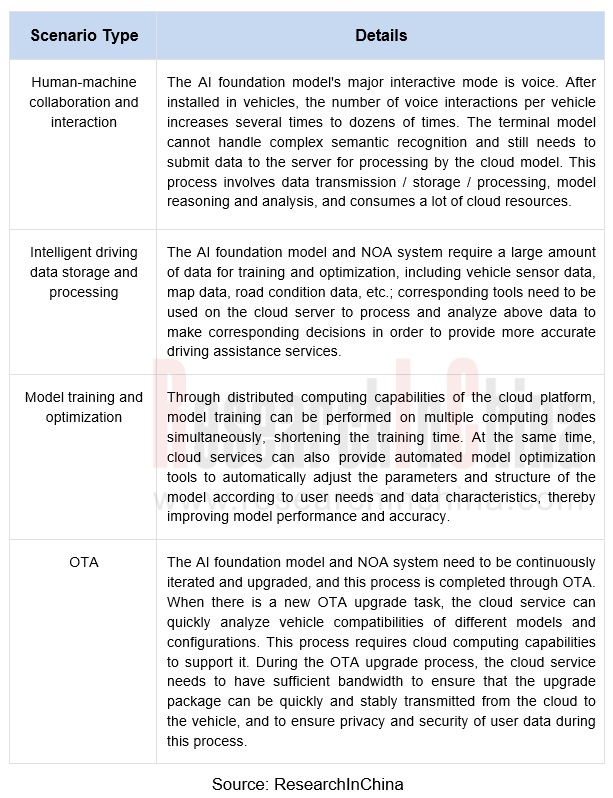
AI foundation model and NOA installed in vehicles have the following requirements for cloud services:
1.Hardware infrastructure: The operation of AI foundation model/NOA requires a lot of computing power. In addition to placing higher demands on the performance and number of cloud servers, it also tests the network performance of server facilities.
2.Software solution:
AI foundation model: As of September 2024, the foundation model installed in domestic mass-produced models mainly adopts cloud-based deployment. Some emerging OEMs (such as NIO/ Xpeng Motors/Li Auto) adopt terminal-cloud integration deployment, in which complex functional modes still need to call cloud-based models to complete.
After the foundation model was installed in vehicles, the frequency of user interactions increased, from a few interaction requests per day to dozens or even hundreds of interaction requests per day, which led to an increase in demand for cloud services.
NOA: NOA’s installation volume has surged significantly, and the frequency of use has also increased, which has led to an increase in the amount of data processed and stored, an increase in the demand for cloud services, and an increase in the supporting tool chain.
After the AI foundation model and NOA are installed in vehicles, the demand for cloud services in some key scenarios is as follows:
In 2024, Alibaba Cloud provides Momenta with stable and flexible cloud-native computing resources to build automated closed-loop data. The solution supports an end-to-end technical framework, covers visual perception AI capabilities, and can promote large-scale deployment and application of intelligent driving solutions. Momenta uses Spot cases to achieve high cost- effectiveness based on the elasticity of Alibaba Cloud ESS&HPA mechanisms.
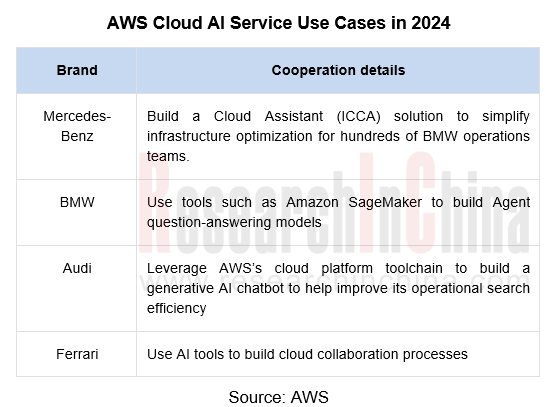
In the same year, AWS cooperates with international brands such as Mercedes-Benz and BMW to build AI assistants through cloud platform tool chain to improve operational efficiency.
2. Deep Integration of cloud platform tool chain
In 2024, automotive cloud service solutions will further develop in the direction of deep integration, realizing data integration and intelligent decision support for the entire chain from design and development to production management, supply chain optimization, marketing promotion and even after-sales service. New solutions of cloud vendors reflect characteristics of deep functional integration and perfect tool chain:
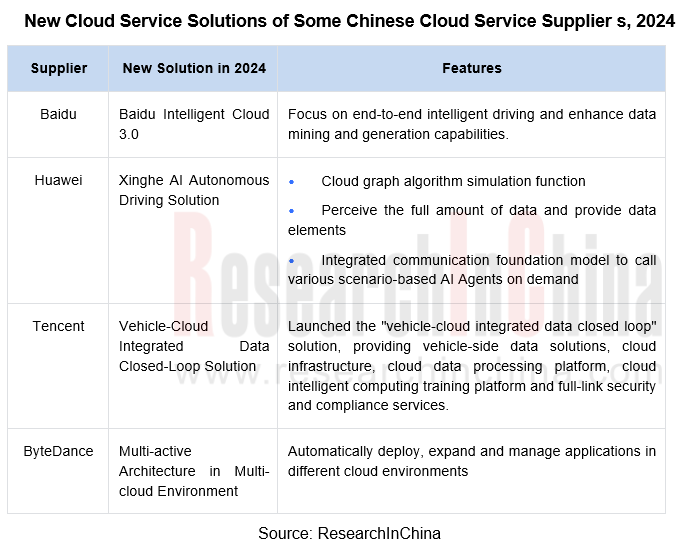
In 2024, taking the autonomous driving cloud platform as an example, most cloud service solutions include the following tool chains:
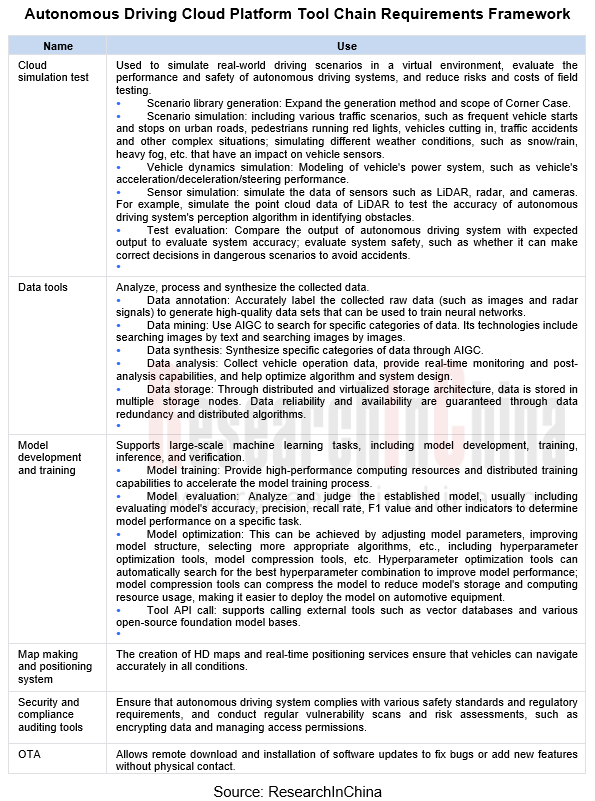
In September 2024, Baidu launched Intelligent Cloud 3.0, focusing on end-to-end intelligent driving development. Features include:
It can be used for full-process intelligent driving training from vehicle to cloud, including building virtual simulation data;
By improving training efficiency in the cloud and breaking down data barriers between the vehicle and the road, a real-time vehicle-road cloud platform is built; the platform provides services including early avoidance of congested sections, beyond-visual-range risk warnings, traffic light reminders, and remote live bird's-eye view.
Provides a cloud-based cockpit foundation model for R&D scenarios such as semantic understanding scheduling, content generation, vector search, and cross-modality.
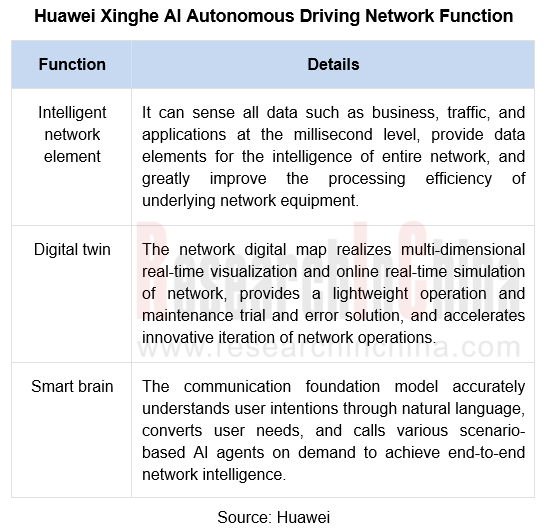
In September 2024, Huawei launched the L4 autonomous driving network solution - Xinghe AI autonomous driving network, which implements network data analysis, multi - scenario simulation and Agent calling in the cloud:
3. Cloud native further changes the way automotive software is developed
As some OEMs/Tier1s begin to build a vehicle-cloud collaborative infrastructure and try to upload vehicle-side data to the cloud for analysis and processing, and send cloud-side commands to the vehicle to achieve simple vehicle-cloud interaction. Cloud native technology has begun to be applied to the cloud-vehicle collaborative development process in automotive industry.
Cloud native is a software approach to building and running scalable applications in new dynamic environments such as public clouds, private clouds, and hybrid clouds. The concept of "cloud native" was proposed before 2020, but its application in automobiles has been in the exploratory stage and has not been widely used. It is mainly concentrated in telematics and some intelligent cockpit functions. In 2024, with the application of multi-cloud environments and AI technologies, the application scenarios of cloud native will increase greatly, and begin to affect construction logic of PaaS/SaaS cloud service solutions in the automotive industry from underlying layer:
On the vehicle side, in addition to in-vehicle infotainment system, cloud native has been used for the development and optimization of related technologies for autonomous driving and intelligent cockpit. For example, through large-scale computing and training functions of cloud-based autonomous driving platform, more accurate models and more comprehensive algorithms are provided for autonomous driving system, improving the safety and reliability of autonomous driving.
In the cloud, OEMs use a more complete cloud platform to store, mine, analyze and process vehicle data, provide support for intelligent vehicle operations, and gradually apply cloud-native software development models to OEM supply chain management, production and manufacturing and other fields, achieving collaborative optimization of entire industry chain. For example, container orchestration technology (Kubernetes, etc.) has gradually become the core technology for OEMs to build cloud-vehicle software collaborative development platforms.
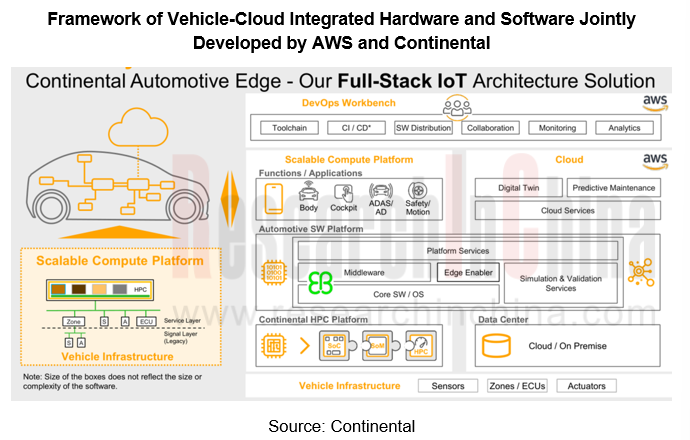
Taking the cooperation between AWS and Continental to develop cloud-based ECU as an example, Continental used AWS Graviton to simulate the hardware environment, then selected operating system and middleware to run on AWS EC2, and completed the creation of virtualized development environment through AWS EC2.
In 2024, cloud native applications will focus on:
1.Computing power management: The cloud-native platform can provide efficient computing power management technologies, including GPU computing power scheduling and distributed training, to meet the needs of AI algorithm training and real-time reasoning.
2.Optimization of service mesh and API gateway: Besides 5G communication, performance optimization of service mesh, collaboration with Kubernetes scheduler, flexible configuration and security protection of API gateway also have a great impact on cloud communication.
3.Data management and governance: Data management capabilities of Automotive Cloud Native Platform include data storage, backup, cleaning, labeling, and data security & compliance management. As OEMs increasingly value the circulation of data assets, efficient data circulation and sharing have become one of factors affecting the cloud native platform.
4.Cloud resource utilization: Some OEMs are beginning to pay attention to factors such as energy efficiency and resource utilization of cloud native technologies. Some energy-saving technologies and strategies reduce the energy consumption of cloud native platforms, while improving resource utilization efficiency and reducing operating costs.
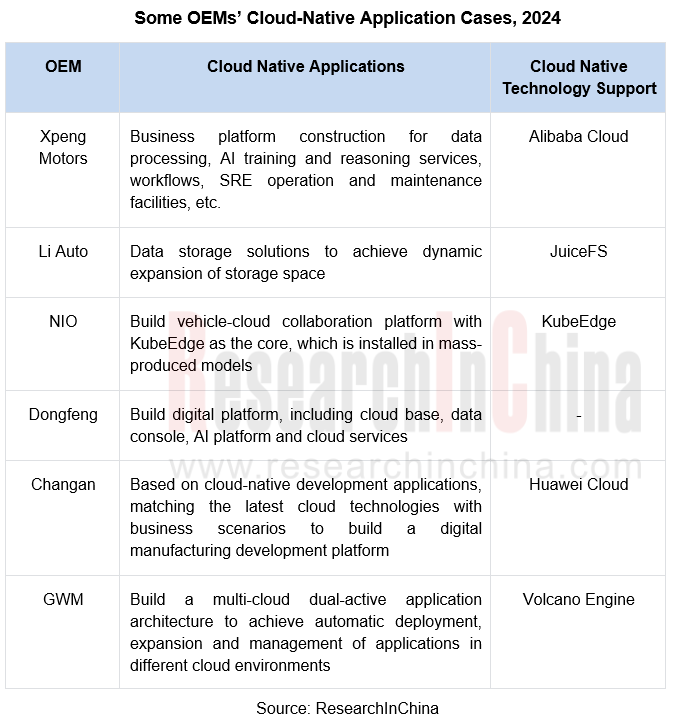
NIO uses cloud-native technology to build a vehicle-cloud collaborative development platform
In order to solve problems such as scarce computing power, chaotic edge node management, and unstable cloud communications, NIO uses KubeEdge as the core of platform and builds a complete vehicle-cloud collaborative development platform with Kubernetes + KubeEdge as the technical base.
NIO's vehicle-cloud collaboration platform uses KubeEdge's cloud-edge communication mechanism to solve the tidal effect problem of node connections.
Typical application scenarios of this technology include:
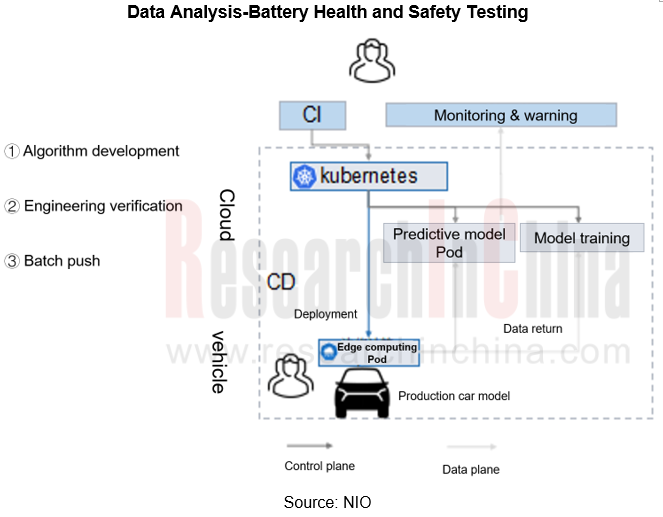
1. New energy vehicle battery health and safety data analysis: In the algorithm development stage, use containerization to develop edge algorithms; in the engineering vehicle verification stage, deploy edge computing container applications in small batches; after verification, replace the corresponding mass production base image.
2. Build a vehicle-side software test management platform: After introducing cloud native capabilities, Virtual car, test benches, and real vehicles can be connected to K8s for unified monitoring and management, which can arrange test tasks more reasonably and improve the utilization of test resources.
Automotive 4D Radar Industry Research Report 2025
4D radar research: From "optional" to "essential," 4D radar's share will exceed 50% by 2030.
1. 4D imaging radar has transformed from an "optional" to a "must-have" sensor.
4D radar adds the detecti...
China Automotive Multimodal Interaction Development Research Report, 2025
Research on Automotive Multimodal Interaction: The Interaction Evolution of L1~L4 Cockpits
ResearchInChina has released the "China Automotive Multimodal Interaction Development Research Report, 2025"...
Automotive Vision Industry Report, 2025
Automotive Vision Research: Average Camera Installation per Vehicle Reaches 5.2 Units, and Front-View Tricam Installation Exceeds 1.2 Million Sets.
From January to September 2025, the total installa...
Automotive Infrared Night Vision System Research Report, 2025
Automotive night vision research: The rise of infrared AEB, with automotive infrared night vision experiencing a 384.7% year-on-year increase from January to September.
From January to September 2025...
New Energy Vehicle Cross-Domain (Electric Drive System and Powertrain Domain) Integration Trend Report 2025-2026
Electric Drive and Powertrain Domain Research: New technologies such as three-motor four-wheel drive, drive-brake integration, and corner modules are being rapidly installed in vehicles.
Electric dri...
Analysis on Desay SV and Joyson Electronic's Electrification, Connectivity, Intelligence and Sharing, 2025
Research on Desay SV and Joyson Electronic: Who is the No.1 Intelligent Supplier?
Both Desay SV and Joyson Electronic are leading domestic suppliers in automotive intelligence. "Analysis on Desay SV ...
OEMs and Tier 1 Suppliers' Cost Reduction and Efficiency Enhancement Strategy Analysis Report, 2025
ResearchInChina released the "OEMs and Tier 1 Suppliers' Cost Reduction and Efficiency Enhancement Strategy Analysis Report, 2025", summarizing hundreds of cost reduction strategies to provide referen...
Automotive Fixed Panoramic Sunroof and Smart Roof Research Report, 2025
With the intelligent application of car roofs as the core, this report systematically sorts out a series of new products such as fixed panoramic sunroof/openable sunroof, ceiling screen, roof ambient ...
Automotive-Grade Power Semiconductor and Module (SiC, GaN) Industry Research Report, 2025
SiC/GaN Research: Sales volume of 800V+ architecture-based vehicles will increase more than 10 times, and hybrid carbon (SiC+IGBT) power modules are rapidly being deployed in vehicles.
Sales volume o...
Cockpit Agent Engineering Research Report, 2025
Cockpit Agent Engineering Research: Breakthrough from Digital AI to Physical AI
Cockpit Agent Engineering Research Report, 2025 starts with the status quo of cockpit agents, summarizes the technical ...
Prospective Study on L3 Intelligent Driving Technology of OEMs and Tier 1 Suppliers, 2025
L3 Research: The Window of Opportunity Has Arrived - Eight Trends in L3 Layout of OEMs and Tier 1 Suppliers
Through in-depth research on 15 OEMs (including 8 Chinese and 7 foreign OEMs) and 9 Tier 1 ...
China Commercial Vehicle IoV and Intelligent Cockpit Industry Research Report 2025
Commercial Vehicle IoV and Cockpit Research: The Third Wave of Passenger Car/Commercial Vehicle Technology Integration Arrives, and T-Box Integrates e-Call and 15.6-inch for Vehicles
I. The third wav...
Intelligent Vehicle Electronic and Electrical Architecture (EEA) and Technology Supply Chain Construction Strategy Research Report, 2025
E/E Architecture Research: 24 OEMs Deploy Innovative Products from Platform Architectures to Technical Selling Points
According to statistics from ResearchInChina, 802,000 passenger cars with domain...
Research Report on Intelligent Vehicle Cross-Domain Integration Strategies and Innovative Function Scenarios, 2025
Cross-Domain Integration Strategy Research: Automakers' Competition Extends to Cross-Domain Innovative Function Scenarios such as Cockpit-Driving, Powertrain, and Chassis
Cross-domain integration of ...
China Autonomous Driving Data Closed Loop Research Report, 2025
Data Closed-Loop Research: Synthetic Data Accounts for Over 50%, Full-process Automated Toolchain Gradually Implemented
Key Points:From 2023 to 2025, the proportion of synthetic data increased from 2...
Automotive Glass and Smart Glass Research Report, 2025
Automotive Glass Report: Dimmable Glass Offers Active Mode, Penetration Rate Expected to Reach 10% by 2030
ResearchInChina releases the Automotive Glass and Smart Glass Research Report, 2025. This r...
Passenger Car Brake-by-Wire (BBW) Research Report, 2025
Brake-by-Wire: EHB to Be Installed in 12 Million Vehicles in 2025
1. EHB Have Been Installed in over 10 Million Vehicles, A Figure to Hit 12 Million in 2025.
In 2024, the brake-by-wire, Electro-Hydr...
Autonomous Driving Domain Controller and Central Computing Unit (CCU) Industry Report, 2025
Research on Autonomous Driving Domain Controllers: Monthly Penetration Rate Exceeded 30% for the First Time, and 700T+ Ultrahigh-compute Domain Controller Products Are Rapidly Installed in Vehicles
L...