Research on automotive smart surface: "Plastic material + touch solution" has become mainstream, and sales of smart surface models soared by 105.1% year on year
In this report, smart surface refers to an interior technology that is used outside the vehicle or inside the cabin and is integrated with various interior materials (including but not limited to leather, fabric, wood, glass, plastic, natural fiber, metal, etc.) through electronic sensors. It can be "functionalized" (for decoration or issuing commands) and can generate light and heat, or issue commands, sounds, etc. when activated.
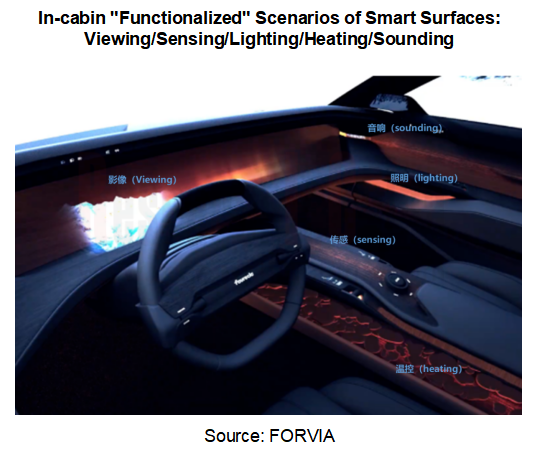
Sales of smart surface models surged by 105.1% year on year
In 2024, automotive smart surfaces find very rapid adoption, with a rising penetration rate:
From January to September 2023, sales of models equipped with smart surfaces reached 256,000 units.
From January to September 2024, sales of models equipped with smart surfaces climbed to 525,000 units, soaring by 105.1% on a like-on-lie basis, with a penetration rate of 3.4%.
From the perspective of installation locations, smart surfaces are mainly concentrated in steering wheel, center console, doors, dashboard functional zone, etc., providing sensing/temperature control/lighting functions.
From January to September 2024, among the smart surface models, most applied smart surfaces to the center console, with sales up to 234,000 units; those that applied smart surfaces to doors, ceiling, and steering wheel grew rapidly year on year, with sales reaching 111,000 units, 21,000 units, and 75,000 units, respectively.
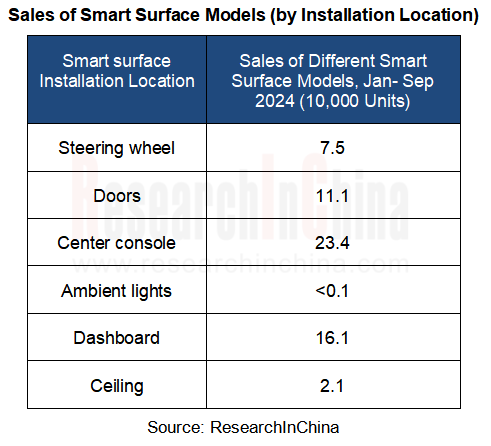
Wherein:
The center console adopts smart surface interior trims, integrating multiple functions such as information display and air conditioning, and transforming the originally cumbersome buttons into a simple touch control interface, thus making the center console look more simple, elegant and modern in appearance;
On the door interior panel, the smart surface design enables integrated operation of door lock control, window control and other functions through touch, and supports hiding related functions when not activated, enhancing the ornamental value of door interiors;
The smart surface on the steering wheel allows for control over multiple functions, for example, volume adjustment and driving mode switching, making it easier for the driver to operate.
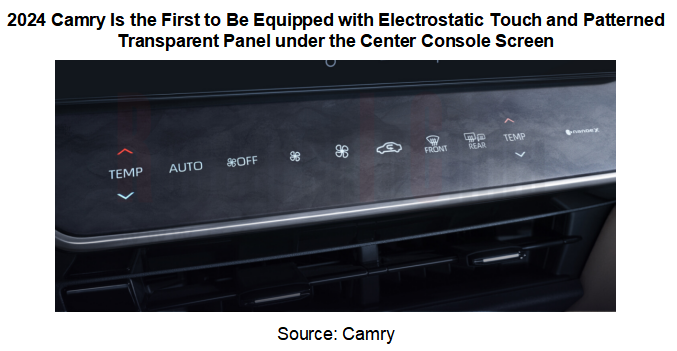
Camry
The 2024 Camry uses electrostatic touch and patterned transparent panel at the center console, supporting touch control on air-conditioner temperature, wind direction, glass heating and other functions.
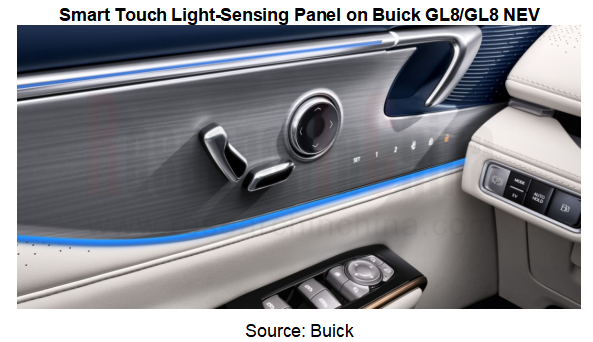
Buick
Buick GL8/GL8 NEV’s front doors are equipped with a Smart Touch light-sensing panel using a new fusion process. When not activated, it blends into the interior style. When activated, it allows seat position adjustment and door locking/unlocking.
Cost control is the key to mass production of smart surfaces
In 2024, the penetration rate of automotive smart surfaces is still lower than 5%. The key to further expanding mass production is to solve the process and cost issues. Wherein, the cost of smart surfaces is mainly composed of materials, process and maintenance.
Materials cost
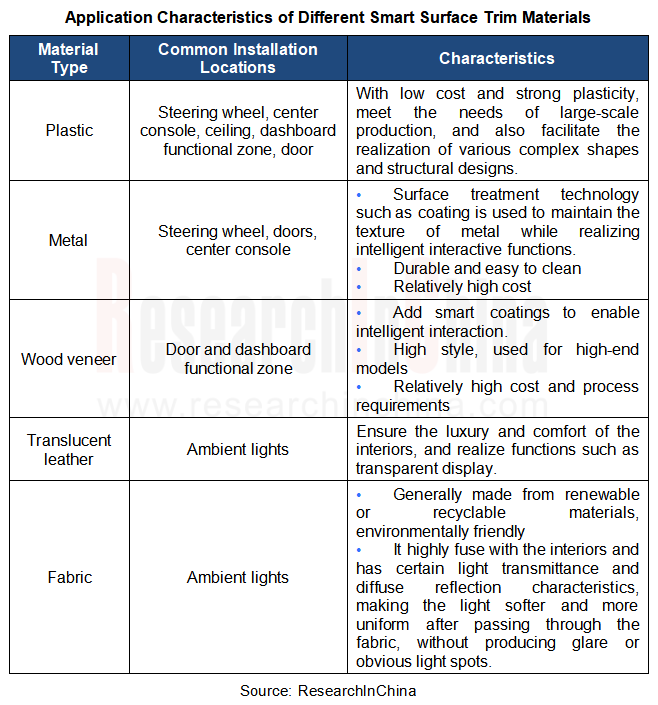
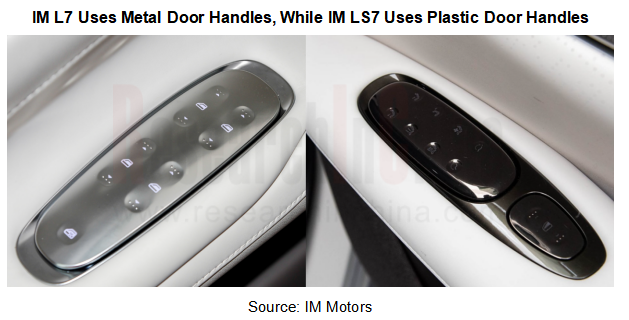
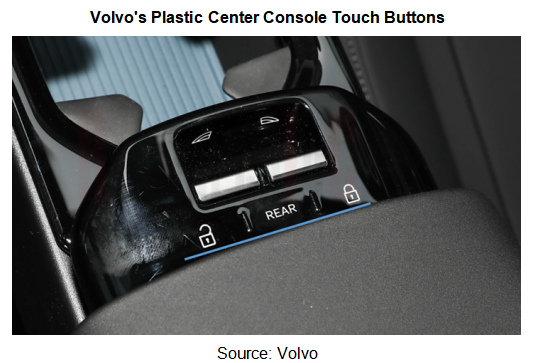
In addition to electronic components, smart surface trim materials mainly include plastic, metal, wood veneer, translucent leather and fabric. The most common material in 2024 is plastic. Related smart surface models prefer to use the combination of "plastic material" and "touch solution". It is expected that this solution will still prevail during 2024-2025.
Process cost
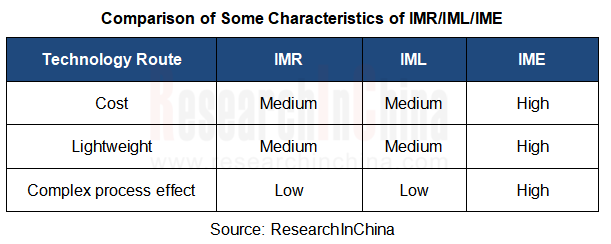
There are multiple smart surface production process routes, including IMD (including IML/IMR), IME and OMD. In actual applications, manufacturers will choose the process route according to cost and effect. Compared with 2023, the number of smart surface supply chain manufacturers in 2024 further increases, and the IME process is used on a larger scale. Compared with routes such as IML/IMR, IME can achieve lighter weight and more complex processes despite high cost.
For suppliers, it is more difficult to develop new smart surface materials than change the structural design scheme, so suppliers tend to change the structure of smart surface accessories and optimize the design scheme, for example:
Through modular design, smart surface components can be integrated into different interior modules within a limited space, reducing installation and maintenance costs;
In terms of the selection of touch chips, a more integrated chip design is adopted to reduce circuit volume and energy consumption;
In terms of latency, capacitive touch sensor with higher sensitivity is used to improve the response speed and accuracy of smart surfaces to user operation;
In terms of communication, to achieve seamless connection with the overall electronic system of vehicles, the faster and more stable CAN - FD protocol is adopted.
How smart surface design improves customer experience?
In 2024, the most common interaction mode of smart surfaces is touch, which is easier to operate than traditional buttons and can effectively avoid mis-operation. In the case of Awinic's smart surface solution, its touch-superimposed pressure-sensitive button design can effectively reduce false triggers, and the haptic feedback effect can also restore the touch of traditional micro switches, allowing users to obtain clear feedback during operation, improving the accuracy and comfort of operation.
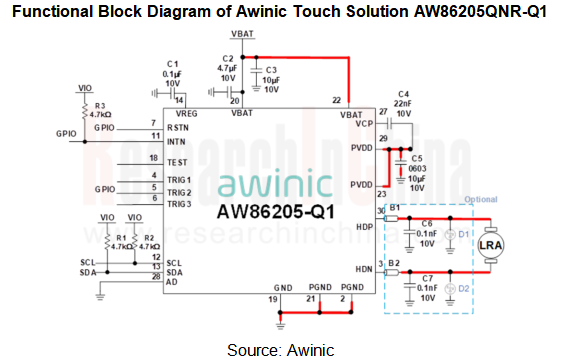
For smart surface design, consumers pay more attention to the three aspects: enhancing the sense of technology, optimizing space utilization and aesthetics, and personalized customization.
Enhance the sense of technology
Automotive smart surface fully meets customers' pursuit of a sense of technology, with the cool touch interaction mode and futuristic display effects:
In terms of touch sensing, capacitive touch technology is used to build a highly sensitive touch sensing matrix. Whether it is a light touch, a slide or a multi-touch gesture, it can achieve accurate and rapid response. The response time can be as low as a few milliseconds, effectively avoiding the adverse experience caused by operation delays.
In terms of touch feedback, the built-in precision haptic feedback device, such as linear resonant brake or eccentric rotating mass motor, can generate suitable vibration feedback according to touch operation. For example, when selecting a menu, a gentle and short vibration will be generated; when confirming an important operation, a slightly stronger and longer-lasting vibration prompt will be given, thus simulating the real touch of buttons and enhancing the intuitiveness and confirmability of the operation.
In terms of display, Micro LED or OLED technology is used to present functional logos in an intuitive graphical interface.
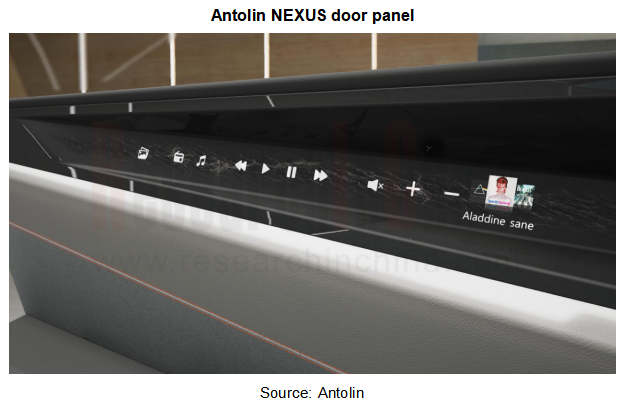
In March 2024, Antolin unveiled NEXUS, a door panel concept which is equipped with a touch smart surface. In addition to vision lighting, it also provides heating function using the interior adaptive thermal surface technology. Meanwhile, it supports electronic rearview mirror function for the 3D hologram driving assistance system, providing different information about the road outside the vehicle when needed.
Optimize space utilization and aesthetics
The complex layout of traditional buttons is easy to make the cockpit look cluttered, while smart surfaces can reduce the number of physical buttons through integrated design, for example, use electronic integration technologies such as system-in-package (SiP) and multi-chip module (MCM) to highly integrate such electronic components as originally scattered microcontroller unit (MCU), touch chip, display driver IC and various sensors into a compact module, effectively reducing the physical space occupied by electronic components and creating favorable conditions for optimizing the layout of other cockpit components.
The smart surfaces of relevant models in 2024 all support invisible touch function when not activated, making the overall cockpit more concise and elegant, creating a spacious, comfortable and beautiful visual experience in a limited space. For example, on the smart surface center console, multiple physical buttons originally used to control the air conditioning system, audio system, window lifting and driving mode switching are integrated into one or several simple touch zones. By presenting intuitive function icons and operation prompts on the display interface, it will make it easier for occupants to complete various complex operations.
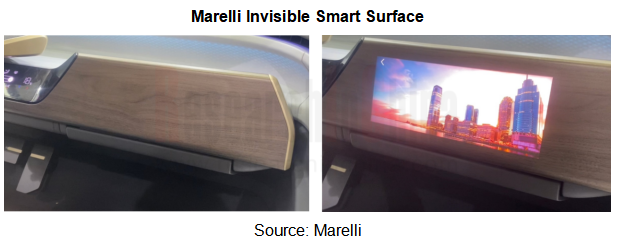
In April 2024, Marelli launched a new invisible smart surface product, which adopts the design concept of "screen-free cockpit". The product is designed at the co-pilot seat, and installs a screen under the translucent surface trim with a thin film material covered with tiny holes on the surface. When activated, lights or LED/OLED in it will light up, and the light will pass through the tiny holes to display the control interface; when not wakened up, it will blend into the interior surface.
Personalization
Different consumers have different preferences for car interiors. Smart surfaces can be designed through process schemes to achieve different function layouts and display effects to meet personalized needs of consumers. For example, consumers can set theme color, display content, etc. of the center console smart surface as they like.
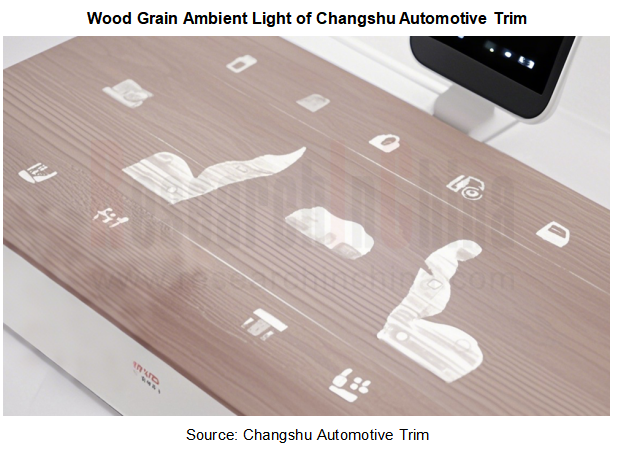
In April 2024, Changshu Automotive Trim launched a door ambient light, which is composed of wood grain LED, translucent PU leather and translucent fabric from top to bottom. All the three allows users to customize lighting later. Wherein, the wood grain LED enables occupants to customize the virtual touch function via the embedded inductive vibration mechanism.
Research Report on Overseas Layout of Chinese Passenger Car OEMs and Supply Chain Companies, 2025
Automotive Overseas Expansion Research: Accelerated Release of OEM Overseas Production Capacity, Chinese Intelligent Supply Chain Goes Global
This report conducts an in-depth analysis of the current ...
Passenger Car Intelligent Steering Industry Research Report, 2025-2026
Intelligent steering research: Rear-wheel steering prices drop to RMB200,000-250,000
1. Rear-wheel steering installations increased by 36.5% year-on-year.
From January to October 2025, the number of...
Global Autonomous Driving Policies & Regulations and Automotive Market Access Research Report, 2025-2026
Research on Intelligent Driving Regulations and Market Access: New Energy Vehicle Exports Double, and "Region-Specific Policies" Adapt to Regulatory Requirements of Various Countries in A Refined Mann...
Two-wheeler Intelligence and Industry Chain Research Report, 2025-2026
Two-Wheeler Electric Vehicle Research: New National Standard Drives Intelligent Popularization, AI Agent Makes Its Way onto Vehicles
ResearchInChina releases the "Two-wheeler Intelligence and Industr...
China Smart Door and Electric Tailgate Market Research Report, 2025
Smart Door Research: Driven by Automatic Doors, Knock-Knock Door Opening, etc., the Market Will Be Worth Over RMB100 Billion in 2030.
This report analyzes and researches the installation, market size...
New Energy Vehicle Thermal Management System Industry Research Report, 2025-2026
Policy and Regulation Drive: Promoting the Development of Electric Vehicle Thermal Management Systems towards Environmental Compliance, Active Safety Protection, and Thermal Runaway Management
Accord...
Intelligent Vehicle Redundant Architecture Design and ADAS Redundancy Strategy Research Report, 2025-2026
Research on Redundant Systems: Septuple Redundancy Architecture Empowers High-Level Intelligent Driving, and New Products Such as Corner Modules and Collision Unlock Modules Will Be Equipped on Vehicl...
Passenger Car Mobile Phone Wireless Charging Research Report, 2025
Automotive Wireless Charging Research: Domestic Installation Rate Will Exceed 50%, and Overseas Demand Emerges as Second Growth Driver.
The Passenger Car Mobile Phone Wireless Charging Research Repor...
Automotive 4D Radar Industry Research Report 2025
4D radar research: From "optional" to "essential," 4D radar's share will exceed 50% by 2030.
1. 4D imaging radar has transformed from an "optional" to a "must-have" sensor.
4D radar adds the detecti...
China Automotive Multimodal Interaction Development Research Report, 2025
Research on Automotive Multimodal Interaction: The Interaction Evolution of L1~L4 Cockpits
ResearchInChina has released the "China Automotive Multimodal Interaction Development Research Report, 2025"...
Automotive Vision Industry Report, 2025
Automotive Vision Research: Average Camera Installation per Vehicle Reaches 5.2 Units, and Front-View Tricam Installation Exceeds 1.2 Million Sets.
From January to September 2025, the total installa...
Automotive Infrared Night Vision System Research Report, 2025
Automotive night vision research: The rise of infrared AEB, with automotive infrared night vision experiencing a 384.7% year-on-year increase from January to September.
From January to September 2025...
New Energy Vehicle Cross-Domain (Electric Drive System and Powertrain Domain) Integration Trend Report 2025-2026
Electric Drive and Powertrain Domain Research: New technologies such as three-motor four-wheel drive, drive-brake integration, and corner modules are being rapidly installed in vehicles.
Electric dri...
Analysis on Desay SV and Joyson Electronic's Electrification, Connectivity, Intelligence and Sharing, 2025
Research on Desay SV and Joyson Electronic: Who is the No.1 Intelligent Supplier?
Both Desay SV and Joyson Electronic are leading domestic suppliers in automotive intelligence. "Analysis on Desay SV ...
OEMs and Tier 1 Suppliers' Cost Reduction and Efficiency Enhancement Strategy Analysis Report, 2025
ResearchInChina released the "OEMs and Tier 1 Suppliers' Cost Reduction and Efficiency Enhancement Strategy Analysis Report, 2025", summarizing hundreds of cost reduction strategies to provide referen...
Automotive Fixed Panoramic Sunroof and Smart Roof Research Report, 2025
With the intelligent application of car roofs as the core, this report systematically sorts out a series of new products such as fixed panoramic sunroof/openable sunroof, ceiling screen, roof ambient ...
Automotive-Grade Power Semiconductor and Module (SiC, GaN) Industry Research Report, 2025
SiC/GaN Research: Sales volume of 800V+ architecture-based vehicles will increase more than 10 times, and hybrid carbon (SiC+IGBT) power modules are rapidly being deployed in vehicles.
Sales volume o...
Cockpit Agent Engineering Research Report, 2025
Cockpit Agent Engineering Research: Breakthrough from Digital AI to Physical AI
Cockpit Agent Engineering Research Report, 2025 starts with the status quo of cockpit agents, summarizes the technical ...