ADAS and Autonomous Driving Industry Chain Report 2018 (II)– Automotive Vision
ADAS and Autonomous Driving Industry Chain Report 2018 - Automotive Vision, about 240 pages, highlights the followings:
 Overview of the automotive camera industry;
Lane detection function;
Autonomous Emergency Braking (AEB);
Night vision system and intelligent headlight;
Driver monitoring system (DMS);
Study into foreign automotive vision companies;
Study into Chinese automotive vision companies
Automotive vision enterprises fall into two parts: car camera-related companies; the enterprises that are engaged in visual software development based on car camera to help achieve specific ADAS and autonomous driving functions.
Car camera is the one installed on the car to realize sundry image acquisition and video recording functions, mainly covering inner-view camera, rear-view camera, front-view camera, side-view camera, and surround-view camera. As a main sensor of ADAS autonomous driving era, the camera is widely used in lane detection, traffic sign recognition, obstacle monitoring, pedestrian recognition, fatigue driving monitoring, occupant monitoring, rear-view mirror replacement, reverse image, 360-degree panorama and so forth.
Camera installations amounted to 6.39 million units in the Chinese passenger car market in 2017, and the figure is expected to grow to 31.80 million units by 2021 with an AAGR of 49.3%, according to ResearchInChina.
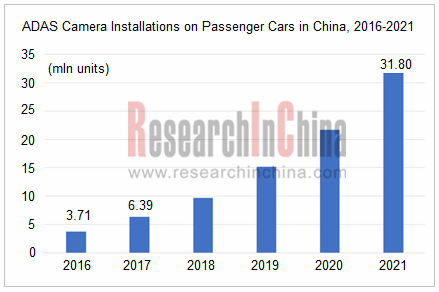
The camera is mainly used for reverse image (rear view) and 360-degree panoramic view (surround view). And then forward- and inner-view cameras will become the main growth drivers. Major applications of the front-view camera are FCW, LDW and AEB, while the inner-view camera the driver monitoring system.
Being capable of capturing static images and videos, the camera, the most important imaging device, is primarily made up of lens, motor, filter, image sensor, and image signal processor (ISP).
Lens: Sunny Optical Technology, a leading automotive lens manufacturer in the world, shipped 18 million lenses in the first half of 2018. It has been a supplier of automotive lens for Magna, Continental, Delphi, Mobileye, Autoliv, Steel-mate, TTE, Panasonic and Fujitsu. The company also forays into the field of LiDAR optical parts.
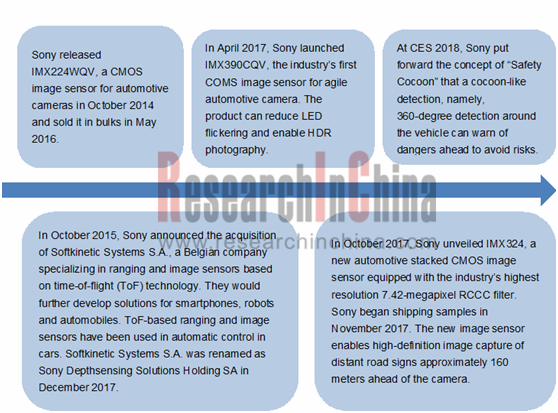
Image sensor: ON Semiconductor and Sony are leaders, with the former sweeping a 44% share of the automotive image sensor market. Getting back into black ink by virtue of image sensor, Sony has continued to expand image sensor production capacity in recent years with heavy investment in automotive image sensor.
As an ADAS vendor, Mobileye stays far ahead of its global peers. The company has not only developed eyeQ series vision-based ADAS chips but made layout of REM map and RSS model, leaving its rivals far behind.
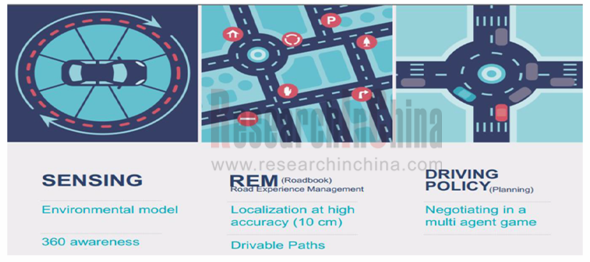
To keep its competitive edges in ADAS field, Mobileye also improves its layout in the autonomous driving field by integrating with Intel system. Mobileye’s ADAS solutions in 2018 feature 8 cameras and an improved redundancy design for perception link, leaving interfaces for LiDAR and MMW radar, and therefore realizing full perception for automated driving.
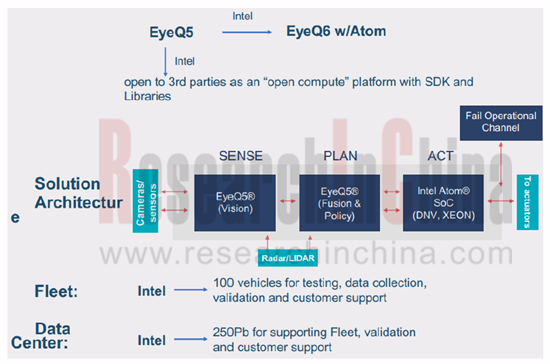
Mobileye Integration with Intel
The majority of Chinese vision ADAS vendors are the followers of Mobileye which has successfully turned to a provider of autonomous driving solutions from an ADAS supplier by way of being acquired by Intel. Having to seek for a transition, Chinese vision ADAS vendors can take the following three paths into account.
Firstly, the providers of partial ADAS function solutions grow to become providers of comprehensive autonomous driving and intelligent connected vehicle solutions (TIER 1) by means of mergers. Suzhou INVO Automotive Electronics, a leading player in vision ADAS, is hard to sustain growth and hit the ceiling if it develops on its own. TUS International (872.HK) with the background of Tsinghua University forays into intelligent and connected business through acquiring Suzhou INVO Automotive Electronics and taking over Telit’s in-vehicle communication business for USD105 million. TUS International is anticipated to become an important Tier1 vendor in the intelligent connected field in China if it continues to stage mergers and acquisitions in fields like sensor and chip, and to enrich its product portfolios.
Next, vision ADAS vendors may become providers of mobility service technology solutions like ZongMu Technology which starts from surround-view business to tap into automated parking and then foray into mobility services. The OEMs are successively transferring to be providers of mobility services, to which ZongMu Technology supplies mobility service technology solutions. ZongMu Technology attempts to break through the technical chains about autonomous driving mobility and service eco-system.
Last, products with core technologies are focused. For instance, Horizon Robotics prioritizes AI chip and Beijing SmarterEye has binocular stereo camera as its hit product. Most suppliers boasting core technologies will be ultimately either merged or acquired by the listed companies, while those that fail to forge core competitiveness will be knocked out.
Automotive Microcontroller Unit (MCU) and Application Scenario Research Report, 2026
Automotive MCU Research: Increased demand for redundant security drives ASIL D-compliant MCU shipments to exceed 100 million units
In a vehicle EEA, MCUs are widely distributed in various functional ...
China Intelligent Cockpit Patent Analysis Report, 2026
Intelligent Cockpit Patent Research: Cockpit AI, In?vehicle Health, and Infotainment Are Upgrade to Scenario?based and Proactive Functions
From a patent perspective, this report explores the cutting?...
Research Report on Application of VLA Large Model in Automobiles and Robots, 2026
Research on Automotive and Robot VLA: Hybrid Architectures Become Mainstream, VLA Integrates with General World Models, and Reinforcement Learning Serves as Core Engine
Vision?Language?Action (VLA) m...
China Charging Infrastructure (Supercharging, Battery Swapping, V2G, etc.) and High-Performance Supercharging Battery Research Report, 2026
Charging and battery swapping research: as 5C+ supercharging vehicle models go into mass production, the pace of OEMs self-building supercharging networks quickens
800-1000V high-voltage platforms ar...
China Passenger Car Electronic Controlled Suspension Industry Report, 2026
Electronic Controlled Suspension Industry Research: As the First Year of Full Active Suspension Unfolds, Three Technical Routes Race Forward
1. Penetration Rate Surges Three Times, and Electronic Con...
Intelligent Driving SoC Research Report, 2026
Research on Intelligent Driving SoCs: Competition Focus Shifts to L3/L4 Embedded Hardware, and Computing Power of Flagship Vehicle Models Exceeds 1,000 TOPS
In terms of intelligent driving system in...
Automotive AI Large Model Technology Research Report, 2026
Automotive AI Large Model Research: Competition Shifts from "Who Has the Stronger Model" to "Who Boasts Higher Link Efficiency"
ResearchInChina released the Automotive AI Large Model Technology Resea...
Intelligent Vehicle Cockpit Domain Controller Research Report, 2026
Cockpit domain controller research: L3 AIDV intelligent cockpit domain controllers are entering a boom period
Driven by multiple factors such as the continuous evolution of the automotive central int...
Automotive Acoustic System (Audio, Multi-Channel) Industry Report, 2026
Automotive Acoustics Research: Multiple Channels, AI Tuning, and Self-Developed Algorithms Drive the Transformation of High-End Cockpit Sound Fields
I. Automotive Audio Hardware Solutions with 6–9 S...
Autonomous Driving Sensor Chip Research Report, 2026
Research on Autonomous Driving Sensor Chips: Deeply Perceiving the Physical World, Sensor Chips Are Playing A “Leading Role” in Intelligence
In 2026, the autonomous driving sensor chip industr...
Passenger Car Corner Module and Wheel‑Side Control System Research Report, 2026
Wheel-side control research: the “last mile” chassis innovation
Wheel-side control dismantles the traditional drive, braking, steering, and suspension control of the chassis from a "centralized" styl...
Embodied Artificial Intelligence (& Humanoid Robot) MCU Research Report, 2026
Research on Humanoid Robot MCUs: Evolution from General-Purpose Control to High-Value Dedicated Chip Solutions Integrated with Edge AI Functions
MCU (Microcontroller Unit) refers to a compact integra...
Intelligent Vehicle Zone Control Unit (ZCU) Research Report, 2026
ZCU Research: Cross-domain integrated ZCUs are becoming the edge computing nodes of the next-generation zonal architecture
Currently, the mainstream zonal architecture is mainly the quasi-central + z...
Automotive Cybersecurity and Data Security Research Report, 2026
Cybersecurity & Data Security Research: Intelligent Connected Vehicles Enter the Era of “Systematic Offense-Defense and AI-Defined Security”.
Centering on the panorama of intelligent connect...
Report on Breakthrough Strategies of OEMs and ADAS Tier 1 Suppliers for Overseas Layout of Intelligent Driving, 2026
Regulatory Breakthrough, Local System Establishment, OEMs Competing for NOA Layout: Overall Trends of China’s Intelligent Driving Overseas Layout in 2026
Research on overseas intelligent driving layo...
OEMs and Tier1s’ Intelligent Cockpit Platform (Hardware and Software) Innovation Strategy Research Report, 2026
Intelligent Cockpit Platform Research: multi-dimensional cockpit system architecture reconstruction for multi-agent collaboration and proactive intelligent services
The intelligent cockpit software s...
Automotive AIOS Research Report, 2026
Automotive AIOS Research: Mass Production Solutions Are Implemented
Mass Production Solutions Are Implemented on A Small Scale.
In 2026, AIOS starts small-scale implementation, helping to improve v...
Automotive Telematics Service Provider (TSP) Research Report, 2026
TSP Research: Leading providers collectively turn to AI agents to provide all-scenario active services
Telematics Service Providers (TSPs) are the core hub of the telematics industry chain, connectin...