Automotive Head-up Display (HUD) Industry Report: Installation of OEM HUD for Passenger Cars Soared by 94.1% Year on Year in China in 2018
In 2018, 308,900 units of OEM HUDs were installed in passenger cars in China, a 94.1% upsurge from a year earlier, according to our recent report -- Automotive HUD Industry Report, 2018-2019.
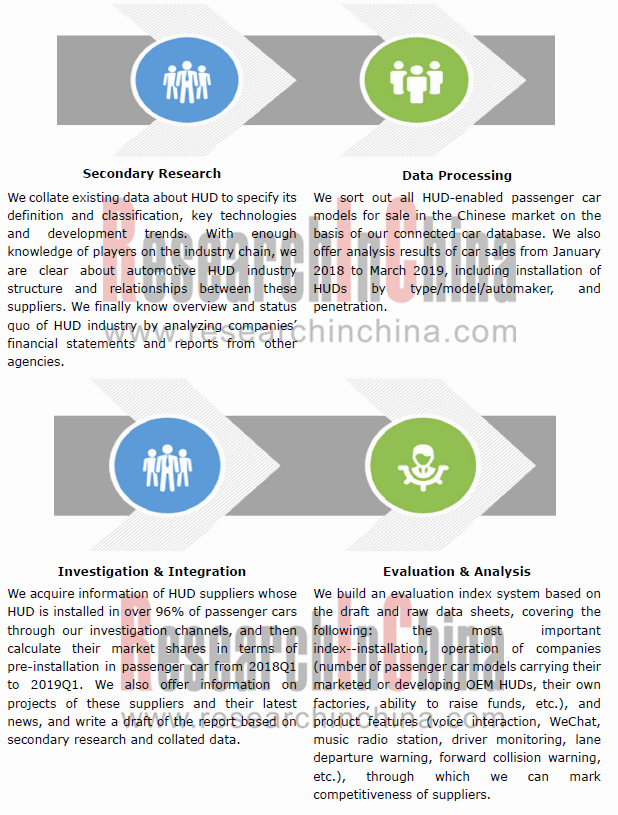
We worked out 2019Q1 lists of passenger car HUD supplier ranking by competitiveness with efforts from secondary research, data processing, and investigation & integration to evaluation & analysis. Denso came to the top spot among all suppliers and CarRobot ranked first among Chinese suppliers.
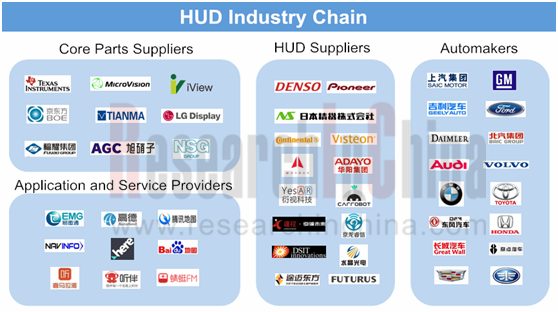
HUD was in vogue from 2014 to 2015. NAVDY that was a typical supplier then, however, doesn’t appear on our latest HUD industry chain.
NAVDY followed a digital light processing (DLP) technology roadmap, but DLP HUD had some drawbacks like complicated design and high cost. In TI’s case, its first-generation DLP chip only worked at temperatures of -40-85℃, short of automotive standards. Navdy raised USD42 million from Qualcomm and several other venture capital firms. Navdy HUD which should have been launched in the first quarter of 2015 came out just in recent two years. In October 2016, the product was put on sale, but its price surged to USD799 from the pre-sale price of USD299. In 2018, NAVDY had to go into liquidation after its failure in aftermarket.
Many a HUD start-up applied Navdy’s technology between 2016 and 2017. Using DLP as display system only left them a range of technology bottlenecks and often deferred launch of products. Most of them then turned to thin film transistor (TFT) display technology. Examples include CarRobot who designed its first-generation HUD with DLP technology but changed to TFT for its second-generation products.
In 2018, TI officially rolled out the 2nd-generation automotive chips DLP3030-Q1 and DLP5530-Q1 featuring smaller size and wider field of view and sufficing for AR head-up display (HUD). DLP3030-Q1 sees the digital micromirror device (DMD) footprint reduction by 65%, enabling smaller picture generation unit (PGU) design. It can operate between -40°C and +105°C
Technically, DLP is the best and most mature display technology by far. Therefore, Sunny Optical and other giants are still optimistic about HUD based on DLP technology, and they even spend tens of millions of yuan on introducing free-form surface mirror production lines.
The second HUD craze since 2018 arises from the emergence of AR HUD.
AR HUD, the augmented reality head-up display technology, superimposes some driving information in the driver's field of vision reasonably and combines it with real traffic conditions. Compared with HUD, AR HUD displays a wider range from a farther distance, and it is more complex. HUD is just a device that projects and displays information, while AR HUD needs to be deeply integrated with ADAS to achieve more advanced effects and functions.
Given the deep integration of AR HUD with ADAS, the burgeoning development of ADAS as a must for automotive intelligence has driven the demand for AR HUD.
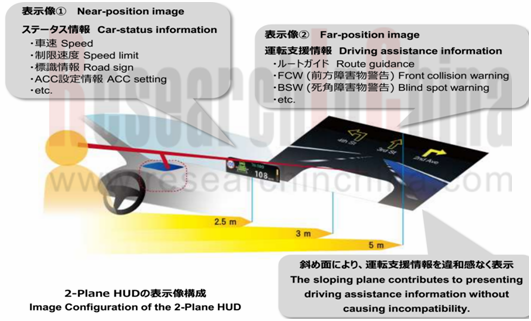
The image display of AR HUD is generally distributed in two or three layers. For instance, the AR-HUD of Nippon Seiki boasts three layers: the near field display layer, the far field display layer, and the side layer. The near field display layer is mainly a presentation of vehicle status, the far field display layer displays ADAS information, and the stereo side layer offers lane or navigation information.
Amid the intelligent connected trend of cars, any automotive electronic product is difficult to be independent. As an automotive electronic product, HUD has been an integral of the cockpit electronics solution and the overall ADAS solution.
Panasonic Automotive showcased its latest SPYDR 2.0 at CES 2019, which is a single-chip cockpit domain controller solution integrating Driver Monitoring System (DMS) with Head-Up Display (HUD). Besides, SPYDR 2.0 can integrate In-Vehicle Infotainment (IVI), dashboard, surround view system, Active Noise Control (ANC), HUD and four IVI displays on a platform
For this integration trend, traditional Tier1 giants enjoy first-mover advantages, whereas independent HUD suppliers have to establish close cooperation with other product suppliers. The collaboration modes -- Jiang Cheng + Baidu, Carrobot + China Unicom, Carrobot + AI Speech, etc. just follow the integration trend.
Automotive Microcontroller Unit (MCU) and Application Scenario Research Report, 2026
Automotive MCU Research: Increased demand for redundant security drives ASIL D-compliant MCU shipments to exceed 100 million units
In a vehicle EEA, MCUs are widely distributed in various functional ...
China Intelligent Cockpit Patent Analysis Report, 2026
Intelligent Cockpit Patent Research: Cockpit AI, In?vehicle Health, and Infotainment Are Upgrade to Scenario?based and Proactive Functions
From a patent perspective, this report explores the cutting?...
Research Report on Application of VLA Large Model in Automobiles and Robots, 2026
Research on Automotive and Robot VLA: Hybrid Architectures Become Mainstream, VLA Integrates with General World Models, and Reinforcement Learning Serves as Core Engine
Vision?Language?Action (VLA) m...
China Charging Infrastructure (Supercharging, Battery Swapping, V2G, etc.) and High-Performance Supercharging Battery Research Report, 2026
Charging and battery swapping research: as 5C+ supercharging vehicle models go into mass production, the pace of OEMs self-building supercharging networks quickens
800-1000V high-voltage platforms ar...
China Passenger Car Electronic Controlled Suspension Industry Report, 2026
Electronic Controlled Suspension Industry Research: As the First Year of Full Active Suspension Unfolds, Three Technical Routes Race Forward
1. Penetration Rate Surges Three Times, and Electronic Con...
Intelligent Driving SoC Research Report, 2026
Research on Intelligent Driving SoCs: Competition Focus Shifts to L3/L4 Embedded Hardware, and Computing Power of Flagship Vehicle Models Exceeds 1,000 TOPS
In terms of intelligent driving system in...
Automotive AI Large Model Technology Research Report, 2026
Automotive AI Large Model Research: Competition Shifts from "Who Has the Stronger Model" to "Who Boasts Higher Link Efficiency"
ResearchInChina released the Automotive AI Large Model Technology Resea...
Intelligent Vehicle Cockpit Domain Controller Research Report, 2026
Cockpit domain controller research: L3 AIDV intelligent cockpit domain controllers are entering a boom period
Driven by multiple factors such as the continuous evolution of the automotive central int...
Automotive Acoustic System (Audio, Multi-Channel) Industry Report, 2026
Automotive Acoustics Research: Multiple Channels, AI Tuning, and Self-Developed Algorithms Drive the Transformation of High-End Cockpit Sound Fields
I. Automotive Audio Hardware Solutions with 6–9 S...
Autonomous Driving Sensor Chip Research Report, 2026
Research on Autonomous Driving Sensor Chips: Deeply Perceiving the Physical World, Sensor Chips Are Playing A “Leading Role” in Intelligence
In 2026, the autonomous driving sensor chip industr...
Passenger Car Corner Module and Wheel‑Side Control System Research Report, 2026
Wheel-side control research: the “last mile” chassis innovation
Wheel-side control dismantles the traditional drive, braking, steering, and suspension control of the chassis from a "centralized" styl...
Embodied Artificial Intelligence (& Humanoid Robot) MCU Research Report, 2026
Research on Humanoid Robot MCUs: Evolution from General-Purpose Control to High-Value Dedicated Chip Solutions Integrated with Edge AI Functions
MCU (Microcontroller Unit) refers to a compact integra...
Intelligent Vehicle Zone Control Unit (ZCU) Research Report, 2026
ZCU Research: Cross-domain integrated ZCUs are becoming the edge computing nodes of the next-generation zonal architecture
Currently, the mainstream zonal architecture is mainly the quasi-central + z...
Automotive Cybersecurity and Data Security Research Report, 2026
Cybersecurity & Data Security Research: Intelligent Connected Vehicles Enter the Era of “Systematic Offense-Defense and AI-Defined Security”.
Centering on the panorama of intelligent connect...
Report on Breakthrough Strategies of OEMs and ADAS Tier 1 Suppliers for Overseas Layout of Intelligent Driving, 2026
Regulatory Breakthrough, Local System Establishment, OEMs Competing for NOA Layout: Overall Trends of China’s Intelligent Driving Overseas Layout in 2026
Research on overseas intelligent driving layo...
OEMs and Tier1s’ Intelligent Cockpit Platform (Hardware and Software) Innovation Strategy Research Report, 2026
Intelligent Cockpit Platform Research: multi-dimensional cockpit system architecture reconstruction for multi-agent collaboration and proactive intelligent services
The intelligent cockpit software s...
Automotive AIOS Research Report, 2026
Automotive AIOS Research: Mass Production Solutions Are Implemented
Mass Production Solutions Are Implemented on A Small Scale.
In 2026, AIOS starts small-scale implementation, helping to improve v...
Automotive Telematics Service Provider (TSP) Research Report, 2026
TSP Research: Leading providers collectively turn to AI agents to provide all-scenario active services
Telematics Service Providers (TSPs) are the core hub of the telematics industry chain, connectin...