Shared Mobility Industry Research--Autonomous Driving Leads Shared Mobility 3.0
The global shared mobility industry is experiencing a hard time. It is since 2019 that shared mobility enterprises have been exposed to financial fragility and have closed down one after another amid a nosedive in financing amount and rounds. The COVID-19 pandemic makes things worse. Shared mobility companies such as Uber and Lyft have cut jobs, while many automakers and Robotaxi companies have dabbled in the shared mobility market.
Tan Yi from GoFun believes that Shared Mobility 1.0 refers to the current public transit system, 2.0 means the new formats -- ride-hailing and timeshare rental occurring now, and 3.0 represents the application of autonomous driving in the future.
Shared mobility is closely related to autonomous driving. It is difficult for both of them to make money at this stage.
By 2030, the global Robotaxi fleet market will be worth at least US$2 trillion annually, 12% of new cars will be sold to Robotaxi fleets globally, and 26 million Robotaxis will be in operation, as estimated by UBS Evidence Lab.
To have a bite of the future shared mobility market, the giants have offered subsidies to squeeze small and medium-sized mobility firms. Only the full exertion of autonomous driving can make the shared mobility market scale up, but the current immature autonomous driving technology, regulations and business models makes the goal impossible.
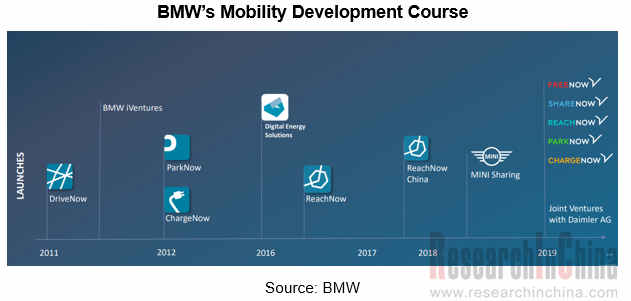
The shared mobility market is the battlefield of vibrant players who still need fight in alliance. WAYMO has tested Robotaxi for ten years. BMW has been groping for shared mobility business for almost a decade, but it eventually allied with Daimler to push on deeper cooperation on autonomous driving and shared mobility.
A study by General Motors shows that the cost of shared mobility will be slashed from $ 3 / mile to $1 / mile through autonomous driving by 2025, thereby diluting the operation cost through a large scale. After 2030, the mobility mileage of Robotaxis will constitute 75% of the total.

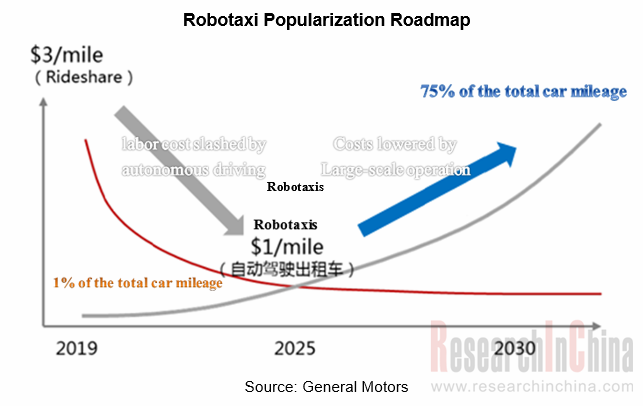
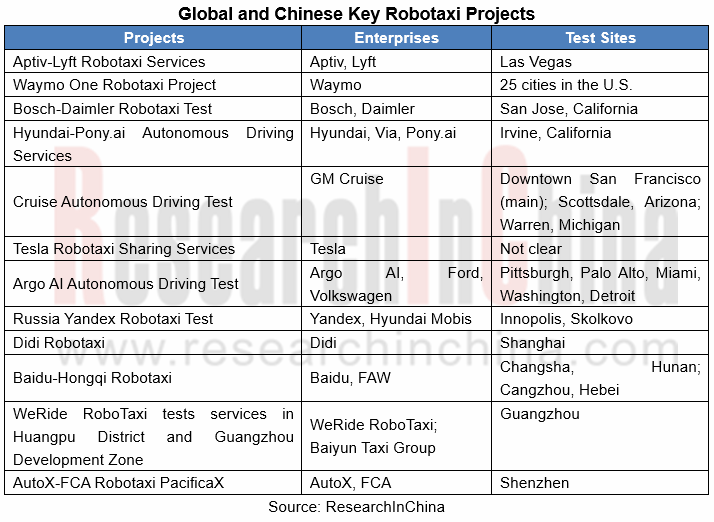
That is to say, autonomous driving will not give much impetus to shared mobility until 2025. From now on, it is a challenge for ambitious companies to make a layout in just five years. Looking back at the players’ Robotaxi trials in 2019, we can see that fiercer rivalry is under way.
Trial Operation of Robotaxi
Three major forces are competing for the Robotaxi market, including:
(1) Didi, Uber, Lyft and other mobility platforms;
(2) Waymo, Aptiv, Baidu, Pony.ai and other Robotaxi solution providers;
(3) OEMs. Tesla plans to launch a Robotaxi network involving over a million Robotaxis on the road. Waymo has secured US$3 billion in financing for enlarging the Robotaxi test fleet. Baidu announced in April 2020 the availability of China's first Robotaxi services which are being offered on mobile apps to the public.
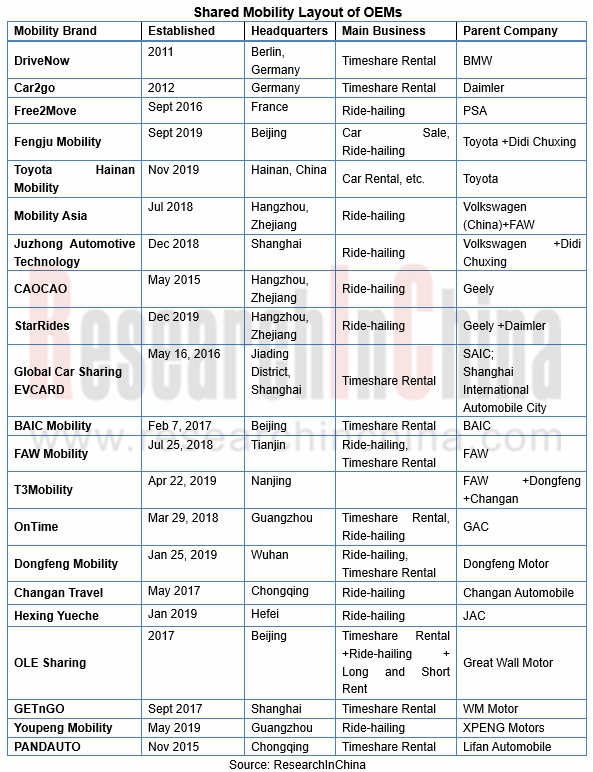
Although a few giants and top Robotaxi startups are making long-term plans, it is still too early for most automakers, most of which have launched their own mobility service brands successively and made attempts in the lucrative but fiercely contested mobility market.
Automotive Microcontroller Unit (MCU) and Application Scenario Research Report, 2026
Automotive MCU Research: Increased demand for redundant security drives ASIL D-compliant MCU shipments to exceed 100 million units
In a vehicle EEA, MCUs are widely distributed in various functional ...
China Intelligent Cockpit Patent Analysis Report, 2026
Intelligent Cockpit Patent Research: Cockpit AI, In?vehicle Health, and Infotainment Are Upgrade to Scenario?based and Proactive Functions
From a patent perspective, this report explores the cutting?...
Research Report on Application of VLA Large Model in Automobiles and Robots, 2026
Research on Automotive and Robot VLA: Hybrid Architectures Become Mainstream, VLA Integrates with General World Models, and Reinforcement Learning Serves as Core Engine
Vision?Language?Action (VLA) m...
China Charging Infrastructure (Supercharging, Battery Swapping, V2G, etc.) and High-Performance Supercharging Battery Research Report, 2026
Charging and battery swapping research: as 5C+ supercharging vehicle models go into mass production, the pace of OEMs self-building supercharging networks quickens
800-1000V high-voltage platforms ar...
China Passenger Car Electronic Controlled Suspension Industry Report, 2026
Electronic Controlled Suspension Industry Research: As the First Year of Full Active Suspension Unfolds, Three Technical Routes Race Forward
1. Penetration Rate Surges Three Times, and Electronic Con...
Intelligent Driving SoC Research Report, 2026
Research on Intelligent Driving SoCs: Competition Focus Shifts to L3/L4 Embedded Hardware, and Computing Power of Flagship Vehicle Models Exceeds 1,000 TOPS
In terms of intelligent driving system in...
Automotive AI Large Model Technology Research Report, 2026
Automotive AI Large Model Research: Competition Shifts from "Who Has the Stronger Model" to "Who Boasts Higher Link Efficiency"
ResearchInChina released the Automotive AI Large Model Technology Resea...
Intelligent Vehicle Cockpit Domain Controller Research Report, 2026
Cockpit domain controller research: L3 AIDV intelligent cockpit domain controllers are entering a boom period
Driven by multiple factors such as the continuous evolution of the automotive central int...
Automotive Acoustic System (Audio, Multi-Channel) Industry Report, 2026
Automotive Acoustics Research: Multiple Channels, AI Tuning, and Self-Developed Algorithms Drive the Transformation of High-End Cockpit Sound Fields
I. Automotive Audio Hardware Solutions with 6–9 S...
Autonomous Driving Sensor Chip Research Report, 2026
Research on Autonomous Driving Sensor Chips: Deeply Perceiving the Physical World, Sensor Chips Are Playing A “Leading Role” in Intelligence
In 2026, the autonomous driving sensor chip industr...
Passenger Car Corner Module and Wheel‑Side Control System Research Report, 2026
Wheel-side control research: the “last mile” chassis innovation
Wheel-side control dismantles the traditional drive, braking, steering, and suspension control of the chassis from a "centralized" styl...
Embodied Artificial Intelligence (& Humanoid Robot) MCU Research Report, 2026
Research on Humanoid Robot MCUs: Evolution from General-Purpose Control to High-Value Dedicated Chip Solutions Integrated with Edge AI Functions
MCU (Microcontroller Unit) refers to a compact integra...
Intelligent Vehicle Zone Control Unit (ZCU) Research Report, 2026
ZCU Research: Cross-domain integrated ZCUs are becoming the edge computing nodes of the next-generation zonal architecture
Currently, the mainstream zonal architecture is mainly the quasi-central + z...
Automotive Cybersecurity and Data Security Research Report, 2026
Cybersecurity & Data Security Research: Intelligent Connected Vehicles Enter the Era of “Systematic Offense-Defense and AI-Defined Security”.
Centering on the panorama of intelligent connect...
Report on Breakthrough Strategies of OEMs and ADAS Tier 1 Suppliers for Overseas Layout of Intelligent Driving, 2026
Regulatory Breakthrough, Local System Establishment, OEMs Competing for NOA Layout: Overall Trends of China’s Intelligent Driving Overseas Layout in 2026
Research on overseas intelligent driving layo...
OEMs and Tier1s’ Intelligent Cockpit Platform (Hardware and Software) Innovation Strategy Research Report, 2026
Intelligent Cockpit Platform Research: multi-dimensional cockpit system architecture reconstruction for multi-agent collaboration and proactive intelligent services
The intelligent cockpit software s...
Automotive AIOS Research Report, 2026
Automotive AIOS Research: Mass Production Solutions Are Implemented
Mass Production Solutions Are Implemented on A Small Scale.
In 2026, AIOS starts small-scale implementation, helping to improve v...
Automotive Telematics Service Provider (TSP) Research Report, 2026
TSP Research: Leading providers collectively turn to AI agents to provide all-scenario active services
Telematics Service Providers (TSPs) are the core hub of the telematics industry chain, connectin...