Vision Sensor Chip, and Radar/LiDAR chip, who are doing it?
Automated Driving Sensor Chip Industry Report, 2020, published by ResearchInChina, analyzes market size, technologies, competitive landscape, development trend, etc of vision sensor chip, Radar and LiDAR chip for automated driving.
Vision sensor Chip: features with function integration and product diversification
Automotive vision sensor chips mainly cover CMOS image sensor (CIS) and image signal processor (ISP) chip. Currently CMOS chips are challenged by high expansion barrier, while the growth rate of CMOS demand is far higher than the expansion speed, especially under the background that automated driving ushers in rapid development in recent years, automotive camera demand skyrockets, pre-installed 960P and 1080P camera CMOS chips are in tight supply.
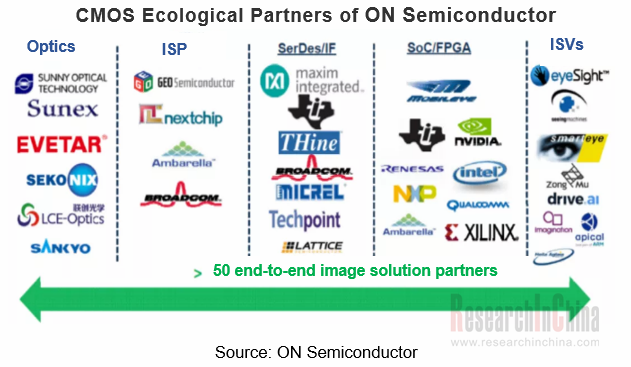
In terms of market pattern, although SONY, Samsung and other traditional mobile phone CIS vendors have successively launched several CMOS sensors for self-driving, ON Semiconductor still occupies a leading position in the market. It has more than 50 automotive ecological partners, involving businesses like optical lens, signal processors, I/O, Interface, SoC processors and software systems, etc.
In terms of image processing chip, independent ISP chips have strong performance but high cost, the main suppliers include Texas Instruments (TI), Moileye, Huawei HiSilicon, etc, among which TI outstands with the deepest accumulation of technology and the largest market share. In recent years, CIS suppliers like Aptina and OmniVision have also launched the latest CIS integration products with built-in ISP, which have low cost, small area and low power consumption, but is just capable of simple algorithms and is weak in processing power. Under the background of increased requirements for automotive intelligence, independent ISP chip in automotive camera is still the focus.
With the development of artificial intelligence (AI) and automated driving, image processing and calculation are facing more and more challenges. The integration of vision sensor chips has become a trend. In addition to ISP chips, vision processors (VP) chips with AI capabilities are gradually added.
In May 2020, Sony unveiled two models of intelligent vision sensors with AI processing functionality-- IMX500 and IMX50, which feature a stacked configuration consisting of a pixel chip (photosensitive function) and a logic chip (calculation and memory function). They are the world’s first CMOS image sensors to be equipped with AI image analysis and processing functionality on the logic chip.
In Jan. 2021, OmniVision released new sensor OAX8000, which uses a stacked-die architecture and integrates a neural processing unit (NPU) and ISP. OAX8000 ASIC samples are provided by BGA196 package now and already passed automotive AEC- Q100 2 certification.
Due to different application positions of vision camera in the car, it can be subdivided into surround view, front view, rear view, side view, drive monitoring, cockpit monitoring, etc. From the perspective of chip, there are also image sensor products dedicated to surround view, front view, rear view and driving monitoring. For example, OmniVision’s vehicle image sensor products include driver monitoring sensors (OV10652, OV2311, OV2312, OV2778, OV4690, etc), sensors for automated driving systems (OV10625, OV10640, OV10642, OV10650, OV10652, etc.), rear view and electronic mirror sensors (OV10626, OV10635, OV10640, OV10650, OV10652, etc), surround view sensors (OV10635, OV10640, OV10652, OV2312, OV2775, etc.), 8-megapixel forward camera OX08A and OX08B, and DMS sensor OAX8000, etc.
Increase in usage and industrial M&As
The number of vehicle cameras for mainstream models will increase from 1.7 in 2018 to more than 3 in 2022 per vehicle, while the number for high-end models even be more than 10. For example, Leapmotor C11 unveiled a the end of 2020 carries 10 cameras, and NIO ET7, which will be launched in 2022, carries 11 8-megapixel high-definition cameras. Also, the first model of IM (Zhiji Auto) just released in early 2021 comes standard with 15 high-definition vision cameras, 5 radars and 12 ultrasonic radars.
As the incremental application of image sensors in the next few years will be mainly in automotive market, leading players in the industry begin to deploy and a number of image sensor companies are acquired in 2020:
SmartSens Technology acquired Allchip
Goodix acquired Dreamchip
TE Connectivity acquired First Sensor
AMS acquired Osram
Nuvoton acquired Semiconductor Business from Panasonic (including image sensor)
Jenoptik acquired Trioptics(test equipment for optical components and sensors)
Sony acquired Insightness(event-based vision sensor)
Radar chip: 4D imaging radar enters mass-production and radar SoC solution arouses much concern.
Radar-used chips cover master chips (MCU, DSP, FPGA), radar chip (e.g., MMIC, ASIC) and other auxiliary ones (like PMI, ADC). The radar vendors are championing 77GHz and chip providers deliver new products, mainly 77GHz chips.
The 4D imaging radar market is already fiercely contested, and the players such as Huawei and Oculii have rolled out 4D imaging radar systems. In early 2021, Continental AG announced it would spawn the first 4D imaging radar – ARS540 within 2021, a solution based on chip cascade plus Xilinx FPGA.
Continental’s 4D imaging radar will be first available to BMW production cars; and SUV Ocean with 4D imaging radar, as an outcome of joint efforts between Magna and Fisker, made its debut in early 2021 and plans to be launched on the market at the end of 2022. Besides, there are also signs of Tesla to deploy 4D imaging radar (the 4D radar Phoenix offered by Arbe Robotics).
In addition to 4D radar, startups prefer to develop radar SoC (radar-on-a-chip) products. Vayyar, with the already raised funds of $188 million has the automotive radar chips enabling 77-81GHz imaging and radar band, incorporating a total of 48 transceivers in a SoC system able to accommodate 2,000-plus virtual channels. Vayyar’s radar SoC contains an internal DSP as well, enabling real-time signal processing. Vayyar’s sensors are enhanced through the integrated powerful DSP and large internal memory to administer complex imaging algorithms and application without a need for external tackling capability. Vayyar’s radar SoC is able to output post-processing data and original 3D images or point-cloud formats.
In December 2020, Uhnder, a start-up in the development of radar-on-a-chip secured its C-round series funding of $45 million, with a plan to unveil its first automotive-grade 4D imaging radar – Voxel within 2021, containing chips and 4D imaging software algorithms. The successful financing will serve as a stimulus to the company’s ambitious production plan in 2021.
Lidar chip: SoC solution becomes the apple of vendors’ eyes, and hopefully FMCW solution is gaining ground
Despite a varied focus of vendors on chip technologies, LiDAR on chip grows a key trend as those are beneficial to automated driving such as high reliability coming of no mechanical motion mechanisms as well as conforming to vehicle requirements, miniature and being easy to integrate, among others. Moreover, the semiconductor process (like CMOS) truly brings a cut in vehicle lidar costs, from the tens of thousands of yuan to less than ten thousand yuan in readiness for massive use.
Lidar SoC solution is the dream of many a vendor. In August 2016, Massachusetts Institute of Technology (MIT) together with Defense Advanced Research Projects Agency (DARPA) offered such a solution like this: to encapsulate lidar sensors onto a single chip with a footprint just 0.5mm×6mm, for the commercialization of which MIT set up a company named Kyber Photonic in early 2020.
In June 2020, Xilight Technology joined forces with Xidian University to develop dToF SPAD lidar sensor chip -- XHS301 on which the core photosensitive element SPAD is integrated. The solution enables the miniature and cost reduction of LiDAR and is well placed for mass production with proprietary control technologies.
In January 2021, Mobileye announced a partnership with Intel to develop silicon photonics lidar SoC system with which the lidar sensors are produced for availability onto Mobileye self-driving fleets in 2025. Such chip enjoys significant superiority in the lidar sector thanks to Intel’s professional silicon photonics workshops.
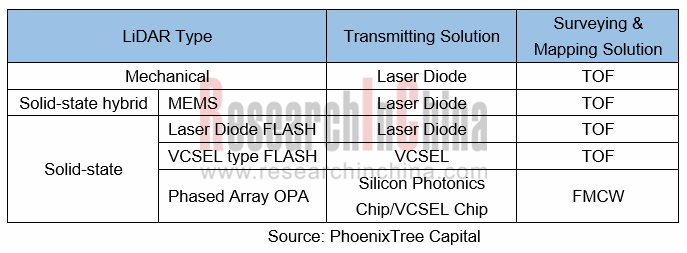
The lidar SoC developed by Mobileye and Intel employs FMCW (Frequency Modulated Continuous Wave) technology, featuring a high signal-to-noise ratio, low power consumption, irrelevance to both the distance away from objects (compared with the farther TOF lidar detects, the lower accuracy of detection will be) and the motion velocity of objects, but with the demerits including great difficulty, high costs and low yield. ToF-based pulse laser has long been dominant in the industry, and only about ten out of more than 100 lidar developers worldwide dedicate themselves to the development of FMCW lidars. It is over the recent years that FMCW technology is increasingly favored by ever more companies.
Being bullish about FMCW lidar, the optics giant Carl Zeiss AG invested and founded Bridger Photonics, an American lidar developer in November 2018 and made investments in August 2020 in Scantinel Photonics, a German FMCW lidar startup.
Autonomous Driving Domain Controller and Central Computing Unit (CCU) Industry Report, 2026
Autonomous Driving Domain Controller (ADCU) Research: One-Chip CCU solutions are quickly available in vehicles
In China's passenger car market, autonomous driving systems involved in mass production ...
Automotive EMS and ECU Industry Research Report, 2026
Automotive EMS Research: The boundaries between EMS providers and Tier1 suppliers are becoming blurred, and the supply chain model is evolving from a linear chain to a networked structure
Mainstream ...
Automotive Microcontroller Unit (MCU) and Application Scenario Research Report, 2026
Automotive MCU Research: Increased demand for redundant security drives ASIL D-compliant MCU shipments to exceed 100 million units
In a vehicle EEA, MCUs are widely distributed in various functional ...
China Intelligent Cockpit Patent Analysis Report, 2026
Intelligent Cockpit Patent Research: Cockpit AI, In?vehicle Health, and Infotainment Are Upgrade to Scenario?based and Proactive Functions
From a patent perspective, this report explores the cutting?...
Research Report on Application of VLA Large Model in Automobiles and Robots, 2026
Research on Automotive and Robot VLA: Hybrid Architectures Become Mainstream, VLA Integrates with General World Models, and Reinforcement Learning Serves as Core Engine
Vision?Language?Action (VLA) m...
China Charging Infrastructure (Supercharging, Battery Swapping, V2G, etc.) and High-Performance Supercharging Battery Research Report, 2026
Charging and battery swapping research: as 5C+ supercharging vehicle models go into mass production, the pace of OEMs self-building supercharging networks quickens
800-1000V high-voltage platforms ar...
China Passenger Car Electronic Controlled Suspension Industry Report, 2026
Electronic Controlled Suspension Industry Research: As the First Year of Full Active Suspension Unfolds, Three Technical Routes Race Forward
1. Penetration Rate Surges Three Times, and Electronic Con...
Intelligent Driving SoC Research Report, 2026
Research on Intelligent Driving SoCs: Competition Focus Shifts to L3/L4 Embedded Hardware, and Computing Power of Flagship Vehicle Models Exceeds 1,000 TOPS
In terms of intelligent driving system in...
Automotive AI Large Model Technology Research Report, 2026
Automotive AI Large Model Research: Competition Shifts from "Who Has the Stronger Model" to "Who Boasts Higher Link Efficiency"
ResearchInChina released the Automotive AI Large Model Technology Resea...
Intelligent Vehicle Cockpit Domain Controller Research Report, 2026
Cockpit domain controller research: L3 AIDV intelligent cockpit domain controllers are entering a boom period
Driven by multiple factors such as the continuous evolution of the automotive central int...
Automotive Acoustic System (Audio, Multi-Channel) Industry Report, 2026
Automotive Acoustics Research: Multiple Channels, AI Tuning, and Self-Developed Algorithms Drive the Transformation of High-End Cockpit Sound Fields
I. Automotive Audio Hardware Solutions with 6–9 S...
Autonomous Driving Sensor Chip Research Report, 2026
Research on Autonomous Driving Sensor Chips: Deeply Perceiving the Physical World, Sensor Chips Are Playing A “Leading Role” in Intelligence
In 2026, the autonomous driving sensor chip industr...
Passenger Car Corner Module and Wheel‑Side Control System Research Report, 2026
Wheel-side control research: the “last mile” chassis innovation
Wheel-side control dismantles the traditional drive, braking, steering, and suspension control of the chassis from a "centralized" styl...
Embodied Artificial Intelligence (& Humanoid Robot) MCU Research Report, 2026
Research on Humanoid Robot MCUs: Evolution from General-Purpose Control to High-Value Dedicated Chip Solutions Integrated with Edge AI Functions
MCU (Microcontroller Unit) refers to a compact integra...
Intelligent Vehicle Zone Control Unit (ZCU) Research Report, 2026
ZCU Research: Cross-domain integrated ZCUs are becoming the edge computing nodes of the next-generation zonal architecture
Currently, the mainstream zonal architecture is mainly the quasi-central + z...
Automotive Cybersecurity and Data Security Research Report, 2026
Cybersecurity & Data Security Research: Intelligent Connected Vehicles Enter the Era of “Systematic Offense-Defense and AI-Defined Security”.
Centering on the panorama of intelligent connect...
Report on Breakthrough Strategies of OEMs and ADAS Tier 1 Suppliers for Overseas Layout of Intelligent Driving, 2026
Regulatory Breakthrough, Local System Establishment, OEMs Competing for NOA Layout: Overall Trends of China’s Intelligent Driving Overseas Layout in 2026
Research on overseas intelligent driving layo...
OEMs and Tier1s’ Intelligent Cockpit Platform (Hardware and Software) Innovation Strategy Research Report, 2026
Intelligent Cockpit Platform Research: multi-dimensional cockpit system architecture reconstruction for multi-agent collaboration and proactive intelligent services
The intelligent cockpit software s...