Our recent report Global and China Automotive Seating Industry Report, 2020-2021 highlights the following: development history of automotive seating, industry pattern, market size, supplier relationships, “CASE” (Connected, Autonomous, Shared, Electrified) and cooperation dynamics of major automotive seat manufacturers, and ten trends for automotive seating industry in an upsurge of CASE.
Automotive seat is the interior component that occupants contact for the longest time during the ride. Since the world’s first automobile came into being in 1885, automotive seat has evolved for over a century from a simple component into a practical tool offering comfort and safety.
Global automotive seating market is dominated by American, European and Japanese brands.
In 2019, North American, Japanese and European seat manufacturers commanded around 50%, 14% and 11% of the global market, separately. China’s automotive seating market is grabbed by foreign companies such as Adient and Lear and their affiliates and Toyota Boshoku, or foreign-funded joint ventures, which together sweep more than 60%.
Ten trends for automotive seating industry amid CASE
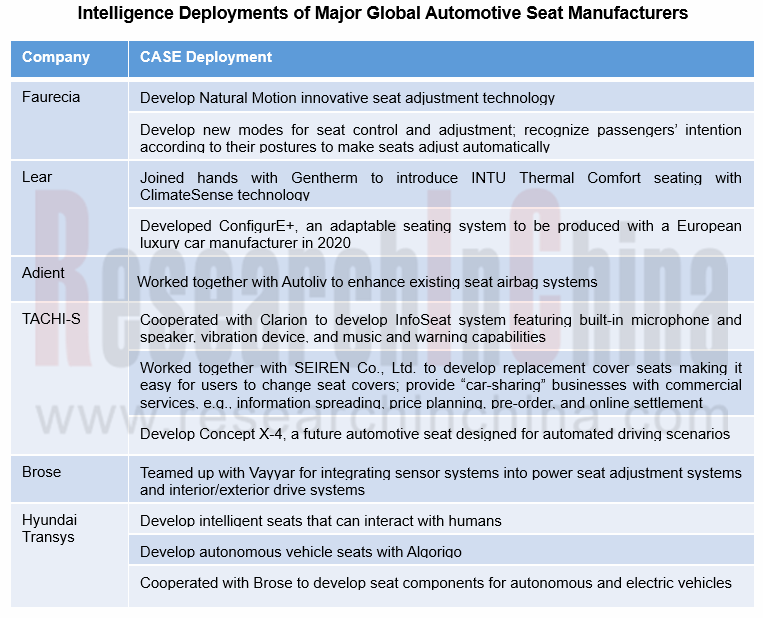
Under the development trend of CASE, the tide of software-defined cars is unstoppable. However, software cannot define everything about vehicles. Traditional auto parts manufacturers still have many core technologies, which cannot be replaced by emerging auto-making forces, such as automotive settings. Seat manufacturers have also made a lot of intelligent improvements to seats according to the development needs of intelligent connected vehicles. We summarized the ten development trends for automotive seating industry amid CASE boom.
Trend 1: Multi-scenario Application
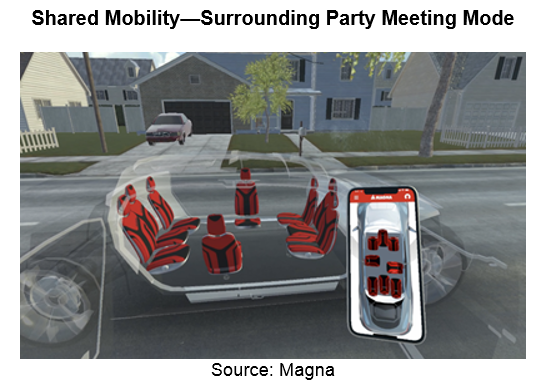
In future, autonomous vehicle cockpit will be a mobile space for office, living and entertainment, so seat needs to transform for different application scenarios. An example is the next-generation reconfigurable seating concept Magna showcased at CES 2019. Users can reconfigure seats via their smartphone APP, with reconfigurable modes including vehicle sharing, long journey, and autonomous shared mobility.
Trend 2: Integration with ADAS
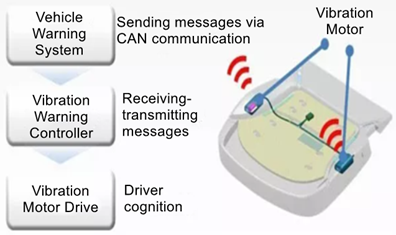
In future, automotive seat that plays a crucial role in vehicle safety will integrate with ADAS to deliver more driving assistance capabilities. Examples include InfoSeat, an automotive seating system TACHI-S and Clarion co-developed and launched in 2019: when the vehicle travels too close to the front vehicle or the driver is drowsy, the vibration device installed in the seat will send a vibrative warning to occupants.
Trend 3: Intelligent Control
At present, CASE is reshaping the automotive industry. Facing the disruption in automotive industry, seat manufacturers race to double down on intelligence deployment by way of such as cooperation and independent development. Future intelligent seats can not only provide comfortable experience but learn to “know” what passengers want with AI technology and adjust and control themselves without any active operation. For instance, the fusion of sensors and seats makes seat control mode change from conventional button to intelligent control methods, e.g., APP, gesture control and intention perception.
Trend 4: Intelligent Monitoring
In future, automotive seat will also act as a “health manager” that can monitor heart and breath rates. Examples include HiRain Technologies’ intelligent automotive seating system with the ability to intelligently monitor health, heart and breath rates, and temperature.
Trend 5: Personalization
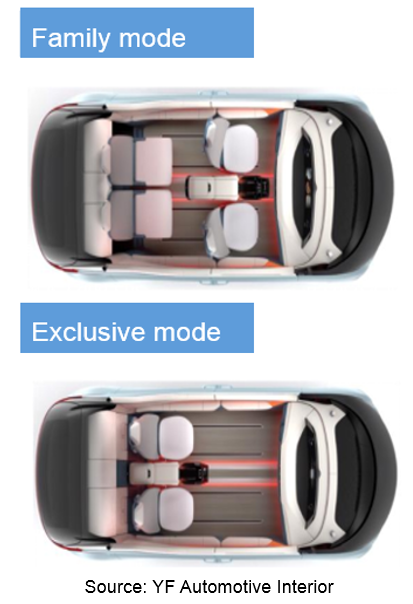
As well as function intelligence, personalized design holds a trend for automotive seat, helping users to create a more private interior space. In the case of gender-targeted design, ambient lamps are used to build exclusive private sound areas.
Trend 6: Modularization
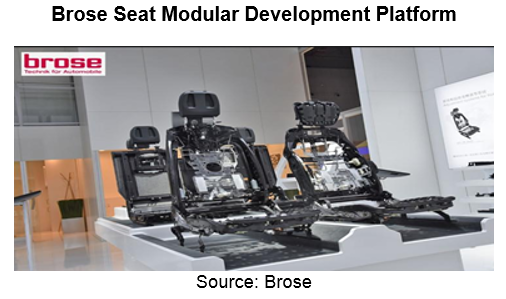
Automotive modular platform that helps automakers reduce cost, development time, vehicle weight and fuel consumption will be well-welcomed. For example, Brose’s complete seat modular structure allows for higher uniformity of motors in size for quick response to different customers’ needs for—any drive for basic capabilities such as adjusting length, height, seat tilt and backrest tilt, serving as an efficient supplement in comfort and safety.
Trend 7: Application of Intelligent Surface
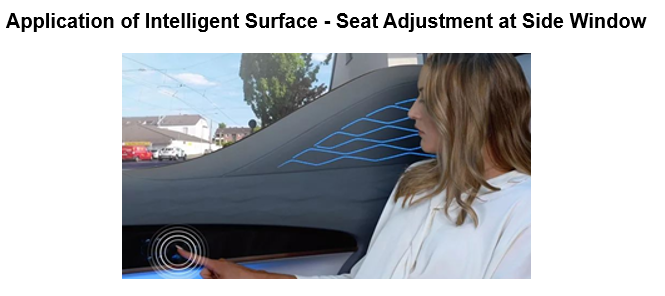
As intelligent cockpit booms, decorative, functional intelligent automotive surface attracts ever more attention from industry players. Examples include BWM Vision iNext, a concept car fully demonstrating which direction intelligent automotive surface will head in. iNext allows users to operate the infotainment system by interacting with and tracking symbols on seat or side panel woven fabrics with their fingers, which replaces traditional buttons and touch screen control capability.
Trend 8: Replacement Cover Seat
The growing awareness of hygiene and disinfection in car comes with popularity of car sharing and current pandemic. The emergence of replacement cover seat will be an efficient way to reduce the spread of viruses and bacteria and better protect the health of occupants.
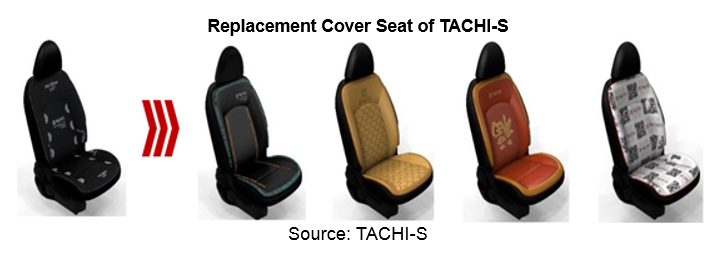
An example is the replacement cover seat co-developed by TACHI-S and SEIREN Co., Ltd. Users can replace seat covers as they like in any time. For car sharing, corporate LOGO or QR code can be printed on the cover of the seat in support of offering commercial services from information spreading and price planning to pre-order and online settlement.
Trends 9: Lightweight
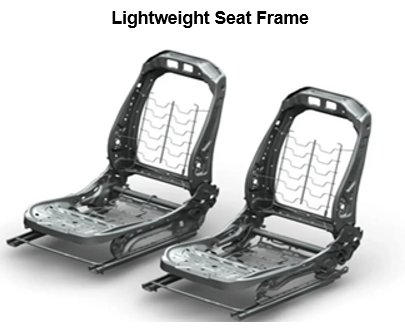
Seats make up 6% of vehicle curb weight, and 5% of total vehicle cost, the second highest share among all components. Lightweight seats are an effective solution to vehicle energy conservation and emission reduction. Reducing the weight of seats lies in use of lightweight seat frames or complete seats.
Trends 10: Zero Gravity
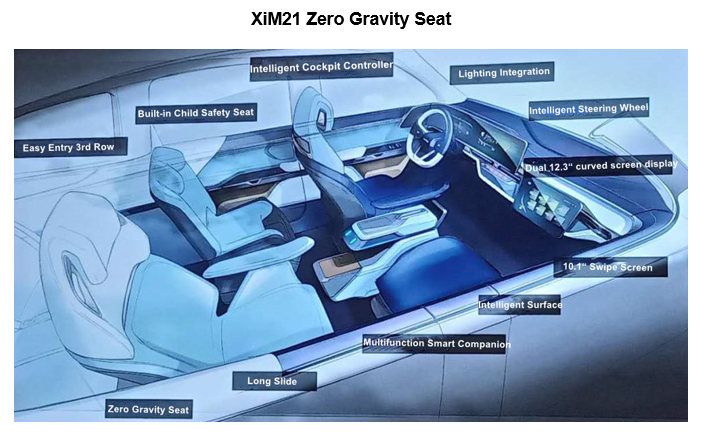
Statistics shows that in autopilot mode, the comfortable recumbent mode (zero gravity) gives users the greatest pleasure. A zero gravity seat is a boon for them to feel less tired during the journey. For example, in June 2020 Yanfeng Automotive Interiors introduced XiM21, a self-developed intelligent cockpit featuring a zero gravity seat that affords a large angle tilt, integrates with massage function and lets passengers relax their body and mind with fragrance from the hidden air outlet.
Autonomous Driving Domain Controller and Central Computing Unit (CCU) Industry Report, 2026
Autonomous Driving Domain Controller (ADCU) Research: One-Chip CCU solutions are quickly available in vehicles
In China's passenger car market, autonomous driving systems involved in mass production ...
Automotive EMS and ECU Industry Research Report, 2026
Automotive EMS Research: The boundaries between EMS providers and Tier1 suppliers are becoming blurred, and the supply chain model is evolving from a linear chain to a networked structure
Mainstream ...
Automotive Microcontroller Unit (MCU) and Application Scenario Research Report, 2026
Automotive MCU Research: Increased demand for redundant security drives ASIL D-compliant MCU shipments to exceed 100 million units
In a vehicle EEA, MCUs are widely distributed in various functional ...
China Intelligent Cockpit Patent Analysis Report, 2026
Intelligent Cockpit Patent Research: Cockpit AI, In?vehicle Health, and Infotainment Are Upgrade to Scenario?based and Proactive Functions
From a patent perspective, this report explores the cutting?...
Research Report on Application of VLA Large Model in Automobiles and Robots, 2026
Research on Automotive and Robot VLA: Hybrid Architectures Become Mainstream, VLA Integrates with General World Models, and Reinforcement Learning Serves as Core Engine
Vision?Language?Action (VLA) m...
China Charging Infrastructure (Supercharging, Battery Swapping, V2G, etc.) and High-Performance Supercharging Battery Research Report, 2026
Charging and battery swapping research: as 5C+ supercharging vehicle models go into mass production, the pace of OEMs self-building supercharging networks quickens
800-1000V high-voltage platforms ar...
China Passenger Car Electronic Controlled Suspension Industry Report, 2026
Electronic Controlled Suspension Industry Research: As the First Year of Full Active Suspension Unfolds, Three Technical Routes Race Forward
1. Penetration Rate Surges Three Times, and Electronic Con...
Intelligent Driving SoC Research Report, 2026
Research on Intelligent Driving SoCs: Competition Focus Shifts to L3/L4 Embedded Hardware, and Computing Power of Flagship Vehicle Models Exceeds 1,000 TOPS
In terms of intelligent driving system in...
Automotive AI Large Model Technology Research Report, 2026
Automotive AI Large Model Research: Competition Shifts from "Who Has the Stronger Model" to "Who Boasts Higher Link Efficiency"
ResearchInChina released the Automotive AI Large Model Technology Resea...
Intelligent Vehicle Cockpit Domain Controller Research Report, 2026
Cockpit domain controller research: L3 AIDV intelligent cockpit domain controllers are entering a boom period
Driven by multiple factors such as the continuous evolution of the automotive central int...
Automotive Acoustic System (Audio, Multi-Channel) Industry Report, 2026
Automotive Acoustics Research: Multiple Channels, AI Tuning, and Self-Developed Algorithms Drive the Transformation of High-End Cockpit Sound Fields
I. Automotive Audio Hardware Solutions with 6–9 S...
Autonomous Driving Sensor Chip Research Report, 2026
Research on Autonomous Driving Sensor Chips: Deeply Perceiving the Physical World, Sensor Chips Are Playing A “Leading Role” in Intelligence
In 2026, the autonomous driving sensor chip industr...
Passenger Car Corner Module and Wheel‑Side Control System Research Report, 2026
Wheel-side control research: the “last mile” chassis innovation
Wheel-side control dismantles the traditional drive, braking, steering, and suspension control of the chassis from a "centralized" styl...
Embodied Artificial Intelligence (& Humanoid Robot) MCU Research Report, 2026
Research on Humanoid Robot MCUs: Evolution from General-Purpose Control to High-Value Dedicated Chip Solutions Integrated with Edge AI Functions
MCU (Microcontroller Unit) refers to a compact integra...
Intelligent Vehicle Zone Control Unit (ZCU) Research Report, 2026
ZCU Research: Cross-domain integrated ZCUs are becoming the edge computing nodes of the next-generation zonal architecture
Currently, the mainstream zonal architecture is mainly the quasi-central + z...
Automotive Cybersecurity and Data Security Research Report, 2026
Cybersecurity & Data Security Research: Intelligent Connected Vehicles Enter the Era of “Systematic Offense-Defense and AI-Defined Security”.
Centering on the panorama of intelligent connect...
Report on Breakthrough Strategies of OEMs and ADAS Tier 1 Suppliers for Overseas Layout of Intelligent Driving, 2026
Regulatory Breakthrough, Local System Establishment, OEMs Competing for NOA Layout: Overall Trends of China’s Intelligent Driving Overseas Layout in 2026
Research on overseas intelligent driving layo...
OEMs and Tier1s’ Intelligent Cockpit Platform (Hardware and Software) Innovation Strategy Research Report, 2026
Intelligent Cockpit Platform Research: multi-dimensional cockpit system architecture reconstruction for multi-agent collaboration and proactive intelligent services
The intelligent cockpit software s...