TOP4 Emerging Automakers’ CASE Layout and Strategy Research Report, 2020
Our TOP4 Emerging Automakers’ CASE Layout and Strategy Research Report, 2020 highlights in-depth analysis of CASE situation (connectivity, automation, sharing and electrification) of NIO, Xiaopeng Motors, Weltmeister and Leading Ideal.
By sales, vehicle model and brand recognition, NIO, Leading Ideal, Xiaopeng Motors and Weltmeister are the first-echelon emerging automakers in China.
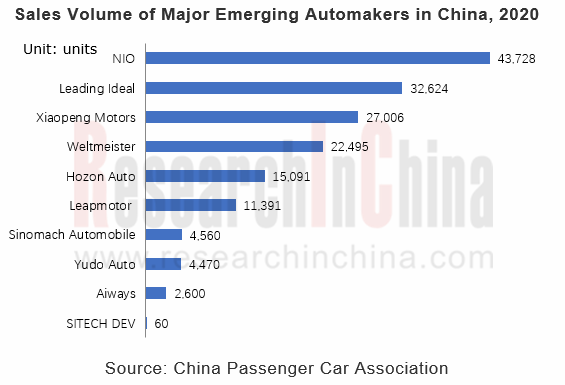
Favored by investors, the top four emerging automakers have raised more than RMB100 billion in all.
Internet firms and strategic investment companies are particularly optimistic about intelligent new energy vehicles, and some investors make simultaneous deployments of more than one emerging automakers. Examples include Sequoia Capital investing NIO, Xiaopeng Motors and Weltmeister, and Tencent that has funded NIO, Weltmeister and Aiways. Local governments attract new energy automakers to settle as well. For instance, NIO secured RMB7 billion strategic investment from Hefei in April 2020; Xiaopeng Motors raised RMB4 billion from Guangzhou Development District in September 2020.
As of December 2020, NIO has closed 14 funding rounds and raised around RMB71.3 billion, the largest amount among all emerging automakers in China; Xiaopeng Motors has obtained approximately RMB51.8 billion in its 15 funding rounds; a total of 8 funding rounds have raised over RMB30 billion for Weltmeister; Leading Ideal has reported 8 funding rounds and raised funds of more than RMB32.9 billion.
This report summarizes fives reasons why emerging automakers are a hotspot for investors and explains what emerging automakers mean.
1.Adopt direct sales or partially direct sales model, with digital operation covering full life cycle of vehicle.
Through the lens of business model, emerging automakers employ direct sales or partial direct sales model, which means they put greater emphasis on user operation and bind themselves to users for close communication. An example is NIO which uses fully direct sales model where car picking and customization are done online and most customer feedback and communications are carried out offline. NIO House provides car owners with free meeting rooms and libraries, among others. NIO APP connects users in full life cycle from pre-sales consultation to online picking and reservation for test drive, then to fully digital tracking in after-sales service, enabling the carmaker to know using habit, needs and preference of its users and potential users. Moreover, NIO APP that is open to NIO users or non-users, allows them to contact with each other or share experience in the community, not only improving customer loyalty but enlarging fan and potential user bases.
Xiaopeng Motors adopts a model of partially pre-sales franchise and fully direct after-sales service, paying more attention to after-sales service experience. It has three types of physical stores: 2S (experience + sales), 2S (delivery + service), and 4S (experience + sales + delivery + service).
Weltmeister sets up “new 4S” outlets: Space (experience store, displaying its products and providing premium fan services), Store (user center, offering test drive, delivery, maintenance, mobility, charging, etc.), Station (service home, after-sales services, e.g., charging, maintenance and repair and emergency rescue), and Spot (E station, convenient services, e.g., car washing, beauty and daily maintenance, being planned).
Leading Ideal uses a direct pre-sales and after-sales franchise model where retail and delivery centers are set up separately. In future, the carmaker will increase its service outlets, expectedly up to over 1,000 in 2024.
2. Superior autonomous driving configurations for new cars, especially ET7, pose great stress to conventional automakers.
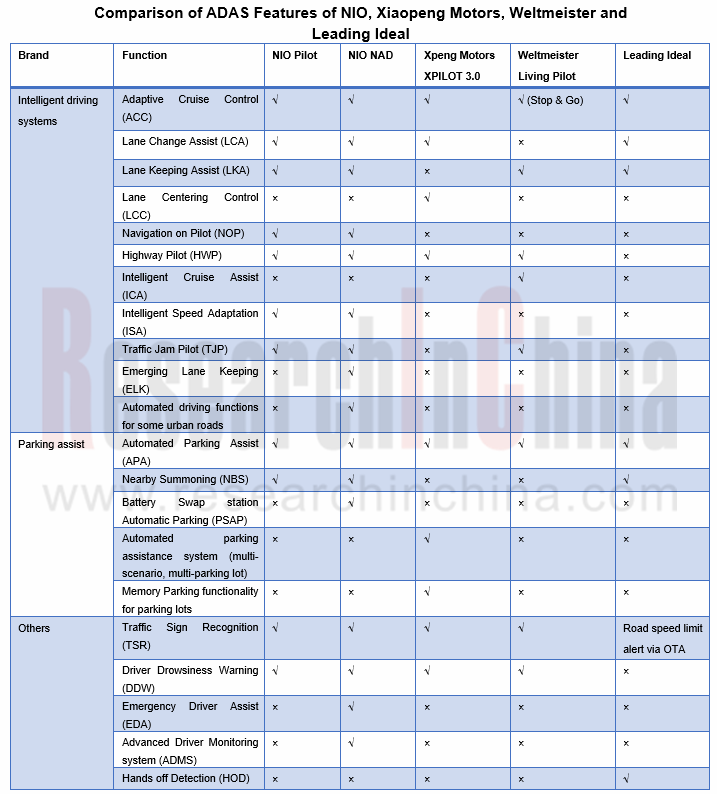
NIO Autonomous Driving (NAD), a safety and driving assistance system mounted on ET7 which was launched in January 2020, delivers functions such as advanced driver monitoring system (ADMS), autonomous driving (available to some urban roads and closed highways), and low-speed automated parking (fully automated parking pilot, remote parking, remote summon, narrow road passing and reversing in a parking lot), and driving assistance (navigation on pilot (NOP) and auto lane change (ALC)). ET7 features 1016TOPS computing force, 300-channel LiDAR, 2 positioning units, V2X vehicle-infrastructure cooperation and perception, and higher precision hardware like ADMS, supporting future upgrades to more functions.
New car launches like ET7 make emerging automakers stay ahead in the race to configure intelligent connected vehicle capabilities, weighing heavily on conventional automakers.
Xiaopeng Motors’ XPILOT 3.0 boasts navigation guided pilot (NGP) and a Memory Parking functionality for parking lots. The NGP highway solution enables traffic cone recognition and avoidance, super follow-up on congested roads, night overtaking reminder, faulty vehicle avoidance, large truck avoidance, automatic speed limit adjustment, optimal lane selection, automatic on/off-ramp, and automatic overtaking, and works on highways, expressways, and some urban trunk roads. The automaker plans release of mass-produced intelligent vehicles equipped with Lidar and L3 autonomous driving function in 2021, L4 autonomous driving technologies in 2023 and implementation of XPILOT 5.0 in 2025 to realize L5 full automation.
Weltmeister and Baidu partner more closely. Their L3 driving assistance functions are expected to be rolled out and mounted on mass-produced cars in 2021.
Leading Ideal plans to deliver navigate on autopilot (NOA) capability between 2021 and 2022, and introduce X01, a model with standard configurations of L4 hardware and single NVIDIA Orin SoC that affords 200TOPS computing force (upgraded to dual SoC, 400TOPS) and 45W power consumption.
3. Brand-new architecture design allows for more frequent OTA updates and rapid function iteration
As of December 2020, NIO’s IVI system has undergone 16 OTA updates, every 1.9 months a time on average, of which at least 7 OTA updates were on the intelligent voice system NOMI, which totally added 8 features and optimized 3 functions. NOMI that increased 6 new in-vehicle control functions in the latest update, is expected to achieve more control features. Moreover, the digital operation throughout the life cycle enables NIO to collect user data quickly for offering targeted better product experience.
Xiaopeng Motors backed by Alibaba, introduces applets like Tmall Yangche, Tao Piao Piao, Fliggy, Ele.me, Che Dian Dian, Tuhu, AliHealth and Umetrip, and provides more convenient services, for example, when a vehicle knows the driver goes to the office, an applet will wake up itself to ask if there is a need to reserve breakfast.
Weltmeister and Xiaomi have established a close partnership. Xiaoai Speaker allows users to control their vehicle remotely and also to control 8 categories of Xiaomi smart home appliances in over 20 kinds just in their vehicle.
4. Adopt a totally new mode of hardware first and charged software upgrade
As a pioneer of the “embedded hardware + charged software unlock” model, Tesla is expected to introduce FSD subscription service before July 2021. Charged software service has been a business model of Tesla.
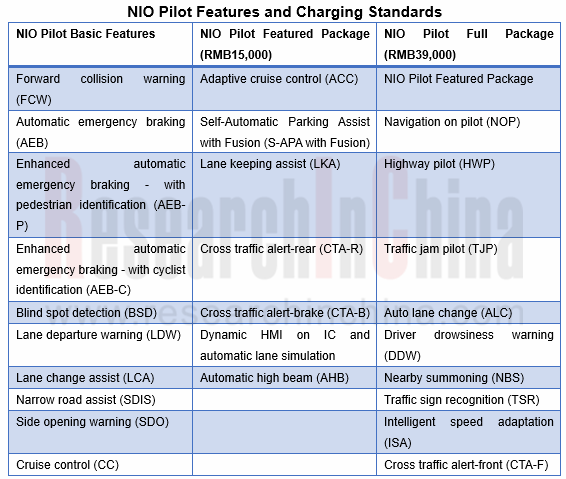
Following Tesla that has rolled out its software service model, NIO and Xiaopeng Motors have unveiled related services as well. For instance, NIO Pilot Featured Package service priced at RMB15,000 incorporates such capabilities as automated parking system and adaptive cruise control, and NIO Pilot Full Package service priced at RMB39,000 offers navigation on pilot, automated driving in traffic jams and other functions.
Xiaopeng Motors’ XPILOT 3.0 software and upgrade services are split into: Standard Lifetime Service (RMB36,000), Preferential Lifetime Service ordered with car (RMB20,000), and Yearly Service (RMB12,000/year).
5. Emerging automakers hoard more R&D talents and constantly enlarge their software talent base.
In 2020, NIO had a R&D workforce of 3,400, or 50% of its total employees; as of June 2020, Xiaopeng Motors has hired 3,676 persons in all, including 1,570 R&D workers, or 42.7% of the total; Leading Ideal’s Shanghai R&D Center plans to employ 2,000 engineers and add another 300 persons in its 300-person automated driving R&D team by the end of 2021, with half R&D budget to be spent on autonomous driving.
Comparably, conventional automakers have 10%-20% R&D employees, lack of software talents, especially the top-class software engineers who prefer emerging automakers with internet/IT genes. Yet they learn fast how emerging bellwethers make successes, and have begun to rid themselves of old systems in order to build themselves into innovative companies. For example, Geely and Baidu co-funded Jidu Auto; SAIC and Alibaba jointly founded IM Motors; Great Wall Motor set up HAOMO.AI, its autonomous driving subsidiary which introduces former Baidu worker Gu Weihao as CEO.
Mutual contest and learning between emerging and established automakers is a booster to make the Chinese automotive market the most innovative and dynamic one across the globe.
Automotive Microcontroller Unit (MCU) and Application Scenario Research Report, 2026
Automotive MCU Research: Increased demand for redundant security drives ASIL D-compliant MCU shipments to exceed 100 million units
In a vehicle EEA, MCUs are widely distributed in various functional ...
China Intelligent Cockpit Patent Analysis Report, 2026
Intelligent Cockpit Patent Research: Cockpit AI, In?vehicle Health, and Infotainment Are Upgrade to Scenario?based and Proactive Functions
From a patent perspective, this report explores the cutting?...
Research Report on Application of VLA Large Model in Automobiles and Robots, 2026
Research on Automotive and Robot VLA: Hybrid Architectures Become Mainstream, VLA Integrates with General World Models, and Reinforcement Learning Serves as Core Engine
Vision?Language?Action (VLA) m...
China Charging Infrastructure (Supercharging, Battery Swapping, V2G, etc.) and High-Performance Supercharging Battery Research Report, 2026
Charging and battery swapping research: as 5C+ supercharging vehicle models go into mass production, the pace of OEMs self-building supercharging networks quickens
800-1000V high-voltage platforms ar...
China Passenger Car Electronic Controlled Suspension Industry Report, 2026
Electronic Controlled Suspension Industry Research: As the First Year of Full Active Suspension Unfolds, Three Technical Routes Race Forward
1. Penetration Rate Surges Three Times, and Electronic Con...
Intelligent Driving SoC Research Report, 2026
Research on Intelligent Driving SoCs: Competition Focus Shifts to L3/L4 Embedded Hardware, and Computing Power of Flagship Vehicle Models Exceeds 1,000 TOPS
In terms of intelligent driving system in...
Automotive AI Large Model Technology Research Report, 2026
Automotive AI Large Model Research: Competition Shifts from "Who Has the Stronger Model" to "Who Boasts Higher Link Efficiency"
ResearchInChina released the Automotive AI Large Model Technology Resea...
Intelligent Vehicle Cockpit Domain Controller Research Report, 2026
Cockpit domain controller research: L3 AIDV intelligent cockpit domain controllers are entering a boom period
Driven by multiple factors such as the continuous evolution of the automotive central int...
Automotive Acoustic System (Audio, Multi-Channel) Industry Report, 2026
Automotive Acoustics Research: Multiple Channels, AI Tuning, and Self-Developed Algorithms Drive the Transformation of High-End Cockpit Sound Fields
I. Automotive Audio Hardware Solutions with 6–9 S...
Autonomous Driving Sensor Chip Research Report, 2026
Research on Autonomous Driving Sensor Chips: Deeply Perceiving the Physical World, Sensor Chips Are Playing A “Leading Role” in Intelligence
In 2026, the autonomous driving sensor chip industr...
Passenger Car Corner Module and Wheel‑Side Control System Research Report, 2026
Wheel-side control research: the “last mile” chassis innovation
Wheel-side control dismantles the traditional drive, braking, steering, and suspension control of the chassis from a "centralized" styl...
Embodied Artificial Intelligence (& Humanoid Robot) MCU Research Report, 2026
Research on Humanoid Robot MCUs: Evolution from General-Purpose Control to High-Value Dedicated Chip Solutions Integrated with Edge AI Functions
MCU (Microcontroller Unit) refers to a compact integra...
Intelligent Vehicle Zone Control Unit (ZCU) Research Report, 2026
ZCU Research: Cross-domain integrated ZCUs are becoming the edge computing nodes of the next-generation zonal architecture
Currently, the mainstream zonal architecture is mainly the quasi-central + z...
Automotive Cybersecurity and Data Security Research Report, 2026
Cybersecurity & Data Security Research: Intelligent Connected Vehicles Enter the Era of “Systematic Offense-Defense and AI-Defined Security”.
Centering on the panorama of intelligent connect...
Report on Breakthrough Strategies of OEMs and ADAS Tier 1 Suppliers for Overseas Layout of Intelligent Driving, 2026
Regulatory Breakthrough, Local System Establishment, OEMs Competing for NOA Layout: Overall Trends of China’s Intelligent Driving Overseas Layout in 2026
Research on overseas intelligent driving layo...
OEMs and Tier1s’ Intelligent Cockpit Platform (Hardware and Software) Innovation Strategy Research Report, 2026
Intelligent Cockpit Platform Research: multi-dimensional cockpit system architecture reconstruction for multi-agent collaboration and proactive intelligent services
The intelligent cockpit software s...
Automotive AIOS Research Report, 2026
Automotive AIOS Research: Mass Production Solutions Are Implemented
Mass Production Solutions Are Implemented on A Small Scale.
In 2026, AIOS starts small-scale implementation, helping to improve v...
Automotive Telematics Service Provider (TSP) Research Report, 2026
TSP Research: Leading providers collectively turn to AI agents to provide all-scenario active services
Telematics Service Providers (TSPs) are the core hub of the telematics industry chain, connectin...