Research on Intelligent Cockpit Platforms: Intelligent cockpits rush into a new era of "cross-domain integration and layered software design"
Cockpit hardware platform field: Faster cross-domain integration layout
Driven by centralization of EEA, high-computing-power chips and improved software development capabilities, cockpit domain is constantly integrating new functions, and the intelligent cockpit is evolving from a single domain to cross-domain integration, such as integration of cockpit domain and ADAS domain. Some enterprises even have embarked on R&D layout of vehicle-cloud integrated multi-domain central computing platforms.
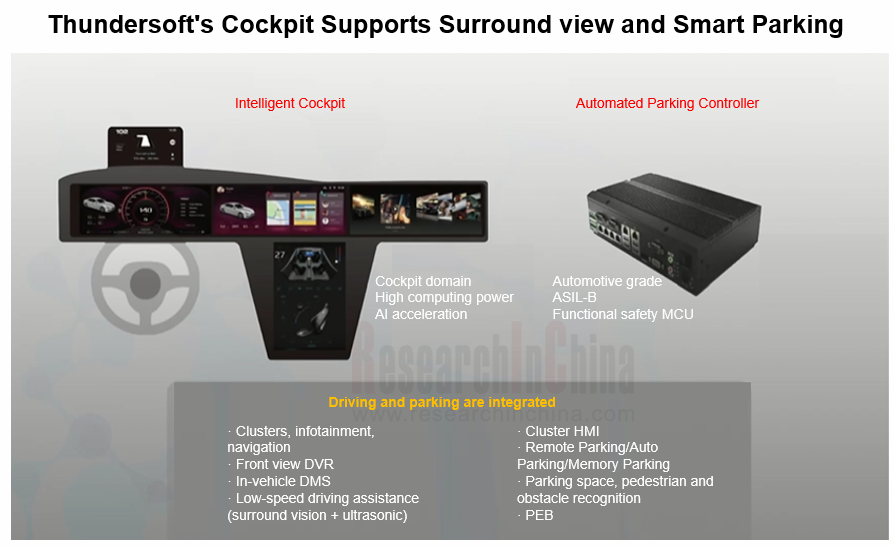
At the beginning of 2022, Thundersoft released a new Intelligent cockpit solution. Based on Qualcomm SA8295, it is a one-core multi-screen cockpit domain control solution. With high computing power and multiple cameras, it integrates low-speed assisted driving and cockpit domain to better support 360° surround view and smart parking.
In addition, Thundersoft uses Qualcomm 8795 chip to deploy cockpits and domain integration in the field of autonomous driving. Mass production is planned for 2024.
In 2021, Bosch China's first cockpit domain control product was mass-produced. At present, Bosch is actively exploring a vehicle-cockpit-driving integration platform that conforms to the central E/E architecture. The hardware will be designed in the form like a pluggable blade. Combined with a cross-domain SOA platform, a set of middleware meet the demand of both intelligent driving and intelligent cockpits to integrate information between all domains of the vehicle, allocate computing power, and promote the application of cross-domain integration.
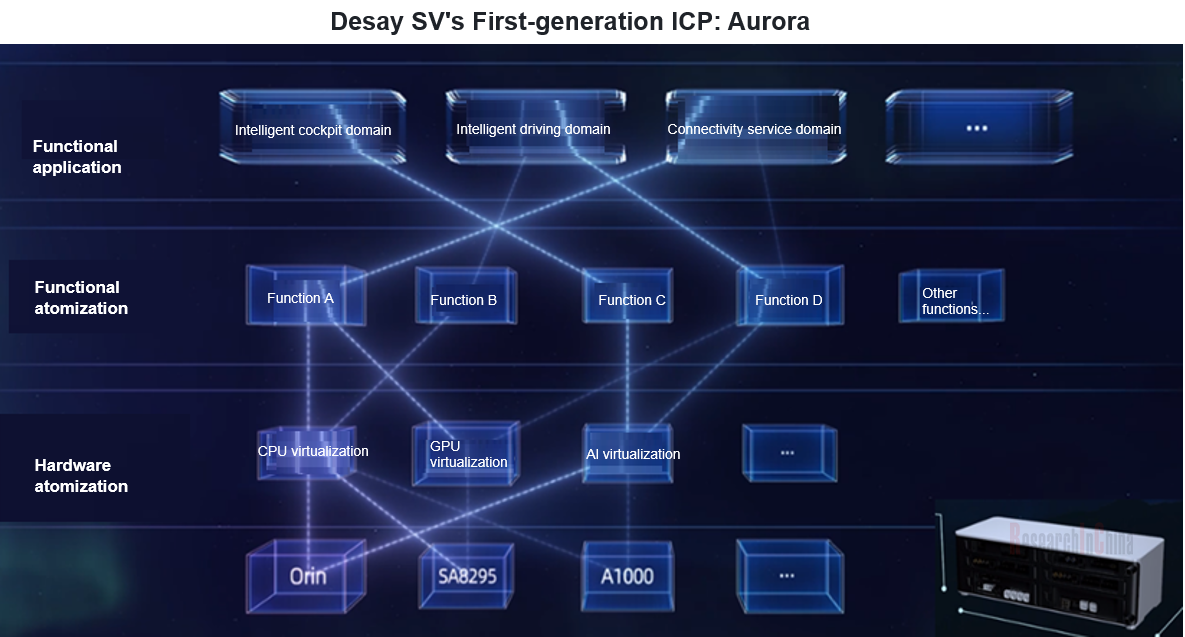
In April 2022, Desay SV released the first-generation mass-produced in-vehicle intelligent computing platform "Aurora", which integrates core functional domains such as intelligent cockpits, intelligent driving and connected services, realizes cross-domain integration from "domain control" to "central computing", and features intelligent computing, multi-domain integration, intelligent expansion (flexible configuration of "building blocks"), intelligent integration (designed for the open SOA platform), ASIL D, environmental protection and sustainability.
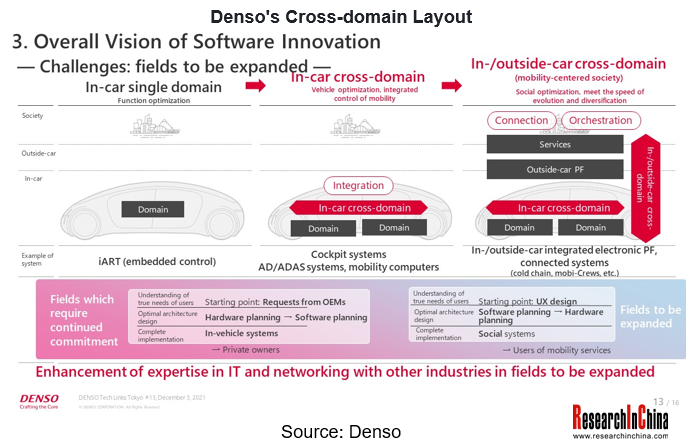
Denso is actively making breakthroughs in the fields of domains, cross-domain and even vehicle-cloud integration. In the future, its business scope will expand to the infrastructure and public sectors, and it will connect vehicles with cloud and infrastructure. In terms of cross-domain controllers, Denso will strengthen software development and cooperate with OEMs and technology companies.
Cockpit software platform: SOA and layered design
In the context of software-defined vehicles, software and hardware decoupling has become an inevitable trend on the basis of SOA. Cockpit software platforms are gradually evolving from fragmentation to modular platformization, and tending to layered design (that is, OS, middleware, basic software platform, application software platform, and application ecological services are distributed at different levels). Software technology companies have launched cockpit software platforms.
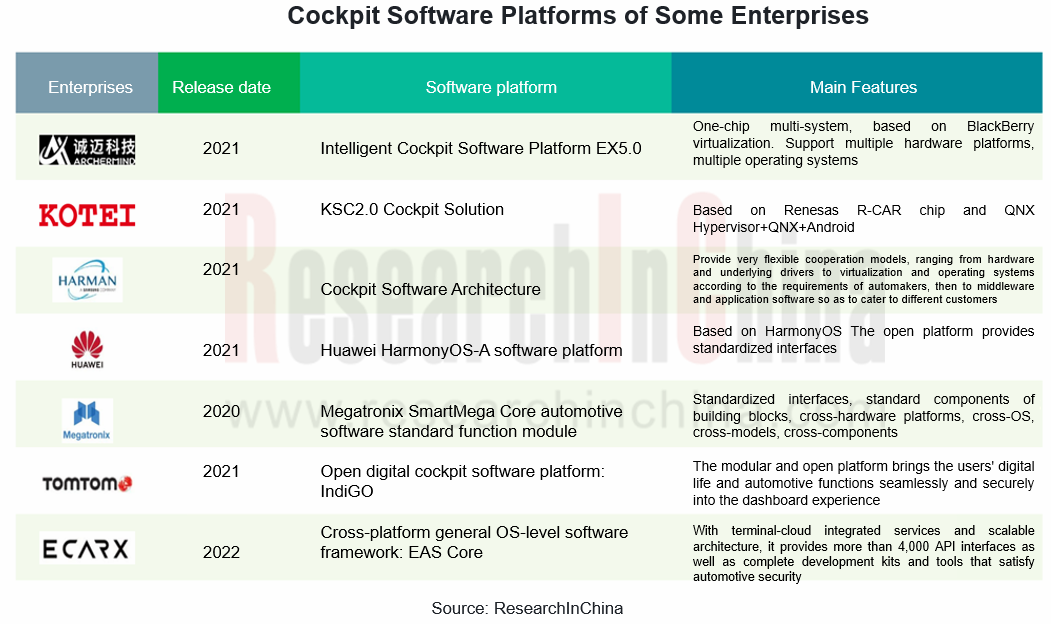
Through the standardization, modularization and reusability of software platforms, the software development cycle can be significantly reduced, and the development process can be simplified. At the same time, application software and services can be customized upon demand, allowing users to enjoy differentiated functions and experience. With the continuous evolution of EEA, software platforms are moving from single-domain to multi-domain/cross-domain and even vehicle-cloud integrated software platforms.
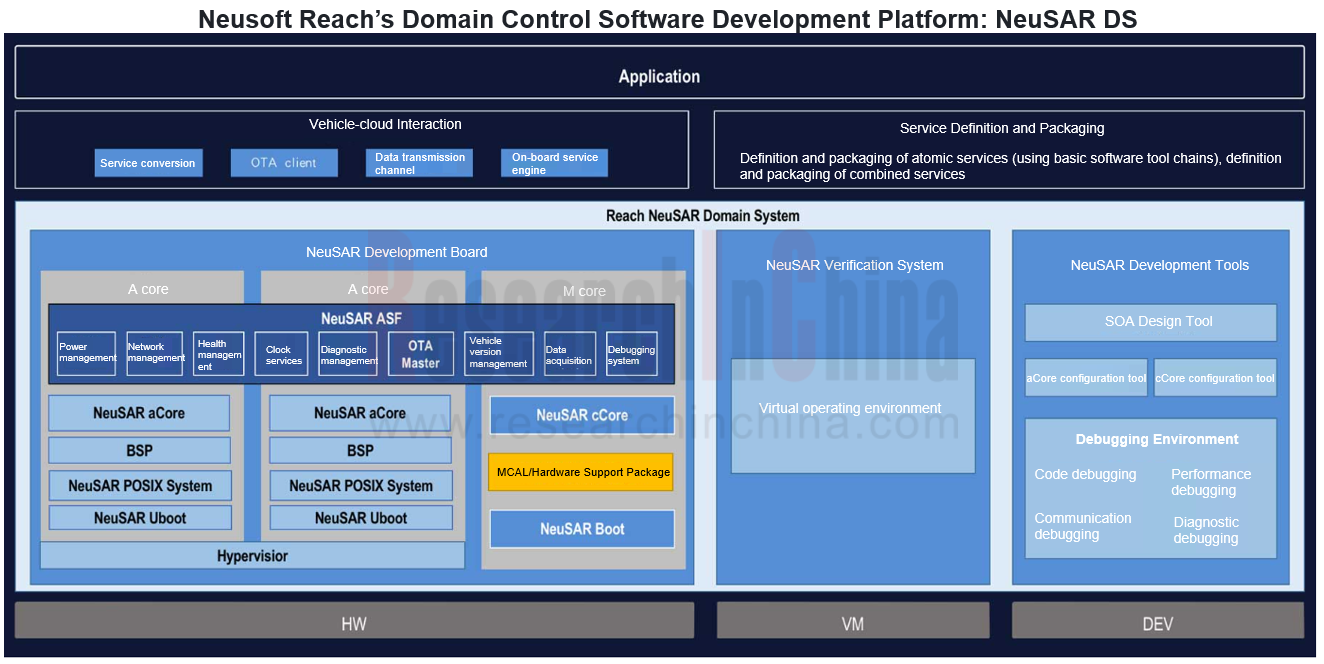
In April 2022, Neusoft Reach released the domain controller software development platform NeuSAR DS (Domain System), which can provide complete underlying software systems and virtualization on the domain controller SOC and MCU. It covers the software stack and tool chain required by the entire development process as well as engineering adaptation for typical chips, so as to realize the SOA design and development from the perspective of the whole vehicle. It allows developers to complete entire development process in a tool chain, and enables upstream and downstream development processes to be more closely coordinated.
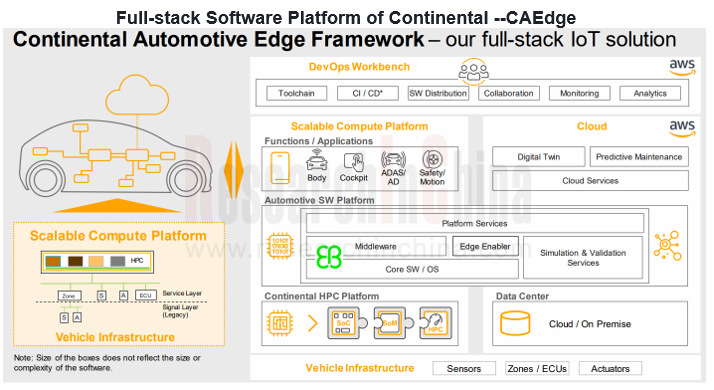
At CES 2022, Continental demonstrated how software and powerful IT infrastructure based on Continental Automotive Edge Framework enable new functions and are transforming mobility. This modular hardware and software platform connects vehicle to cloud and features numerous options to develop, supply and maintain software-intensive system functions. The platform also provides a software-intensive automotive architecture development environment for automakers and partners, greatly shortening development cycles and reducing development costs.
In 2021, ArcherMind launched the intelligent domain control Fusion SOA platform, which deeply customizes AUTOSAR protocol stack based on NXP32G (body domain) and Qualcomm 8155 (intelligent cockpit domain) to achieve cross-domain integration and global SOA services. It is compatible with QNX, Android, Linux, etc.
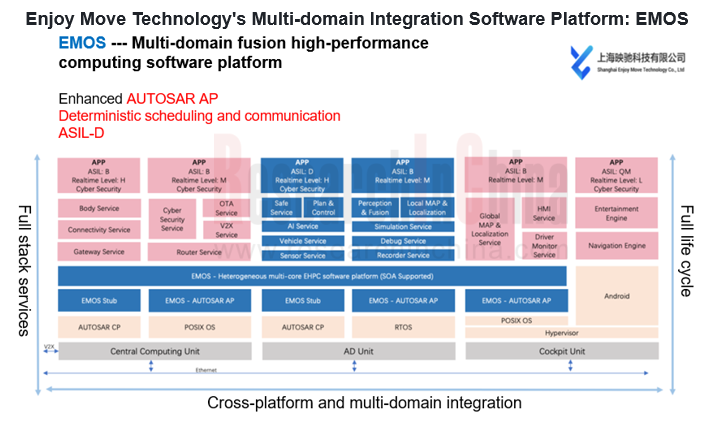
In 2021, Enjoy Move Technology mass-produced multi-domain integration software platform EMOS which integrates the enhanced AutoSAR AP (with self-developed deterministic scheduling and communication) and conventional CP. Covering the vehicle central computing unit, autonomous driving domain control and cockpit domain control (the key functional safety part), the entire architecture is oriented to SOA, and all of its modules and services are developed through a standardized model to maximize compatibility between services and other modules.
OEMs: Enhanced self-research capabilities, improved rights in cockpit development
According to the current layout, OEM cockpit system solutions are transferring from Tier 1 supplies to multi-supplier joint development and flattened cooperation. With the continuous enhancement of self-research capabilities, OEMs will have a greater right to speak in the field of customization such as cockpit system development.
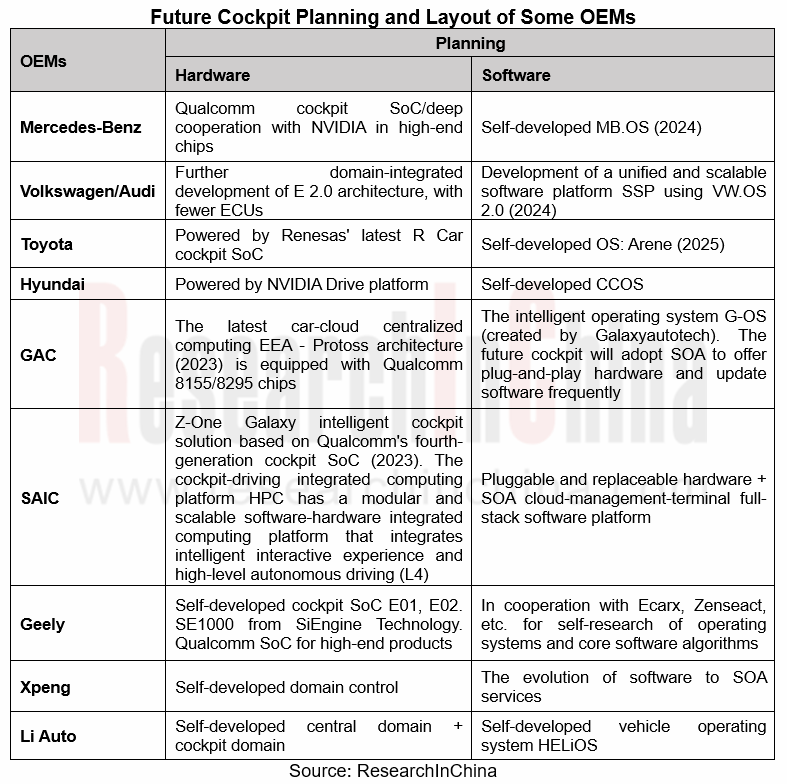
In terms of products, OEM cockpit single-domain control products have been mass-produced and installed. OEMs are vigorously deploying cross-domain integration, central computing platforms and self-developed OS/SOA platform, gradually moving towards SOA-based intelligent cars.
At the software level, OEMs have announced that they will develop automotive operating systems and basic software platforms, such as Volkswagen VW.OS, Mercedes-Benz MB.OS, Hyundai CCOS, Toyota Arene, etc.
For intelligent cockpit suppliers, flexible supply, modularization and standardized platforms will be the future focus of their layout. Bosch has pointed out that it will focus on the common functions below the middle layer in terms of software, adopt a modular approach to iterate layer by layer from the bottom up, and realize the replacement and iteration of chips and applications through software and hardware standardized interfaces.
Automotive Microcontroller Unit (MCU) and Application Scenario Research Report, 2026
Automotive MCU Research: Increased demand for redundant security drives ASIL D-compliant MCU shipments to exceed 100 million units
In a vehicle EEA, MCUs are widely distributed in various functional ...
China Intelligent Cockpit Patent Analysis Report, 2026
Intelligent Cockpit Patent Research: Cockpit AI, In?vehicle Health, and Infotainment Are Upgrade to Scenario?based and Proactive Functions
From a patent perspective, this report explores the cutting?...
Research Report on Application of VLA Large Model in Automobiles and Robots, 2026
Research on Automotive and Robot VLA: Hybrid Architectures Become Mainstream, VLA Integrates with General World Models, and Reinforcement Learning Serves as Core Engine
Vision?Language?Action (VLA) m...
China Charging Infrastructure (Supercharging, Battery Swapping, V2G, etc.) and High-Performance Supercharging Battery Research Report, 2026
Charging and battery swapping research: as 5C+ supercharging vehicle models go into mass production, the pace of OEMs self-building supercharging networks quickens
800-1000V high-voltage platforms ar...
China Passenger Car Electronic Controlled Suspension Industry Report, 2026
Electronic Controlled Suspension Industry Research: As the First Year of Full Active Suspension Unfolds, Three Technical Routes Race Forward
1. Penetration Rate Surges Three Times, and Electronic Con...
Intelligent Driving SoC Research Report, 2026
Research on Intelligent Driving SoCs: Competition Focus Shifts to L3/L4 Embedded Hardware, and Computing Power of Flagship Vehicle Models Exceeds 1,000 TOPS
In terms of intelligent driving system in...
Automotive AI Large Model Technology Research Report, 2026
Automotive AI Large Model Research: Competition Shifts from "Who Has the Stronger Model" to "Who Boasts Higher Link Efficiency"
ResearchInChina released the Automotive AI Large Model Technology Resea...
Intelligent Vehicle Cockpit Domain Controller Research Report, 2026
Cockpit domain controller research: L3 AIDV intelligent cockpit domain controllers are entering a boom period
Driven by multiple factors such as the continuous evolution of the automotive central int...
Automotive Acoustic System (Audio, Multi-Channel) Industry Report, 2026
Automotive Acoustics Research: Multiple Channels, AI Tuning, and Self-Developed Algorithms Drive the Transformation of High-End Cockpit Sound Fields
I. Automotive Audio Hardware Solutions with 6–9 S...
Autonomous Driving Sensor Chip Research Report, 2026
Research on Autonomous Driving Sensor Chips: Deeply Perceiving the Physical World, Sensor Chips Are Playing A “Leading Role” in Intelligence
In 2026, the autonomous driving sensor chip industr...
Passenger Car Corner Module and Wheel‑Side Control System Research Report, 2026
Wheel-side control research: the “last mile” chassis innovation
Wheel-side control dismantles the traditional drive, braking, steering, and suspension control of the chassis from a "centralized" styl...
Embodied Artificial Intelligence (& Humanoid Robot) MCU Research Report, 2026
Research on Humanoid Robot MCUs: Evolution from General-Purpose Control to High-Value Dedicated Chip Solutions Integrated with Edge AI Functions
MCU (Microcontroller Unit) refers to a compact integra...
Intelligent Vehicle Zone Control Unit (ZCU) Research Report, 2026
ZCU Research: Cross-domain integrated ZCUs are becoming the edge computing nodes of the next-generation zonal architecture
Currently, the mainstream zonal architecture is mainly the quasi-central + z...
Automotive Cybersecurity and Data Security Research Report, 2026
Cybersecurity & Data Security Research: Intelligent Connected Vehicles Enter the Era of “Systematic Offense-Defense and AI-Defined Security”.
Centering on the panorama of intelligent connect...
Report on Breakthrough Strategies of OEMs and ADAS Tier 1 Suppliers for Overseas Layout of Intelligent Driving, 2026
Regulatory Breakthrough, Local System Establishment, OEMs Competing for NOA Layout: Overall Trends of China’s Intelligent Driving Overseas Layout in 2026
Research on overseas intelligent driving layo...
OEMs and Tier1s’ Intelligent Cockpit Platform (Hardware and Software) Innovation Strategy Research Report, 2026
Intelligent Cockpit Platform Research: multi-dimensional cockpit system architecture reconstruction for multi-agent collaboration and proactive intelligent services
The intelligent cockpit software s...
Automotive AIOS Research Report, 2026
Automotive AIOS Research: Mass Production Solutions Are Implemented
Mass Production Solutions Are Implemented on A Small Scale.
In 2026, AIOS starts small-scale implementation, helping to improve v...
Automotive Telematics Service Provider (TSP) Research Report, 2026
TSP Research: Leading providers collectively turn to AI agents to provide all-scenario active services
Telematics Service Providers (TSPs) are the core hub of the telematics industry chain, connectin...