ResearchInChina released "Chinese Independent OEMs’ ADAS and Autonomous Driving Report, 2022". This report combs through and summarizes status quo (installations, installation rate), function application, market layout, development trends, etc. of leading conventional OEMs in China in the current ADAS and autonomous driving market.
Chinese independent brands plan implementation of L4 autonomous driving in 2024/2025
This report sorts out the autonomous driving development plans and product implementation of each company. In terms of L4 autonomous driving, they set almost the same goal: implementation in 2024/2025.
 In its strategy "Smart Geely 2025", Geely proposes commercialization of L4 autonomous driving, complete mastery of L5 autonomous driving, and realization of full-stack self-development in 2025.
GAC will release a strategic model (AH8) in 2024, which will be based on Huawei's MDC810 platform and support L4 autonomous driving.
In April 2022, HAOMO.AI, an autonomous driving subsidiary of Great Wall Motor, announced its roadmap for HPilot, an intelligent driving product for passenger cars, and the plan of launching HPilot 4.0 in 2023, a product that supports L4 autonomous driving.
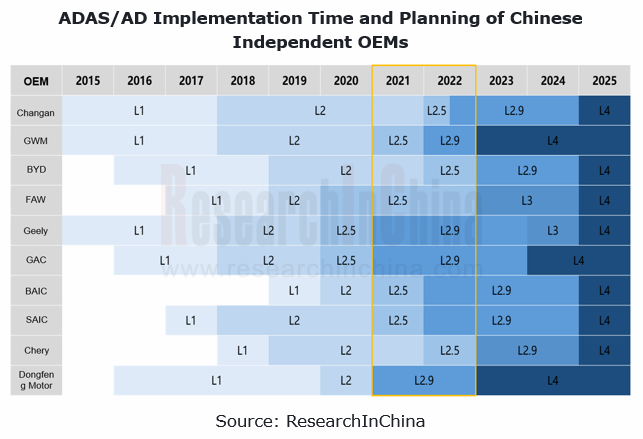
Following their progressive development strategy, Chinese independent brands have kept rolling out vehicle models with L0-L2.9 functions. In sales’ term, their performance also shines.
Chinese independent brands have been in the battle position of L2 ADAS and launch an offensive in L2.5/2.9.
ResearchInChina’s data show that Chinese independent brands had 2.489 million vehicles equipped with ADAS functions in 2021 (installation rate: 29.1%), an upsurge of 69.6% year on year; from January to April 2022, the ADAS installations sustained growth, up from 636,000 vehicles in the same period of the previous year to 887,000 units (installation rate: 33.9%). It is clear that the ADAS installation has not been hampered by negative factors such as the epidemic or chip shortage, but instead taken a big step forward.
From sub-functions, it can be seen that with the battle position in L2 ADAS, Chinese independent brands go on the offensive in L2.5/L2.9. In 2021, Chinese auto brands gradually doubled down on L2, and thus enjoyed growth in both installations and installation rate. Between January and April 2022, L2 installations soared by 118.4% on the previous year to 574,000 units, and the installation rate also reached 21.9%; the installations of L2.5 and L2.9 surged to 106,000 units, and the combined installation rate rose to 4.1%.
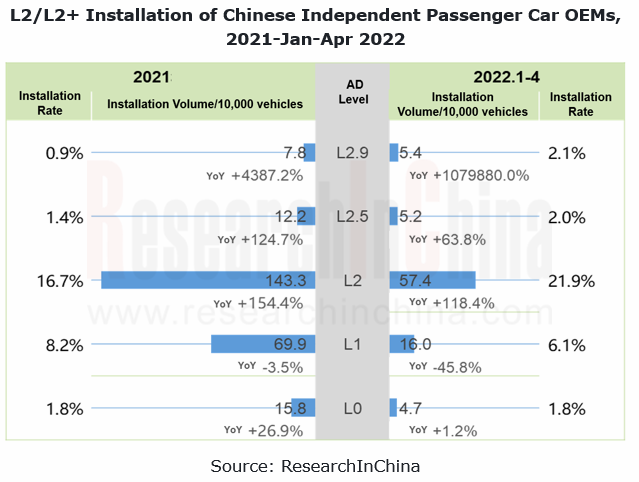
Around 2021, quite a few OEMs such as Changan, GWM and BYD added the lane change turn signal capability, plus TJA+ICA+LKA, enabling highway assist (HWA), which meant they stepped into L2.5 autonomous driving. Furthermore, the upgrade of HD maps and sensors empowers vehicles with the function of navigation guided pilot (NGP) or navigate on pilot (NOP), realizing the L2.9 autonomous driving function. Examples include WEY Mocha, Lynk & Co 01EM-F and new ARCFOXαS HI version.
BYD is way ahead in L2 ADAS market, and local suppliers follow local OEMs to rise.
As of April 2022, among all the Chinese independent competitors (including emerging carmakers), 47 and 14 brands have delivered L2 and L2.5 models to users, respectively, of which BYD, Haval and Geely were at the forefront.
Entering 2022, BYD still gains popularity in market, becoming a sought-after brand among multiple consumers. The average monthly installations of L2 in Song PLUS and Han models outnumber 10,000, helping BYD to claim the top spot on the OEMs’ ranking list by L2 installations.
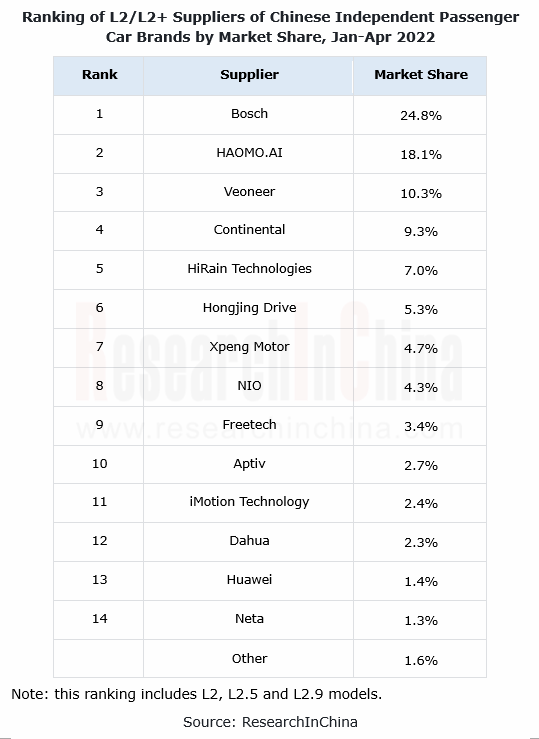
The boom of Chinese independent OEMs in the L2 passenger car market has also boosted local L2 suppliers, among which HAOMO.AI, Jingwei HiRain Technologies, Hongjing Drive and Freetech among others lead the way.
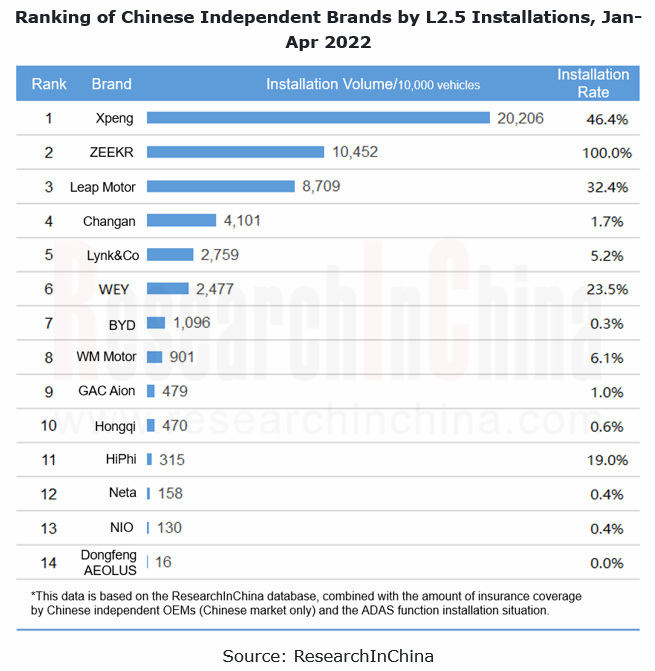
In the L2.5 camp, there are few companies, 14 in total, having actually delivered cars to users, of which 5 are conventional brands. From both installations and installation rate, it can be said that GWM WEY is an outstanding typical conventional automaker in L2.5.
Thanks to the full-stack self-development of autonomous driving algorithms of Great Wall Motor's autonomous driving subsidiary HAOMO.AI, the full range of WEY Mocha models rolled out in May 2021 carry standard L2.5 functions, gaining the lead in the industry. In addition, in April 2022 BYD introduced 2022 Han, a model equipped with highway assist (HWA) and interactive lane change assist (ILCA) systems. This model is expected to be a trump card for BYD to forge into the L2.5 market.
Research Report on Application of VLA Large Model in Automobiles and Robots, 2026
Research on Automotive and Robot VLA: Hybrid Architectures Become Mainstream, VLA Integrates with General World Models, and Reinforcement Learning Serves as Core Engine
Vision?Language?Action (VLA) m...
China Charging Infrastructure (Supercharging, Battery Swapping, V2G, etc.) and High-Performance Supercharging Battery Research Report, 2026
Charging and battery swapping research: as 5C+ supercharging vehicle models go into mass production, the pace of OEMs self-building supercharging networks quickens
800-1000V high-voltage platforms ar...
China Passenger Car Electronic Controlled Suspension Industry Report, 2026
Electronic Controlled Suspension Industry Research: As the First Year of Full Active Suspension Unfolds, Three Technical Routes Race Forward
1. Penetration Rate Surges Three Times, and Electronic Con...
Intelligent Driving SoC Research Report, 2026
Research on Intelligent Driving SoCs: Competition Focus Shifts to L3/L4 Embedded Hardware, and Computing Power of Flagship Vehicle Models Exceeds 1,000 TOPS
In terms of intelligent driving system in...
Automotive AI Large Model Technology Research Report, 2026
Automotive AI Large Model Research: Competition Shifts from "Who Has the Stronger Model" to "Who Boasts Higher Link Efficiency"
ResearchInChina released the Automotive AI Large Model Technology Resea...
Intelligent Vehicle Cockpit Domain Controller Research Report, 2026
Cockpit domain controller research: L3 AIDV intelligent cockpit domain controllers are entering a boom period
Driven by multiple factors such as the continuous evolution of the automotive central int...
Automotive Acoustic System (Audio, Multi-Channel) Industry Report, 2026
Automotive Acoustics Research: Multiple Channels, AI Tuning, and Self-Developed Algorithms Drive the Transformation of High-End Cockpit Sound Fields
I. Automotive Audio Hardware Solutions with 6–9 S...
Autonomous Driving Sensor Chip Research Report, 2026
Research on Autonomous Driving Sensor Chips: Deeply Perceiving the Physical World, Sensor Chips Are Playing A “Leading Role” in Intelligence
In 2026, the autonomous driving sensor chip industr...
Passenger Car Corner Module and Wheel‑Side Control System Research Report, 2026
Wheel-side control research: the “last mile” chassis innovation
Wheel-side control dismantles the traditional drive, braking, steering, and suspension control of the chassis from a "centralized" styl...
Embodied Artificial Intelligence (& Humanoid Robot) MCU Research Report, 2026
Research on Humanoid Robot MCUs: Evolution from General-Purpose Control to High-Value Dedicated Chip Solutions Integrated with Edge AI Functions
MCU (Microcontroller Unit) refers to a compact integra...
Intelligent Vehicle Zone Control Unit (ZCU) Research Report, 2026
ZCU Research: Cross-domain integrated ZCUs are becoming the edge computing nodes of the next-generation zonal architecture
Currently, the mainstream zonal architecture is mainly the quasi-central + z...
Automotive Cybersecurity and Data Security Research Report, 2026
Cybersecurity & Data Security Research: Intelligent Connected Vehicles Enter the Era of “Systematic Offense-Defense and AI-Defined Security”.
Centering on the panorama of intelligent connect...
Report on Breakthrough Strategies of OEMs and ADAS Tier 1 Suppliers for Overseas Layout of Intelligent Driving, 2026
Regulatory Breakthrough, Local System Establishment, OEMs Competing for NOA Layout: Overall Trends of China’s Intelligent Driving Overseas Layout in 2026
Research on overseas intelligent driving layo...
OEMs and Tier1s’ Intelligent Cockpit Platform (Hardware and Software) Innovation Strategy Research Report, 2026
Intelligent Cockpit Platform Research: multi-dimensional cockpit system architecture reconstruction for multi-agent collaboration and proactive intelligent services
The intelligent cockpit software s...
Automotive AIOS Research Report, 2026
Automotive AIOS Research: Mass Production Solutions Are Implemented
Mass Production Solutions Are Implemented on A Small Scale.
In 2026, AIOS starts small-scale implementation, helping to improve v...
Automotive Telematics Service Provider (TSP) Research Report, 2026
TSP Research: Leading providers collectively turn to AI agents to provide all-scenario active services
Telematics Service Providers (TSPs) are the core hub of the telematics industry chain, connectin...
Automotive Smart Interior Research Report, 2026
Smart Interior Research: As Technologies like Interactive Starlight Headliner, Hidden Display and Surface Projection Are Launched, Automotive Interiors Become Ever More Intelligent
The Automotive Sma...
Research Report on AI Applications in Cockpits, 2026
AI Application in Cockpits: AI Services Become More Comprehensive, Convenient, and Refined.
In the first half of 2026, cockpit AI functions underwent initial upgrades across multiple dimensions, inc...