China Passenger Car Brake-by-Wire and AEB Market Research Report, 2022
-
July 2022
- Hard Copy
- USD
$4,200
-
- Pages:301
- Single User License
(PDF Unprintable)
- USD
$4,000
-
- Code:
SY002
- Enterprise-wide License
(PDF Printable & Editable)
- USD
$6,000
-
- Hard Copy + Single User License
- USD
$4,400
-
Brake-by-wire research: with an astonishing growth in installation rate, One-Box has commanded much more of the market.
In new energy vehicles, especially intelligent vehicles, the bake-by-wire technology plays an irreplaceable, important role in regardless of intelligent driving systems or various control systems. Brake-by-wire system that replaces vacuum booster with electronic booster is a solution to the lack of stable vacuum sources in new energy vehicles, and is capable of recovering energy, a crucial function to increase the cruising range of new energy vehicles. As autonomous driving technologies gain ever greater popularity, brake-by-wire becomes more superior in quick response and precise execution, and is serving as a key factor to facilitate electrified and intelligent upgrades of vehicles.
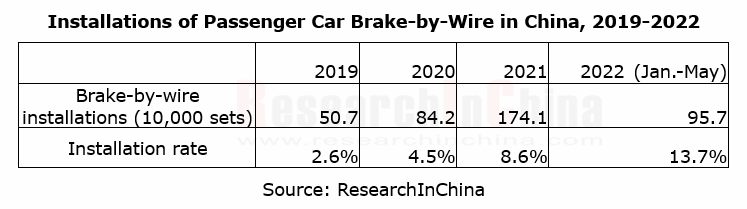
In current stage, brake-by-wire is still in its infancy, still with a low overall penetration. Yet the installation rate of brake-by-wire in new energy vehicles is relatively high. According to our statistics, the installation rate of brake-by-wire in passenger cars in China reached 8.6% in 2021 compared with 2.6% in 2019. The soaring EV sales in China drove the installation rate of brake-by-wire to 13.7% in the first five months of 2022.
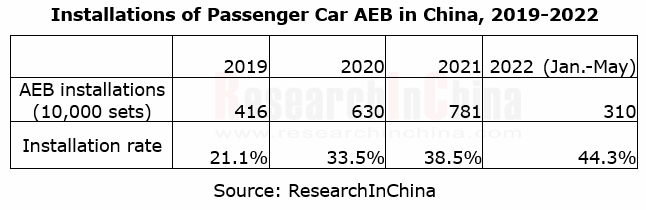
As well as brake-by-wire, AEB and AUTOHOLD, the other two functions related to Braking System, also boasted surging installation rates. In the first five months of 2022, the penetration rate of AEB in China's passenger car market reached up to 44.3%.
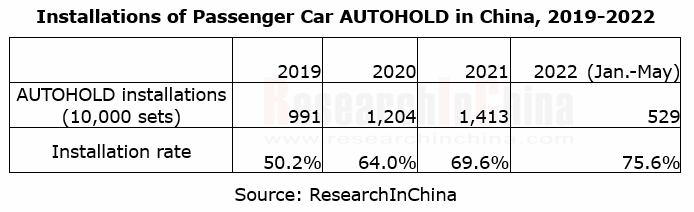
In the first five months of 2022, the penetration rate of AUTOHOLD in China's passenger car market hit 75.6%.
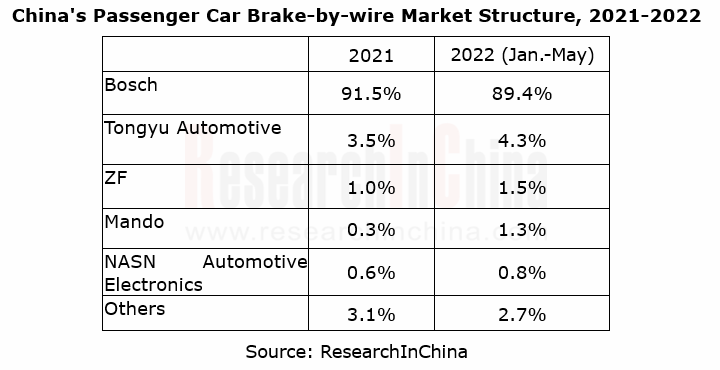
Bosch takes a lion’s share, and Chinese suppliers are expanding their shares.
Our statistics shows that Bosch swept 91.5% of China’s passenger car brake-by-wire market in 2021, a figure edging down to 89.4% in the first five months of 2022. The market shares of Tongyu Automotive, ZF, Mando and NASN Automotive Electronics all rose.
Two-Box still prevails in the brake-by-wire market, and One-Box gathers pace.
The Two-Box solution with independent electronic booster and ESP/ABS features lower integration and higher price. In the One-Box solution, the integration of electronic booster and ESP/ABS leads to high complexity and potential safety hazards, so an RBU (Redundant Brake Unit) needs to be added to meet the redundancy requirements.
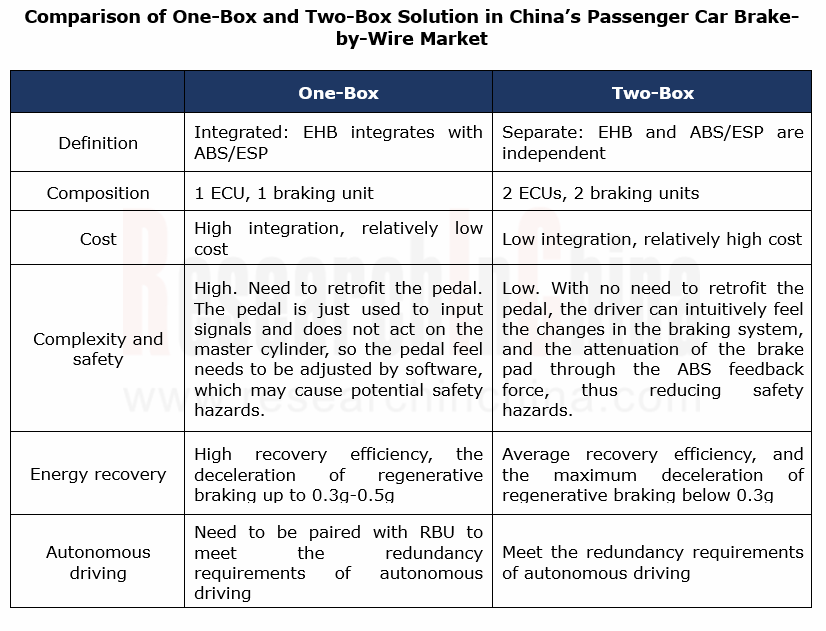
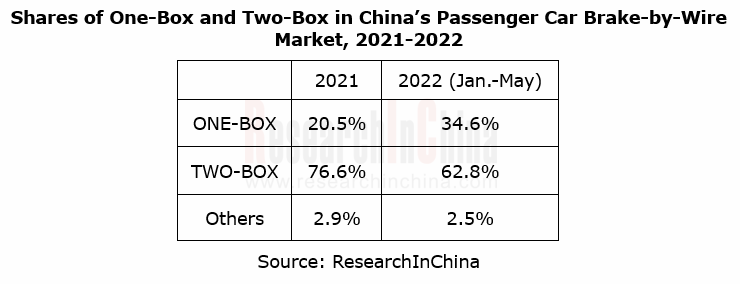
Our data indicate that Two-Box is still a mainstay in the brake-by-wire market, but its market share fell from 76.6% in 2021 to 62.8% in the first five months of 2022, while the share of One-Box jumped from 20.5% to 34.6%.
1 Overview of Automotive Brake Industry
1.1 Overview of Automotive Brake Industry
1.1.1 Preface
1.1.2 Definition of Automotive Braking System
1.1.3 Classification of Automotive Braking Systems
1.1.4 Conventional Automotive Braking System Products: Drum Brake
1.1.5 Conventional Automotive Braking System Products: Disc Brakes
1.1.6 Conventional Automotive Braking System Products: Vacuum Booster
1.1.7 Conventional Automotive Braking System Products: Brake Master Cylinder & Wheel Cylinder
1.1.8 Conventional Automotive Braking System Products: Parking Brake
1.1.9 Conventional Automotive Braking System Products: AutoHold
1.1.10 Conventional Automotive Braking System Products: ABS
1.1.11 Conventional Automotive Braking System Products: EPB
1.1.12 Conventional Automotive Braking System Products: Relationship between EPB and AutoHold
1.1.13 Conventional Automotive Braking System Products: ESC
1.1.14 Development Directions of Automotive Braking System
1.2 Automotive Brake-by-wire System
1.2.1 Automotive Brake-by-wire System
1.2.2 Automotive Brake-by-wire System: EHB
1.2.3 Automotive Brake-by-wire System: Two Technology Routes of EHB
1.2.4 Automotive Brake-by-wire System: EMB
1.2.5 Automotive Brake-by-wire System: Status Quo and Development Trends of EMB
1.2.6 Automotive Brake-by-wire System: Horizontal Comparison between EMB and EHB
1.2.7 Automotive Brake-by-wire System: Global Tier 1 Suppliers
1.2.8 Automotive Brake-by-wire System: Chinese Independent Tier 1 Suppliers
1.3 Installation of Passenger Car AUTOHOLD
1.3.1 Installations and Installation Rate of Passenger Car AUTOHOLD, 2019-2025E
1.3.2 TOP15 Brands by Passenger Car AUTOHOLD Installations and Their Installation Rates, 2021/2022
1.3.3 TOP30 Vehicle Models by Passenger Car AUTOHOLD Installations, 2021/2022
1.3.4 Installations and Installation Rate of Passenger Car AUTOHOLD (by China-made/Joint Venture), 2021/2022
1.3.5 Installations and Installation Rate of Passenger Car AUTOHOLD (by Price Range), 2021/2022
1.4 Installation of Passenger Car AEB
1.4.1 Installations and Installation Rate of Passenger Car AEB, 2019-2025E
1.4.2 TOP15 Brands by Passenger Car AEB Installations and Their Installation Rates, 2021/2022
1.4.3 TOP30 Vehicle Models by Passenger Car AEB Installations, 2021/2022
1.4.4 Installations and Installation Rate of Passenger Car AEB (by Price Range), 2019-2022
1.4.5 Installations and Installation Rate of Passenger Car AEB (by China-made/Joint Venture), 2019-2022
1.5 Installation of Passenger Car Brake-by-wire System
1.5.1 Installations and Installation Rate of Passenger Car Brake-by-wire Systems, 2019-2025E
1.5.2 TOP10 Brands by Passenger Car Brake-by-wire System Installations and Their Installation Rates, 2021/2022
1.5.3 TOP15 Vehicle Models by Passenger Car Brake-by-wire System Installations, 2021/2022
1.5.4 Installations and Installation Rate of Passenger Car Brake-by-wire Systems (by China-made/Joint Venture), 2019-2022
1.5.5 Installations and Installation Rate of Passenger Car Brake-by-wire Systems (by Price Range), 2019-2022
1.5.6 Ranking of Passenger Car Brake-by-Wire Suppliers by Market Share, 2021-2022
2 Foreign Passenger Car Braking System Suppliers
2.1 Continental
2.1.1 Layout in China
2.1.2 Development Trend of Continental Automotive Braking Systems Has Changed
2.1.3 Development History of Braking System
2.1.4 MK C1 Targets Highly Automated Driving
2.1.5 MK C2 Leads the Innovation of Future Automotive Architecture Braking Systems
2.1.6 MK C2 Integrated Brake-by-wire System
2.1.7 Technical Highlights of MK C2 Integrated Brake-by-wire System
2.1.8 MK Cx HAD Redundant Brake-by-Wire System
2.1.9 MK C2 Integrated Brake-by-Wire System Products
2.1.10 DIAS Automotive Electronic Systems and Continental Jointly Promoted Implementation of Two-Box
2.1.11 Production & R&D Layout in the Capacity of 1 Million Sets of MK C2
2.1.12 Application of Brake Products
2.1.13 Future Planning and Layout in Braking System
2.2 Robert Bosch
2.2.1 Layout in China
2.2.2 Development History of Automotive Braking System
2.2.3 Classification of Braking Systems
2.2.4 The Latest Antilock Braking System (ABS): Version 9.2
2.2.5 The Latest ESP System: Version 9.3
2.2.6 Application of ABS Integrating with ESP, ADAS, etc.
2.2.7 iBooster System
2.2.7 iBooster System Technology Route
2.2.8 iBooster + ESP
2.2.9 iBooster IPB
2.2.10 Production & R&D Layout in Braking System
2.2.11 Main Customers and Application Vehicle Models of iBooster System Products
2.2.12 Mass Production and Application of Braking System Products
2.2.13 Future Planning and Layout in Automotive Braking System
2.3 ZF
2.3.1 Layout in China
2.3.2 Development History of Automotive Braking System
2.3.3 New Automotive Braking System: EBB
2.3.4 Integrated Brake Control System (IBC)
2.3.5 2nd-generation Brake-by-wire System
2.3.6 Automotive Braking System Products
2.3.7 Production & R&D Layout in Braking System
2.3.8 Main Customers and Application Vehicle Models of Braking System Products
2.3.9 Mass Production and Application of Braking System Products
2.3.10 Future Planning and Layout in Automotive Braking System
2.4 Hitachi Astemo
2.4.1 Layout in China
2.4.2 Development History of Automotive Braking System
2.4.3 Automotive Braking System Products
2.4.4 E-ACT
2.4.5 Automotive Parking Brake System: APB
2.4.6 Automotive Parking Brake Systems and Products
2.4.7 Production & R&D Layout in Braking System
2.4.8 Main Customers and Application Vehicle Models of Braking System Products
2.4.9 Mass Production and Application of Braking System Products
2.4.10 Future Planning and Layout in Automotive Braking System
2.5 Brembo
2.5.1 Layout in China
2.5.2 Development History of Braking System
2.5.3 Automotive Braking System Products
2.5.4 GREENTIVE Brake Disc
2.5.5 Enesys Energy Saving System
2.5.6 Brake-by-Wire Solutions
2.5.7 Production & R&D Layout in Braking System
2.5.8 Mass Production and Application of Braking System Products
2.5.9 Future Planning and Layout in Automotive Braking System
2.6 ADVICS
2.6.1 Layout in China
2.6.2 Development History of Braking System
2.6.3 Braking System Products
2.6.4 Electronically Controlled Brake System: ECB2
2.6.5 Brake Assist (BA) System and Regenerative Coordinated Brake System
2.6.6 Braking Systems: ADS-A2 & ADS-V2G
2.6.7 Production & R&D Layout in Braking System
2.6.8 Mass Production and Application of Braking System Products
2.6.9 Future Planning and Layout in Automotive Braking System
2.7 Mando
2.7.1 Layout in China
2.7.2 Development History of Braking System
2.7.3 Automotive Braking System Products
2.7.4 AHB III & IDB
2.7.5 MGH-100
2.7.6 IDB2 HAD
2.7.7 Production & R&D Layout in Braking System
2.7.8 Mass Production and Application of Brake Products
2.7.9 Future Planning and Layout in Automotive Braking System
3 Chinese Passenger Car Braking System Suppliers
3.1 GLOBAL Technology
3.1.1 Profile
3.1.2 Development History
3.1.3 Braking System Product: GIBS
3.1.4 Integrated Brake-by-wire System: GIBC
3.1.5 Important Redundant Braking System: EPB
3.1.6 Important Chassis Domain Controllers
3.1.7 Comparison between Two-box and One-box
3.1.8 Brake Control System Products
3.1.9 Production & R&D Layout in Braking System
3.1.10 Capital Support
3.1.11 Application and Customers of Braking System Products
3.1.12 Future Planning and Layout in Automotive Braking System
3.2 Trinova Technology
3.2.1 Profile
3.2.2 Development History
3.2.3 Passenger Car Brake-by-wire System
3.2.4 T-IBC & T-EPB & TBS
3.2.5 ABS & ESC/EPBi & Sensor
3.2.6 Production & R&D Layout in Automotive Braking System
3.2.7 Capital Support
3.2.8 Applications and Customers of Automotive Braking System Products
3.2.9 Future Planning and Layout in Automotive Braking System
3.3 Tongyu Technology
3.3.1 Profile
3.3.2 Development History of Automotive Braking System
3.3.3 Automotive Electronic Hydraulic Brake-by-wire System: EHB
3.3.4 Automotive Autonomous Emergency Braking System (AEB)
3.3.5 Automotive Braking System Products
3.3.6 Production & R&D Layout in Automotive Braking System
3.3.7 Capital Support
3.3.8 Applications and Customers of Automotive Braking System Products
3.3.9 Future Planning and Layout in Automotive Braking System
3.4 NASN Automotive Electronics
3.4.1 Profile
3.4.2 Development History of Automotive Braking System
3.4.3 NBooster Intelligent Braking System
3.4.4 Electronic Stability Control System (ESC)
3.4.5 Chassis Domain Controller: NXU
3.4.6 NBooster+ESC Redundant Brake-by-Wire Solution
3.4.7 Production & R&D Layout in Automotive Braking System
3.4.8 Capital Support
3.4.9 Application and Customers of Automotive Braking System Products
3.4.10 Future Planning and Layout in Automotive Braking System
3.5 KUNTYE Vehicle System
3.5.1 Profile
3.5.2 Development History of Automotive Braking System
3.5.3 Automotive Braking System Products
3.5.4 EBOOSTER
3.5.5 EPB CALiper
3.5.6 Automotive Brake Corner Modules
3.5.7 Production & R&D Layout in Automotive Braking System
3.5.8 Application and Customers of Automotive Braking System Products
3.5.9 Future Planning and Layout in Automotive Braking System
3.6 Zhejiang Asia-Pacific Mechanical & Electronic
3.6.1 Profile
3.6.2 Development History
3.6.3 Production Layout
3.6.4 Operation
3.6.5 Presiding over Formulation of Industry Standards
3.6.6 Main Products - Transmission and Brake Products
3.6.6 Main Braking System Products
3.6.7 Relationship between Products and Core Customers
3.6.8 Brake-by-Wire Layout
3.7 Zhejiang VIE Science & Technology
3.7.1 Profile
3.7.2 Development History
3.7.3 Strategic Layout and Production and R&D Bases
3.7.4 Operation and Operating Revenue
3.7.5 Main Braking System Products
3.8 Bethel Automotive Safety Systems
3.8.1 Profile
3.8.2 Development History
3.8.3 Production and R&D Bases
3.8.4 Main Braking System Products
3.8.5 WCBS & EPB & ESC
3.8.6 Production and R&D Layout in Braking System
3.8.7 Future Planning and Layout in Braking System
3.9 Wanxiang Qianchao
3.9.1 Profile
3.9.2 Conventional Braking System Products
3.9.3 Electronic Brake Booster (QBooster) for Braking System
3.9.4 Production & R&D Layout in Braking System
3.9.5 Future Planning and Layout in Automotive Braking System
3.10 Tuopu Group
3.10.1 Profile
3.10.2 Development History
3.10.3 Automotive Braking System Products
3.10.4 Intelligent Braking System: IBS-PRO
3.10.5 Production & R&D Layout in Automotive Braking System
3.10.6 Future Planning and Layout in Automotive Braking System
3.11 Nanjing JWD Automotive Technology
3.11.1 Profile
3.11.2 Development History
3.11.3 Production & R&D Layout
3.11.4 iCAS-Brake
3.11.5 ICAS-AEB
3.11.7 Capital Support
3.11.8 Future Planning and Layout in Braking System
3.12 Shanghai Huizhong Automobile Manufacturing
3.12.1 Profile
3.12.2 Development History
3.12.3 Production & R&D Layout
3.12.4 Distribution of Braking System Customers
3.12.5 Future Planning and Layout in Braking System
4 Automotive Braking System Layout of Passenger Car OEMs
4.1 Braking Systems of Geely
4.1.1 Braking System, AEB and Collision Avoidance System of Main Vehicle Models
4.1.2 Four Collision Avoidance Modes of Typical Vehicle Models
4.1.3 Cooperation, Layout and Planning in Braking System
4.2 Braking Systems of BYD
4.2.1 Braking Systems of Main Vehicle Models
4.2.2 Active Safety System of Typical Model Han
4.2.3 Cooperation, Layout and Planning in Braking System
4.3 Braking Systems of Great Wall Motor
4.3.1 Braking Systems of Main Vehicle Models
4.3.2 Active Safety Systems of Typical Vehicle Models
4.3.3 Cooperation, Layout and Planning in Braking System
4.4 Braking Systems of Changan Automobile
4.4.1 Braking Systems of Main Vehicle Models
4.4.2 Active Safety System of Typical Model UNI-V
4.4.3 Cooperation, Layout and Planning in Braking System
4.5 Braking Systems of SAIC Motor Passenger Vehicle
4.5.1 Braking Systems of Main Vehicle Models
4.5.2 Active Safety System of Typical Model Roewe RX
4.5.3 Cooperation, Layout and Planning in Braking System
4.6 Braking Systems of Chery
4.6.1 Braking Systems of Main Vehicle Models
4.6.2 Active Safety System of Typical Model Tiggo 8
4.6.3 Cooperation, Layout and Planning in Braking System
4.7 Braking Systems of FAW Hongqi
4.7.1 Braking Systems of Main Vehicle Models
4.7.2 Collision Mitigation Systems of Typical Vehicle Models
4.7.3 Cooperation, Layout and Planning in Braking System
4.8 Braking Systems of Voyah
4.8.1 Braking Systems of Main Vehicle Models
4.8.2 Active Safety System of Typical Model FREE
4.8.3 Cooperation, Layout and Planning in Braking System
4.9 Braking Systems of NIO
4.9.1 Braking Systems of Main Vehicle Models
4.9.2 Active Safety Configuration of Typical Model ES8
4.9.3 Cooperation, Layout and Planning in Braking System
4.10 Braking Systems of Xpeng Motors
4.10.1 Braking Systems of Main Vehicle Models
4.10.2 Intelligent Driving Assistance System of Typical Model P7
4.10.3 Cooperation, Layout and Planning in Braking System
4.11 Braking Systems of Li Auto
4.11.1 Braking Systems of Main Vehicle Models
4.11.2 Full-stack Self-developed AEB of Typical Model L9
4.11.3 Cooperation, Layout and Planning in Braking System
4.12 Braking Systems of Leapmotor
4.12.1 Braking Systems of Main Vehicle Models
4.12.2 FCW and AEB of Typical Vehicle Models
4.12.3 Cooperation, Layout and Planning in Braking System
4.13 Braking Systems of HiPhi
4.13.1 Braking Systems of Main Vehicle Models
4.13.2 Active Safety Systems of Vehicle Models
4.13.3 Cooperation, Layout and Planning in Braking System
4.14 Braking Systems of Tesla
4.14.1 Braking Systems of Main Vehicle Models
4.14.2 Active Safety Systems of Typical Vehicle Models
4.14.3 Cooperation, Layout and Planning in Braking System
5. Passenger Car Braking Industry Development Trend
5.1 Automotive “Electrification, Intelligence, Lightweight, and Connectivity” Promote the Development of Brake-by-wire
5.2 Brake-by-wire System (EHB) Layout of Mainstream Passenger Car OEMs in China
5.3 Automotive Brake-by-wire System: Development Trends
5.4 Trend 1
5.5 Trend 2
5.6 Trend 3
5.7 Trend 4
5.8 Trend 5
5.9 Trend 6
5.10 Trend 7
5.11 Trend 8
5.12 Trend 9
5.13 Trend 10
5.14 Trend 11
Vehicle-Road-Cloud Integration and C-V2X Industry Report, 2026
Vehicle-Road-Cloud and C-V2X Research: with the three-tier promotion system of "top-level planning + mandatory pilot + evaluation binding", the industry turning point is approachingThis report focuses...
China OEM Data Capability Analysis Report, 2026
OEM Data Capability Research: 24 OEMs × 9 Capability Domains, Who Takes the Lead?
An L4 autonomous driving R&D and test vehicle can generate approximately 10TB of raw data per single day — data v...
Autonomous Driving Domain Controller and Central Computing Unit (CCU) Industry Report, 2026
Autonomous Driving Domain Controller (ADCU) Research: One-Chip CCU solutions are quickly available in vehicles
In China's passenger car market, autonomous driving systems involved in mass production ...
Automotive EMS and ECU Industry Research Report, 2026
Automotive EMS Research: The boundaries between EMS providers and Tier1 suppliers are becoming blurred, and the supply chain model is evolving from a linear chain to a networked structure
Mainstream ...
Automotive Microcontroller Unit (MCU) and Application Scenario Research Report, 2026
Automotive MCU Research: Increased demand for redundant security drives ASIL D-compliant MCU shipments to exceed 100 million units
In a vehicle EEA, MCUs are widely distributed in various functional ...
China Intelligent Cockpit Patent Analysis Report, 2026
Intelligent Cockpit Patent Research: Cockpit AI, In?vehicle Health, and Infotainment Are Upgrade to Scenario?based and Proactive Functions
From a patent perspective, this report explores the cutting?...
Research Report on Application of VLA Large Model in Automobiles and Robots, 2026
Research on Automotive and Robot VLA: Hybrid Architectures Become Mainstream, VLA Integrates with General World Models, and Reinforcement Learning Serves as Core Engine
Vision?Language?Action (VLA) m...
China Charging Infrastructure (Supercharging, Battery Swapping, V2G, etc.) and High-Performance Supercharging Battery Research Report, 2026
Charging and battery swapping research: as 5C+ supercharging vehicle models go into mass production, the pace of OEMs self-building supercharging networks quickens
800-1000V high-voltage platforms ar...
China Passenger Car Electronic Controlled Suspension Industry Report, 2026
Electronic Controlled Suspension Industry Research: As the First Year of Full Active Suspension Unfolds, Three Technical Routes Race Forward
1. Penetration Rate Surges Three Times, and Electronic Con...
Intelligent Driving SoC Research Report, 2026
Research on Intelligent Driving SoCs: Competition Focus Shifts to L3/L4 Embedded Hardware, and Computing Power of Flagship Vehicle Models Exceeds 1,000 TOPS
In terms of intelligent driving system in...
Automotive AI Large Model Technology Research Report, 2026
Automotive AI Large Model Research: Competition Shifts from "Who Has the Stronger Model" to "Who Boasts Higher Link Efficiency"
ResearchInChina released the Automotive AI Large Model Technology Resea...
Intelligent Vehicle Cockpit Domain Controller Research Report, 2026
Cockpit domain controller research: L3 AIDV intelligent cockpit domain controllers are entering a boom period
Driven by multiple factors such as the continuous evolution of the automotive central int...
Automotive Acoustic System (Audio, Multi-Channel) Industry Report, 2026
Automotive Acoustics Research: Multiple Channels, AI Tuning, and Self-Developed Algorithms Drive the Transformation of High-End Cockpit Sound Fields
I. Automotive Audio Hardware Solutions with 6–9 S...
Autonomous Driving Sensor Chip Research Report, 2026
Research on Autonomous Driving Sensor Chips: Deeply Perceiving the Physical World, Sensor Chips Are Playing A “Leading Role” in Intelligence
In 2026, the autonomous driving sensor chip industr...
Passenger Car Corner Module and Wheel‑Side Control System Research Report, 2026
Wheel-side control research: the “last mile” chassis innovation
Wheel-side control dismantles the traditional drive, braking, steering, and suspension control of the chassis from a "centralized" styl...
Embodied Artificial Intelligence (& Humanoid Robot) MCU Research Report, 2026
Research on Humanoid Robot MCUs: Evolution from General-Purpose Control to High-Value Dedicated Chip Solutions Integrated with Edge AI Functions
MCU (Microcontroller Unit) refers to a compact integra...
Intelligent Vehicle Zone Control Unit (ZCU) Research Report, 2026
ZCU Research: Cross-domain integrated ZCUs are becoming the edge computing nodes of the next-generation zonal architecture
Currently, the mainstream zonal architecture is mainly the quasi-central + z...
Automotive Cybersecurity and Data Security Research Report, 2026
Cybersecurity & Data Security Research: Intelligent Connected Vehicles Enter the Era of “Systematic Offense-Defense and AI-Defined Security”.
Centering on the panorama of intelligent connect...