China Automotive Integrated Die Casting Industry Research Report, 2022
Integrated Die Casting Research: Upstream, midstream and downstream companies are making plans and layouts in this booming field
Automotive integrated die casting is an automotive manufacturing process proposed and put into practice by Tesla. It redesigns and highly integrates multiple separate and scattered small parts in the original design, then uses a large die casting machine to perform high-pressure die casting at one time, and directly produces a complete large part without the welding process. Compared with traditional automotive manufacturing, automotive integrated die casting has advantages in manufacturing cost, production efficiency, labor cost, model development cycle, performance, materials recycling, etc.
Against the traditional concept that product and process design hinges on the existing conditions and capabilities, Tesla prefers reverse thinking. Taking automotive integrated die-casting as an example, Tesla determines how large the part can be to achieve the best effect, then deduces how much equipment, tooling and materials are needed. Afterwards, it cooperates with suppliers to develop new equipment, corresponding molds, materials and new processes. This kind of thinking has greatly inspired the innovation of the traditional industry and brought upheaval and the secondary innovation to the industry.
OEMs master the know-how of integrated die casting through independent research and development
After Tesla Model Y adopted the integrated die casting process for the first time, a new wave of integrated die casting has staged worldwide. A complete industrial chain layout has been formed between upstream die casting machine manufacturers, material manufacturers and mold manufacturers, as well as midstream die-casting companies and downstream automakers.
There are currently two main business modes:
 Independent research and development of OEMs: OEMs: directly purchase die casting machines, molds and materials, and then build their own factories to produce die casting parts. Tesla, Xpeng and Volvo adopt this mode.
Procurement: OEMs directly purchase die casting parts from die-casting manufacturers who buy relevant materials to produce die casting parts and deliver them to OEMs. HiPhi, NIO and Li Auto follow this mode.
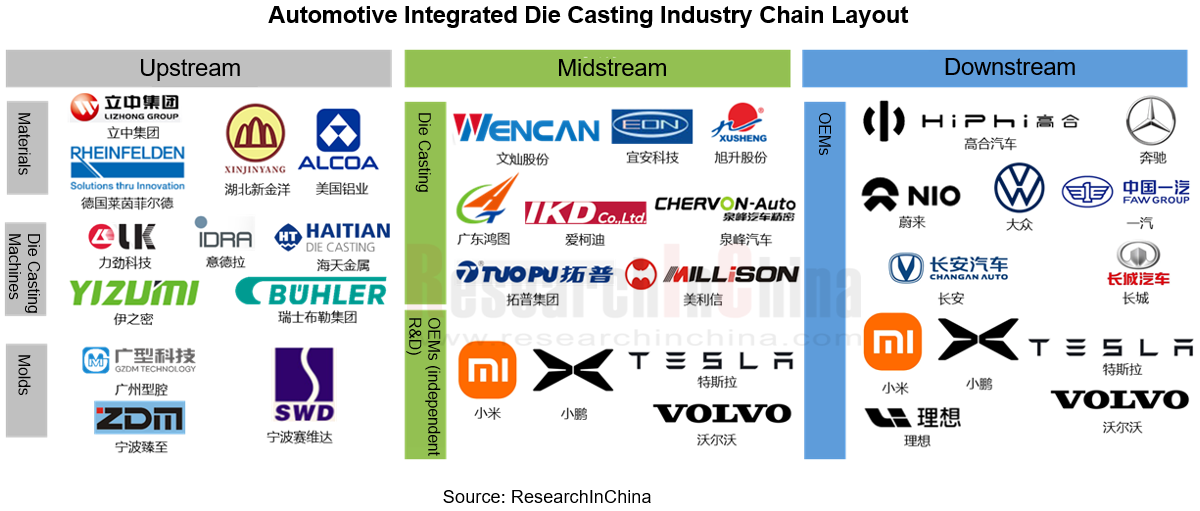
In the long run, automotive integrated die casting will gradually return to the procurement mode. OEMs have to invest heavily in building their own production lines, and they may be extremely concerned about the later operation and management. Tesla, the representative of the independent R&D mode, has cooperated with die casting manufacturers in order to add new capacity by outsourcing in the future. The main purpose of the OEM's self-research is to master the know-how of integrated die-casting, which is convenient for technical communication with suppliers in the future.
Upstream: Super-large die casting machines debuted, helping vehicle-level integrated die casting
Large die casting machines are the key to realizing automotive integrated die casting. At present, integrated die casting requires 6000T (or above) die casting machines. Globally, IDRA (a wholly-owned subsidiary of L.K. Technology), Bühler Group, as well as China-based L.K. Technology, Haitian Die Casting and Guangdong Yizumi can produce die casting machines over 6000T.
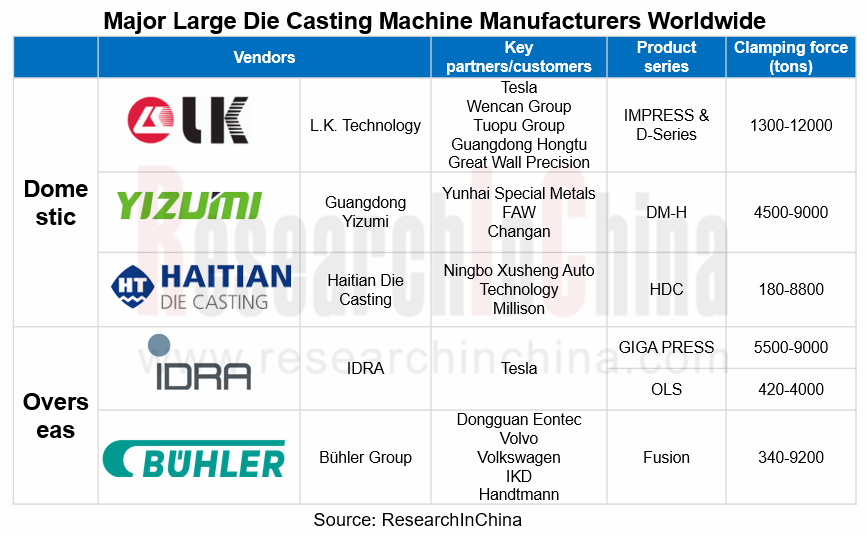
Higher-tonnage die casting machines can facilitate breakthroughs in die casting size and structure. Now, Tesla, L.K. Technology, Guangdong Hongtu, Haitian Die Casting and other companies have started research and development of die casting machines above 12,000T. In September 2022, L.K. Technology and Guangdong Hongtu successfully released a 12,000T super-large intelligent die casting unit jointly, marking the advent of world's highest-tonnage die casting machine. This is expected to boost vehicle-level integrated die-casting.
Midstream: Die casting leaders emerged
As midstream die-casting companies, Wencan Group, Tuopu Group, Guangdong Hongtu, Xusheng Auto Technology, Millison, etc., have deployed automotive integrated die casting by purchasing large die casting equipment and cooperating with automakers.
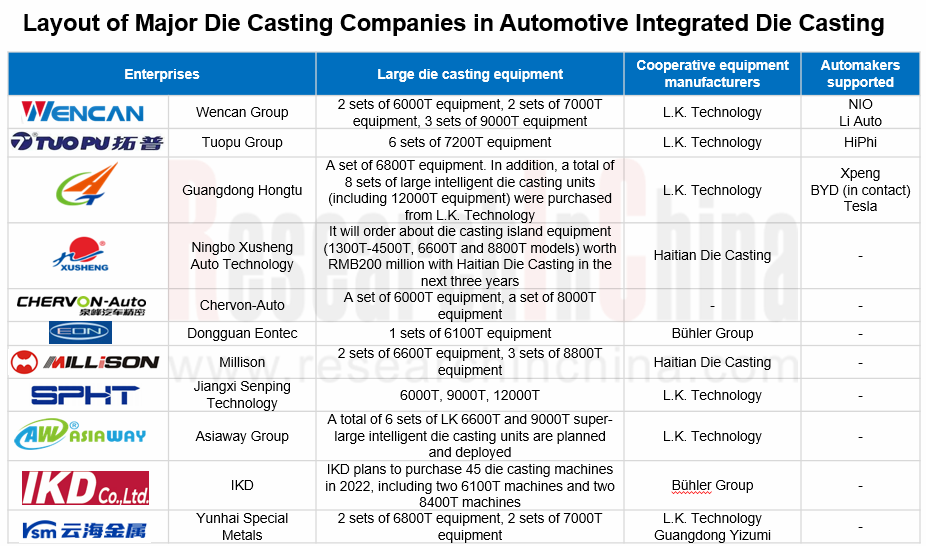
Currently, Wencan Group, Tuopu Group and Guangdong Hongtu have first-mover advantages in experience accumulation and order intake. All three have established cooperation with automakers and successfully completed the trial production of integrated die casting parts. Especially, Guangdong Hongtu is superior to others thanks to its heat-treatment-free aluminum alloy patent and the yield rate of 85%-90%. So far, it has not only obtained the designation from Xpeng, but also become Tesla's only die casting partner in integrated die casting.
Downstream: Automakers scramble to deploy integrated die casting in a bid to integrate the upper and lower car body
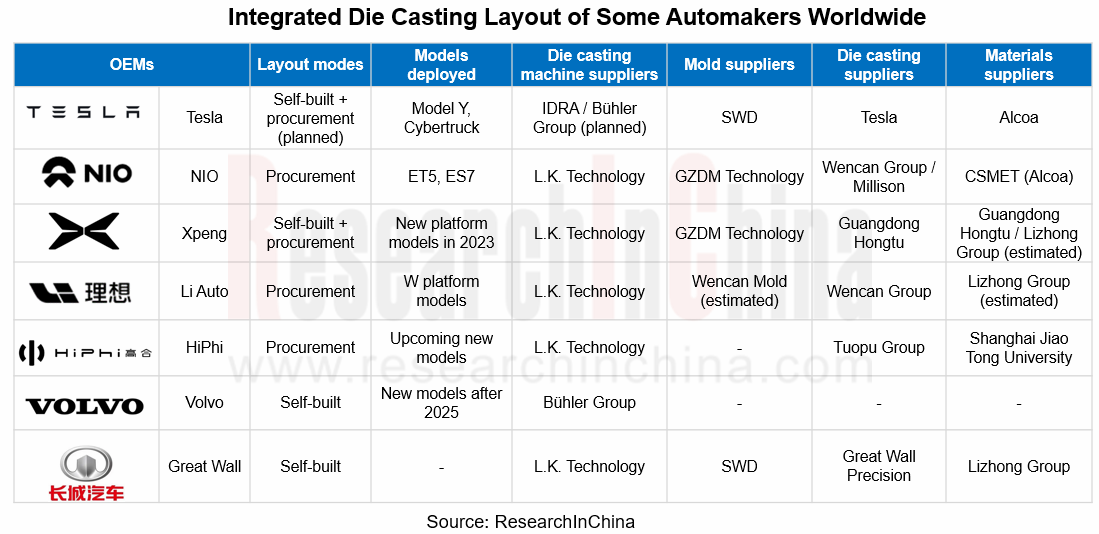
At present, Tesla, NIO, Xpeng, HiPhi, Volvo, Great Wall and other automakers have made layout in the field of automotive integrated die casting.
In terms of emerging automakers, Tesla has officially delivered Model Y with integrated die casting floors. NIO ET5 with an integrated die casting rear subframe is about to be delivered. In addition, Xpeng, Li Auto and HiPhi have put integrated die casting on the agenda, and they may apply it to vehicles in 2023.
As for traditional automakers, Volkswagen and Volvo have a long-term timetable for the layout of integrated die casting, and they expect to achieve mass production around 2025. Chinese automakers Changan and Great Wall have started bidding for integrated die casting projects, and they are likely to accomplish mass production in the next two to three years.
Now, major OEMs mainly apply integrated die casting to the rear floor, the front cockpit, etc. With the advent of higher-tonnage die casting machines, integrated die casting is expected to spread to lower body assembly, upper body integrated casting parts, and even body-in-white in the future.
Tesla plans to replace the 370-part lower body assembly with 2-3 large die casting parts. Tesla has extended the integrated die casting to the front and rear floors. At the same time, the upper cover of the battery pack and the middle floor of the vehicle are combined into one for integrated die casting, which can reduce the vehicle weight by 10% and increase the cruising range by 14%.
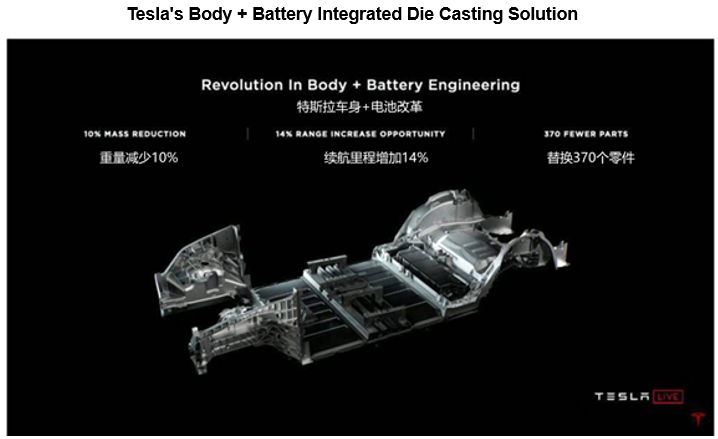
In addition, Wencan Group has successfully trial-manufactured large integrated casting parts on the upper body, and it will deliver samples in small batches later.
China Charging Infrastructure (Supercharging, Battery Swapping, V2G, etc.) and High-Performance Supercharging Battery Research Report, 2026
Charging and battery swapping research: as 5C+ supercharging vehicle models go into mass production, the pace of OEMs self-building supercharging networks quickens
800-1000V high-voltage platforms ar...
China Passenger Car Electronic Controlled Suspension Industry Report, 2026
Electronic Controlled Suspension Industry Research: As the First Year of Full Active Suspension Unfolds, Three Technical Routes Race Forward
1. Penetration Rate Surges Three Times, and Electronic Con...
Intelligent Driving SoC Research Report, 2026
Research on Intelligent Driving SoCs: Competition Focus Shifts to L3/L4 Embedded Hardware, and Computing Power of Flagship Vehicle Models Exceeds 1,000 TOPS
In terms of intelligent driving system in...
Automotive AI Large Model Technology Research Report, 2026
Automotive AI Large Model Research: Competition Shifts from "Who Has the Stronger Model" to "Who Boasts Higher Link Efficiency"
ResearchInChina released the Automotive AI Large Model Technology Resea...
Intelligent Vehicle Cockpit Domain Controller Research Report, 2026
Cockpit domain controller research: L3 AIDV intelligent cockpit domain controllers are entering a boom period
Driven by multiple factors such as the continuous evolution of the automotive central int...
Automotive Acoustic System (Audio, Multi-Channel) Industry Report, 2026
Automotive Acoustics Research: Multiple Channels, AI Tuning, and Self-Developed Algorithms Drive the Transformation of High-End Cockpit Sound Fields
I. Automotive Audio Hardware Solutions with 6–9 S...
Autonomous Driving Sensor Chip Research Report, 2026
Research on Autonomous Driving Sensor Chips: Deeply Perceiving the Physical World, Sensor Chips Are Playing A “Leading Role” in Intelligence
In 2026, the autonomous driving sensor chip industr...
Passenger Car Corner Module and Wheel‑Side Control System Research Report, 2026
Wheel-side control research: the “last mile” chassis innovation
Wheel-side control dismantles the traditional drive, braking, steering, and suspension control of the chassis from a "centralized" styl...
Embodied Artificial Intelligence (& Humanoid Robot) MCU Research Report, 2026
Research on Humanoid Robot MCUs: Evolution from General-Purpose Control to High-Value Dedicated Chip Solutions Integrated with Edge AI Functions
MCU (Microcontroller Unit) refers to a compact integra...
Intelligent Vehicle Zone Control Unit (ZCU) Research Report, 2026
ZCU Research: Cross-domain integrated ZCUs are becoming the edge computing nodes of the next-generation zonal architecture
Currently, the mainstream zonal architecture is mainly the quasi-central + z...
Automotive Cybersecurity and Data Security Research Report, 2026
Cybersecurity & Data Security Research: Intelligent Connected Vehicles Enter the Era of “Systematic Offense-Defense and AI-Defined Security”.
Centering on the panorama of intelligent connect...
Report on Breakthrough Strategies of OEMs and ADAS Tier 1 Suppliers for Overseas Layout of Intelligent Driving, 2026
Regulatory Breakthrough, Local System Establishment, OEMs Competing for NOA Layout: Overall Trends of China’s Intelligent Driving Overseas Layout in 2026
Research on overseas intelligent driving layo...
OEMs and Tier1s’ Intelligent Cockpit Platform (Hardware and Software) Innovation Strategy Research Report, 2026
Intelligent Cockpit Platform Research: multi-dimensional cockpit system architecture reconstruction for multi-agent collaboration and proactive intelligent services
The intelligent cockpit software s...
Automotive AIOS Research Report, 2026
Automotive AIOS Research: Mass Production Solutions Are Implemented
Mass Production Solutions Are Implemented on A Small Scale.
In 2026, AIOS starts small-scale implementation, helping to improve v...
Automotive Telematics Service Provider (TSP) Research Report, 2026
TSP Research: Leading providers collectively turn to AI agents to provide all-scenario active services
Telematics Service Providers (TSPs) are the core hub of the telematics industry chain, connectin...
Automotive Smart Interior Research Report, 2026
Smart Interior Research: As Technologies like Interactive Starlight Headliner, Hidden Display and Surface Projection Are Launched, Automotive Interiors Become Ever More Intelligent
The Automotive Sma...
Research Report on AI Applications in Cockpits, 2026
AI Application in Cockpits: AI Services Become More Comprehensive, Convenient, and Refined.
In the first half of 2026, cockpit AI functions underwent initial upgrades across multiple dimensions, inc...
Software-Defined Vehicles in 2026: OEM Software Development and Supply Chain Deployment Strategy Research Report
Research on OEMs’ Software Strategies: R&D Focus, Development Strategies and Supplier Building Models of 30 OEMs
In this paper, we adopt a research framework covering 13 subsystems and 48 sub-di...