Emerging carmaker strategy research: NIO is deploying battery swap and sub-brands for the knockout match in 2023.
In 2022, the sales surged by 32.3% year on year, being concentrated in first-tier cities.
In 2022, NIO sold 120,134 cars, up by 32.3% on an annual basis, specifically:
ES6, ET7 and EC6 were the top three models by sales, of which 42,319 ES6 cars were sold, accounting for 35.2% of the total sales. As ES7, ET7 and ET5 (“775”) were delivered, they saw a rising share of sales. Among them, the sales proportion of ET7 grew fastest, up to 19.1%.
By province, Zhejiang (26,747 units), Jiangsu (18,105 units) and Guangdong (15,626 units) ranked top three by sales.
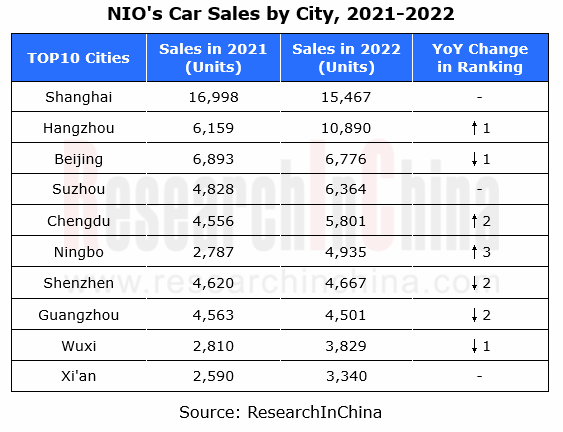
NIO's cars are largely sold in first-tier cities. In 2022, the first three cities by sales were Shanghai (15,467 units), Hangzhou (10,890 units) and Beijing (6,776 units); users in first-tier cities swept 69.9%, down 5.9 percentage points on the previous year.
Strategy 1: lay out the construction of Power Swap stations
To boost sales in third-and fourth-tier cities, NIO has doubled down on the layout of battery swap infrastructure, and has planned to add 1,000 swap stations in 2023 instead of the originally planned 400, of which: about 400 stations will be built at highway service areas or intersections; another 600 stations will be deployed in urban areas, especially in third- and fourth-tier cities and counties where there is a certain user base but without battery swap stations. NIO intends to offer more convenient Power Swap services, alleviate the anxiety about energy replenishment, and encourage potential car owners in third- and fourth-tier cities to enjoy NIO’s services, so as to push up its car sales.
NIO’s Power Swap stations having iterated to the third generation (launched in December 2022) so far not only support the Summon & Swap feature for cars but also allow for Navigate on Pilot + Summon & Swap. In March 2023, the first third-generation Power Swap stations will land in Nanxiang Town in Jiading District, Shanghai.
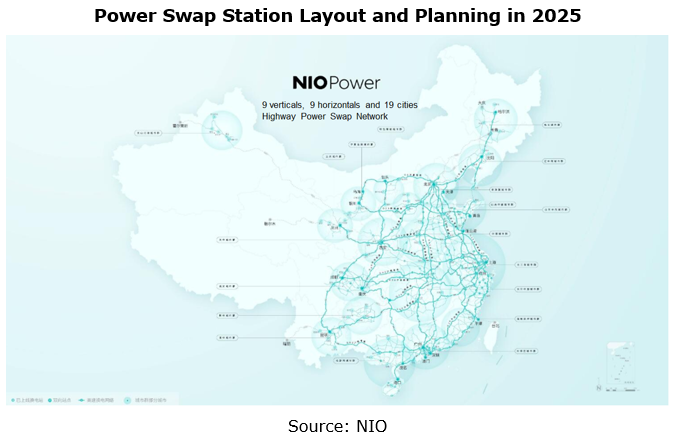
According to its plan, NIO will lay out more than 2,300 Power Swap stations (including 700+ highway Power Swap stations) in 2023; in 2025, NIO will build a 9-vertical, 9-horizontal highway battery swap network with about 3,000 Power Swap stations.
Strategy 2: establish sub-brands to explore the lower end of the market, and enable cockpit and driving integration in the models under the third brand.
In 2022, NIO delivered ET7, ES7 and ET5, three models based on the NT2 platform, and switched from NT1 (the perception system includes cameras, ultrasonic radar, etc.) to NT2 (the perception system adds LiDAR, and upgrades cameras to the high-definition for L4 autonomous driving).
In the first half of 2023, NIO plans to deliver five new NT2-based models and a total of 200,000 cars, and develop the NT3 platform (supporting battery swap and 800V fast charging technology, and carrying batteries made by NIO).
At present, all the cars delivered by NIO are positioned as high-end models priced at higher than RMB300,000. NIO plans to cover the mid-to-high-end and low-to-mid-end markets on the basis of the original high-end brand. In the market of mid-to-high-end cars worth RMB200,000-300,000, NIO will launch "ALPS", a NT3.0-based brand. In the market of low-to-mid-end cars valued at RMB100,000-200,000, NIO will unveil “Firefly", a small-sized car brand to debut in Europe, supporting battery swap and L2+ driving assistance.
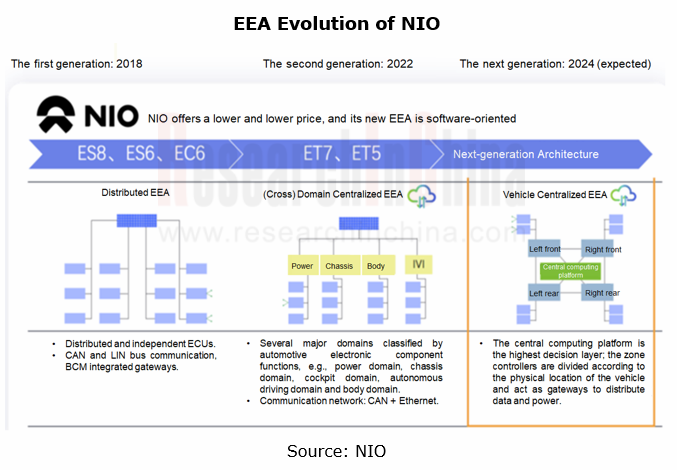
NIO’s EEA has evolved from the distributed architecture NT1 to the domain centralized (5*DCU) architecture NT2. In the future, the cockpit and driving integration will be available to the models under the third brand "Firefly". In February, 2023, NIO partnered with KEBODA, a provider of automotive intelligent and energy-efficient components, systems and solutions. KEBODA will provide cockpit and driving integrated domain controller solutions for Firefly, covering autonomous driving domain control, cockpit domain control and gateway functions.
Strategy 3: phase in Navigate on Pilot (NOP) and Power Swap Assist features.
In terms of the evolution of driving assistance functions, NT1-based models feature NOP (pushed with the NIO OS 2.7.0 in October 2020), and NT2-based models support NOP+ (NOP+beta was pushed in December 2022). In the first half of 2023, NT2-based models will gradually introduce the NOP and Power Swap features via OTA updates, specifically: allowing cars to complete the route planning for battery swap on highways; intelligently navigating cars to a Power Swap station in a highway service area; supporting cars to automatically drive away from the service area after automatic battery swapping, and re-enter highways.
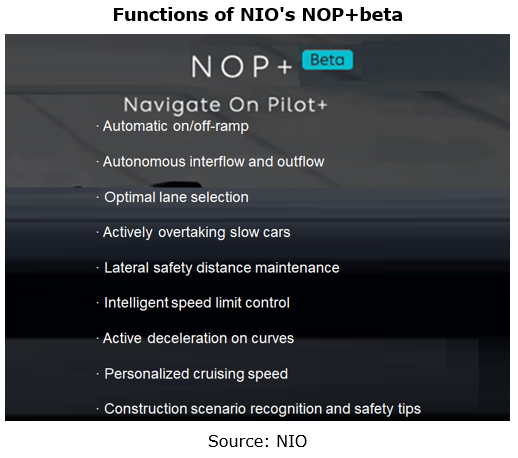
Compared with NOP, NOP+ offers improvements in both software and hardware. In terms of software, NOP+ has a global unified architecture and a brand-new algorithm framework. The fusion of data from vehicle cameras, LiDAR and HD maps assists the system in decision and planning. For hardware, the front view camera is replaced by a 360° fisheye camera-based sensing system, 1,550nm LiDAR is added, and radar and ultrasonic sensor (USS) constitute a two-layer sensor. As for computing platform, four Orin SoCs are installed on the 1,016 TOPS ADAM supercomputing platform.
In terms of perception architecture, NIO will update the NOP+ perception architecture to a BEV model architecture in the first half of 2023; meanwhile, the planning and control logics of NOP+ and NIO Pilot (NP) will be integrated, that is, NOP+ will shift the current map-heavy route to the perception-heavy route.
As concerns charging mode, NOP+beta is currently free of charge in a bid to cultivate users' habits. The later official version may charge fees.
Strategy 4: highlight immersive cockpit experience and build smartphone and IVI integration.
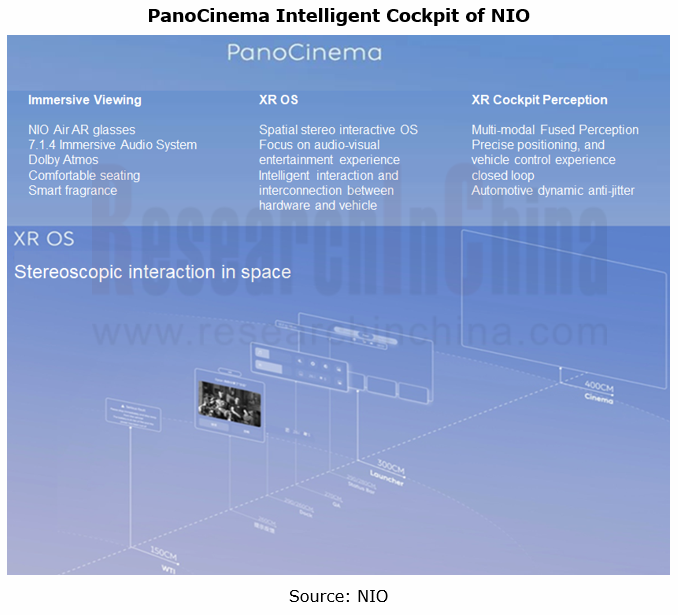
In terms of cockpit experience, NIO’s PanoCinema Intelligent Cockpit comes with the standard configuration of 23 speaker units, which are laid out according to the 7.1.4 channel scheme with 20-channel 1000W power amplifier outputs. Active tuning algorithms and Dolby Atmos bring immersive listening experience.
Based on XR OS, NIO's self-developed exclusive automotive AR operation interface, users can control AR and cockpit functions via NOMI voice assistant, NIO Air Ring and the dedicated smartphone App, when wearing AR glasses. In the future, AR glasses are expected to be combined with HUD or AR HUD. According to the latest patent of AR glasses from NIO in January 2023, its next-generation AR glasses can realize display of vehicle information.
In addition to AR glasses, NIO has also developed the mobile phone business. It aims to offer smartphone and IVI integrated experience, build a people-vehicle-smartphone closed loop, share data and make mobile phones a part of NIO’s automotive ecosystem. Its selling point may be software, offering differentiated smartphone and IVI integrated experience. In February 2023, NIO applied for the trademark "NIO PHONE". It will start close beta test in Q2 2023, and begin official release in Q3 2023.
According to its recent 2022 financial report, NIO was still in the red, with the full-year net loss of RMB14.4371 billion, up by 259.4% year on year. To achieve CEO Li Bin's goal of "break even in Q4 2023 and make profit in 2024", NIO, which persists in long-termism, has to face a last-ditch battle in 2023.
Vehicle-Road-Cloud Integration and C-V2X Industry Report, 2026
Vehicle-Road-Cloud and C-V2X Research: with the three-tier promotion system of "top-level planning + mandatory pilot + evaluation binding", the industry turning point is approachingThis report focuses...
China OEM Data Capability Analysis Report, 2026
OEM Data Capability Research: 24 OEMs × 9 Capability Domains, Who Takes the Lead?
An L4 autonomous driving R&D and test vehicle can generate approximately 10TB of raw data per single day — data v...
Autonomous Driving Domain Controller and Central Computing Unit (CCU) Industry Report, 2026
Autonomous Driving Domain Controller (ADCU) Research: One-Chip CCU solutions are quickly available in vehicles
In China's passenger car market, autonomous driving systems involved in mass production ...
Automotive EMS and ECU Industry Research Report, 2026
Automotive EMS Research: The boundaries between EMS providers and Tier1 suppliers are becoming blurred, and the supply chain model is evolving from a linear chain to a networked structure
Mainstream ...
Automotive Microcontroller Unit (MCU) and Application Scenario Research Report, 2026
Automotive MCU Research: Increased demand for redundant security drives ASIL D-compliant MCU shipments to exceed 100 million units
In a vehicle EEA, MCUs are widely distributed in various functional ...
China Intelligent Cockpit Patent Analysis Report, 2026
Intelligent Cockpit Patent Research: Cockpit AI, In?vehicle Health, and Infotainment Are Upgrade to Scenario?based and Proactive Functions
From a patent perspective, this report explores the cutting?...
Research Report on Application of VLA Large Model in Automobiles and Robots, 2026
Research on Automotive and Robot VLA: Hybrid Architectures Become Mainstream, VLA Integrates with General World Models, and Reinforcement Learning Serves as Core Engine
Vision?Language?Action (VLA) m...
China Charging Infrastructure (Supercharging, Battery Swapping, V2G, etc.) and High-Performance Supercharging Battery Research Report, 2026
Charging and battery swapping research: as 5C+ supercharging vehicle models go into mass production, the pace of OEMs self-building supercharging networks quickens
800-1000V high-voltage platforms ar...
China Passenger Car Electronic Controlled Suspension Industry Report, 2026
Electronic Controlled Suspension Industry Research: As the First Year of Full Active Suspension Unfolds, Three Technical Routes Race Forward
1. Penetration Rate Surges Three Times, and Electronic Con...
Intelligent Driving SoC Research Report, 2026
Research on Intelligent Driving SoCs: Competition Focus Shifts to L3/L4 Embedded Hardware, and Computing Power of Flagship Vehicle Models Exceeds 1,000 TOPS
In terms of intelligent driving system in...
Automotive AI Large Model Technology Research Report, 2026
Automotive AI Large Model Research: Competition Shifts from "Who Has the Stronger Model" to "Who Boasts Higher Link Efficiency"
ResearchInChina released the Automotive AI Large Model Technology Resea...
Intelligent Vehicle Cockpit Domain Controller Research Report, 2026
Cockpit domain controller research: L3 AIDV intelligent cockpit domain controllers are entering a boom period
Driven by multiple factors such as the continuous evolution of the automotive central int...
Automotive Acoustic System (Audio, Multi-Channel) Industry Report, 2026
Automotive Acoustics Research: Multiple Channels, AI Tuning, and Self-Developed Algorithms Drive the Transformation of High-End Cockpit Sound Fields
I. Automotive Audio Hardware Solutions with 6–9 S...
Autonomous Driving Sensor Chip Research Report, 2026
Research on Autonomous Driving Sensor Chips: Deeply Perceiving the Physical World, Sensor Chips Are Playing A “Leading Role” in Intelligence
In 2026, the autonomous driving sensor chip industr...
Passenger Car Corner Module and Wheel‑Side Control System Research Report, 2026
Wheel-side control research: the “last mile” chassis innovation
Wheel-side control dismantles the traditional drive, braking, steering, and suspension control of the chassis from a "centralized" styl...
Embodied Artificial Intelligence (& Humanoid Robot) MCU Research Report, 2026
Research on Humanoid Robot MCUs: Evolution from General-Purpose Control to High-Value Dedicated Chip Solutions Integrated with Edge AI Functions
MCU (Microcontroller Unit) refers to a compact integra...
Intelligent Vehicle Zone Control Unit (ZCU) Research Report, 2026
ZCU Research: Cross-domain integrated ZCUs are becoming the edge computing nodes of the next-generation zonal architecture
Currently, the mainstream zonal architecture is mainly the quasi-central + z...
Automotive Cybersecurity and Data Security Research Report, 2026
Cybersecurity & Data Security Research: Intelligent Connected Vehicles Enter the Era of “Systematic Offense-Defense and AI-Defined Security”.
Centering on the panorama of intelligent connect...