Cockpit-parking integration research: cockpit-parking vs. driving-parking, which one is the optimal solution for cockpit-driving integration?
Cockpit-parking vs. driving-parking, which one is the optimal solution for cockpit-driving integration?
Currently, automotive E/E architecture is evolving from the distributed to domain centralized architecture, and will eventually be integrated into a central computing platform. In this process both cockpit-parking integration and driving-parking integration are products of domain centralized E/E architecture, and the ultimate form in the future is cockpit-driving integration.
Subject to the maturity of current chip and software technologies, the cockpit-parking solution is a transitional form to cockpit-driving integration. The solution integrates the parking function into the cockpit and allows the cockpit domain controller to receive parking signals, eliminating the cost of parking controllers.
The cockpit-parking integration offers the following benefits: first, cost reduction: the implementation of APA in the cockpit domain only needs addition of ultrasonic sensor (USS) and connector, bringing little cost pressure; second, better human-computer interaction design: the integration of the parking function into the cockpit enable the cockpit domain controller to gain more parking signals and use the rendering capability of the cockpit to improve the overall user experience of HMI; third, the computing power on the cockpit can be brought into full play.
From the comparison between the cockpit chip and the intelligent driving chip, it can be seen that the cockpit domain controller main SoC more highlights CPU and GPU, favoring the realization of such functions as environment puzzle and 3D rendering.
In terms of application fields, the cockpit-parking integrated solution is fitter to integrate basic parking functions, while for advanced parking functions like HPA and AVP, the driving-parking integrated solution is more suitable due to the needs for the driving perception system, and the functional safety level requirements.
Considering cost, lowly configured vehicle models are thus more likely to use the cockpit-parking solution, while medium and highly configured models with medium- and high-compute domain controller platforms will apply the driving-parking integrated solution.
The cockpit-parking integration track is heating up, and there are already more than ten Tier 1 players.
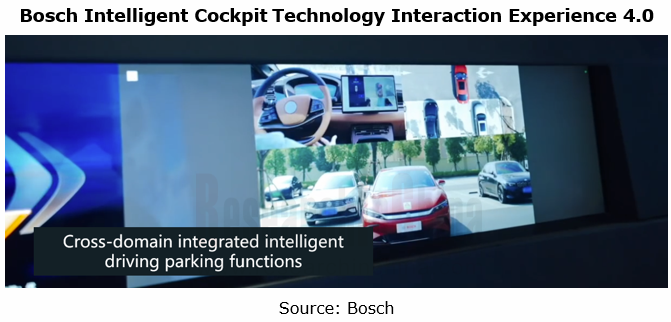
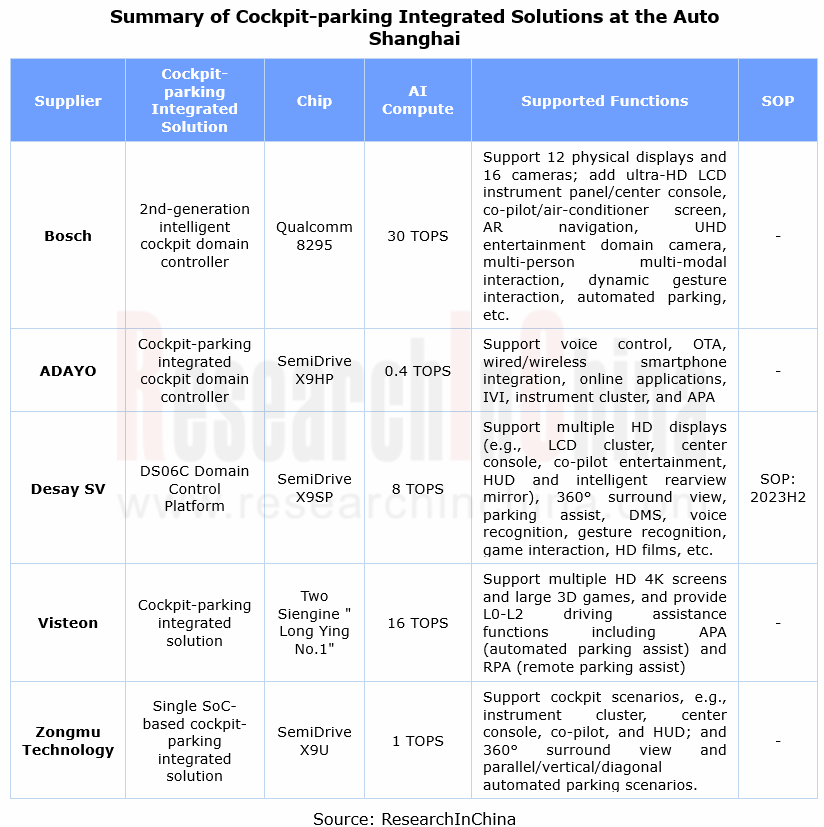
At present, more than ten Tier 1 suppliers have launched cockpit-parking integrated solutions. At the Auto Shanghai, six players introduced their solutions, including Bosch, ADAYO, Zongmu Technology and Voyager Technology. Among them, Bosch's Intelligent Cockpit Technology Interaction Experience 4.0, equipped with Qualcomm's high-compute chip, enables an infotainment domain platform providing seamless cockpit experience, and supports the cross-domain function of the "cockpit-parking integration".
At the Auto Shanghai, Desay SV introduced DS06C, its cockpit domain control platform based on SemiDrive's latest chip X9SP. The single chip can support multiple HD displays such as LCD cluster, center console, co-pilot entertainment, HUD and intelligent rearview mirror, and are available to application scenarios like 360° surround view, parking assist, DMS, voice recognition, gesture recognition, game interaction, and HD films.
High-end intelligent cockpit platform master chips show the trend of replacing foreign counterparts.
In the field of high-end intelligent cockpit platform master chip, there is a trend of replacing foreign products. For example, the "Long Ying No.1", a 7nm cockpit chip that Siengine launched in 2021, has broken the monopoly of Samsung, Qualcomm and Nvidia in this field.
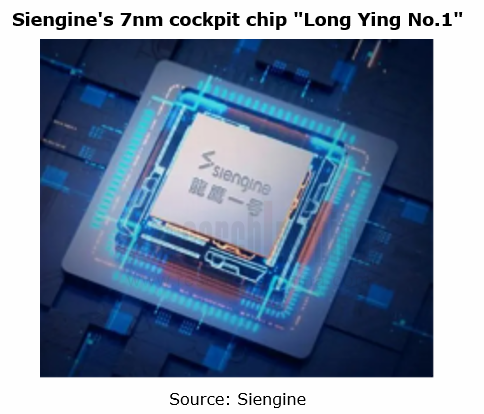
The chip is equipped with Arm China's self-developed "Zhouyi" NPU and Arm IP. It adopts the ultra-large multi-core heterogeneous SoC design and integrates 87-layer circuits with 8.80 billion transistors. It packs an 8-core CPU with integral computing power up to 90K, of which the large core is Cortex-A76; a 14-core GPU with up to 900G floating-point operations; integrated programmable NPU core with the INT8 computing power up to 8TOPS; high-bandwidth low-latency LPDDR5 memory channel. It features a built-in cyber security engine that complies with national cryptographic algorithms, and the ASIL-D-compliant safety island design. At present, the chip has been installed in cockpit-parking integrated solutions of Visteon and ECARX.
2023 is the first year of mass production of cockpit-parking integrated solutions, and software capability building facilitates an upgrade to the cockpit-driving integration.
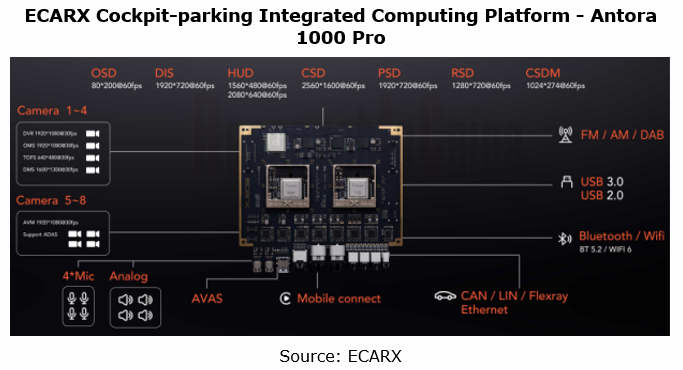
At present, the cockpit-parking integrated solution has been spawned and designated, including the cockpit-parking integrated platform jointly developed by Aptiv and ZEEKR and expected to debut in late 2023. Lynk 08 will carry ECARX’s Antora 1000 Pro computing platform with total NPU compute of 16 TOPS and total GPU compute of 1800G FLOPS, and is expected to be rolled out in August 2023. Dongfeng Forthing flagship MPV and Forthing Leiting will bear Yuanfeng Technology's intelligent cockpit platform based on Qualcomm 8155. In terms of production time, 2023 can be called the first year of volume production of cockpit-parking integrated solutions.
In response to the future trend for centralized architecture, Tier 1 suppliers work hard on planning and have even launched cockpit-driving integrated products. One example is Trinity Series, a cockpit-driving integrated product Zongmu Technology announced at the Auto Shanghai. SemiDrive is exploring centralized computing and has created a driving-parking-cockpit integrated solution which uses SemiDrive’s EMOS Platform to connect the centralized computing, cockpit and autonomous driving domains. The solution is based on service-oriented architecture (SOA) and introduces DDS communication.
The cockpit-driving integration requires an entire vehicle OS that manages all the tasks of the clusters for intelligent cockpit and autonomous driving. For this purpose, ECARX together with Volvo founded HaleyTek, an operating system company (with a 100-people team), and in March 2023 unveiled CloudPeak, an intelligent cockpit OS that features cross-domain system capabilities, is available to the Antora platform and also has access to 22 markets worldwide.
Vehicle-Road-Cloud Integration and C-V2X Industry Report, 2026
Vehicle-Road-Cloud and C-V2X Research: with the three-tier promotion system of "top-level planning + mandatory pilot + evaluation binding", the industry turning point is approachingThis report focuses...
China OEM Data Capability Analysis Report, 2026
OEM Data Capability Research: 24 OEMs × 9 Capability Domains, Who Takes the Lead?
An L4 autonomous driving R&D and test vehicle can generate approximately 10TB of raw data per single day — data v...
Autonomous Driving Domain Controller and Central Computing Unit (CCU) Industry Report, 2026
Autonomous Driving Domain Controller (ADCU) Research: One-Chip CCU solutions are quickly available in vehicles
In China's passenger car market, autonomous driving systems involved in mass production ...
Automotive EMS and ECU Industry Research Report, 2026
Automotive EMS Research: The boundaries between EMS providers and Tier1 suppliers are becoming blurred, and the supply chain model is evolving from a linear chain to a networked structure
Mainstream ...
Automotive Microcontroller Unit (MCU) and Application Scenario Research Report, 2026
Automotive MCU Research: Increased demand for redundant security drives ASIL D-compliant MCU shipments to exceed 100 million units
In a vehicle EEA, MCUs are widely distributed in various functional ...
China Intelligent Cockpit Patent Analysis Report, 2026
Intelligent Cockpit Patent Research: Cockpit AI, In?vehicle Health, and Infotainment Are Upgrade to Scenario?based and Proactive Functions
From a patent perspective, this report explores the cutting?...
Research Report on Application of VLA Large Model in Automobiles and Robots, 2026
Research on Automotive and Robot VLA: Hybrid Architectures Become Mainstream, VLA Integrates with General World Models, and Reinforcement Learning Serves as Core Engine
Vision?Language?Action (VLA) m...
China Charging Infrastructure (Supercharging, Battery Swapping, V2G, etc.) and High-Performance Supercharging Battery Research Report, 2026
Charging and battery swapping research: as 5C+ supercharging vehicle models go into mass production, the pace of OEMs self-building supercharging networks quickens
800-1000V high-voltage platforms ar...
China Passenger Car Electronic Controlled Suspension Industry Report, 2026
Electronic Controlled Suspension Industry Research: As the First Year of Full Active Suspension Unfolds, Three Technical Routes Race Forward
1. Penetration Rate Surges Three Times, and Electronic Con...
Intelligent Driving SoC Research Report, 2026
Research on Intelligent Driving SoCs: Competition Focus Shifts to L3/L4 Embedded Hardware, and Computing Power of Flagship Vehicle Models Exceeds 1,000 TOPS
In terms of intelligent driving system in...
Automotive AI Large Model Technology Research Report, 2026
Automotive AI Large Model Research: Competition Shifts from "Who Has the Stronger Model" to "Who Boasts Higher Link Efficiency"
ResearchInChina released the Automotive AI Large Model Technology Resea...
Intelligent Vehicle Cockpit Domain Controller Research Report, 2026
Cockpit domain controller research: L3 AIDV intelligent cockpit domain controllers are entering a boom period
Driven by multiple factors such as the continuous evolution of the automotive central int...
Automotive Acoustic System (Audio, Multi-Channel) Industry Report, 2026
Automotive Acoustics Research: Multiple Channels, AI Tuning, and Self-Developed Algorithms Drive the Transformation of High-End Cockpit Sound Fields
I. Automotive Audio Hardware Solutions with 6–9 S...
Autonomous Driving Sensor Chip Research Report, 2026
Research on Autonomous Driving Sensor Chips: Deeply Perceiving the Physical World, Sensor Chips Are Playing A “Leading Role” in Intelligence
In 2026, the autonomous driving sensor chip industr...
Passenger Car Corner Module and Wheel‑Side Control System Research Report, 2026
Wheel-side control research: the “last mile” chassis innovation
Wheel-side control dismantles the traditional drive, braking, steering, and suspension control of the chassis from a "centralized" styl...
Embodied Artificial Intelligence (& Humanoid Robot) MCU Research Report, 2026
Research on Humanoid Robot MCUs: Evolution from General-Purpose Control to High-Value Dedicated Chip Solutions Integrated with Edge AI Functions
MCU (Microcontroller Unit) refers to a compact integra...
Intelligent Vehicle Zone Control Unit (ZCU) Research Report, 2026
ZCU Research: Cross-domain integrated ZCUs are becoming the edge computing nodes of the next-generation zonal architecture
Currently, the mainstream zonal architecture is mainly the quasi-central + z...
Automotive Cybersecurity and Data Security Research Report, 2026
Cybersecurity & Data Security Research: Intelligent Connected Vehicles Enter the Era of “Systematic Offense-Defense and AI-Defined Security”.
Centering on the panorama of intelligent connect...