China Automotive Fragrance and Air Purification Systems Research Report, 2023
Automotive fragrance and air purification systems: together to create a comfortable and healthy cockpit
Technology trend: intelligence of fragrance system and integration of air purification system
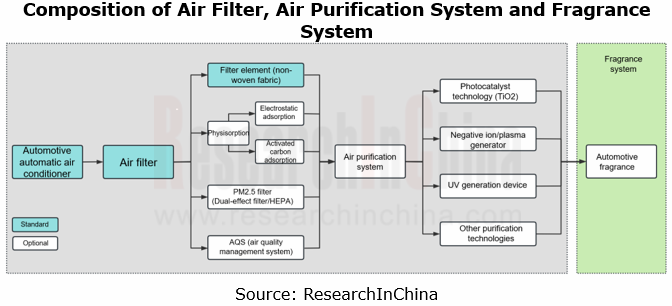
In the passenger car market, the fragrance and air purification systems boom: the fragrance system has developed from the initial "perfume bottle + negative ion generator" to independent intelligent fragrance system; in some models, the air purification system is integrated with the air filter to constitute a complete automotive air management system, and also packs comprehensive air management technologies such as advanced filter elements (dual-effect element, HEPA element, etc.), air quality system (AQS), and air purification system (e.g., negative ion generator and UV generation device).
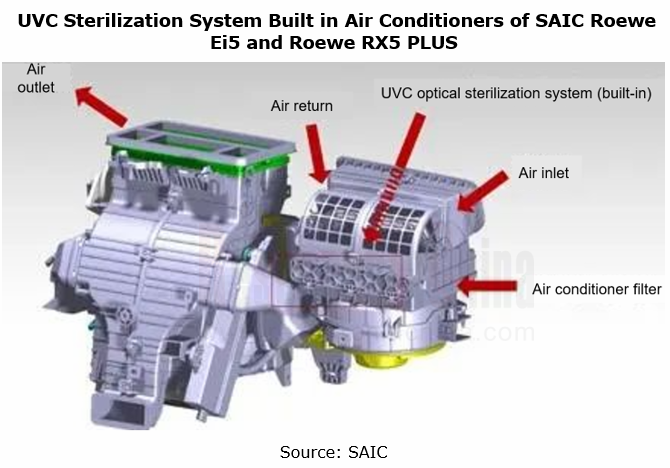
At present, the fragrance system heads in the direction of intelligence, for example, carrying the NFC chip for rapid recognition (NIO ES6, ZEEKR 001, etc.), delivering fragrance according to driving scenarios (IM L7), and using magnetic suction technology and rotating fragrance frame (XPeng G9, etc.); the air purification system tends to integrate a variety of filtration and sterilization technologies, including photocatalyst (Oshan A800, etc.), UV sterilization (SAIC Roewe RX5 PLUS, etc.) and negative ion generator (e.g., Geely Boyue). The air purification technology of the current mainstream car models is negative ion/plasma generator, with sterilization rate higher than 80%. In the future, the more advanced technologies will be UV sterilization system and photocatalyst technology, with sterilization rate higher than 99%.
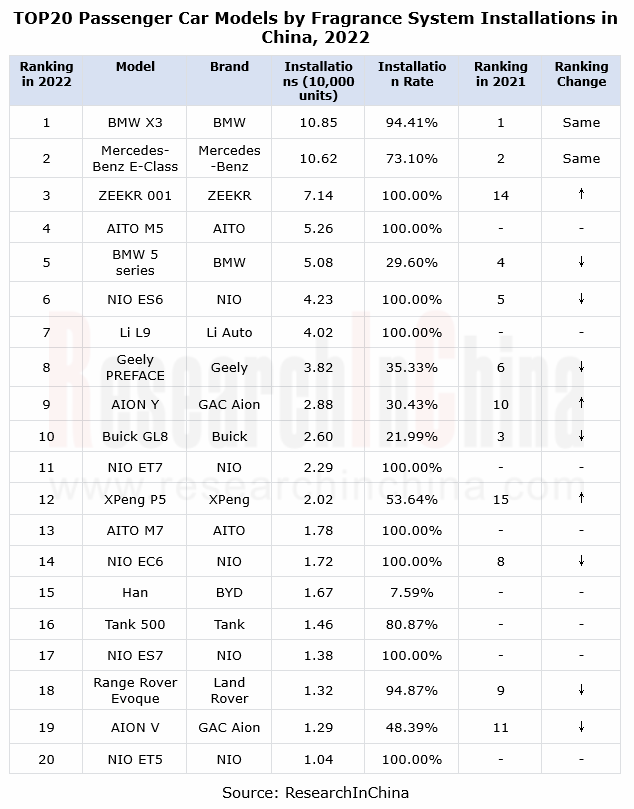
The TOP20 passenger car models by installations of fragrance and air purification systems in China in 2022 are as follows:
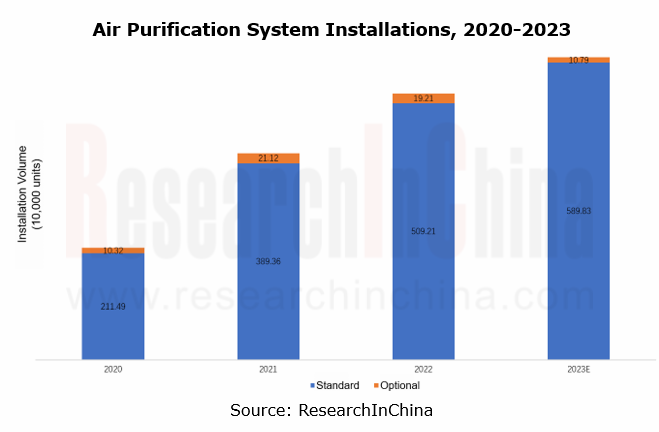
Rapid growth: in 2023, the automotive fragrance installation will exceed 1 million units, and the air purification system installation will surpass 6 million units.
From 2020 to 2023, the installations of automotive air purification and fragrance systems will sustain steady growth. It is predicted that in 2023 the installations of automotive air purification systems will exceed 6 million units, and that of fragrance systems will reach 1.03 million units.
Overall the air purification system is mainly a standard component of passenger cars. The installation of standard fragrance systems began to surge in 2022, and is expected to reach 582,700 units in 2023, exceeding the optional for the first time.
Suppliers: explore new air purification technologies and develop vehicle air management solutions
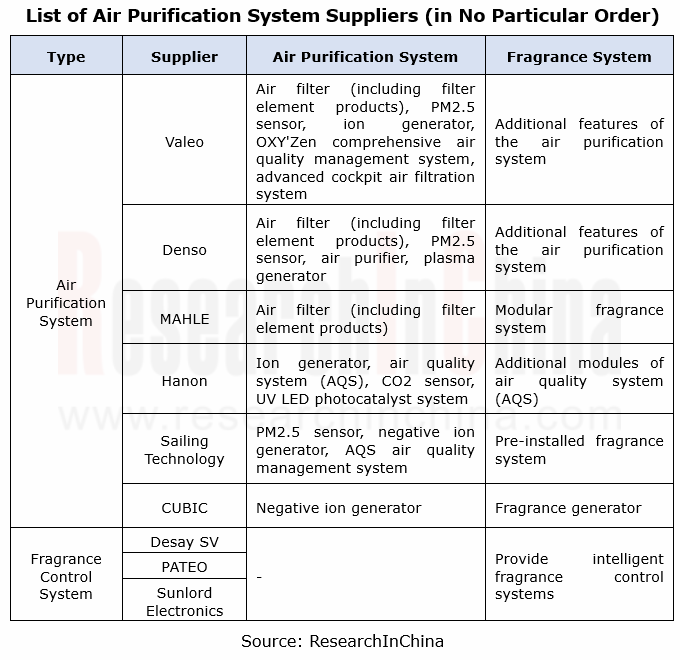
Air purification and fragrance systems are generally integrated into the functional module of air conditioning systems, and the main suppliers are as follows:
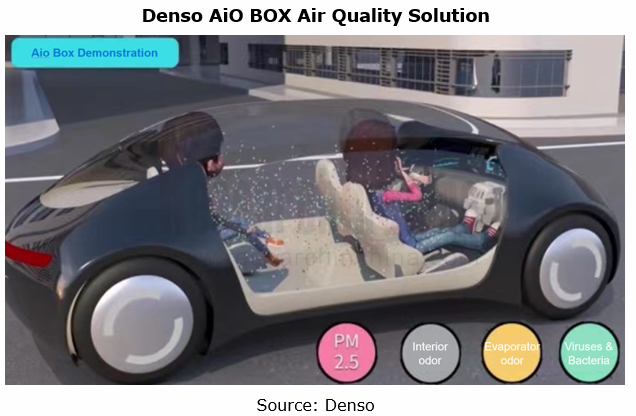
Denso
In 2022, Denso introduced AiO BOX, an air quality solution that fully integrates all air purification system components and uses the unique airflow cleaning technology. With a plasma generator and double electrodes, it can release positive and negative ions simultaneously at the front and rear air outlets. The high integration of PM2.5 sensor and HVAC enables fanless air filtration.
The simple version of AiO BOX equipped with plasma generator, PM2.5 sensor and CN95 filter was mass-produced in late 2022. Denso plans volume production of the complete version of AiO BOX equipped with evaporator cleaning system and intelligent fragrance unit in 2024.
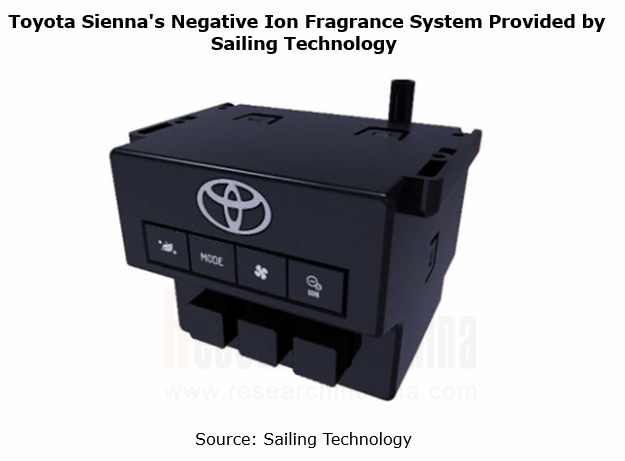
Sailing Technology
Sailing Automotive Electronics (Taizhou) Co., Ltd. provides complete air system solutions for OEMs. During 2022-2027, the company plans to produce a total of about 34.11 million designated products, including more than 12.77 million PM2.5 filters, more than 7.4 million negative ion generators, more than 12.78 million fragrance systems and more than 1.16 million AQS systems. By the end of 2022, some of the designated products have started to be delivered to automakers. For example, Sailing Technology has already provided fragrance systems for Li L9 and XPeng G9.
Sailing Technology provides Toyota with a customized negative ion fragrance system, with the concentration adjusted via WeChat applet and the center console screen. This system is applicable to models like Sienna, Venza, Highlander and Frontlander, with the fragrance bottle placed in the glove box.
OEMs: upgrade air purification system functions, and emerging OEMs prefer intelligent fragrance systems.
Since 2020, mainstream models have offered upgrading air purification system functions. Some automakers (e.g. Geely and WM Motor) have passed the CN95 certification for their air filters. International OEMs are cooperating with air purification system integrators like Valeo and MAHLE to add an air quality manager (AQS) and negative ion/plasma technology to their original air purification systems, aiming to further improve the pollutant filtration efficiency of their existing air purification systems.
Chinese emerging OEMs (NIO, Li Auto, XPeng Motor, AITO, etc.) boast a higher installation rate of fragrance systems, and prefer intelligent fragrance systems. Their fragrance suppliers are international groups (Givaudan, Symrise, IFF, Firmenich, etc.). Most conventional international OEMs (Mercedes-Benz, BMW, etc.) adopt non-intelligent fragrance system designs.
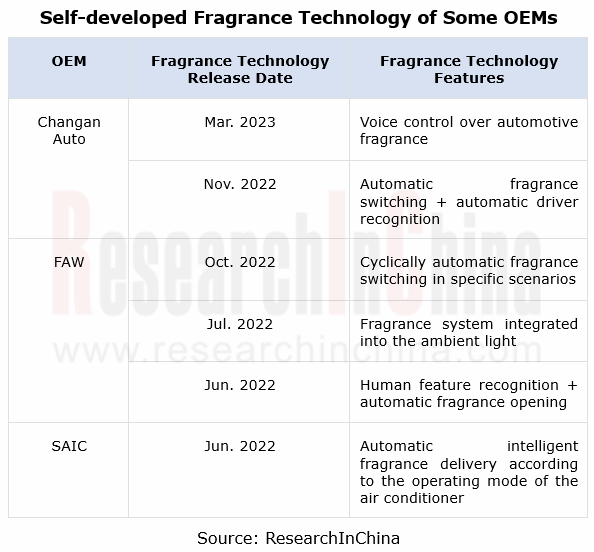
At present, some Chinese OEMs have the ability to independently develop intelligent fragrance technologies, especially human feature recognition and monitoring, and fragrance system intelligent control (automatic opening / intelligent fragrance delivery / automatic fragrance switching / voice control).
NIO intelligent fragrance system
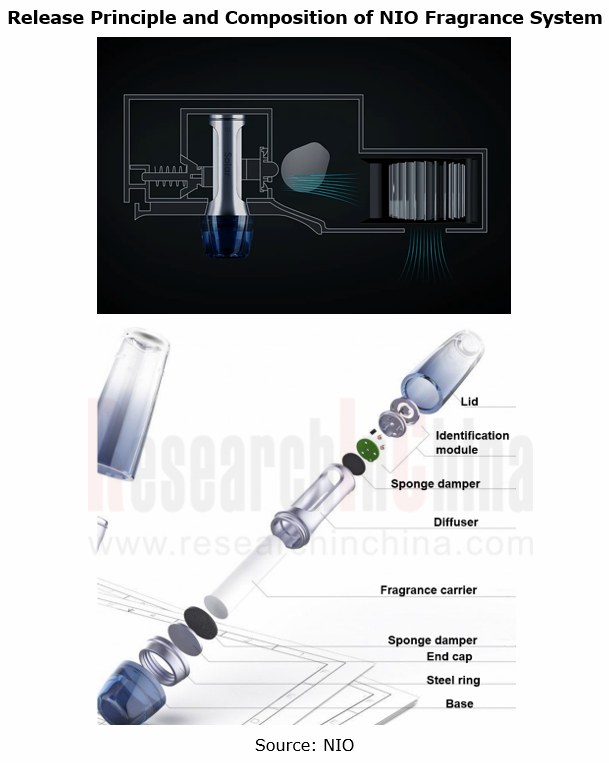
All of NIO's models carry an intelligent fragrance system, which is connected to the IVI system and can be turned on independently. Its fragrance bottle is equipped with magnetic suction technology and NFC chip for fast recognition. The system is designed by Shanghai ARTOP Industrial Design Co., Ltd.
Mercedes-Benz fragrance system
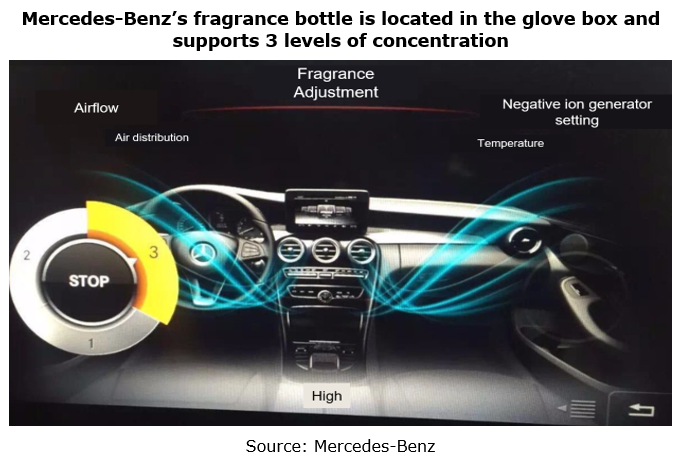
Mercedes-Benz was the first OEM to introduce fragrance systems, which is installed in C-Class (AMG Models), GLS, CLS, S-Class, GLE, E-Class, G-Class and other models. Provided by the international fragrance group Symrise, the fragrance for S-Class is integrated with the Mercedes-Benz Air Balance system that offers the negative ion air purification function.
Geely IAPS (Intelligent Air Purification System)
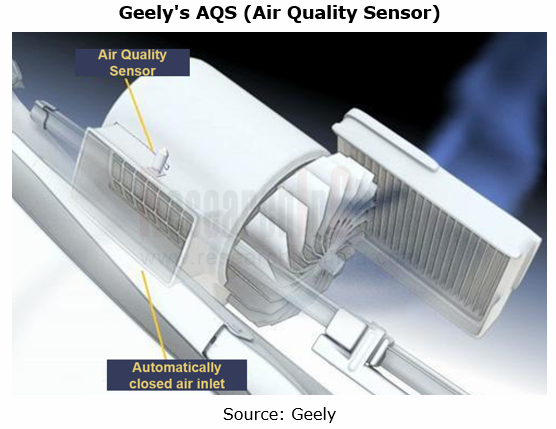
Based on the original air conditioner filter, Geely's intelligent air purification system (IAPS) adopts the architecture of "AQS + PM2.5 four-layer air purification device + negative ion generator", which can efficiently filter conventional dusts, harmful gases, PM2.5 particles, >0.74μm droplets, and >0.3μm particles.
Automotive Microcontroller Unit (MCU) and Application Scenario Research Report, 2026
Automotive MCU Research: Increased demand for redundant security drives ASIL D-compliant MCU shipments to exceed 100 million units
In a vehicle EEA, MCUs are widely distributed in various functional ...
China Intelligent Cockpit Patent Analysis Report, 2026
Intelligent Cockpit Patent Research: Cockpit AI, In?vehicle Health, and Infotainment Are Upgrade to Scenario?based and Proactive Functions
From a patent perspective, this report explores the cutting?...
Research Report on Application of VLA Large Model in Automobiles and Robots, 2026
Research on Automotive and Robot VLA: Hybrid Architectures Become Mainstream, VLA Integrates with General World Models, and Reinforcement Learning Serves as Core Engine
Vision?Language?Action (VLA) m...
China Charging Infrastructure (Supercharging, Battery Swapping, V2G, etc.) and High-Performance Supercharging Battery Research Report, 2026
Charging and battery swapping research: as 5C+ supercharging vehicle models go into mass production, the pace of OEMs self-building supercharging networks quickens
800-1000V high-voltage platforms ar...
China Passenger Car Electronic Controlled Suspension Industry Report, 2026
Electronic Controlled Suspension Industry Research: As the First Year of Full Active Suspension Unfolds, Three Technical Routes Race Forward
1. Penetration Rate Surges Three Times, and Electronic Con...
Intelligent Driving SoC Research Report, 2026
Research on Intelligent Driving SoCs: Competition Focus Shifts to L3/L4 Embedded Hardware, and Computing Power of Flagship Vehicle Models Exceeds 1,000 TOPS
In terms of intelligent driving system in...
Automotive AI Large Model Technology Research Report, 2026
Automotive AI Large Model Research: Competition Shifts from "Who Has the Stronger Model" to "Who Boasts Higher Link Efficiency"
ResearchInChina released the Automotive AI Large Model Technology Resea...
Intelligent Vehicle Cockpit Domain Controller Research Report, 2026
Cockpit domain controller research: L3 AIDV intelligent cockpit domain controllers are entering a boom period
Driven by multiple factors such as the continuous evolution of the automotive central int...
Automotive Acoustic System (Audio, Multi-Channel) Industry Report, 2026
Automotive Acoustics Research: Multiple Channels, AI Tuning, and Self-Developed Algorithms Drive the Transformation of High-End Cockpit Sound Fields
I. Automotive Audio Hardware Solutions with 6–9 S...
Autonomous Driving Sensor Chip Research Report, 2026
Research on Autonomous Driving Sensor Chips: Deeply Perceiving the Physical World, Sensor Chips Are Playing A “Leading Role” in Intelligence
In 2026, the autonomous driving sensor chip industr...
Passenger Car Corner Module and Wheel‑Side Control System Research Report, 2026
Wheel-side control research: the “last mile” chassis innovation
Wheel-side control dismantles the traditional drive, braking, steering, and suspension control of the chassis from a "centralized" styl...
Embodied Artificial Intelligence (& Humanoid Robot) MCU Research Report, 2026
Research on Humanoid Robot MCUs: Evolution from General-Purpose Control to High-Value Dedicated Chip Solutions Integrated with Edge AI Functions
MCU (Microcontroller Unit) refers to a compact integra...
Intelligent Vehicle Zone Control Unit (ZCU) Research Report, 2026
ZCU Research: Cross-domain integrated ZCUs are becoming the edge computing nodes of the next-generation zonal architecture
Currently, the mainstream zonal architecture is mainly the quasi-central + z...
Automotive Cybersecurity and Data Security Research Report, 2026
Cybersecurity & Data Security Research: Intelligent Connected Vehicles Enter the Era of “Systematic Offense-Defense and AI-Defined Security”.
Centering on the panorama of intelligent connect...
Report on Breakthrough Strategies of OEMs and ADAS Tier 1 Suppliers for Overseas Layout of Intelligent Driving, 2026
Regulatory Breakthrough, Local System Establishment, OEMs Competing for NOA Layout: Overall Trends of China’s Intelligent Driving Overseas Layout in 2026
Research on overseas intelligent driving layo...
OEMs and Tier1s’ Intelligent Cockpit Platform (Hardware and Software) Innovation Strategy Research Report, 2026
Intelligent Cockpit Platform Research: multi-dimensional cockpit system architecture reconstruction for multi-agent collaboration and proactive intelligent services
The intelligent cockpit software s...
Automotive AIOS Research Report, 2026
Automotive AIOS Research: Mass Production Solutions Are Implemented
Mass Production Solutions Are Implemented on A Small Scale.
In 2026, AIOS starts small-scale implementation, helping to improve v...
Automotive Telematics Service Provider (TSP) Research Report, 2026
TSP Research: Leading providers collectively turn to AI agents to provide all-scenario active services
Telematics Service Providers (TSPs) are the core hub of the telematics industry chain, connectin...