Automotive DMS/OMS (Driver/Occupant Monitoring System) Research Report, 2023-2024
In-cabin Monitoring study: installation rate increases by 81.3% in first ten months of 2023, what are the driving factors?
ResearchInChina released "Automotive DMS/OMS (Driver/Occupant Monitoring System) Research Report, 2023-2024 ", mainly combing DMS, OMS-based in-cabin monitoring system market status, in-cabin monitoring solutions of main models, domestic and foreign monitoring system suppliers, industry chain suppliers, etc., and development trend of in-cabin monitoring.
The primary driver of in-cabin monitoring systems is regulations, and major automotive countries such as China, the United States, European Union, South Korea, and India have introduced relevant regulations or technical standards.
One of the most leading one is Driver Drowsiness and Attention Warning systems (DDAWS) issued by the EU, which requires the mandatory implementation of DDAWS requirements for newly certified models in categories M and N with speeds exceeding 70 km/h from July 6, 2022, and the mandatory installation of DDAWS systems on all newly registered models from July 7, 2024.
In China, the 2024 exposure draft of "C-NCAP Management Rules" includes DMS in the project score for the first time, setting three scenario weights for DMS (including fatigue monitoring and attention monitoring), and the project score is 2 points, second only to AEB in the ADAS experimental score.
Overall, from the perspective of policy and regulatory environment, in-cabin monitoring is becoming one of the smart vehicle functional evaluation projects, and the market demand is expected to continue to grow.
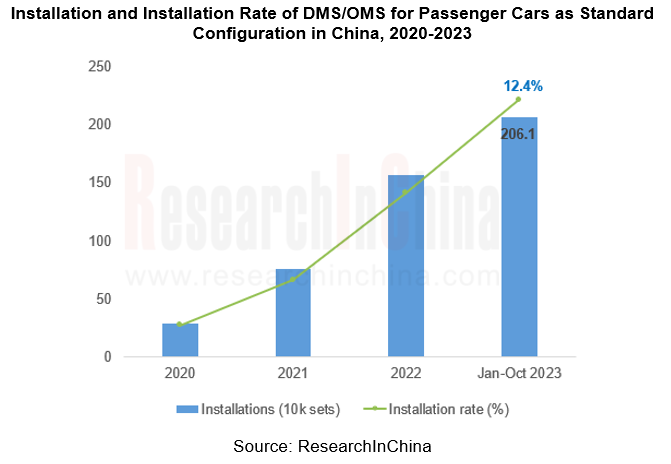
1. From January to October 2023, the installation of passenger car in-cabin monitoring systems in China increased by 81.3% year-on-year.
In recent years, the in-cabin monitoring market has entered the fast lane. From January to October 2023, the installation of China's passenger car cabin monitoring system reached 2.061 million sets, an increase of 81.3% year-on-year; the installation rate reached 12.4%, an increase of 4.5 percentage points over the same period last year.
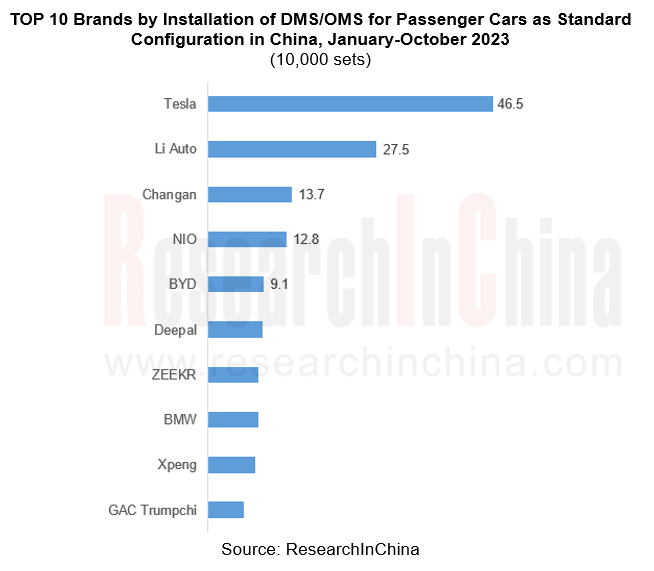
From the perspective of brand distribution, the brands with a large installation from January to October 2023 include Tesla, Li Auto, Changan, NIO, BYD, etc. The total installation of the TOP10 brands accounts for 72%.
2. ADAS will drive the growth in demand for DMS systems
In addition to regulations, the expansion of functions such as intelligent cockpit and high-level driver assistance on board also promotes in-cabin monitoring systems such as DMS and OMS. For example, in autonomous driving systems above L2, human-machine co-driving has become a difficult problem that needs to be solved, and DMS has become an indispensable redundancy solution. In addition, in different scenarios of high-level autonomous driving, the functional requirements and system strategies of in-cabin monitoring are different, and the functions and scenarios need to be defined according to the system requirements of autonomous driving.
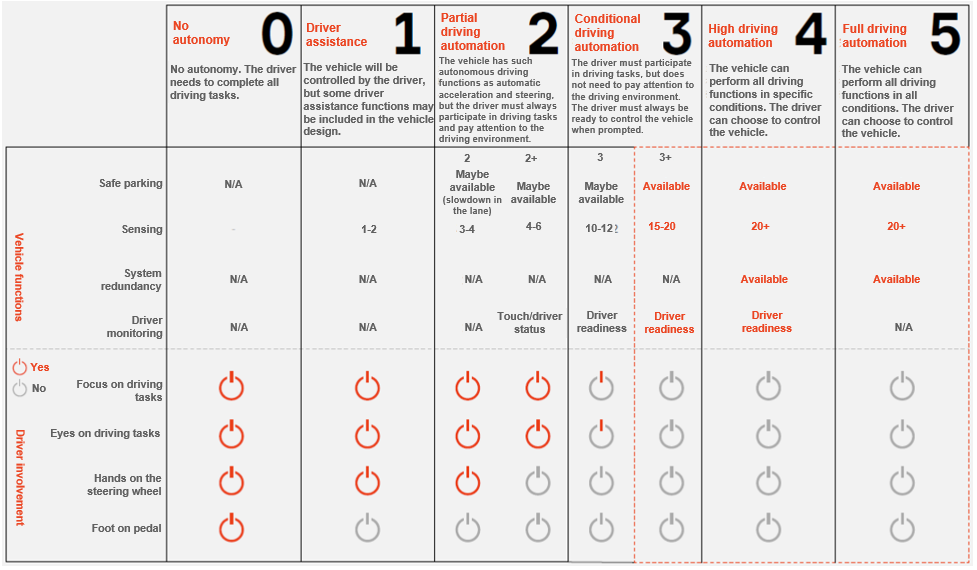
Source: Aptiv
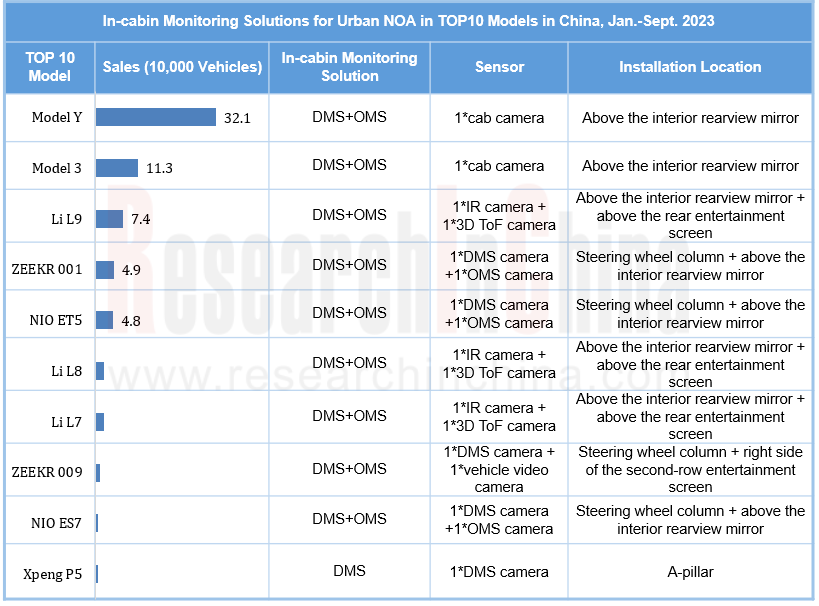
From the perspective of the top 10 models of urban NOA assembly, DMS + OMS has become the mainstream solution for in-cabin monitoring, mostly through 1-2 cameras to achieve all-round monitoring of drivers and occupants, meeting the high-level autonomous driving redundancy while also meeting intelligent requirements of cockpit.
Source: ResearchInChina
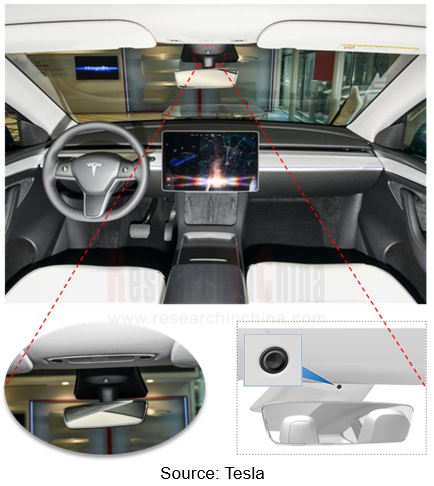
Tesla Model Y has a camera in the cab of the car. In October 2023, the version was upgraded to add a "Driver Sleepy Warning" function. This function uses camera to determine whether the driver is paying attention and sounds an alarm. It also allows users to remotely view the in-car camera when the vehicle's Sentinel mode or Pet mode functions are activated.
3. Radar sensors are widely used in OMS
In some scenarios (such as legacy child monitoring), the monitoring range of camera is easily affected by conditions such as installation location and line of sight, making it difficult to achieve accurate monitoring and alerting. And radar sensors (including radar, ultrasonic radar, UWB radar) have ability to penetrate solid matter, which can more accurately detect unattended children, monitor the status of occupants, and estimate the vital signs of drivers. The application in cabin monitoring is expected to expand.
As a new system radar, UWB works in the frequency band of 6-8GHz. The UWB radar has robust and high-precision characteristics, which can penetrate solid materials inside the car, such as metal barriers, car seats and baby blankets. It can also accurately detect very small movements, such as the detection of small fluctuations in the chest when a baby breathes.
Among in-cabin monitoring suppliers, HARMAN upgraded the Ready Care product function in January 2023. After upgrade, the vital signs sensing and legacy child detection functions can be realized through 24 GHz living body radar sensor and 60 GHz occupancy radar sensor.
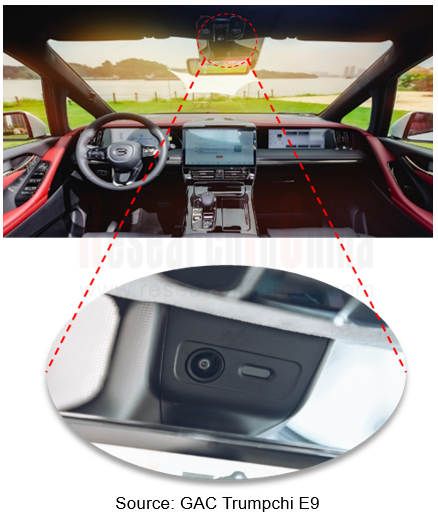
Among OEMs, GAC Trumpchi E9, which was launched in May 2023, has an OMS equipped with two OMS cameras, a vital signs monitoring radar (located above the inner rearview mirror) and an infrared monitor. Through this radar, the vital signs of drivers and passengers in the car can be detected.
4. Further integration of in-cabin monitoring system and multi-modal interaction
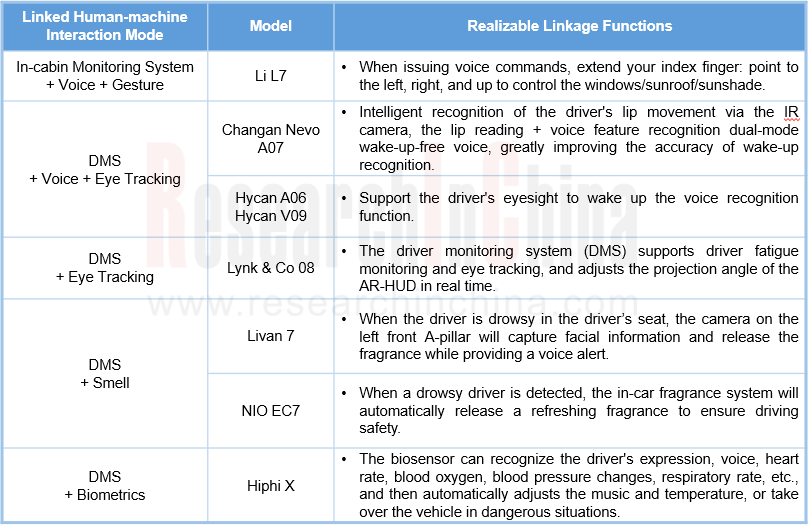
The in-cabin monitoring system, as the key ring of human-vehicle interaction, is being integrated with other multi-modal interactions such as voice/gesture/biometrics/smell in the cockpit.
Jingwei Hirain intelligent cockpit full cabin perception system SCSS has perception, presentation and processing capabilities, including camera modules, microphones, ambient lights, streaming media rearview mirrors, AR-HUD, smart seats, domain controllers and other components, which can deeply integrate ADAS, TBOX, body, HD maps and other information.
In mass-produced models, for example, the in-cabin monitoring system of Li Auto L7 supports interactive linkage with voice + gesture recognition; the DMS system of Changan Qiyuan A07, Lynk & Co 08, Rui Lan 7 and other models supports linkage with voice, eye tracking, and smell.
Application Case of DMS/OMS and Multi-modal Interaction Integration
Source: ResearchInChina
Vehicle-Road-Cloud Integration and C-V2X Industry Report, 2026
Vehicle-Road-Cloud and C-V2X Research: with the three-tier promotion system of "top-level planning + mandatory pilot + evaluation binding", the industry turning point is approachingThis report focuses...
China OEM Data Capability Analysis Report, 2026
OEM Data Capability Research: 24 OEMs × 9 Capability Domains, Who Takes the Lead?
An L4 autonomous driving R&D and test vehicle can generate approximately 10TB of raw data per single day — data v...
Autonomous Driving Domain Controller and Central Computing Unit (CCU) Industry Report, 2026
Autonomous Driving Domain Controller (ADCU) Research: One-Chip CCU solutions are quickly available in vehicles
In China's passenger car market, autonomous driving systems involved in mass production ...
Automotive EMS and ECU Industry Research Report, 2026
Automotive EMS Research: The boundaries between EMS providers and Tier1 suppliers are becoming blurred, and the supply chain model is evolving from a linear chain to a networked structure
Mainstream ...
Automotive Microcontroller Unit (MCU) and Application Scenario Research Report, 2026
Automotive MCU Research: Increased demand for redundant security drives ASIL D-compliant MCU shipments to exceed 100 million units
In a vehicle EEA, MCUs are widely distributed in various functional ...
China Intelligent Cockpit Patent Analysis Report, 2026
Intelligent Cockpit Patent Research: Cockpit AI, In?vehicle Health, and Infotainment Are Upgrade to Scenario?based and Proactive Functions
From a patent perspective, this report explores the cutting?...
Research Report on Application of VLA Large Model in Automobiles and Robots, 2026
Research on Automotive and Robot VLA: Hybrid Architectures Become Mainstream, VLA Integrates with General World Models, and Reinforcement Learning Serves as Core Engine
Vision?Language?Action (VLA) m...
China Charging Infrastructure (Supercharging, Battery Swapping, V2G, etc.) and High-Performance Supercharging Battery Research Report, 2026
Charging and battery swapping research: as 5C+ supercharging vehicle models go into mass production, the pace of OEMs self-building supercharging networks quickens
800-1000V high-voltage platforms ar...
China Passenger Car Electronic Controlled Suspension Industry Report, 2026
Electronic Controlled Suspension Industry Research: As the First Year of Full Active Suspension Unfolds, Three Technical Routes Race Forward
1. Penetration Rate Surges Three Times, and Electronic Con...
Intelligent Driving SoC Research Report, 2026
Research on Intelligent Driving SoCs: Competition Focus Shifts to L3/L4 Embedded Hardware, and Computing Power of Flagship Vehicle Models Exceeds 1,000 TOPS
In terms of intelligent driving system in...
Automotive AI Large Model Technology Research Report, 2026
Automotive AI Large Model Research: Competition Shifts from "Who Has the Stronger Model" to "Who Boasts Higher Link Efficiency"
ResearchInChina released the Automotive AI Large Model Technology Resea...
Intelligent Vehicle Cockpit Domain Controller Research Report, 2026
Cockpit domain controller research: L3 AIDV intelligent cockpit domain controllers are entering a boom period
Driven by multiple factors such as the continuous evolution of the automotive central int...
Automotive Acoustic System (Audio, Multi-Channel) Industry Report, 2026
Automotive Acoustics Research: Multiple Channels, AI Tuning, and Self-Developed Algorithms Drive the Transformation of High-End Cockpit Sound Fields
I. Automotive Audio Hardware Solutions with 6–9 S...
Autonomous Driving Sensor Chip Research Report, 2026
Research on Autonomous Driving Sensor Chips: Deeply Perceiving the Physical World, Sensor Chips Are Playing A “Leading Role” in Intelligence
In 2026, the autonomous driving sensor chip industr...
Passenger Car Corner Module and Wheel‑Side Control System Research Report, 2026
Wheel-side control research: the “last mile” chassis innovation
Wheel-side control dismantles the traditional drive, braking, steering, and suspension control of the chassis from a "centralized" styl...
Embodied Artificial Intelligence (& Humanoid Robot) MCU Research Report, 2026
Research on Humanoid Robot MCUs: Evolution from General-Purpose Control to High-Value Dedicated Chip Solutions Integrated with Edge AI Functions
MCU (Microcontroller Unit) refers to a compact integra...
Intelligent Vehicle Zone Control Unit (ZCU) Research Report, 2026
ZCU Research: Cross-domain integrated ZCUs are becoming the edge computing nodes of the next-generation zonal architecture
Currently, the mainstream zonal architecture is mainly the quasi-central + z...
Automotive Cybersecurity and Data Security Research Report, 2026
Cybersecurity & Data Security Research: Intelligent Connected Vehicles Enter the Era of “Systematic Offense-Defense and AI-Defined Security”.
Centering on the panorama of intelligent connect...