Global and China Automotive Comfort System (Seating system, Air Conditioning System) Research Report, 2024
Automotive comfort systems include seating system, air conditioning system, soundproof system and chassis suspension to improve comfort of drivers and passengers. This report highlights seating system and air conditioning system.
Seating system: the penetration of comfort functions rises, and zero-gravity seats usher in a boom period.
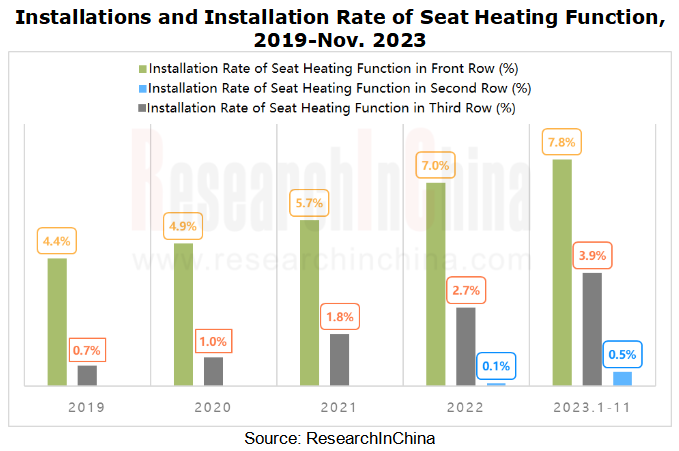
As intelligent vehicles gain popularity, automotive seats have ever more comfort functions such as heating, ventilation, massage, electric leg/foot rests and memory seat. Not only is the penetration of these functions on the rise, but they also begin to spread from the front row to the third row of seats.
In the case of seat heating function, from January to November 2023, its installation rate in the front row and the second row was 7.8% and 3.9%, respectively. Since 2022 the third row of seats has also begun to be equipped with heating function, and the main models include Li L8/L9, WEY Gaoshan and NIO ES8.
In terms of entire seats, the installation of zero-gravity seats has reached a small peak. Since being installed on AITO M7 (RMB289,800-379,800) in July 2022, zero-gravity seats have been mounted on models like IM LS7 (RMB309,800-459,800), AITO S7 (RMB249,800-349,800), ZEEKR X (RMB189,800-209,800) ), WEY Blue Mountain DHT (RMB273,800-308,800), Denza D9 (RMB335,000-445,000), and Trumpchi E8 (RMB209,800-229,800). They have been optional as driver’s and copilot seats of Deepal S7 (RMB149,900-202,900), a model launched in June 2023.
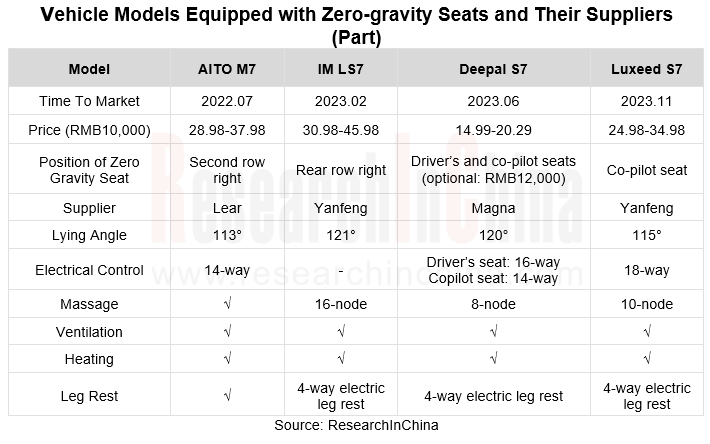
In the future, zero-gravity seats will be equipped with various sensors to enable adaptive adjustment, health monitoring and other functions, and comfort functions will keep being upgraded.
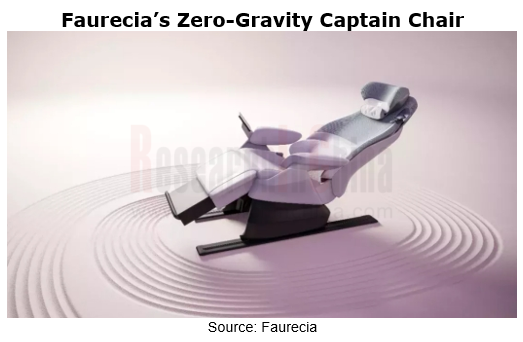
Faurecia: In April 2023, Faurecia introduced Zero-Gravity Captain Chair. It offers additional comfort with sensors able to identify potential physical pain and then activate corrective actions to alleviate any discomfort. It incorporates high-tech comfort solutions, such as an inflatable neck pillow and a headrest that automatically adjusts to its occupant’s height. As well as lower-back support and massage functions with pressure mapping to enhance relaxation, it includes a new, immersive haptic solution called VIBE, where tactile sensations are created by the car seat, stimulating the user’s sense of touch. When activated, digital 4D sound algorithms automatically create vibrations that accompany any sound played on the vehicle’s audio system.
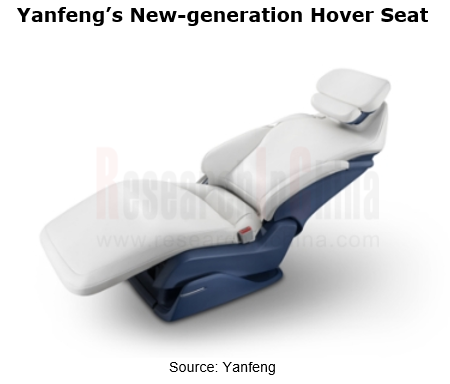
Yanfeng: In January 2024, Yanfeng launched the new-generation Hover Seat equipped with Seat Sensing Posture ID technology. Based on zero-gravity research, this seat actively relieves fatigue for passengers during driving by detecting the user's body languages such as sitting posture, fatigue level and body size.
?Adaptive Welcome Mode for Different Body Sizes: When a passenger gets into the car, the seat’s pressure pad sensors accurately recognize information about his/her body size and automatically adjust the headrest, lumbar support and side wings to make the seat more closely fit his/her body.
?Seating Position Recognition and Fitting: The sensor determines the seating posture of the occupant according to the pressure distribution to the seat. Equipped with a matrix of multi-faceted support blocks, the seat automatically adjusts the blocks to give the most comfortable support to the body where needed.
?Fatigue Detection and Automatic Massage: The seat detects the occupant changing their posture over time, then determines the degree and location of fatigue, and automatically triggers the partition massage function.
Air conditioning system: as the installation rate of heat pump air conditioners rises, air conditioning control systems become personalized, energy-efficient and active.
Heat pump air conditioner is an air conditioning system that integrates cooling and heating functions. Its core components include a compressor and a heat exchanger, which control indoor temperature by absorbing or dissipating heat in the air. By virtue of high heating efficiency, obvious energy saving effect, improvement of cruising range and other benefits, heat pump air conditioner has become a new track in the development of electric vehicle air conditioning systems.
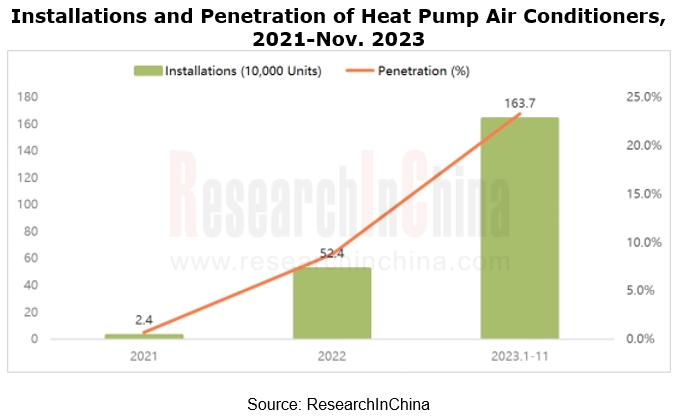
The data from ResearchInChina show that in China electric vehicles have begun to carry heat pump air conditioners since 2021, with a surging penetration, up to 23.3% from January to November 2023.
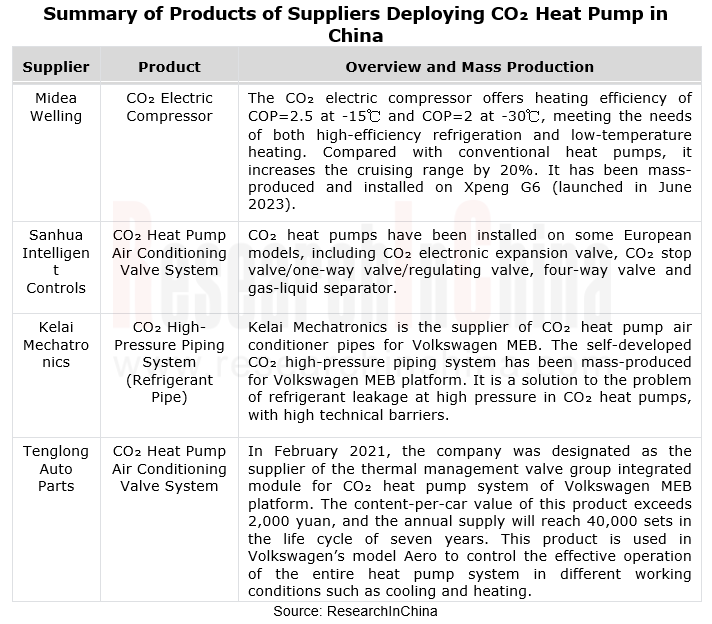
Heat pump air conditioner refrigerants are typically R-134a, R-1234yf and R744 (carbon dioxide, CO?). R744 can extend the cruising range of vehicles because of its better effects in environmental protection, safety, flow heat exchange and low temperature heating, and the prices of its raw materials are low. In the future, CO? heat pump systems using R744 refrigerant will become mainstream. Chinese suppliers have started deploying the CO? heat pump market:
Moreover in terms of air conditioning function, OEMs also head in the direction of refinement. AI algorithms make air conditioning systems controlled in multiple zones, and allow the driver and passengers to set their own temperatures, meeting the needs of different occupants. AI algorithms not only enable accurate control over parameters like refrigerant circulation and fan speed, but also take into account their impacts on battery cruising range to achieve energy-saving control effects.
NIO ES8 (launched in December 2022) packs an intelligent five-zone independent air-conditioning system, which uses a self-developed air-conditioning energy consumption calculation method to achieve: five-zone temperature control, five-zone blowing mode, and four-zone air volume adjustment, accurately controlling 0.5℃ in the range of 15-31℃.This system can be controlled via voice interaction or mobile phone APP remotely.
?Front row: 2-zone temperature control, 2-zone blowing mode, 2-zone air volume control
?Second row: 2-zone temperature control, 2-zone blowing mode, 1-zone air volume control
?Third row: 1-zone temperature control, 1-zone blowing mode, 1-zone air volume control
The OTA Update 4.6.2 has been officially pushed to Li L9 (launched in June 2022), adding a new mode of air conditioning energy saving. In this mode, the car will reduce the power of air conditioning and automatically adjust seat heating and steering wheel heating. While maintaining interior comfortable temperature, this mode cuts down energy consumption and increases the available cruising range of the car in EV mode. In urban commuting in winter (outdoor temperature: <0℃), the CLTC range can be increased by up to 50%.
IM LS6 (launched in October 2023), with its air-conditioning smart air outlet function, automatically turns off the air outlet in unoccupied positions by reading seat signals, making the air-conditioning system more efficient.
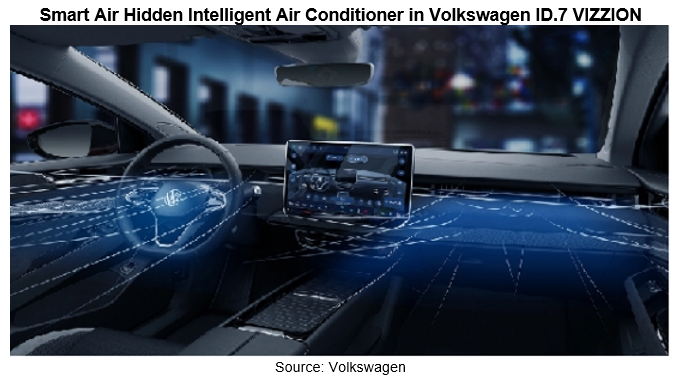
FAW-Volkswagen ID.7 VIZZION (launched in December 2023) is equipped with Smart Air, a hidden intelligent air conditioner that can memorize the height of different passengers, and set and adjust the height of the air outlet. Equipped with a climate sensor, it can automatically adjust the wind speed and air outlet angle according to the in-car environment, and automatically turn on defogging and defrosting functions according to humidity and temperature.
Future automotive air conditioning algorithms will use advanced technologies such as deep learning and neural networks to enable air conditioning systems to self-learn and optimize, more accurately predict the driver's needs, directly and actively adjust temperature, air volume and mode, minimizing manual adjustments by users and achieving more precise temperature control and energy efficiency optimization.
Automotive Microcontroller Unit (MCU) and Application Scenario Research Report, 2026
Automotive MCU Research: Increased demand for redundant security drives ASIL D-compliant MCU shipments to exceed 100 million units
In a vehicle EEA, MCUs are widely distributed in various functional ...
China Intelligent Cockpit Patent Analysis Report, 2026
Intelligent Cockpit Patent Research: Cockpit AI, In?vehicle Health, and Infotainment Are Upgrade to Scenario?based and Proactive Functions
From a patent perspective, this report explores the cutting?...
Research Report on Application of VLA Large Model in Automobiles and Robots, 2026
Research on Automotive and Robot VLA: Hybrid Architectures Become Mainstream, VLA Integrates with General World Models, and Reinforcement Learning Serves as Core Engine
Vision?Language?Action (VLA) m...
China Charging Infrastructure (Supercharging, Battery Swapping, V2G, etc.) and High-Performance Supercharging Battery Research Report, 2026
Charging and battery swapping research: as 5C+ supercharging vehicle models go into mass production, the pace of OEMs self-building supercharging networks quickens
800-1000V high-voltage platforms ar...
China Passenger Car Electronic Controlled Suspension Industry Report, 2026
Electronic Controlled Suspension Industry Research: As the First Year of Full Active Suspension Unfolds, Three Technical Routes Race Forward
1. Penetration Rate Surges Three Times, and Electronic Con...
Intelligent Driving SoC Research Report, 2026
Research on Intelligent Driving SoCs: Competition Focus Shifts to L3/L4 Embedded Hardware, and Computing Power of Flagship Vehicle Models Exceeds 1,000 TOPS
In terms of intelligent driving system in...
Automotive AI Large Model Technology Research Report, 2026
Automotive AI Large Model Research: Competition Shifts from "Who Has the Stronger Model" to "Who Boasts Higher Link Efficiency"
ResearchInChina released the Automotive AI Large Model Technology Resea...
Intelligent Vehicle Cockpit Domain Controller Research Report, 2026
Cockpit domain controller research: L3 AIDV intelligent cockpit domain controllers are entering a boom period
Driven by multiple factors such as the continuous evolution of the automotive central int...
Automotive Acoustic System (Audio, Multi-Channel) Industry Report, 2026
Automotive Acoustics Research: Multiple Channels, AI Tuning, and Self-Developed Algorithms Drive the Transformation of High-End Cockpit Sound Fields
I. Automotive Audio Hardware Solutions with 6–9 S...
Autonomous Driving Sensor Chip Research Report, 2026
Research on Autonomous Driving Sensor Chips: Deeply Perceiving the Physical World, Sensor Chips Are Playing A “Leading Role” in Intelligence
In 2026, the autonomous driving sensor chip industr...
Passenger Car Corner Module and Wheel‑Side Control System Research Report, 2026
Wheel-side control research: the “last mile” chassis innovation
Wheel-side control dismantles the traditional drive, braking, steering, and suspension control of the chassis from a "centralized" styl...
Embodied Artificial Intelligence (& Humanoid Robot) MCU Research Report, 2026
Research on Humanoid Robot MCUs: Evolution from General-Purpose Control to High-Value Dedicated Chip Solutions Integrated with Edge AI Functions
MCU (Microcontroller Unit) refers to a compact integra...
Intelligent Vehicle Zone Control Unit (ZCU) Research Report, 2026
ZCU Research: Cross-domain integrated ZCUs are becoming the edge computing nodes of the next-generation zonal architecture
Currently, the mainstream zonal architecture is mainly the quasi-central + z...
Automotive Cybersecurity and Data Security Research Report, 2026
Cybersecurity & Data Security Research: Intelligent Connected Vehicles Enter the Era of “Systematic Offense-Defense and AI-Defined Security”.
Centering on the panorama of intelligent connect...
Report on Breakthrough Strategies of OEMs and ADAS Tier 1 Suppliers for Overseas Layout of Intelligent Driving, 2026
Regulatory Breakthrough, Local System Establishment, OEMs Competing for NOA Layout: Overall Trends of China’s Intelligent Driving Overseas Layout in 2026
Research on overseas intelligent driving layo...
OEMs and Tier1s’ Intelligent Cockpit Platform (Hardware and Software) Innovation Strategy Research Report, 2026
Intelligent Cockpit Platform Research: multi-dimensional cockpit system architecture reconstruction for multi-agent collaboration and proactive intelligent services
The intelligent cockpit software s...
Automotive AIOS Research Report, 2026
Automotive AIOS Research: Mass Production Solutions Are Implemented
Mass Production Solutions Are Implemented on A Small Scale.
In 2026, AIOS starts small-scale implementation, helping to improve v...
Automotive Telematics Service Provider (TSP) Research Report, 2026
TSP Research: Leading providers collectively turn to AI agents to provide all-scenario active services
Telematics Service Providers (TSPs) are the core hub of the telematics industry chain, connectin...