Automotive XR (Extended Reality) is an innovative technology that integrates VR (Virtual Reality), AR (Augmented Reality) and MR (Mixed Reality) technologies into vehicle systems. It can bring drivers and passengers richer and more intuitive information interaction experiences. It is an important embodiment of differentiation between intelligent cockpits of the future.???
XR is integrated with IVI and smartphones to create multi-terminal integration experience.
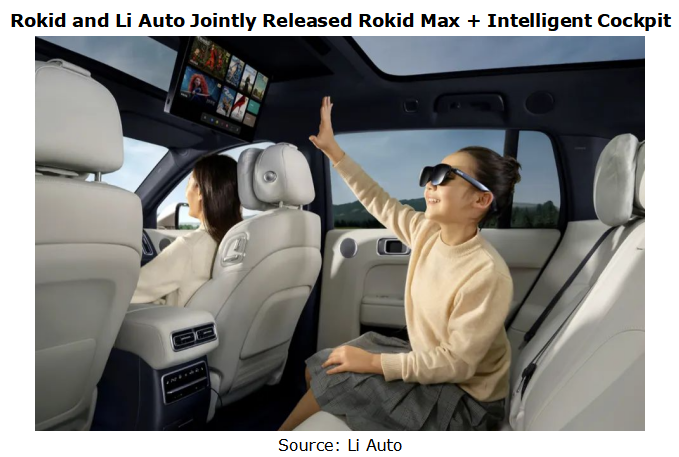
In March 2023, Rokid and Li Auto announced Rokid Max, their cooperative AR glasses which support L series models. Li Auto’s IVI APP can be projected onto VR glasses for viewing, gaming, online office, etc. In addition, it allows handheld game consoles to be projected onto the center console screen and then to the glasses, so that users can control IVI and play games through gesture interaction.???
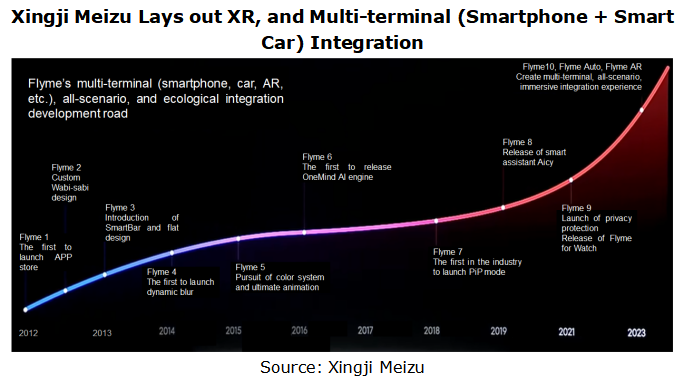
In November 2023, Xingji Meizu released MYVU intelligent AR glasses based on Flyme AR OS. The integration with Meizu smartphones via Flyme Link (a smartphone-IVI integration solution) not only allows for circulation of phone calls, music, videos, navigation, important application notifications and more to the AR glasses, but also makes it share computing power and network with the smartphone, thereby reducing the power consumption of the glasses and enabling a long cruising range. In the future, MYVU AR glasses will be integrated with cars and smartphones to create multi-terminal integration experience through seamless flow of applications and data.??
?
Therefore, at the “Meizu Flyme Ecosystem Launch”, Xingji Meizu upgraded the operating system Flyme to FlymeOS. Composed of Flyme 10 (smartphone OS), Flyme Auto (Meizu IVI system), and Flyme AR (AR glasses OS), FlymeOS covers three major areas: smartphone, XR and intelligent vehicle. FlymeOS features "Internet of Everything, Boundless and Infinite", and becomes the base for connecting all terminals.?????
AI+AR to enhance voice interaction experience
?
At CES 2024, Rayneo unveiled Rayneo X2 Lite, a stereo full-color MicroLED optical waveguide AR glasses that introduce Rayneo AI (released in December 2023), a foundation model voice assistant. With Rayneo AI, Rayneo X2 Lite enables multiple capabilities including multi-round natural language conversations, trip planning, easy encyclopedic Q&A and brainstorming, and supports AI-assisted translation, 3D spatial navigation, and first-person perspective video creation. In March 2024, Rayneo Technology closed a new funding round and raised RMB100 million which will be used to develop and spawn next-generation AR glasses and expedite the construction of the AI+AR glasses ecosystem.????
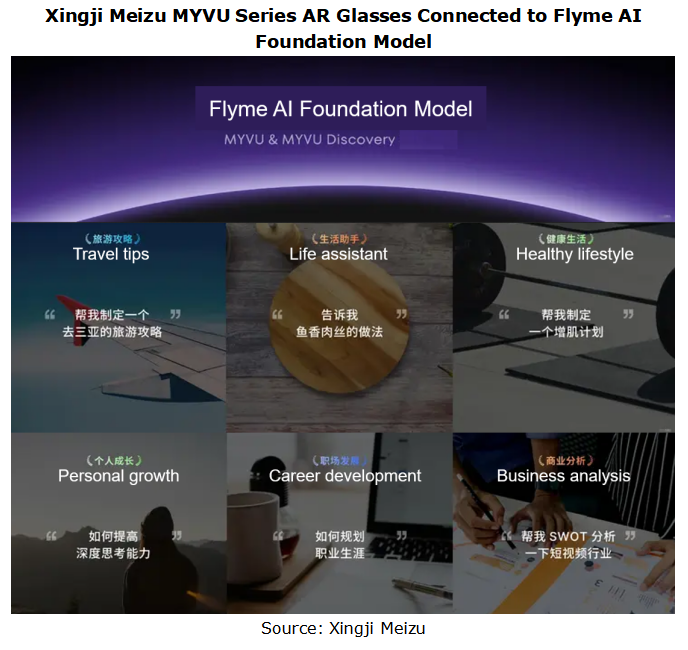
Xingji Meizu is also laying out AI+AR. In November 2023, Xingji Meizu released two MYVU series AR glasses, connected to the Flyme AI foundation model. Based on AI, AI assistant can be awakened in real time to provide travel tips, study plans, business analysis, and other daily life and work collaboration. At the same time, AR glasses can realize scenario functions such as teleprompter, real-time translation (in Chinese and English), and cycling navigation.
Automotive XR scenarios expand from entertainment to driving assistance and vehicle control.
Currently, XR mainly caters to users’ needs for cockpit entertainment, for example, viewing and gaming. Moreover suppliers are also exploring other application scenarios such as driving assistance and vehicle control.?
?
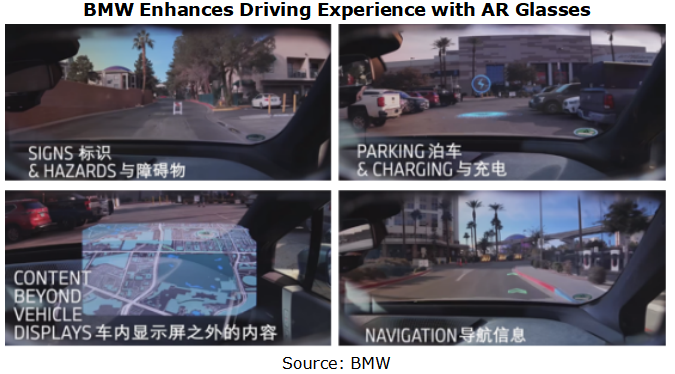
At CES 2024, BMW and XREAL together demonstrated XREAL Air 2 AR glasses, a device which integrates vehicle information, infotainment, vehicle electronic and electrical information, BMW cloud information and other data. Wearing the glasses, users can see how navigation instructions, hazard warnings, entertainment content, information on charging stations and supporting visualizations in parking situations are embedded perfectly into the real-world environment by the “XREAL Air 2”.???
?
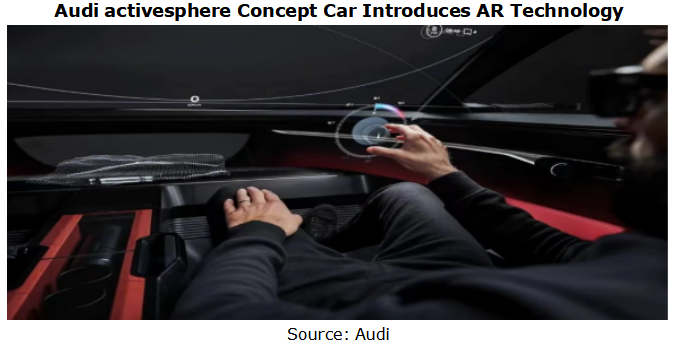
At CES 2023, Audi presented activesphere, a concept car which is equipped with four AR headsets. Wearing Magic Leap 2 AR glasses, the driver can view trip data, road conditions, location and navigation information in real time the MR visual interface with a 70° FOV; the passengers can control air conditioning temperature, airflow, and audio system next to their seats via gestures.??
?
Furthermore, AR technology can be available beyond the cockpit. In off-road scenarios, the topographic map can be projected into the surroundings; in commuting, traffic information, routes and safety warnings can be projected in layers into the driver's view.????
 ?
?
?
Automotive Microcontroller Unit (MCU) and Application Scenario Research Report, 2026
Automotive MCU Research: Increased demand for redundant security drives ASIL D-compliant MCU shipments to exceed 100 million units
In a vehicle EEA, MCUs are widely distributed in various functional ...
China Intelligent Cockpit Patent Analysis Report, 2026
Intelligent Cockpit Patent Research: Cockpit AI, In?vehicle Health, and Infotainment Are Upgrade to Scenario?based and Proactive Functions
From a patent perspective, this report explores the cutting?...
Research Report on Application of VLA Large Model in Automobiles and Robots, 2026
Research on Automotive and Robot VLA: Hybrid Architectures Become Mainstream, VLA Integrates with General World Models, and Reinforcement Learning Serves as Core Engine
Vision?Language?Action (VLA) m...
China Charging Infrastructure (Supercharging, Battery Swapping, V2G, etc.) and High-Performance Supercharging Battery Research Report, 2026
Charging and battery swapping research: as 5C+ supercharging vehicle models go into mass production, the pace of OEMs self-building supercharging networks quickens
800-1000V high-voltage platforms ar...
China Passenger Car Electronic Controlled Suspension Industry Report, 2026
Electronic Controlled Suspension Industry Research: As the First Year of Full Active Suspension Unfolds, Three Technical Routes Race Forward
1. Penetration Rate Surges Three Times, and Electronic Con...
Intelligent Driving SoC Research Report, 2026
Research on Intelligent Driving SoCs: Competition Focus Shifts to L3/L4 Embedded Hardware, and Computing Power of Flagship Vehicle Models Exceeds 1,000 TOPS
In terms of intelligent driving system in...
Automotive AI Large Model Technology Research Report, 2026
Automotive AI Large Model Research: Competition Shifts from "Who Has the Stronger Model" to "Who Boasts Higher Link Efficiency"
ResearchInChina released the Automotive AI Large Model Technology Resea...
Intelligent Vehicle Cockpit Domain Controller Research Report, 2026
Cockpit domain controller research: L3 AIDV intelligent cockpit domain controllers are entering a boom period
Driven by multiple factors such as the continuous evolution of the automotive central int...
Automotive Acoustic System (Audio, Multi-Channel) Industry Report, 2026
Automotive Acoustics Research: Multiple Channels, AI Tuning, and Self-Developed Algorithms Drive the Transformation of High-End Cockpit Sound Fields
I. Automotive Audio Hardware Solutions with 6–9 S...
Autonomous Driving Sensor Chip Research Report, 2026
Research on Autonomous Driving Sensor Chips: Deeply Perceiving the Physical World, Sensor Chips Are Playing A “Leading Role” in Intelligence
In 2026, the autonomous driving sensor chip industr...
Passenger Car Corner Module and Wheel‑Side Control System Research Report, 2026
Wheel-side control research: the “last mile” chassis innovation
Wheel-side control dismantles the traditional drive, braking, steering, and suspension control of the chassis from a "centralized" styl...
Embodied Artificial Intelligence (& Humanoid Robot) MCU Research Report, 2026
Research on Humanoid Robot MCUs: Evolution from General-Purpose Control to High-Value Dedicated Chip Solutions Integrated with Edge AI Functions
MCU (Microcontroller Unit) refers to a compact integra...
Intelligent Vehicle Zone Control Unit (ZCU) Research Report, 2026
ZCU Research: Cross-domain integrated ZCUs are becoming the edge computing nodes of the next-generation zonal architecture
Currently, the mainstream zonal architecture is mainly the quasi-central + z...
Automotive Cybersecurity and Data Security Research Report, 2026
Cybersecurity & Data Security Research: Intelligent Connected Vehicles Enter the Era of “Systematic Offense-Defense and AI-Defined Security”.
Centering on the panorama of intelligent connect...
Report on Breakthrough Strategies of OEMs and ADAS Tier 1 Suppliers for Overseas Layout of Intelligent Driving, 2026
Regulatory Breakthrough, Local System Establishment, OEMs Competing for NOA Layout: Overall Trends of China’s Intelligent Driving Overseas Layout in 2026
Research on overseas intelligent driving layo...
OEMs and Tier1s’ Intelligent Cockpit Platform (Hardware and Software) Innovation Strategy Research Report, 2026
Intelligent Cockpit Platform Research: multi-dimensional cockpit system architecture reconstruction for multi-agent collaboration and proactive intelligent services
The intelligent cockpit software s...
Automotive AIOS Research Report, 2026
Automotive AIOS Research: Mass Production Solutions Are Implemented
Mass Production Solutions Are Implemented on A Small Scale.
In 2026, AIOS starts small-scale implementation, helping to improve v...
Automotive Telematics Service Provider (TSP) Research Report, 2026
TSP Research: Leading providers collectively turn to AI agents to provide all-scenario active services
Telematics Service Providers (TSPs) are the core hub of the telematics industry chain, connectin...