Automotive electronics OEM/ODM/EMS research: top players’ revenue has exceeded RMB10 billion, and new entrants have been coming in.?
At present, OEMs in the Chinese automotive electronics industry can be roughly divided into three types: those that transform from consumer electronics, including conventional consumer electronics EMS providers such as Luxshare Precision, Flextronics, Wistron and Quanta; assembly manufacturers that focus on automotive electronics, such as Wieson Automotive and Maruhi Electronic; OEM and assembly businesses of Tier 1 suppliers like Joyson Electronic and Hangsheng Electronics.
Three paths for OEMs to enter the automotive electronics field
From the summary of the growth paths of some manufacturers entering the automotive electronics field, it can be seen that: most companies participate in the automotive industry chain by acquisition, cooperation and other ways, and acquire core technologies to quicken their pace of entering the automotive industry, make an expansion in the market and improve industry concentration. Manufacturers including Huaqin Technology, Wingtech Technology and Luxshare Precision have established automotive electronics divisions or joint ventures to find new business growth space in the field of automotive electronics.
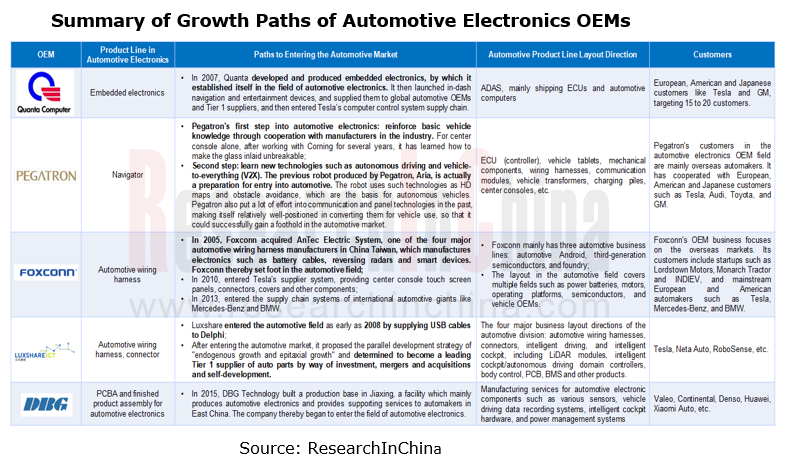
It takes some time to build up resources required to switch the role from consumer electronics to automotive electronics, and it is unlikely to directly enter the supply of core automotive parts. Therefore most manufacturers that have just begun to dabble in automotive electronics have started with products with low added value and low technical threshold.
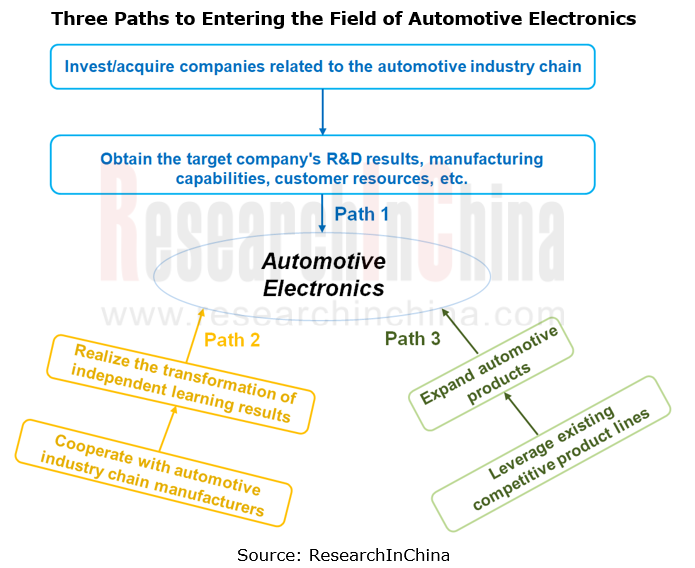
Path 1: Take Foxconn as an example. In 2005, Foxconn acquired AnTec Electric System, one of the four major automotive wiring harness manufacturers in China Taiwan, which manufactures electronics such as battery cables, reversing radars and smart devices. Foxconn thereby set foot in the automotive field. In 2010, Foxconn entered Tesla's supplier system, providing center console touch screen panels, connectors, covers and other components. In 2013, Foxconn entered the supply chain systems of international automotive giants like Mercedes-Benz and BMW.
Path 2: Take Pegatron as an example. Pegatron's first step into the automotive electronics field is to cooperate with industry manufacturers to reinforce basic vehicle knowledge. It has then independently learned related new technologies to prepare for a foothold in the automotive electronics market. For instance, Aria, the commercial robot developed by Pegatron, is actually a preparation for entry into automotive, because Aria uses such technologies as HD maps and obstacle avoidance, which are the basis for autonomous vehicles.
Path 3: Take Luxshare Precision as an example. Luxshare Precision dabbled in the consumer electronics field starting with wire harness OEM and assembly, and gradually expanded to the production of connecting wires, connectors, acoustic and radio frequency devices, wireless charging, electronic modules and other products. Luxshare Precision set foot in the automotive electronics field by the same way as consumer electronics, starting with connectors which it excels at, and then breaking into the automotive electronics field through a range of acquisitions.???
Luxshare Precision stepped into the automotive market as early as 2008 by supplying USB cables to Delphi. After entering the automotive market, it proposed the parallel development strategy of "endogenous growth and epitaxial growth", and has become a Tier 1 supplier of auto parts by way of investment, mergers and acquisitions and self-development. In 2011, Luxshare Precision established Luxshare Precision Industry (Kunshan) Co., Ltd., first developing components businesses like automotive connectors and wiring harnesses; in 2012, Luxshare Precision acquired Fujian JK Wiring Systems Co., Ltd., thereby forging into the automotive connector field, and entered the supply chain of Denso; in 2013, Luxshare Precision further expanded its product lines and customer network and entered the supply chains of German automakers by acquiring Germany’s SUK (SUK is a core supplier of plastic parts for door locks of BMW and Mercedes-Benz).??
The success in the automotive wiring harness and connector product lines has helped Luxshare Precision to expand other automotive products, and has also offered great assistance for it in intelligent cockpit, intelligent driving and other product lines. In recent years, Luxshare Precision has made a gradual expansion from conventional vehicles to new energy vehicles, for example, it collaborated with RoboSense for a foray into the LiDAR market, and teamed up with Chery to enter the vehicle ODM field.
Luxshare Precision's domain controller business mainly adopts OEM (original equipment manufacturer) and JDM (joint design manufacturer) models, with development ideas similar to consumer electronics. In addition, Luxshare Precision dabbles in other automotive products similar to consumer electronics such as wireless charging by partnering with its major clients.?

The competitive edges of automotive electronics OEMs: large-scale delivery experience + vertical integration capability.
For manufacturers that enter the automotive electronics OEM field from different industries or fields, their original genes determine their competitive edges in the field:
The advantage of consumer electronics EMS providers lies in their large-scale delivery experience gathered in consumer electronics, supply chain management capabilities, and strong sense of cost control;?
Assembly manufacturers that specialize in automotive electronics have mature production processes and manufacturing management and quality systems thanks to their years of deployments in automotive electronics, and have accumulated a lot of customer resources. This is their edge that consumer electronics manufacturers do not have;
For automotive Tier 1 suppliers that are engaged in hardware OEM business, their know-how and product R&D capabilities in the automotive industry are their competitive edges that differentiate them from consumer electronics OEM giants.?
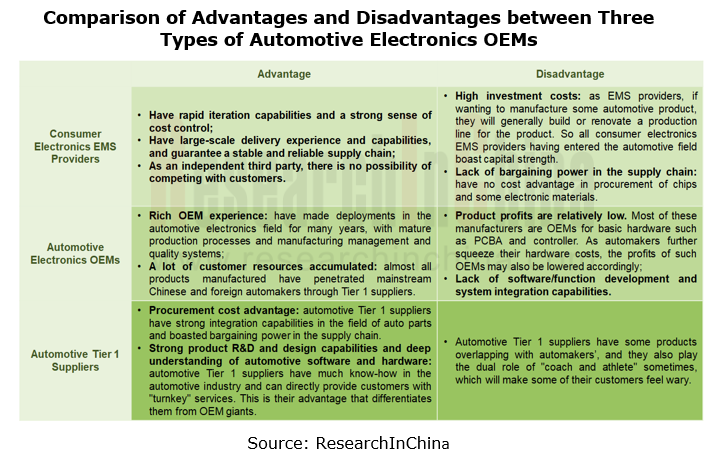
At present, mainstream automakers in China attach ever more importance to companies with experience in consumer electronics when selecting supply chain partners. In particular, the entry of conventional consumer electronics OEM giants has significantly lowered the hardware design and production threshold of auto parts.
These consumer electronics EMS providers with years of efforts have built up rapid iteration capabilities, developed a sense of cost control, gained an edge in supply chain system, and had quick response capabilities and understanding of the ecosystem in consumer electronics. They can well help OEMs to promote and apply new products and new technologies.
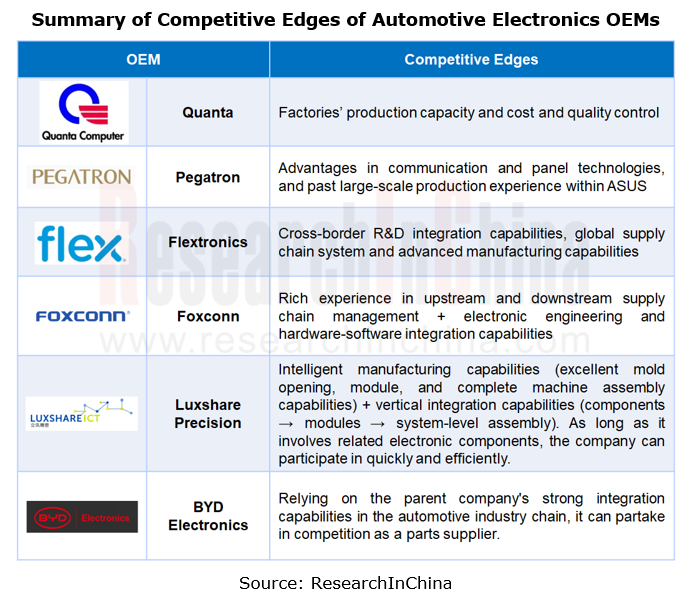
The large-scale delivery experience and vertical integration capability are more in favor of manufacturers to secure automotive electronics OEM orders. Moreover the capabilities of supply chain management, quality and cost control, localized quick response, and technology development are all the focus of attention from customers in the automotive industry chain.
In June 2023, Foxconn received orders for electronic control units (ECUs) from Tesla and planned to produce them at the Mexican factory of its Business Group D. The factory of Foxconn (Hon Hai) in Mexico has advantages in mass production scale, personnel, cost and price. Meanwhile nearby supply also allows Hon Hai to better serve the American market and provide stable supply chain support for Tesla in the market. This will also further shorten the delivery time.
?
The growth trend of automotive electronics OEMs: develop from assembly and OEM to high value-added R&D and design links.?
In recent two years, the price war in the Chinese automotive industry has become increasingly fierce, and OEMs have very extremely controlled and squeezed their costs. For OEMs engaged in automotive electronics assembly and processing, their profit margins will be very limited if they only act as hardware OEMs. As seen in the comparison of gross margin of automotive business between some OEMs in 2022 and 2023, the gross margin of each company's automotive business showed a downward trend in 2023.???
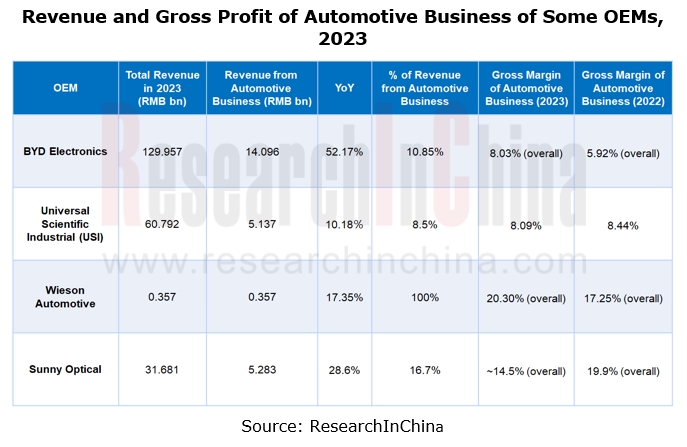
For a higher profit margin, some OEMs have worked to develop their product design and R&D capabilities after improving their manufacturing capabilities. They have moved up to the solution design link and even provided overall solutions, thereby gaining more businesses and a say. Because more capabilities are required, they also enjoy a higher gross margin than those which are engaged in OEM business only. Conventional consumer electronics EMS providers such as Flextronics, Quanta, Foxconn, and Luxshare Precision do not stopped at OEM business when making deployments in the intelligent vehicle segment. Instead they improve capabilities and proportion of self-development, and even build in-depth cooperation with automakers.???
Automotive Microcontroller Unit (MCU) and Application Scenario Research Report, 2026
Automotive MCU Research: Increased demand for redundant security drives ASIL D-compliant MCU shipments to exceed 100 million units
In a vehicle EEA, MCUs are widely distributed in various functional ...
China Intelligent Cockpit Patent Analysis Report, 2026
Intelligent Cockpit Patent Research: Cockpit AI, In?vehicle Health, and Infotainment Are Upgrade to Scenario?based and Proactive Functions
From a patent perspective, this report explores the cutting?...
Research Report on Application of VLA Large Model in Automobiles and Robots, 2026
Research on Automotive and Robot VLA: Hybrid Architectures Become Mainstream, VLA Integrates with General World Models, and Reinforcement Learning Serves as Core Engine
Vision?Language?Action (VLA) m...
China Charging Infrastructure (Supercharging, Battery Swapping, V2G, etc.) and High-Performance Supercharging Battery Research Report, 2026
Charging and battery swapping research: as 5C+ supercharging vehicle models go into mass production, the pace of OEMs self-building supercharging networks quickens
800-1000V high-voltage platforms ar...
China Passenger Car Electronic Controlled Suspension Industry Report, 2026
Electronic Controlled Suspension Industry Research: As the First Year of Full Active Suspension Unfolds, Three Technical Routes Race Forward
1. Penetration Rate Surges Three Times, and Electronic Con...
Intelligent Driving SoC Research Report, 2026
Research on Intelligent Driving SoCs: Competition Focus Shifts to L3/L4 Embedded Hardware, and Computing Power of Flagship Vehicle Models Exceeds 1,000 TOPS
In terms of intelligent driving system in...
Automotive AI Large Model Technology Research Report, 2026
Automotive AI Large Model Research: Competition Shifts from "Who Has the Stronger Model" to "Who Boasts Higher Link Efficiency"
ResearchInChina released the Automotive AI Large Model Technology Resea...
Intelligent Vehicle Cockpit Domain Controller Research Report, 2026
Cockpit domain controller research: L3 AIDV intelligent cockpit domain controllers are entering a boom period
Driven by multiple factors such as the continuous evolution of the automotive central int...
Automotive Acoustic System (Audio, Multi-Channel) Industry Report, 2026
Automotive Acoustics Research: Multiple Channels, AI Tuning, and Self-Developed Algorithms Drive the Transformation of High-End Cockpit Sound Fields
I. Automotive Audio Hardware Solutions with 6–9 S...
Autonomous Driving Sensor Chip Research Report, 2026
Research on Autonomous Driving Sensor Chips: Deeply Perceiving the Physical World, Sensor Chips Are Playing A “Leading Role” in Intelligence
In 2026, the autonomous driving sensor chip industr...
Passenger Car Corner Module and Wheel‑Side Control System Research Report, 2026
Wheel-side control research: the “last mile” chassis innovation
Wheel-side control dismantles the traditional drive, braking, steering, and suspension control of the chassis from a "centralized" styl...
Embodied Artificial Intelligence (& Humanoid Robot) MCU Research Report, 2026
Research on Humanoid Robot MCUs: Evolution from General-Purpose Control to High-Value Dedicated Chip Solutions Integrated with Edge AI Functions
MCU (Microcontroller Unit) refers to a compact integra...
Intelligent Vehicle Zone Control Unit (ZCU) Research Report, 2026
ZCU Research: Cross-domain integrated ZCUs are becoming the edge computing nodes of the next-generation zonal architecture
Currently, the mainstream zonal architecture is mainly the quasi-central + z...
Automotive Cybersecurity and Data Security Research Report, 2026
Cybersecurity & Data Security Research: Intelligent Connected Vehicles Enter the Era of “Systematic Offense-Defense and AI-Defined Security”.
Centering on the panorama of intelligent connect...
Report on Breakthrough Strategies of OEMs and ADAS Tier 1 Suppliers for Overseas Layout of Intelligent Driving, 2026
Regulatory Breakthrough, Local System Establishment, OEMs Competing for NOA Layout: Overall Trends of China’s Intelligent Driving Overseas Layout in 2026
Research on overseas intelligent driving layo...
OEMs and Tier1s’ Intelligent Cockpit Platform (Hardware and Software) Innovation Strategy Research Report, 2026
Intelligent Cockpit Platform Research: multi-dimensional cockpit system architecture reconstruction for multi-agent collaboration and proactive intelligent services
The intelligent cockpit software s...
Automotive AIOS Research Report, 2026
Automotive AIOS Research: Mass Production Solutions Are Implemented
Mass Production Solutions Are Implemented on A Small Scale.
In 2026, AIOS starts small-scale implementation, helping to improve v...
Automotive Telematics Service Provider (TSP) Research Report, 2026
TSP Research: Leading providers collectively turn to AI agents to provide all-scenario active services
Telematics Service Providers (TSPs) are the core hub of the telematics industry chain, connectin...