Ecological Domain and Automotive Hardware Expansion Research Report, 2024
Automotive Ecological Domain Research: How Will OEM Ecology and Peripheral Hardware Develop?
?
Ecological Domain and Automotive Hardware Expansion Research Report, 2024 released by ResearchInChina recently delves in the dynamics of automotive ecological domain in peripheral hardware expansion, supplier ecological solutions and OEM ecological implementation, and comprehensively combs and forecasts the development and future trends of automotive ecological domain.
First, the ecological domain will realize large-scale interconnection between? IVI and external software and hardware, and obtain efficient collaborative perception and calculation of multiple devices.
The automotive ecological domain refers to the software and hardware ecosystem centering on IVI and including various peripheral devices. The IVI can call terminal sensors (such as mobile phones, cameras, UAVs, tablet PCs, etc.) and computing power, and attain efficient collaborative perception and computing of multiple devices through the cloud platform. The ecological expansion of automotive applications has always been a hot spot for OEMs and suppliers, and the development can be divided into three stages. In the first stage, ecological expansion is mainly realized through? IVI application mall. In the second stage, the mobile phone ecosystem will be transferred to IVI through phone-vehicle interconnection. In the third ecological stage, watches, cameras, tablet PCs, and even UAVs, smart homes, seats, etc. are added.
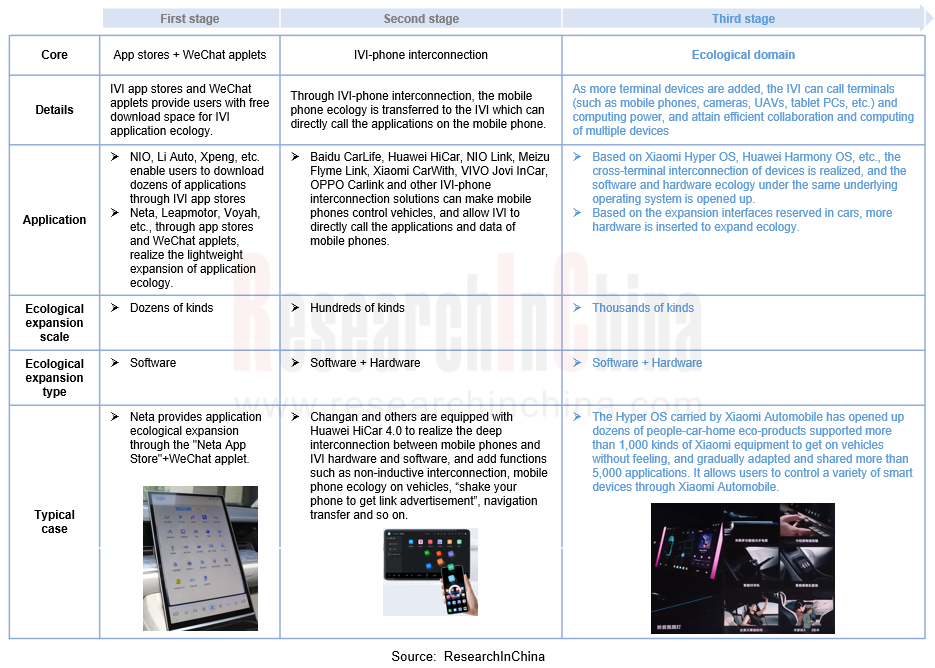
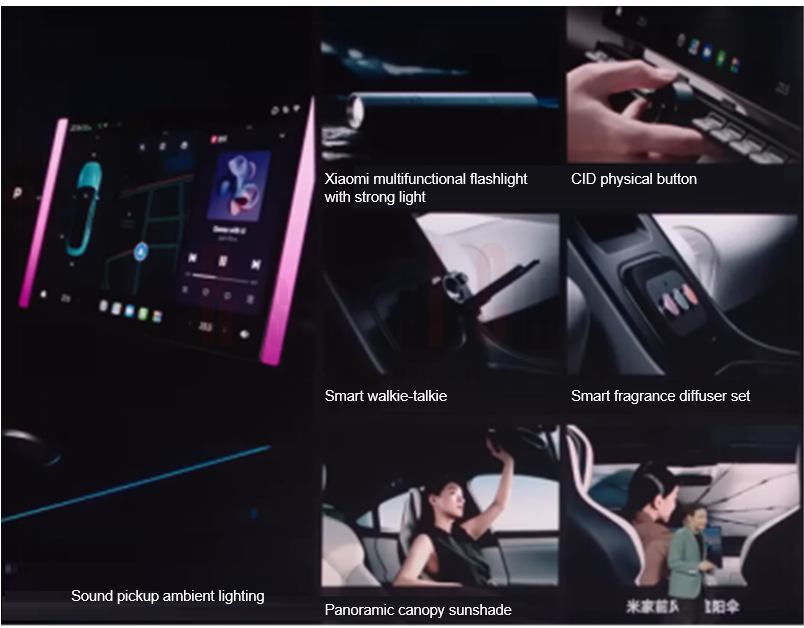
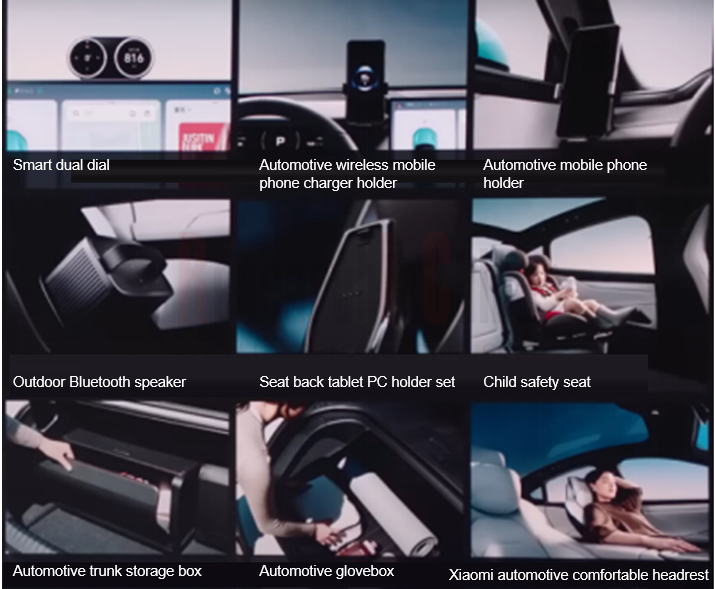
Xiaomi Automobile is a typical ecological domain constructor. Relying on its HyperOS and Mi Home ecosystem, Xiaomi Automobile can support 1,000+ Mi Home devices to get on vehicles seamlessly, and can be connected without passwords under the same account to realize automatic scenario linkage.
?
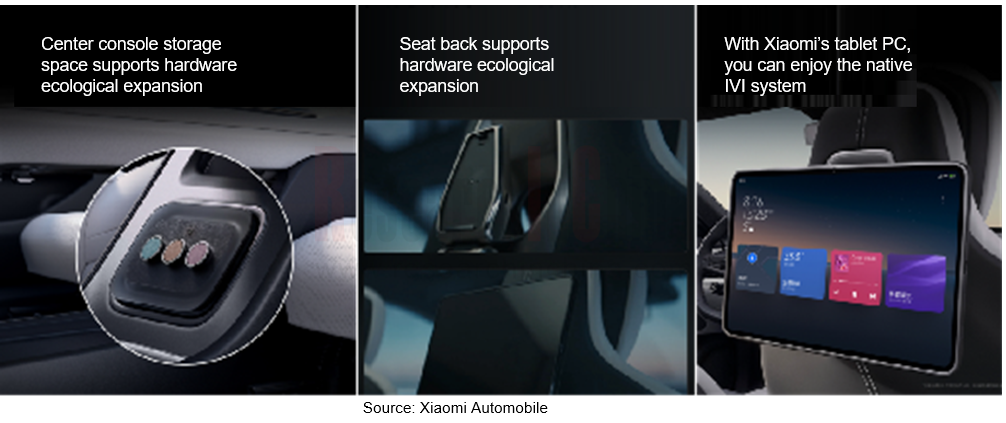
In order to support ecological expansion, Xiaomi has reserved a large number of interfaces in central instrument displays (CIDs), center consoles and seat back. For instance:
?PIN points are reserved around CIDs to expand interfaces, hardware devices of the third parties can realize plug-and-play, and there is a magnet at the bottom of the screen to attract a group of physical buttons for the purpose of control in vehicles.
?The storage space of center consoles reserves hardware interfaces, power interfaces and magnetic attraction, which can expand more innovative hardware of the third parties, such as Mi Home automotive fragrance diffusers.
?The back of seats features 22.5W magnetic charging. After Xiaomi’s tablet PC is adsorbed, it will directly become the original IVI, which can control 30+ automotive systems such as navigation, air conditioning, seating, audio and video. In addition, the IVI has CarPlay and AirPlay wireless connections, and the expansion of the seat back also supports iPad, which can control air conditioning, music and seats.
Second, OEMs often start from scenarios to design the ecological domain expansion.
According to Ecological Domain and Automotive Hardware Expansion Research Report, 2024 by ResearchInChina, the automotive ecology has included hundreds of kinds of hardware and thousands of accessible hardware devices. From OEMs' point of view, Xiaomi Automobile can support the first batch of 1,000+ Mi Home devices to get on vehicles, GAC's Green Smart Car Home can support interconnection with 4,000+ devices, and Huawei's house-wide intelligence is connected with 7,000+ smart items carrying HarmonyOS.
?
Facing massive hardware resources, OEMs often conduct hardware layout from scenarios when designing the ecological domain, especially typical scenarios like smart home, gaming, viewing, karaoke, virtual reality, shooting, office, camping, charging, smart mobility, sports and health. At present, most of automotive hardware products are optional, and some of them can be purchased conveniently through official App stores of OEMs.
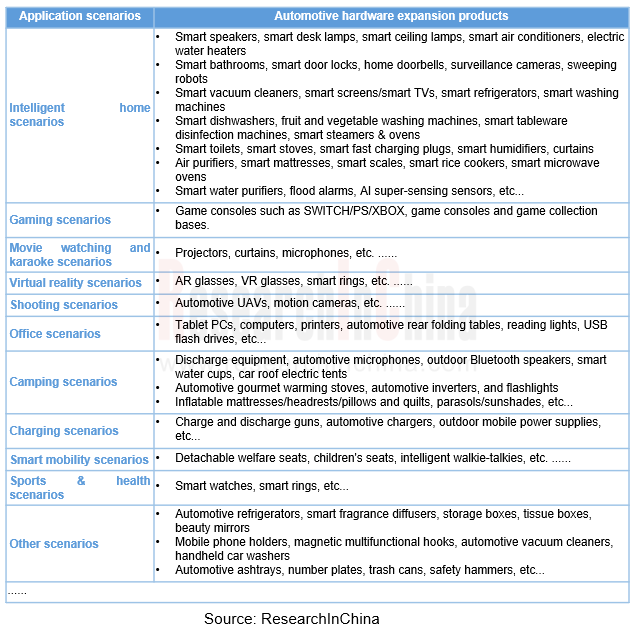
1.In entertainment scenarios, OEMs introduce a series of entertainment equipment such as game consoles (SWITCH, PS, etc.), movie-watching equipment, microphones, automotive UAVs, sports cameras, etc. to link multi-terminal information with IVI, thus improving playability of cockpits.
?
Hardware interconnection cases in entertainment scenarios:
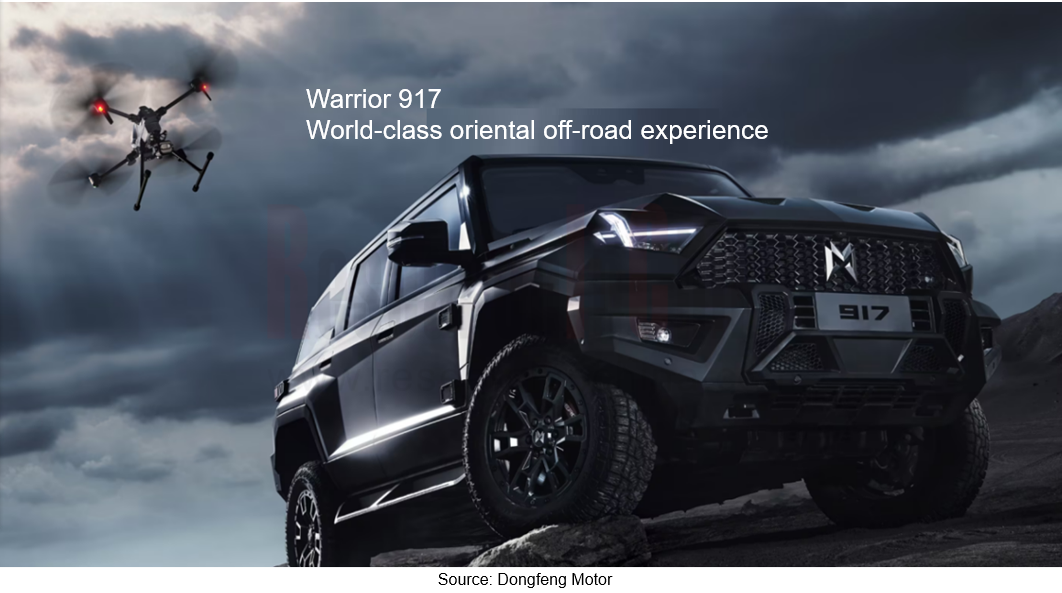
① Dongfeng Warrior is equipped with a UAV system: Warrior 917, which was launched in August 2023, is equipped with a UAV system. The system is composed of a S400 UAV from GDU and a control system, focusing on safe and intelligent outdoor scenarios of IVI integration. Its roof can be expanded to be an apron. In addition to regular flying functions, the UAV can monitor roads, survey road terrain, slope, angle and other environmental information, and support synchronous intelligent path planning.
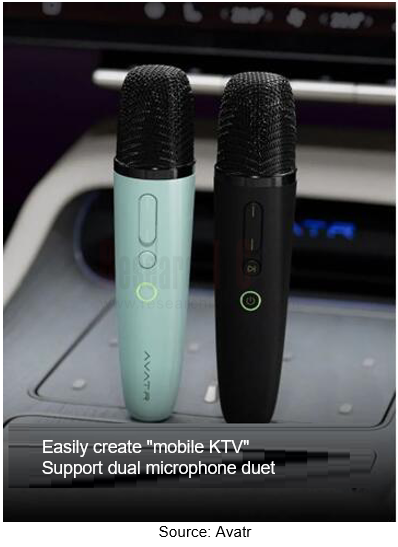
?② Avatr has a custom karaoke microphone: Avatr boasts a wireless karaoke microphone (dual microphone) customized for the smart cockpit, with a built-in DSP processing chip, which can beautify human voice, optimize reverberation curve, and support linkage with the screen, sound and atmosphere lights in the cockpit.
?2.In smart home scenarios, OEMs have promoted "the whole ecology covering people, cars and home". Users can remotely control and manage smart home devices (including air conditioners, water heaters, lighting, security systems, etc.) through mobile phones, cars and other devices.
?
Hardware interconnection cases in smart home scenarios:
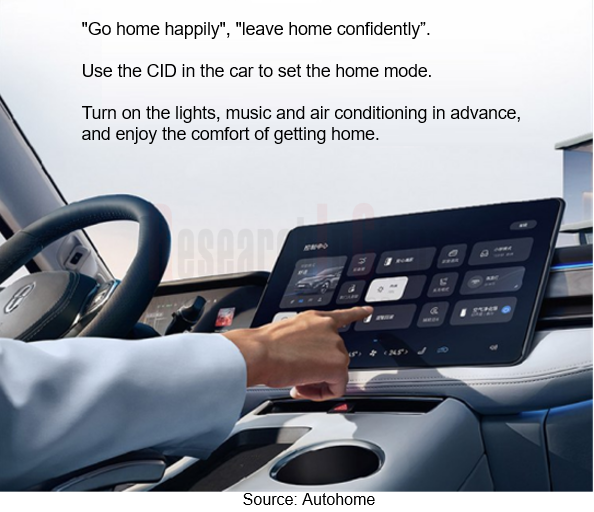
① AITO and various smart home terminals realize car-home linkage: AITO integrates the capabilities of all kinds of terminals including smart screens, smart air conditioners, sweeping robots and home surveillance cameras in smart home scenarios based on HarmonyOS. In addition, AITO also supports preset scenarios like "go home happily", "leave home confidently”. For example, car owners can turn on air conditioners, lights, TV sets and music at home with one click on their way off work.
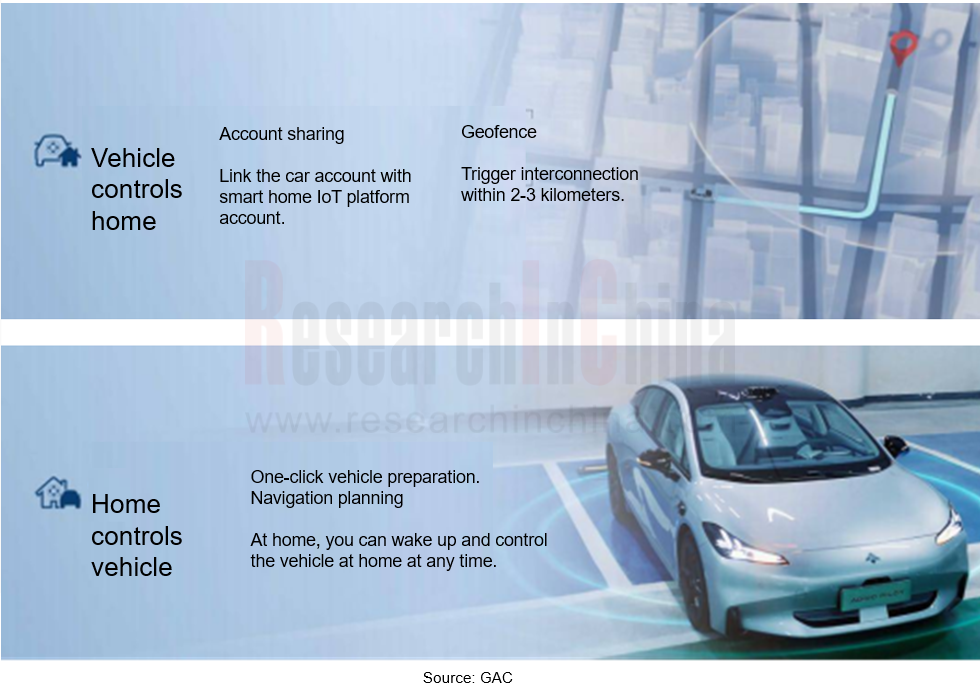
?② GAC's “Green Smart Car Home” solution enables car-home interaction: GAC's “Green Smart Car Home” supports the interconnection of more than 1,000 home appliance brands and 4,000+ devices. It allows car owners to remotely control smart home appliances in their cars through voice, touch screens, etc. It will also wake up and control vehicle functions at home.
?
Third, the way to expand automotive ecological domain
In the process of ecological domain expansion, OEMs give priority to mobile phones as the entry point for ecological domain expansion. Through the deep interconnection between mobile phones and IVI, functions like computing power sharing, data seamless connection and hardware sharing can be attained, bringing users a more convenient and intelligent mobility experience. At the same time, massive user habit data and ecosystem on mobile phones are migrated to cars. On this basis, OEMs gradually expand interconnection with terminal products such as cameras, UAVs and tablet PCs, and build a perfect intelligent ecosystem. This expansion process not only provides users with richer functions and services, but also strengthens the competitiveness of OEMs in the field of intelligent ecology.
?
The cooperation between OEMs and mobile phone/technology vendors can be summarized and classified into the following modes: OEMs acquire mobile phone vendors, OEMs conduct independent R&D, OEMs cooperate with technology companies in research and development, mobile phone vendors manufacture cars (through cooperation), OEMs cooperate with mobile phone/ technology vendors. From the perspective of cooperation modes, some OEMs tend to get through the underlying operating systems of mobile phones and IVI, and promote Internet of Everything based on a unified platform. Other OEMs focus on improving IVI systems and seek cooperation with other vendors to achieve partial IVI interconnection.
?
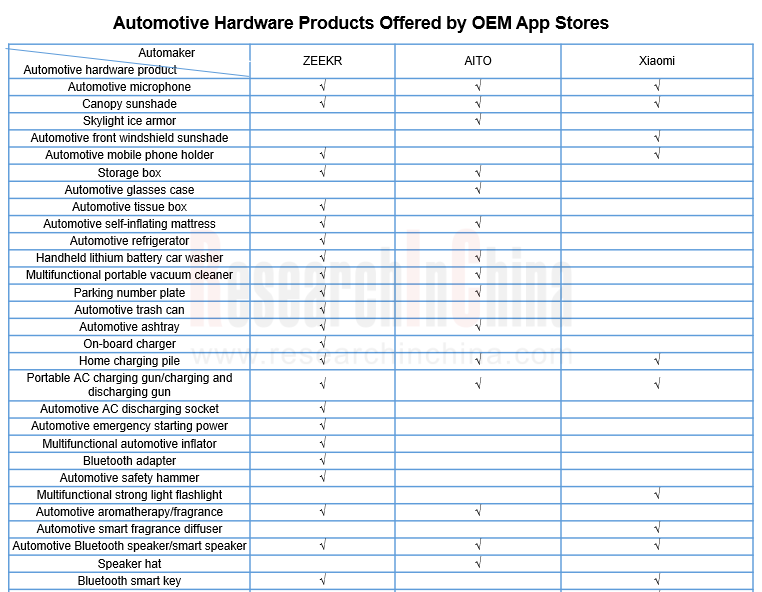
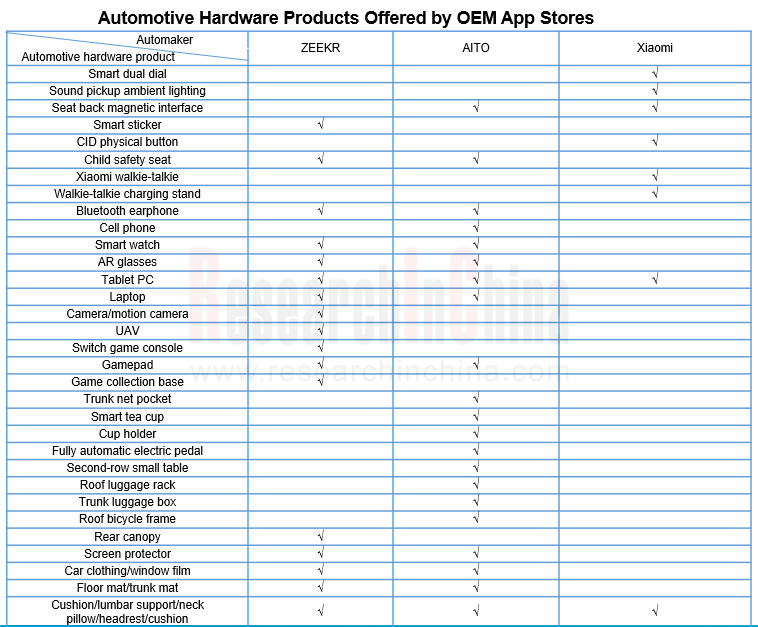
In addition, it is worth noting that AM automotive hardware products are also an indispensable part of building a complete automotive ecosystem. When comparing the automotive hardware products of OEM app stores, we find that Huawei and Xiaomi, as top smart phone players, have a huge user base and mature e-commerce platforms (such as Huawei Mall and Xiaomi Mall). These platforms not only sell core products such as mobile phones, but also offer products in many fields such as smart home, smart wear and accessories. Therefore, for the car owners of Xiaomi and Huawei HarmonyOS, they can completely purchase automotive hardware products which they desire through these existing e-commerce platforms instead of OEM app stores.
Automotive Microcontroller Unit (MCU) and Application Scenario Research Report, 2026
Automotive MCU Research: Increased demand for redundant security drives ASIL D-compliant MCU shipments to exceed 100 million units
In a vehicle EEA, MCUs are widely distributed in various functional ...
China Intelligent Cockpit Patent Analysis Report, 2026
Intelligent Cockpit Patent Research: Cockpit AI, In?vehicle Health, and Infotainment Are Upgrade to Scenario?based and Proactive Functions
From a patent perspective, this report explores the cutting?...
Research Report on Application of VLA Large Model in Automobiles and Robots, 2026
Research on Automotive and Robot VLA: Hybrid Architectures Become Mainstream, VLA Integrates with General World Models, and Reinforcement Learning Serves as Core Engine
Vision?Language?Action (VLA) m...
China Charging Infrastructure (Supercharging, Battery Swapping, V2G, etc.) and High-Performance Supercharging Battery Research Report, 2026
Charging and battery swapping research: as 5C+ supercharging vehicle models go into mass production, the pace of OEMs self-building supercharging networks quickens
800-1000V high-voltage platforms ar...
China Passenger Car Electronic Controlled Suspension Industry Report, 2026
Electronic Controlled Suspension Industry Research: As the First Year of Full Active Suspension Unfolds, Three Technical Routes Race Forward
1. Penetration Rate Surges Three Times, and Electronic Con...
Intelligent Driving SoC Research Report, 2026
Research on Intelligent Driving SoCs: Competition Focus Shifts to L3/L4 Embedded Hardware, and Computing Power of Flagship Vehicle Models Exceeds 1,000 TOPS
In terms of intelligent driving system in...
Automotive AI Large Model Technology Research Report, 2026
Automotive AI Large Model Research: Competition Shifts from "Who Has the Stronger Model" to "Who Boasts Higher Link Efficiency"
ResearchInChina released the Automotive AI Large Model Technology Resea...
Intelligent Vehicle Cockpit Domain Controller Research Report, 2026
Cockpit domain controller research: L3 AIDV intelligent cockpit domain controllers are entering a boom period
Driven by multiple factors such as the continuous evolution of the automotive central int...
Automotive Acoustic System (Audio, Multi-Channel) Industry Report, 2026
Automotive Acoustics Research: Multiple Channels, AI Tuning, and Self-Developed Algorithms Drive the Transformation of High-End Cockpit Sound Fields
I. Automotive Audio Hardware Solutions with 6–9 S...
Autonomous Driving Sensor Chip Research Report, 2026
Research on Autonomous Driving Sensor Chips: Deeply Perceiving the Physical World, Sensor Chips Are Playing A “Leading Role” in Intelligence
In 2026, the autonomous driving sensor chip industr...
Passenger Car Corner Module and Wheel‑Side Control System Research Report, 2026
Wheel-side control research: the “last mile” chassis innovation
Wheel-side control dismantles the traditional drive, braking, steering, and suspension control of the chassis from a "centralized" styl...
Embodied Artificial Intelligence (& Humanoid Robot) MCU Research Report, 2026
Research on Humanoid Robot MCUs: Evolution from General-Purpose Control to High-Value Dedicated Chip Solutions Integrated with Edge AI Functions
MCU (Microcontroller Unit) refers to a compact integra...
Intelligent Vehicle Zone Control Unit (ZCU) Research Report, 2026
ZCU Research: Cross-domain integrated ZCUs are becoming the edge computing nodes of the next-generation zonal architecture
Currently, the mainstream zonal architecture is mainly the quasi-central + z...
Automotive Cybersecurity and Data Security Research Report, 2026
Cybersecurity & Data Security Research: Intelligent Connected Vehicles Enter the Era of “Systematic Offense-Defense and AI-Defined Security”.
Centering on the panorama of intelligent connect...
Report on Breakthrough Strategies of OEMs and ADAS Tier 1 Suppliers for Overseas Layout of Intelligent Driving, 2026
Regulatory Breakthrough, Local System Establishment, OEMs Competing for NOA Layout: Overall Trends of China’s Intelligent Driving Overseas Layout in 2026
Research on overseas intelligent driving layo...
OEMs and Tier1s’ Intelligent Cockpit Platform (Hardware and Software) Innovation Strategy Research Report, 2026
Intelligent Cockpit Platform Research: multi-dimensional cockpit system architecture reconstruction for multi-agent collaboration and proactive intelligent services
The intelligent cockpit software s...
Automotive AIOS Research Report, 2026
Automotive AIOS Research: Mass Production Solutions Are Implemented
Mass Production Solutions Are Implemented on A Small Scale.
In 2026, AIOS starts small-scale implementation, helping to improve v...
Automotive Telematics Service Provider (TSP) Research Report, 2026
TSP Research: Leading providers collectively turn to AI agents to provide all-scenario active services
Telematics Service Providers (TSPs) are the core hub of the telematics industry chain, connectin...