Autonomous Delivery Research: Foundation Models Promote the Normal Application of Autonomous Delivery in Multiple Scenarios
Autonomous Delivery Industry Research Report, 2024 released by ResearchInChina combs and studies the status quo of autonomous delivery vehicles in the autonomous delivery industry, the application scenarios of autonomous delivery robots and solution providers, as well as predicts the future development trends of autonomous delivery.
?
1. Autonomous delivery vehicles have entered normal operation, and Jiangsu Province is at the forefront of the country.
?
So far, autonomous delivery has been applied to express delivery, supermarkets, autonomous retail and other scenarios. The normal application of autonomous delivery has been realized in express delivery enterprises. By region, the normal operation of autonomous delivery vehicles in express delivery enterprises was mainly concentrated in East China, North China and Northwest China during the period from early 2023 to May 2024. Specifically: East China saw the most autonomous delivery vehicles, which mainly spread in Jiangsu, Anhui and Zhejiang. By province, the ranking is Jiangsu > Anhui > Shaanxi > Zhejiang > Shanxi > Sichuan > Hebei/Beijing.?
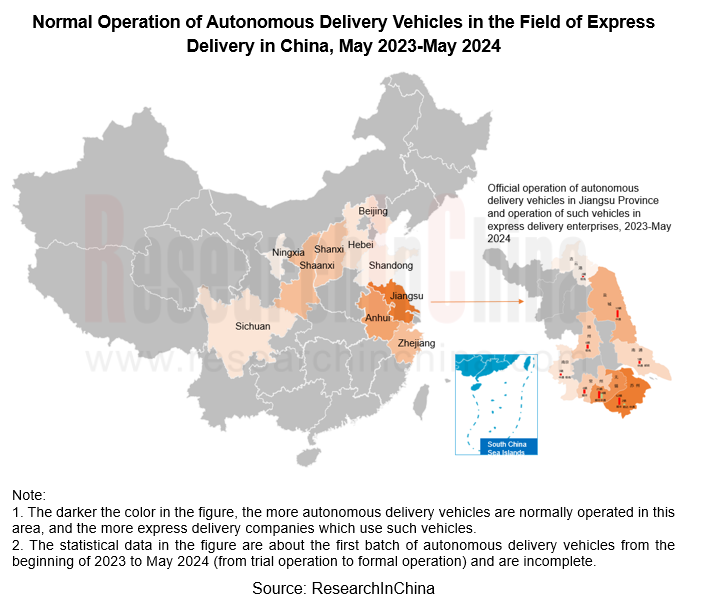
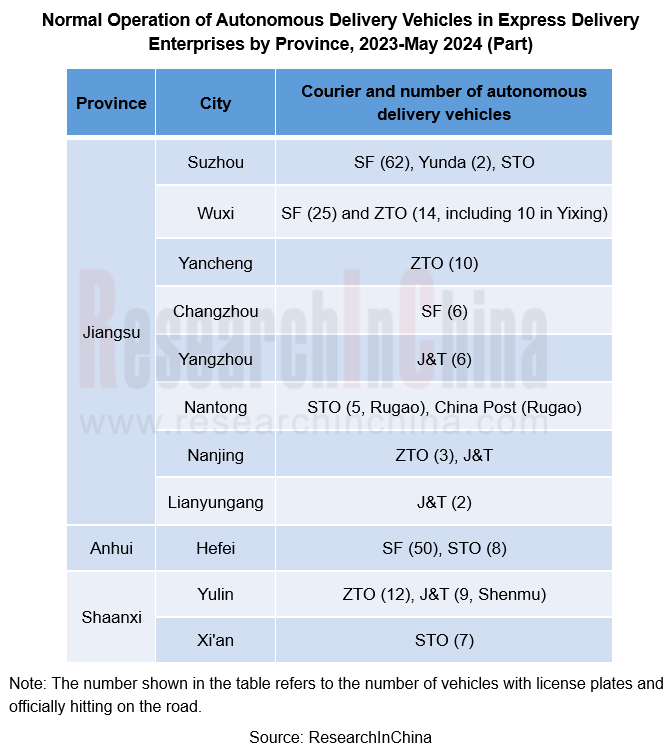
Jiangsu Province has the largest number of autonomous delivery vehicles in normal operation, and Suzhou is the city with the most autonomous delivery vehicles in express delivery enterprises in Jiangsu and even the whole country. In November 2023, Jiangsu took the lead in the country to enact legislation to promote the development of Internet of Vehicles and intelligent connected vehicles: the Standing Committee of the 14th Jiangsu Provincial People's Congress approved the "Decision on Promoting the Development of Internet of Vehicles and Intelligent Connected Vehicles", which made guiding and authoritative provisions on the passage and management of autonomous driving equipment such as autonomous delivery vehicles on roads and came into effect on January 1, 2024. By April 2024, there had been 41 autonomous delivery vehicles in normal operation in Xiangcheng District of Suzhou, delivering about 14,000 parcels every day. Xiangcheng District reached in-depth cooperation with express delivery companies such as SF Express, Yunda Express and STO Express.
The following indicates the normal operation of autonomous delivery vehicles in express delivery enterprises by province:
?2. "Outdoor autonomous vehicles + indoor robots" can accomplish autonomous direct delivery to destinations.
?
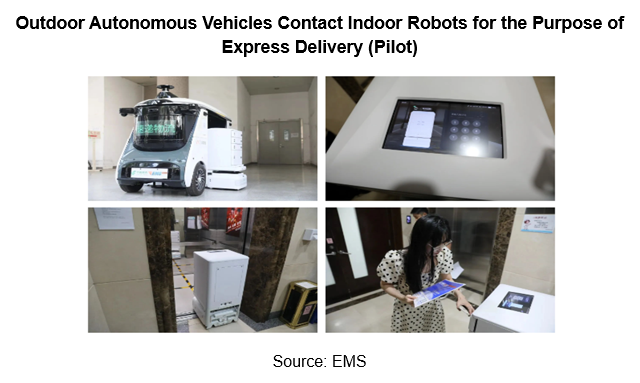
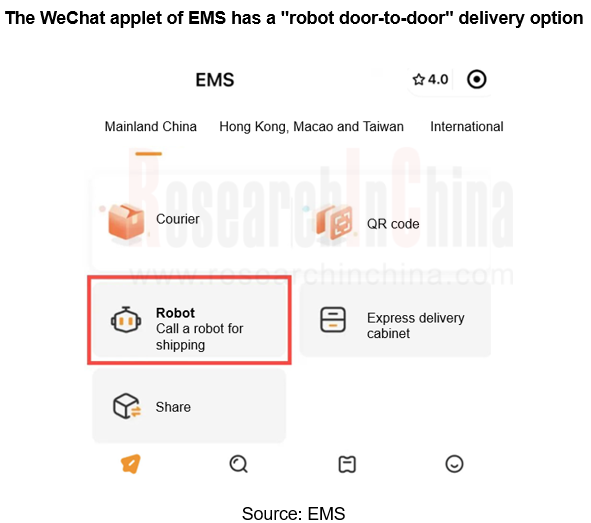
In June 2023, an "outdoor autonomous vehicles + indoor robots" integrated AI delivery solution was officially launched in the headquarters of China Postal Express & Logistics. The new solution can combine outdoor autonomous vehicles with different indoor robots to directly deliver goods to destinations in a variety of scenarios. For example, outdoor autonomous vehicles contact indoor robots, mailroom staff operate robots to deliver goods to destinations, users can order coffee via WeChat applets which is then delivered by robots, and robots pick up items after users place orders on the WeChat applet of EMS.
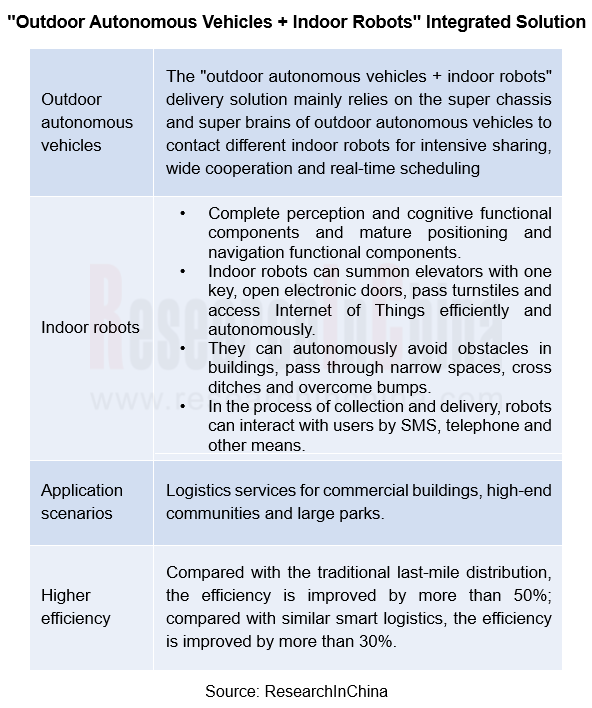
The "outdoor autonomous vehicles + indoor robots" delivery solution mainly relies on the super chassis and super brains of outdoor autonomous vehicles to contact different indoor robots for intensive sharing, wide cooperation and real-time scheduling, while indoor robots have complete perception and cognitive functional components as well as mature positioning and navigation functional components to summon elevators with one key, open electronic doors, pass turnstiles and access Internet of Things.
In April 2024, the WeChat applet of EMS launched the robot door-to-door delivery service. On the delivery page of the applet, there is an additional "robot door-to-door" delivery option. In large parks, universities and other places, couriers operate autonomous vehicles to transport parcels downstairs, and them indoor robots automatically "relay" them to destinations.
3. Autonomous delivery technology has been rapidly iterated, and BEV+Transformer perception technology has landed on vehicles.
?
The algorithm structure of NEOLIX has gone through three stages, from first stage of light perception and heavy maps, to the second stage of heavy perception and light maps, and to the third stage of real-time map generation based on 4D perception of foundation models.
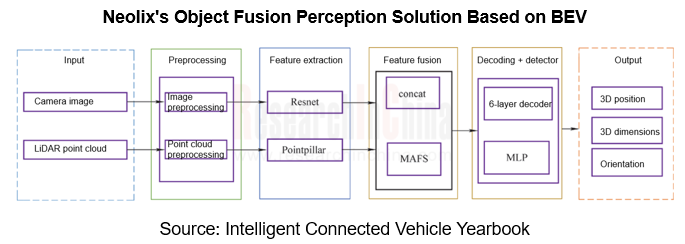
On the technical level of autonomous driving software, X3 Plus, Neolix’s? autonomous vehicle, strictly follows the underlying technical architecture logic of autonomous driving, adopts the multi-modal BEV space 4D time sequence fusion perception technology, carries Orion-X to realize pre-fusion BEV perception, and leverages the Transformer perception foundation model to process multi-sensor data of continuous time series in real time and realize zero-blind-spot, high-precision and high-robustness environmental perception.
In BEV space, time sequence fusion is carried out to form 4D space. At the same time, complex traffic flow reinforcement learning (TFRL) allows autonomous vehicles to interact with other road participants and predict their future behavior, so as to conduct better planning and control. Neolix’s autonomous driving system has the capability of autonomous learning, so that it can perceive more complex obstacles, handle more complicated roads, and make autonomous delivery easy.
In other words, all the features of 2 lidars and 11 panoramic cameras are converted into the BEV space for fusion, and more comprehensive perception is fulfilled based on the fused features. This system can make full use of the advantages of each sensor, and overcome the corresponding shortcomings, so as to perform perfect perception within a range of 40m front and rear and 30m left and right, and ensure that autonomous vehicles can accurately detect objects and lane lines and recognize traffic lights, thus guaranteeing the driving safety of autonomous vehicles.
Automotive Microcontroller Unit (MCU) and Application Scenario Research Report, 2026
Automotive MCU Research: Increased demand for redundant security drives ASIL D-compliant MCU shipments to exceed 100 million units
In a vehicle EEA, MCUs are widely distributed in various functional ...
China Intelligent Cockpit Patent Analysis Report, 2026
Intelligent Cockpit Patent Research: Cockpit AI, In?vehicle Health, and Infotainment Are Upgrade to Scenario?based and Proactive Functions
From a patent perspective, this report explores the cutting?...
Research Report on Application of VLA Large Model in Automobiles and Robots, 2026
Research on Automotive and Robot VLA: Hybrid Architectures Become Mainstream, VLA Integrates with General World Models, and Reinforcement Learning Serves as Core Engine
Vision?Language?Action (VLA) m...
China Charging Infrastructure (Supercharging, Battery Swapping, V2G, etc.) and High-Performance Supercharging Battery Research Report, 2026
Charging and battery swapping research: as 5C+ supercharging vehicle models go into mass production, the pace of OEMs self-building supercharging networks quickens
800-1000V high-voltage platforms ar...
China Passenger Car Electronic Controlled Suspension Industry Report, 2026
Electronic Controlled Suspension Industry Research: As the First Year of Full Active Suspension Unfolds, Three Technical Routes Race Forward
1. Penetration Rate Surges Three Times, and Electronic Con...
Intelligent Driving SoC Research Report, 2026
Research on Intelligent Driving SoCs: Competition Focus Shifts to L3/L4 Embedded Hardware, and Computing Power of Flagship Vehicle Models Exceeds 1,000 TOPS
In terms of intelligent driving system in...
Automotive AI Large Model Technology Research Report, 2026
Automotive AI Large Model Research: Competition Shifts from "Who Has the Stronger Model" to "Who Boasts Higher Link Efficiency"
ResearchInChina released the Automotive AI Large Model Technology Resea...
Intelligent Vehicle Cockpit Domain Controller Research Report, 2026
Cockpit domain controller research: L3 AIDV intelligent cockpit domain controllers are entering a boom period
Driven by multiple factors such as the continuous evolution of the automotive central int...
Automotive Acoustic System (Audio, Multi-Channel) Industry Report, 2026
Automotive Acoustics Research: Multiple Channels, AI Tuning, and Self-Developed Algorithms Drive the Transformation of High-End Cockpit Sound Fields
I. Automotive Audio Hardware Solutions with 6–9 S...
Autonomous Driving Sensor Chip Research Report, 2026
Research on Autonomous Driving Sensor Chips: Deeply Perceiving the Physical World, Sensor Chips Are Playing A “Leading Role” in Intelligence
In 2026, the autonomous driving sensor chip industr...
Passenger Car Corner Module and Wheel‑Side Control System Research Report, 2026
Wheel-side control research: the “last mile” chassis innovation
Wheel-side control dismantles the traditional drive, braking, steering, and suspension control of the chassis from a "centralized" styl...
Embodied Artificial Intelligence (& Humanoid Robot) MCU Research Report, 2026
Research on Humanoid Robot MCUs: Evolution from General-Purpose Control to High-Value Dedicated Chip Solutions Integrated with Edge AI Functions
MCU (Microcontroller Unit) refers to a compact integra...
Intelligent Vehicle Zone Control Unit (ZCU) Research Report, 2026
ZCU Research: Cross-domain integrated ZCUs are becoming the edge computing nodes of the next-generation zonal architecture
Currently, the mainstream zonal architecture is mainly the quasi-central + z...
Automotive Cybersecurity and Data Security Research Report, 2026
Cybersecurity & Data Security Research: Intelligent Connected Vehicles Enter the Era of “Systematic Offense-Defense and AI-Defined Security”.
Centering on the panorama of intelligent connect...
Report on Breakthrough Strategies of OEMs and ADAS Tier 1 Suppliers for Overseas Layout of Intelligent Driving, 2026
Regulatory Breakthrough, Local System Establishment, OEMs Competing for NOA Layout: Overall Trends of China’s Intelligent Driving Overseas Layout in 2026
Research on overseas intelligent driving layo...
OEMs and Tier1s’ Intelligent Cockpit Platform (Hardware and Software) Innovation Strategy Research Report, 2026
Intelligent Cockpit Platform Research: multi-dimensional cockpit system architecture reconstruction for multi-agent collaboration and proactive intelligent services
The intelligent cockpit software s...
Automotive AIOS Research Report, 2026
Automotive AIOS Research: Mass Production Solutions Are Implemented
Mass Production Solutions Are Implemented on A Small Scale.
In 2026, AIOS starts small-scale implementation, helping to improve v...
Automotive Telematics Service Provider (TSP) Research Report, 2026
TSP Research: Leading providers collectively turn to AI agents to provide all-scenario active services
Telematics Service Providers (TSPs) are the core hub of the telematics industry chain, connectin...