Research on electronic rearview mirrors: electronic internal rearview mirrors are growing rapidly, and electronic external rearview mirrors are facing growing pains
ResearchInChina released "Global and China Electronic Rearview Mirror Industry Report, 2024", which summarizes the development status, loading situation, supplier product layout, and supply chain layout of global and Chinese electronic rearview mirrors, and forecasts the future development trend of electronic rearview mirrors.
1. Streaming media rearview mirror: assembly volume is growing rapidly, and market landscape of TOP 5 has changed
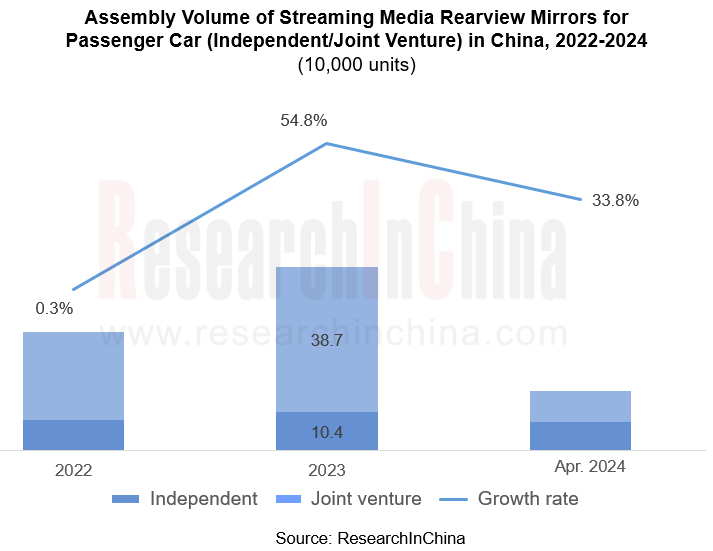
In 2023, the assembly volume of new passenger car electronic rearview mirrors hit 491,000 units, an increase of 54.8% year-on-year. From January to April 2024, the assembly volume of streaming media rearview mirrors was 159,000 units, an increase of 33.8% year-on-year.
?
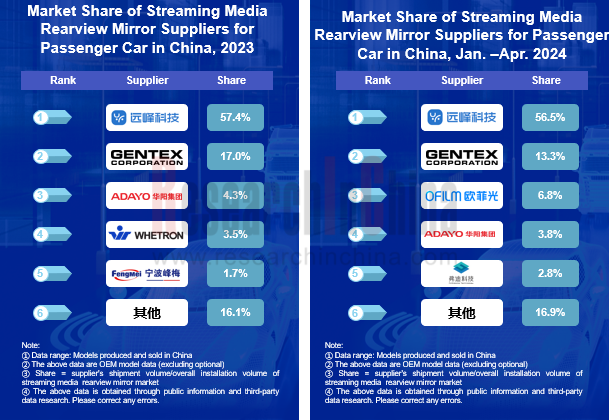
From the perspective of suppliers, Yuanfeng Technology is still in the leading position in the industry, but CR5 decreases from January to April 2024, and market competition intensifies.
From January to April 2024, compared with 2023, the TOP 5 market pattern of electronic internal rearview mirrors changed, with Yuanfeng and Gentex still ranking among the top two. OFILM replaced Huayang in the third place, and FinDreams Technology entered the top five.
Source: ResearchInChina
?
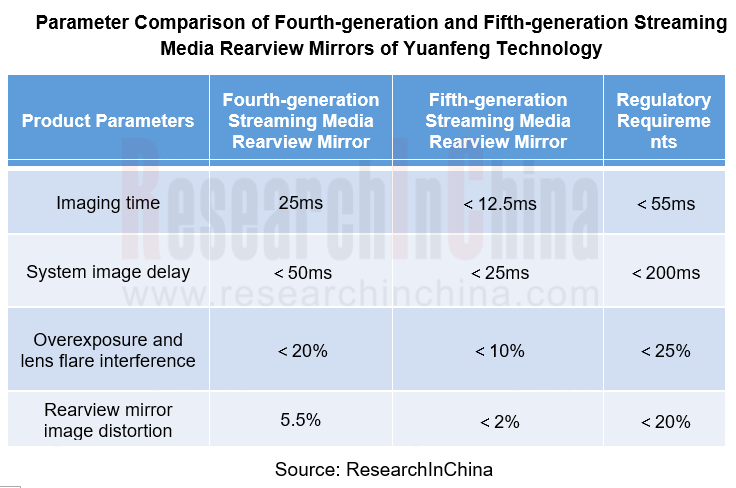
Yuanfeng Technology's fifth-generation streaming media rearview mirror products have improved in imaging time, image delay, overexposure, lens halo interference, and rearview mirror image distortion compared with the fourth-generation streaming media rearview mirror products. The specific comparison is as follows:
2. Installation of CMS is less than expected, facing growth troubles
At present, users encounter the following problems when using electronic exterior mirrors:
Screen position needs to be adapted: The position of electronic external rearview mirror screen setting is lower than that of the physical rearview mirror. Users need to adjust the habit of looking at rearview mirror, and the field of vision needs to be lowered, which takes some time to adapt;
Focusing the screen back and forth can cause eye discomfort: the electronic rearview mirror screen is closer to the eye and is an optical screen. When the user reflexively looks at the physical external rearview mirror, the angle of head and the focus position of the eye need to be readjusted.
The screen field of view is slightly narrow: the screen of electronic rearview mirror is too small, the field of view of rearview mirror is a little narrow, and the electronic rearview mirror cannot change the angle at any time and cannot change with the field of view;
It is difficult to accurately determine the distance of the rear car in electronic rearview mirror: Looking at electronic rearview mirror, the rear vehicle looks obviously far away, but when actually looking back, the vehicle is close to the side of the body, the distance is inaccurate, and the user will have uncertainty when changing lanes.
There will be a little delay in the screen, and users are also worried about blue screen, black screen, stuck and other problems;
The control authority of head unit is not enough: for example, the heating function of electronic rearview mirror of a certain model needs to be found on the secondary interface. The voice control authority of head unit is too low. When the rearview mirror fogs on highway, the user can only operate blindly.
In addition, the high price of electronic external rearview mirror itself is also an important factor affecting its development. At present, existing models have HUD with digital rearview mirror image function, which can project the blind spot image on both sides of the body on HUD, realizing low-cost function of CMS. Users do not need to pay any fees to use? "similar electronic rearview mirror" function. If CMS supplier cannot solve the above problems when using, and the CMS is not recognized by users, the electronic rearview mirror may be replaced by display terminal of this "similar electronic rearview mirror" function.
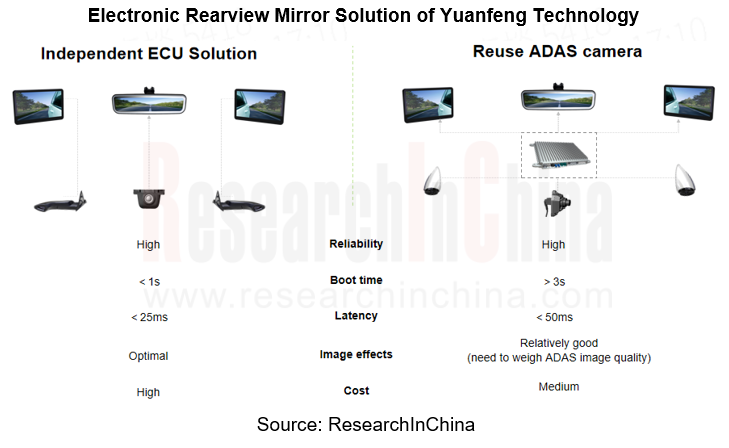
Faced with this situation, CMS suppliers need to improve user experience of CMS products and reduce CMS costs. In terms of cost reduction, Yuanfeng Technology has launched CMS products that support independent ECUs and reused ADAS architectures, which can be more easily adapted to vehicle development, and?? ADAS cameras reuse can also reduce CMS costs.
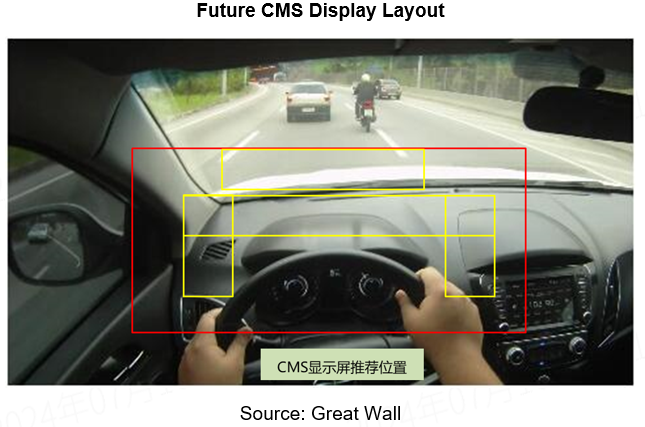
From the user experience of product, the placement of CMS display is an important part that affects user's driving experience. Common installation positions of CMS display are both sides of instrument,? both sides of joint screen,? left and right A pillars, and left and right door panels. From the perspective of product layout, the installation position of? CMS display should comprehensively consider the integration of cockpit shape and convenience of driver's observation. The best position should be to allow driver to complete the field of vision observation without turning his head as much as possible.
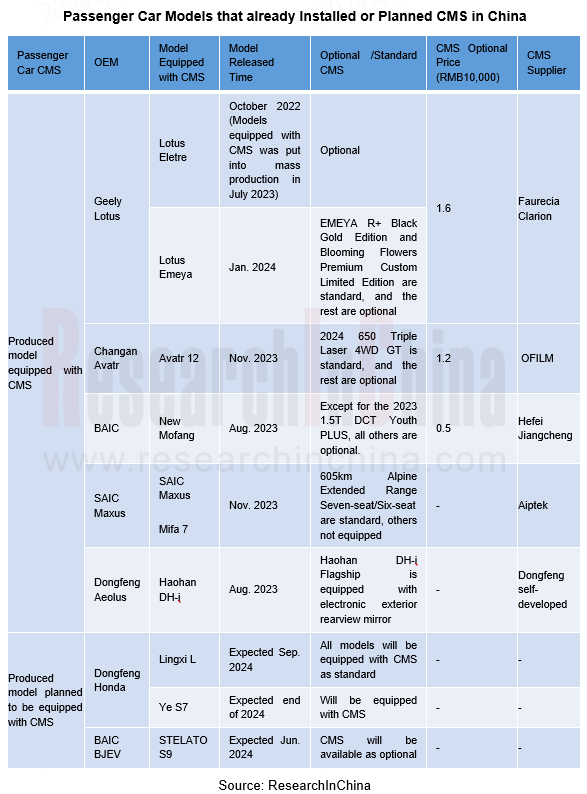
Since China began allowing CMS on the road on July 1, 2023, there have been only 6 mass-produced models equipped with CMS in passenger cars, far below market expectations. At present, some OEMs are also planning CMS models, which are expected to usher in significant growth from 2025 to 2026.
3. There will be an intermediate transition product form of electronic exterior rearview mirrors in the future
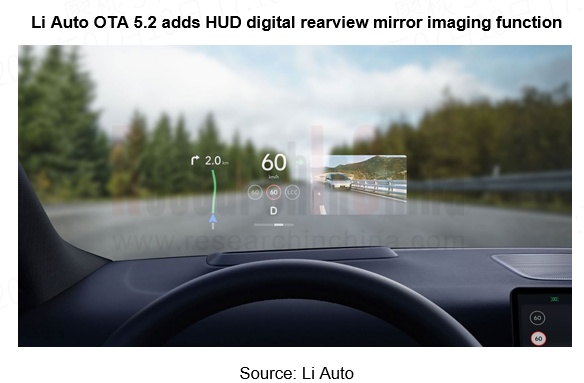
Under the situation that CMS has not yet installed in volume, the appearance of CMS intermediate transition product form may be a new trend. It is undeniable that CMS has great advantages over traditional rearview mirrors in scenarios such as rain and fog, and the impact of bad road lighting environments. But for the current users who dare not rely solely on electronic rearview mirrors, can there be a form in which CMS coexists with traditional rearview mirrors, or can traditional rearview mirrors be retained and existing products be used to achieve CMS functions? At present, Li Auto and IM have realized the form of "similar electronic exterior rearview mirror" function by using existing products.
Taking Li Auto as an example, in May 2024, Li Auto's latest OTA 5.2 added HUD digital rearview mirror imaging function. This system directly calls the surround/side view camera, projects the blind spot images on both sides of car on HUD while the driver toggles steering lever, and can issue a blind spot alarm in time through HUD blind spot image. Although there is a large gap in image display clarity compared to CMS, the low-cost function of CMS is realized.
Automotive Microcontroller Unit (MCU) and Application Scenario Research Report, 2026
Automotive MCU Research: Increased demand for redundant security drives ASIL D-compliant MCU shipments to exceed 100 million units
In a vehicle EEA, MCUs are widely distributed in various functional ...
China Intelligent Cockpit Patent Analysis Report, 2026
Intelligent Cockpit Patent Research: Cockpit AI, In?vehicle Health, and Infotainment Are Upgrade to Scenario?based and Proactive Functions
From a patent perspective, this report explores the cutting?...
Research Report on Application of VLA Large Model in Automobiles and Robots, 2026
Research on Automotive and Robot VLA: Hybrid Architectures Become Mainstream, VLA Integrates with General World Models, and Reinforcement Learning Serves as Core Engine
Vision?Language?Action (VLA) m...
China Charging Infrastructure (Supercharging, Battery Swapping, V2G, etc.) and High-Performance Supercharging Battery Research Report, 2026
Charging and battery swapping research: as 5C+ supercharging vehicle models go into mass production, the pace of OEMs self-building supercharging networks quickens
800-1000V high-voltage platforms ar...
China Passenger Car Electronic Controlled Suspension Industry Report, 2026
Electronic Controlled Suspension Industry Research: As the First Year of Full Active Suspension Unfolds, Three Technical Routes Race Forward
1. Penetration Rate Surges Three Times, and Electronic Con...
Intelligent Driving SoC Research Report, 2026
Research on Intelligent Driving SoCs: Competition Focus Shifts to L3/L4 Embedded Hardware, and Computing Power of Flagship Vehicle Models Exceeds 1,000 TOPS
In terms of intelligent driving system in...
Automotive AI Large Model Technology Research Report, 2026
Automotive AI Large Model Research: Competition Shifts from "Who Has the Stronger Model" to "Who Boasts Higher Link Efficiency"
ResearchInChina released the Automotive AI Large Model Technology Resea...
Intelligent Vehicle Cockpit Domain Controller Research Report, 2026
Cockpit domain controller research: L3 AIDV intelligent cockpit domain controllers are entering a boom period
Driven by multiple factors such as the continuous evolution of the automotive central int...
Automotive Acoustic System (Audio, Multi-Channel) Industry Report, 2026
Automotive Acoustics Research: Multiple Channels, AI Tuning, and Self-Developed Algorithms Drive the Transformation of High-End Cockpit Sound Fields
I. Automotive Audio Hardware Solutions with 6–9 S...
Autonomous Driving Sensor Chip Research Report, 2026
Research on Autonomous Driving Sensor Chips: Deeply Perceiving the Physical World, Sensor Chips Are Playing A “Leading Role” in Intelligence
In 2026, the autonomous driving sensor chip industr...
Passenger Car Corner Module and Wheel‑Side Control System Research Report, 2026
Wheel-side control research: the “last mile” chassis innovation
Wheel-side control dismantles the traditional drive, braking, steering, and suspension control of the chassis from a "centralized" styl...
Embodied Artificial Intelligence (& Humanoid Robot) MCU Research Report, 2026
Research on Humanoid Robot MCUs: Evolution from General-Purpose Control to High-Value Dedicated Chip Solutions Integrated with Edge AI Functions
MCU (Microcontroller Unit) refers to a compact integra...
Intelligent Vehicle Zone Control Unit (ZCU) Research Report, 2026
ZCU Research: Cross-domain integrated ZCUs are becoming the edge computing nodes of the next-generation zonal architecture
Currently, the mainstream zonal architecture is mainly the quasi-central + z...
Automotive Cybersecurity and Data Security Research Report, 2026
Cybersecurity & Data Security Research: Intelligent Connected Vehicles Enter the Era of “Systematic Offense-Defense and AI-Defined Security”.
Centering on the panorama of intelligent connect...
Report on Breakthrough Strategies of OEMs and ADAS Tier 1 Suppliers for Overseas Layout of Intelligent Driving, 2026
Regulatory Breakthrough, Local System Establishment, OEMs Competing for NOA Layout: Overall Trends of China’s Intelligent Driving Overseas Layout in 2026
Research on overseas intelligent driving layo...
OEMs and Tier1s’ Intelligent Cockpit Platform (Hardware and Software) Innovation Strategy Research Report, 2026
Intelligent Cockpit Platform Research: multi-dimensional cockpit system architecture reconstruction for multi-agent collaboration and proactive intelligent services
The intelligent cockpit software s...
Automotive AIOS Research Report, 2026
Automotive AIOS Research: Mass Production Solutions Are Implemented
Mass Production Solutions Are Implemented on A Small Scale.
In 2026, AIOS starts small-scale implementation, helping to improve v...
Automotive Telematics Service Provider (TSP) Research Report, 2026
TSP Research: Leading providers collectively turn to AI agents to provide all-scenario active services
Telematics Service Providers (TSPs) are the core hub of the telematics industry chain, connectin...