Automotive gateway research: 10BASE-T1S and CAN-XL will bring more flexible gateway deployment solutions
ResearchInChina released "Automotive Gateway Industry Report, 2024", analyzing and researching impact of E/E architecture evolution on gateways, new gateways for passenger cars and commercial vehicles, gateway supplier analysis, gateway chip and gateway security software enterprise analysis.
1. Gateway presents different deployment strategies in the three stages of E/E architecture
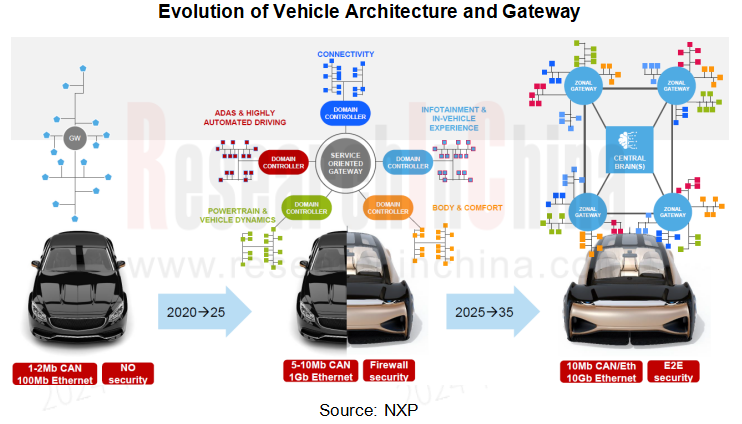
As the hub of in-vehicle network, the deployment strategy of automotive gateway changes with evolution of E/E architecture.
In a distributed architecture, there is a traditional CAN gateway in the vehicle to connect electronic Control Units (ECUs) with different functions in the vehicle.
Under the domain control architecture, the gateway has two forms. One is to use a non-integrated central gateway to securely and reliably transfer data between multiple domains such as Telematics Control Unit (T-BOX), powertrain, body, infotainment system, digital cockpit and ADAS applications. The other is to use an integrated gateway, which integrates the central gateway into a domain controller. It can be divided into several forms, including integrated in central control domain, integrated in body domain, integrated in cockpit domain, integrated in communication domain, and integrated in intelligent computing domain. At this stage, the central gateway is usually a hybrid gateway of CAN + Ethernet.
Under Zonal architecture, the on-board computing platform is at the core of the computing, and Zonal controller mainly acts as a gateway, not only as a data processing center, but also as a power distribution module. Under this architecture, the zonal controller is more divided by physical location, which can further reduce ECU in the car, simplify cable layout and reduce cable length.
2. Deployment method of gateway under domain control architecture
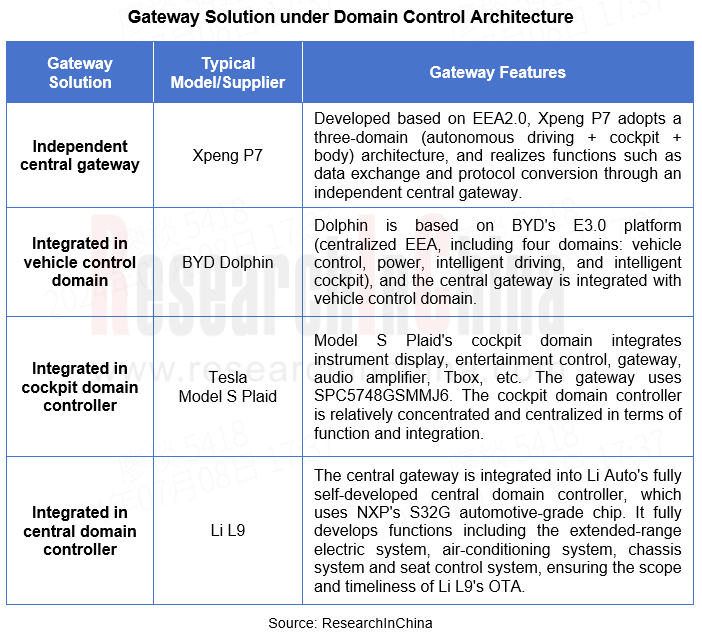
In the domain control stage, there are four main deployment methods of? gateway, namely: an independent central gateway, a gateway integrated in vehicle control domain, a gateway integrated in cockpit domain, and a gateway centralized in central domain.
The independent central gateway is mainly responsible for communication between different domains, and Ethernet is used as backbone network to undertake information exchange tasks; the system interconnection within each domain still uses CAN and FlexRay communication buses. At this stage, the central gateway is usually a hybrid gateway of CAN + Ethernet.
The gateway integrated in vehicle control domain realizes integration of? central gateway with body control, chassis and even power.
The gateway integrated into cockpit domain supports wireless connection of the vehicle, provides remote interconnection functions, such as remote diagnosis, OTA updates, etc., and provides security services (intrusion detection, firewall, etc.). The intelligent gateway is one of the four key modules of the intelligent cockpit of the car.
In addition, the gateway also appears in the form of integration with the central domain control, such as Li L9.
3. Zonal gateway under Zonal architecture will be gradually mass-produced from 2024 to 2025
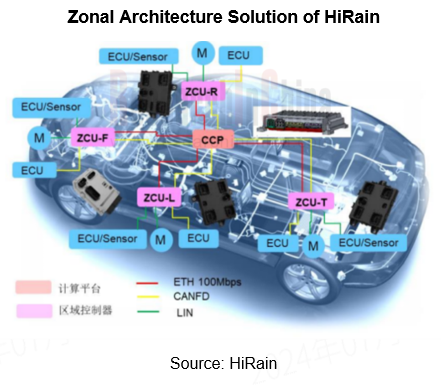
Zonal architecture consists of a central brain and several zonal controllers, among which the central brain is mainly responsible for the complex data processing and calculation of the upper layer, and several zonal controllers are mainly responsible for functions of gateways, power distribution, data collection, and load control. Under Zonal architecture, there are mainly two kinds of gateways, one is integrated in central computing platform, and the other is integrated in zonal controller.
Under the general trend of software-defined vehicles, automotive E/E architectures require more flexible, personalized, and scalable network architectures, and the need for zonal control has become increasingly prominent. In 2024, a number of Zonal architecture models have been launched or will be launched soon, such as Chery STERRA ET, Changan Qiyuan E07, Neta Shanhai 2.0 models, etc.
?
Changan Qiyuan E07 is expected to be launched in October 2024. It adopts a "central + zonal" ring network architecture, composed of C2 (central computer) + EDC (experience computer) to form a central computing platform, plus three VIU (zonal controllers). It adopts ring network communication technology. The backbone is mainly 100-megabit Ethernet, and the core controllers are equipped with Gigabit network. The three VIU are responsible for network management and power distribution and control of nearby devices, and have realized cross-domain integration of 15 controllers for power, chassis, air conditioning thermal management, and body.?
In 2025, Neta Shanhai 2.0 platform model will be mass-produced and launched, which adopts the central controller and zonal controller solutions of HiRain, among which the central computing platform integrates the central gateway, body and comfort control, new energy vehicle power control, air conditioning and thermal management, vehicle management, full data collection, OTA upgrade, SOA services and many other functions; Zonal Control Unit has zonal gateway routing function, 100MB Ethernet, CAN-FD, LIN, etc.
4 Ethernet 10BASE-T1S and CAN-XL will provide more flexible gateway deployment options
With faster transmission speeds and more stable communication connections, Ethernet is gradually becoming the backbone of in-car transmission. Xpeng G9, Voyah Zhuiguang, Lynk & Co 08, EXEED Yaoguang, IM LS7, Li L9, etc. are all equipped with Gigabit Ethernet, and GAC Aion's Xingling architecture even claims to use 10 Gigabit Ethernet data transmission.
In March 2024, BMW and ADI announced that they would be the first to adopt ADI's 10BASE-T1S E 2 B ? (Ethernet-Edge Bus) technology. Using ADI's 10BASE-T1S E 2 B technology, BMW eliminates microcontrollers and moves software from edge nodes to central processing units, thus enabling full hardware edge nodes and reducing software development and authentication tasks. That is to say, based on 10BASE-T1S E 2 B technology, traditional gateways will no longer be a required option.
?
While Ethernet quickly grabbed the market, CAN family welcomed the third generation member - CAN XL, and the performance was upgraded. The main advantages of CAN XL are:
1. High speed: CAN XL communication rate up to 20 Mbit/s, payload size increased to 2048 bytes, providing greater data throughput
2. Compatibility: On the one hand, it inherits the characteristics of CAN FD; and on the other hand, it has greatly expanded its protocol, allowing TCP/IP to run on CAN XL. It is expected to achieve good compatibility with Ethernet upper-layer protocols (especially service-oriented communication methods).
3. Cost-effective: Combining CAN and Ethernet functions while maintaining the low price of CAN.
?
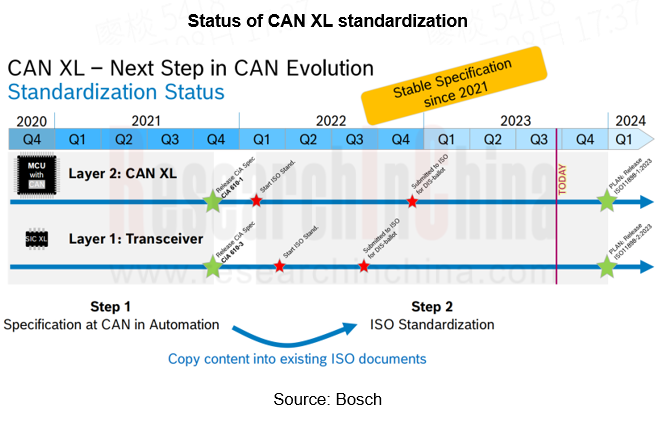
In terms of standardization, ISO standardization work has begun to incorporate CAN XL into ISO standards ISO 11898-1 and ISO 11898-2, and CAN XL has also obtained AUTOSAR support. In terms of productization, Bosch and Daimler trucks use CAN XL networks instead of FD networks in the car for performance verification, and Infineon, NXP, STMicroelectronics, Renesas, etc. are also deploying CAN XL.
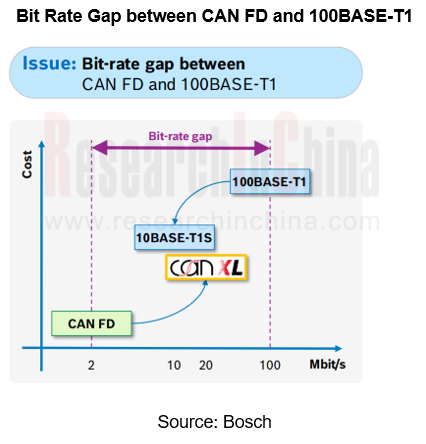
In short, 10BASE-T1S, which sank from high-speed communication technology, and CAN XL, which was upgraded from low-rate bus upgrades, are expected to "divide the world" in the 10 Mbit/s communication range, providing a more flexible solution for the future deployment of automotive communication networks, and will also have a practical impact on gateway requirements. After all, pure Ethernet architectures do not require gateways, while CAN-XL requires gateways to achieve protocol conversion.
Automotive Microcontroller Unit (MCU) and Application Scenario Research Report, 2026
Automotive MCU Research: Increased demand for redundant security drives ASIL D-compliant MCU shipments to exceed 100 million units
In a vehicle EEA, MCUs are widely distributed in various functional ...
China Intelligent Cockpit Patent Analysis Report, 2026
Intelligent Cockpit Patent Research: Cockpit AI, In?vehicle Health, and Infotainment Are Upgrade to Scenario?based and Proactive Functions
From a patent perspective, this report explores the cutting?...
Research Report on Application of VLA Large Model in Automobiles and Robots, 2026
Research on Automotive and Robot VLA: Hybrid Architectures Become Mainstream, VLA Integrates with General World Models, and Reinforcement Learning Serves as Core Engine
Vision?Language?Action (VLA) m...
China Charging Infrastructure (Supercharging, Battery Swapping, V2G, etc.) and High-Performance Supercharging Battery Research Report, 2026
Charging and battery swapping research: as 5C+ supercharging vehicle models go into mass production, the pace of OEMs self-building supercharging networks quickens
800-1000V high-voltage platforms ar...
China Passenger Car Electronic Controlled Suspension Industry Report, 2026
Electronic Controlled Suspension Industry Research: As the First Year of Full Active Suspension Unfolds, Three Technical Routes Race Forward
1. Penetration Rate Surges Three Times, and Electronic Con...
Intelligent Driving SoC Research Report, 2026
Research on Intelligent Driving SoCs: Competition Focus Shifts to L3/L4 Embedded Hardware, and Computing Power of Flagship Vehicle Models Exceeds 1,000 TOPS
In terms of intelligent driving system in...
Automotive AI Large Model Technology Research Report, 2026
Automotive AI Large Model Research: Competition Shifts from "Who Has the Stronger Model" to "Who Boasts Higher Link Efficiency"
ResearchInChina released the Automotive AI Large Model Technology Resea...
Intelligent Vehicle Cockpit Domain Controller Research Report, 2026
Cockpit domain controller research: L3 AIDV intelligent cockpit domain controllers are entering a boom period
Driven by multiple factors such as the continuous evolution of the automotive central int...
Automotive Acoustic System (Audio, Multi-Channel) Industry Report, 2026
Automotive Acoustics Research: Multiple Channels, AI Tuning, and Self-Developed Algorithms Drive the Transformation of High-End Cockpit Sound Fields
I. Automotive Audio Hardware Solutions with 6–9 S...
Autonomous Driving Sensor Chip Research Report, 2026
Research on Autonomous Driving Sensor Chips: Deeply Perceiving the Physical World, Sensor Chips Are Playing A “Leading Role” in Intelligence
In 2026, the autonomous driving sensor chip industr...
Passenger Car Corner Module and Wheel‑Side Control System Research Report, 2026
Wheel-side control research: the “last mile” chassis innovation
Wheel-side control dismantles the traditional drive, braking, steering, and suspension control of the chassis from a "centralized" styl...
Embodied Artificial Intelligence (& Humanoid Robot) MCU Research Report, 2026
Research on Humanoid Robot MCUs: Evolution from General-Purpose Control to High-Value Dedicated Chip Solutions Integrated with Edge AI Functions
MCU (Microcontroller Unit) refers to a compact integra...
Intelligent Vehicle Zone Control Unit (ZCU) Research Report, 2026
ZCU Research: Cross-domain integrated ZCUs are becoming the edge computing nodes of the next-generation zonal architecture
Currently, the mainstream zonal architecture is mainly the quasi-central + z...
Automotive Cybersecurity and Data Security Research Report, 2026
Cybersecurity & Data Security Research: Intelligent Connected Vehicles Enter the Era of “Systematic Offense-Defense and AI-Defined Security”.
Centering on the panorama of intelligent connect...
Report on Breakthrough Strategies of OEMs and ADAS Tier 1 Suppliers for Overseas Layout of Intelligent Driving, 2026
Regulatory Breakthrough, Local System Establishment, OEMs Competing for NOA Layout: Overall Trends of China’s Intelligent Driving Overseas Layout in 2026
Research on overseas intelligent driving layo...
OEMs and Tier1s’ Intelligent Cockpit Platform (Hardware and Software) Innovation Strategy Research Report, 2026
Intelligent Cockpit Platform Research: multi-dimensional cockpit system architecture reconstruction for multi-agent collaboration and proactive intelligent services
The intelligent cockpit software s...
Automotive AIOS Research Report, 2026
Automotive AIOS Research: Mass Production Solutions Are Implemented
Mass Production Solutions Are Implemented on A Small Scale.
In 2026, AIOS starts small-scale implementation, helping to improve v...
Automotive Telematics Service Provider (TSP) Research Report, 2026
TSP Research: Leading providers collectively turn to AI agents to provide all-scenario active services
Telematics Service Providers (TSPs) are the core hub of the telematics industry chain, connectin...