Body (Zone) Domain Controller and Chip Industry Research Report,2024
Research on body (zone) domain controller: an edge tool to reduce vehicle costs, and enable hardware integration + software SOA.
Integration is the most important means to lower vehicle costs. Function integration within the body domain has become widespread. Traditional BCM, seat, PEPS, TPMS, power distribution box, gateway and other functions tend to be controlled in a centralized way. Zoning is the inevitable result of cross-domain integration design, which can reduce wiring harnesses and help reduce vehicle costs and improve efficiency. Traditional BCM (body control module) is evolving towards BDC (body domain controller) and ZCU (zone control unit).
?
Zone control unit (ZCU) is a device based on BDC and connected to the vehicle according to the physical zone. At present, it mainly integrates three modules, i.e., vehicle control unit (VCU), thermal management system (TMS), and body control module (BCM), and enables three functions of electrical appliances in the zone, i.e., power distribution, communication gateway and standard I/O control. The core value of zonal architecture is to create highly integrated electronic and electrical connections and standardized and service-oriented interfaces by separating software and hardware, realize hardware platform reuse and faster and more efficient function updates and iterations, and accelerate the development of vehicle intelligence.??
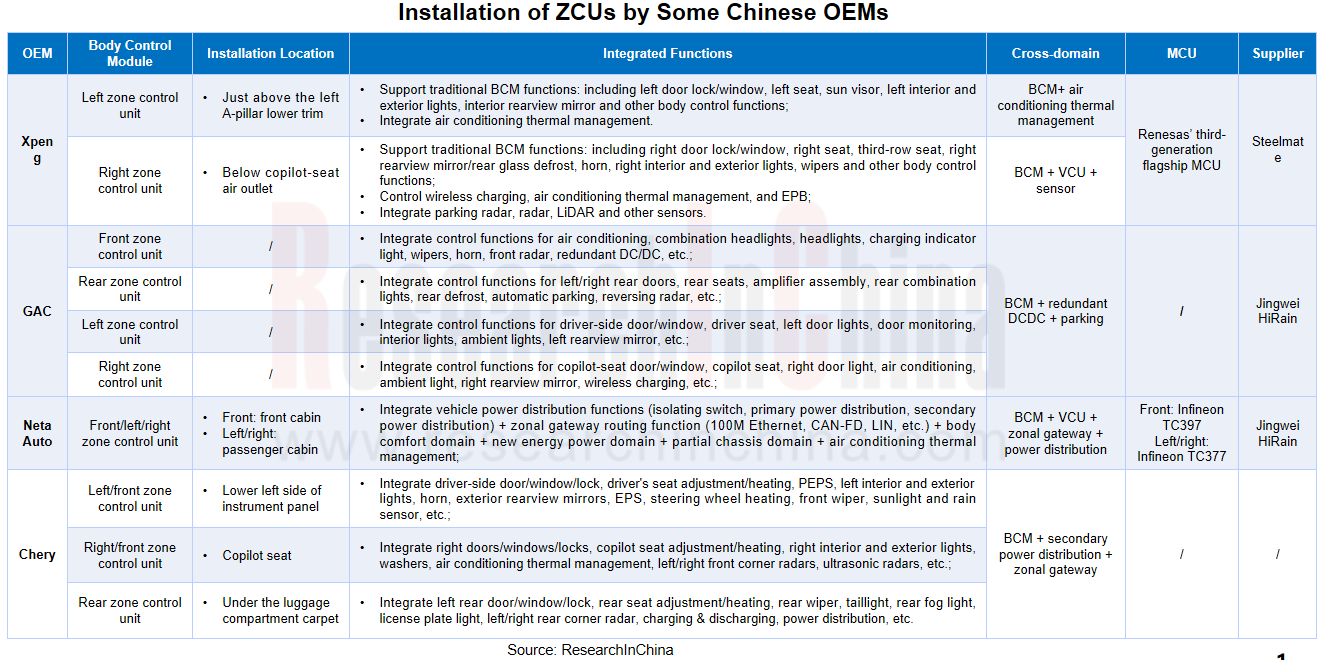
Seen from the central computing + zone control architecture planned by OEMs, their ZCUs now have taken shape, but their progress in mass production varies greatly. Xpeng, GAC, Xiaomi, FAW Hongqi and Chery among others have mass-produced ZCUs for their latest models, while NIO, Neta Auto, Great Wall Motor and foreign OEMs like Volkswagen, BMW and Volvo will mass-produce ZCUs and install them in vehicles during 2024-2026.
Changan’s SDV architecture: the architecture consists of a central computing platform composed of C2 (central computer) + EDC (experience computer), and three vehicle integration units (VIUs). Wherein, C2 delivers computing power of up to 508TOPS, and EDC offers graphics compute of 2000GFLOPS, realizing classified, centralized and reasonably arranged full-vehicle computing power.
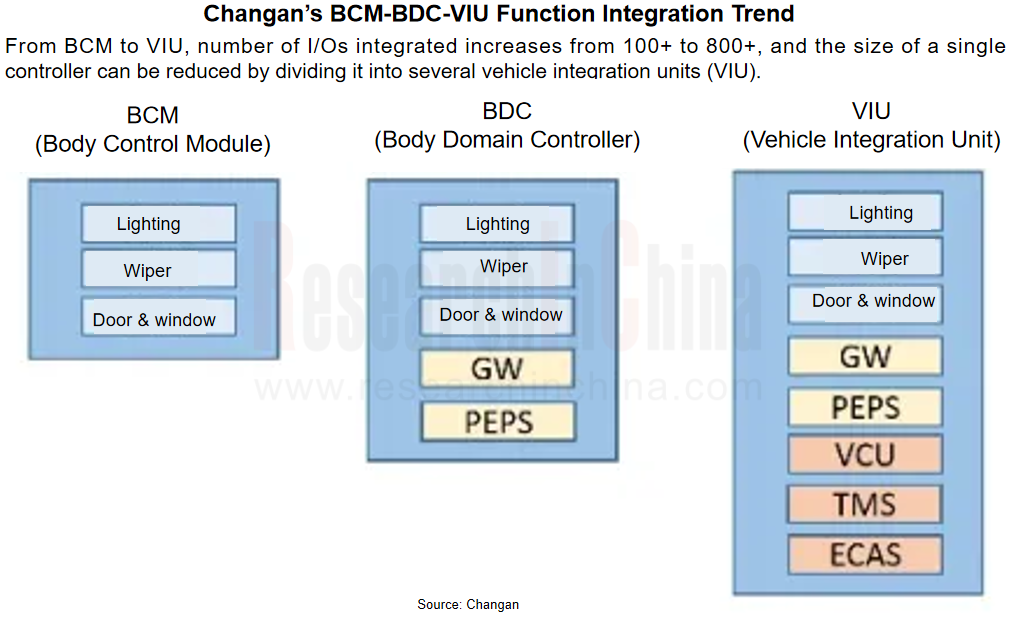
According to Changan, as traditional BCM evolves into BDC and VIU, the integration level is gradually improved and the integration scope is also expanded from traditional body to power, chassis, thermal management and other domains. The higher integration level makes the number of I/Os increase. From BCM to VIU, the number of I/Os integrated has increased from 100+ to 800+, and the size of a single controller can be reduced by dividing it into several VIUs.???
 ????
????
ZCU integrates control functions and is equipped with a high-performance MCU, eliminating scattered MCUs.
Under zonal architecture, the domain gateway will evolve into a zonal gateway, and ZCU will take on some functions of the zone information center and gateway and be responsible for communication management and information forwarding between submodules in the zone. The zonal architecture takes each controller as a zone controlled by a gateway which is placed near the components it takes charge of, and each zonal gateway is connected to the central computing platform.??
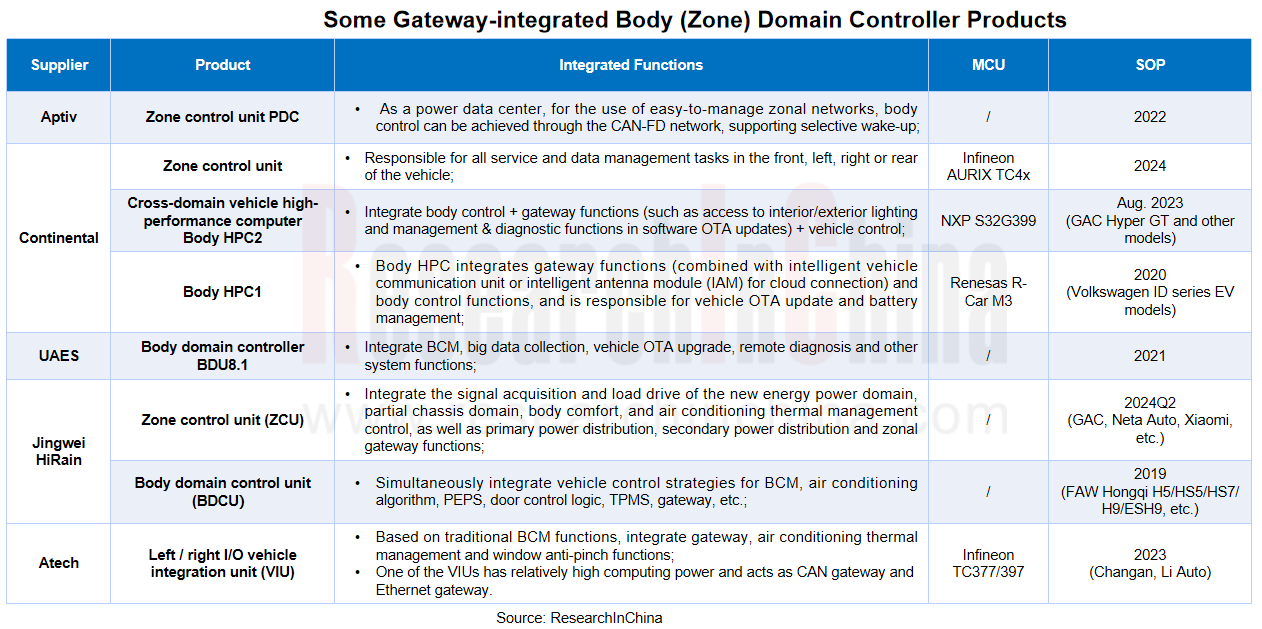
ATECH’s left and right I/O core VIUs: VIU is based on service-oriented architecture (SOA) and integrates air conditioning thermal management, gateway and window anti-pinch functions in addition to functions of traditional BCM. The domain controllers with relatively high computing power will take on the role of CAN gateway and Ethernet gateway.?

In zonal architecture, a ZCU will integrate multiple ECU functions. A multi-core MCU is often required to implement multiple functions. In the multi-core MCU, each core can run a single function. In addition, the master MCU in the ZCU will require higher computing performance and storage capacity, rich CAN/LIN and high-speed vehicle Ethernet communication interfaces, and lower power consumption indicators.???
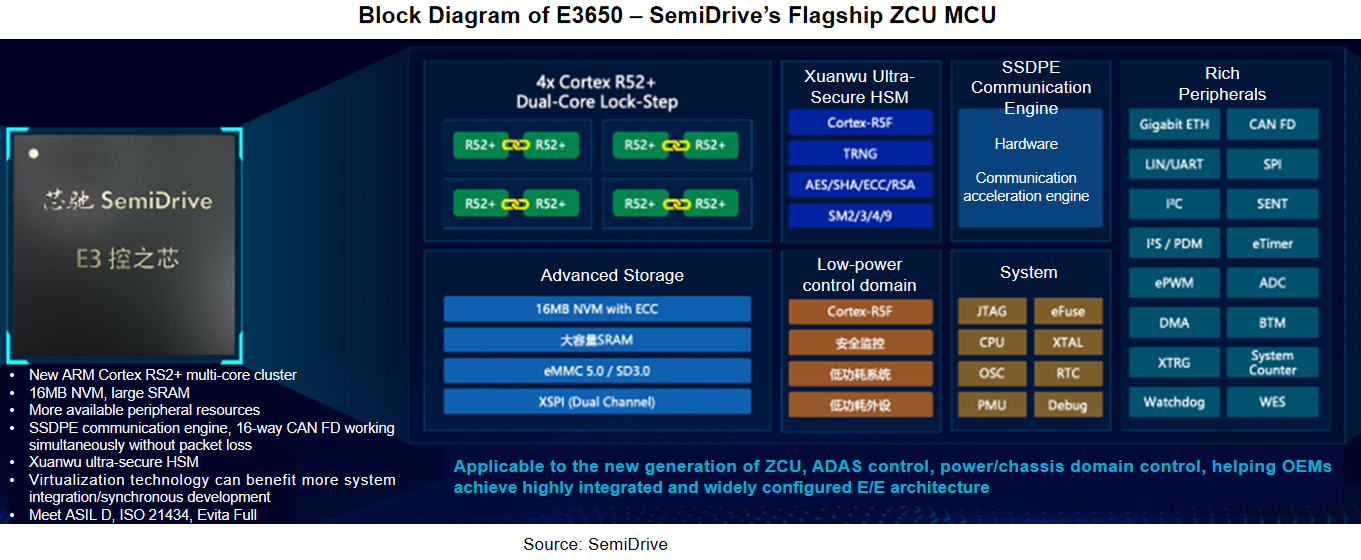
E3650, the ZCU MCU product of SemiDrive: In April 2024, SemiDrive launched a new-generation ZCU product family, coveting I/O-rich ZCU, control-integrated ZCU and compute-intensive ZCU and targeting core application scenarios such as body control, and body + chassis + power cross-domain integration. Wherein, E3650 is SemiDrive’s flagship chip product designed for new-generation cross-domain integrated control ZCU applications.?
Based on ASIL-D functional safety level, SemiDrive E3650 includes 4 ARM Cortex R52+ high-performance lock-step multi-core clusters. In terms of storage, it integrates 16MB embedded non-volatile memory with large-capacity SRAM. As for information security, it integrates Xuanwu Ultra Secure Hardware Security Module (HSM), and complies with the information security standards of ISO 21434, Evita Full and above, better meeting the needs of vehicle models going overseas. It uses the SSDPE (Super Speed Data Packet Engine), a hardware communication acceleration engine which achieves zero data packet loss when all CAN-FDs work simultaneously, effectively reducing CPU load and improving communication throughput. For low-power body application scenarios, E3650 can use a proprietary wake-up detection engine and a low-power CPU to reduce the overall static power consumption.?
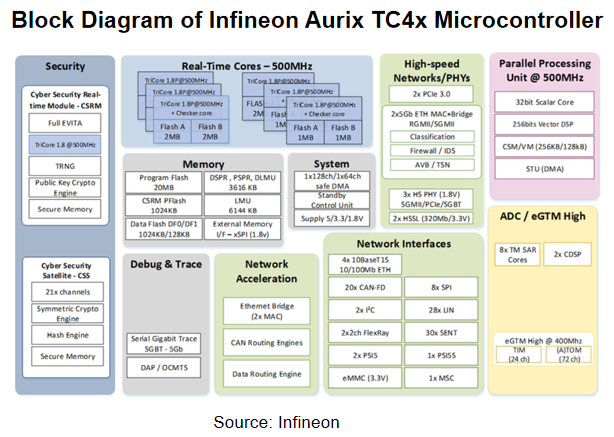
Infineon AURIX TC4x: TC4x microcontroller is designed by Infineon for ZCU and HPC applications. To satisfy the requirements of ZCU architecture and realize the multi-ECU integration of ZCU, Infineon Aurix TC4x microcontroller gets upgraded in terms of functional safety, information security, high-speed internal communication routing and core. The MCU contains 6 TriCore 1.8 embedded cores, and the clock frequency of each core can reach up to 500MHz.?
As intelligent driving booms, foundation models require higher computing power. To this end, Infineon integrates a PPU (Parallel Processing Unit) in TC4x products to implement models that require massive data processing or fast execution time, for example, signal filtering, algorithm processing and model predictive control. With higher computing efficiency, the PPU undertakes complex signal processing and mathematical operations such as AI, motor control, and zone control, for Tricore cores which are mainly used for control. After integrating the PPU coprocessor, TC4x boasts computing power of 8000DMIPS+72GFLOPS*1, of which the PPU contributes 72GFLOPS.?
At present, Infineon's Aurix TC4x microcontroller has been used to develop multiple ZCUs, including ZCU platforms of Tier1s like Continental, G-Pulse Electronics and Marelli.
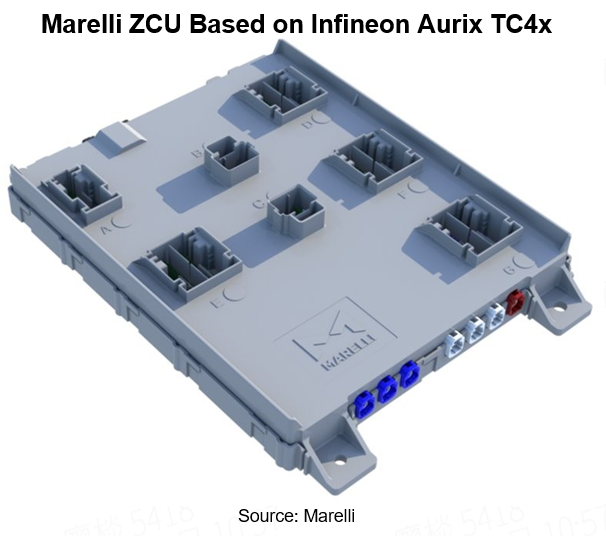
Marelli ZCU: In April 2024, Marelli announced a zone control unit (ZCU) based on Infineon's AURIX TC4x microcontroller. Placed in specific zones of the vehicle and manage various functions, the ZCU? consolidates electronic control units (ECUs) from multiple domains – including lighting, body, audio, power distribution, propulsion, thermal management, chassis control, and vehicle diagnostics. These solutions, combined with service-oriented software and cloud virtualization, enable customization of key vehicle performance through customized application software and functions.???
ZCU integrates power distribution function and realizes intelligent power distribution via e-Fuse.
Under zonal architecture, the power distribution mode of vehicles will change from traditional fuse box power distribution to ZCU power distribution. ZCU integrates the surrounding electronic systems according to the physical location, with the integrated functions including BCM, power, chassis, thermal management and gateway. For the working voltages of the connected sensors and actuators are inconsistent, ZCU needs to be responsible for power supply and power management of electrical appliances in the zone to improve power efficiency and safety.??????
ZCU power supply adopts hierarchical distribution.
Under zonal architecture, zonal power supply generally adopts a hierarchical distribution method: 1. Primary distribution network (backbone power supply network) that requires dual power supplies (redundant backup) to transmit power from the backbone network to ZCUs; 2. Secondary distribution network where ZCU is responsible for further transmitting power downward to the underlying controller.??
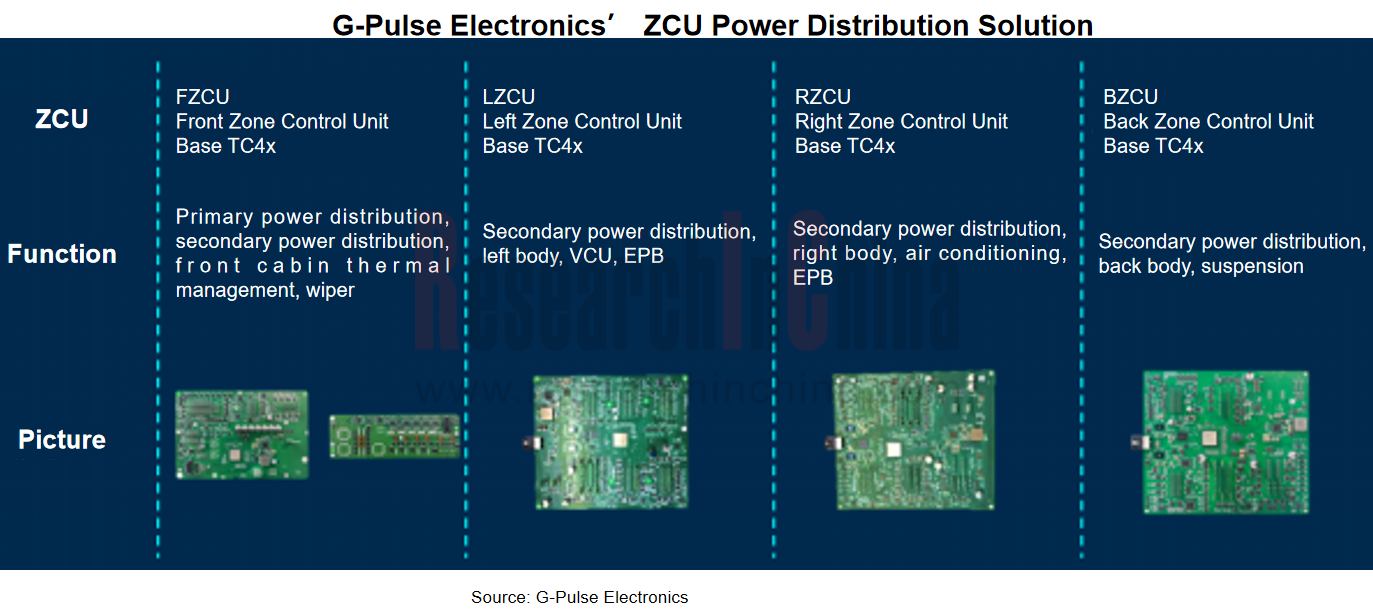
G-Pulse Electronics' power distribution solution based on “1+1+N” architecture: the architecture is composed of 1 central computing unit, 1 intelligent power distribution unit, and 4 ZCUs. Wherein, the intelligent power distribution unit includes primary power distribution, and can act as a separate power distribution controller, or integrate with the front zone control unit (FZCU) to form a primary and secondary power distribution solution, thus saving a primary power distribution unit. ZCUs are based on Infineon Aurix TC4x family, with different configurations required for customers’ vehicle models.???
The front zone control unit (FZCU) in this solution integrates primary and secondary power distribution, front cabin thermal management and other functions. It is connected to two DCDC converters plus a battery for power redundancy. The primary power distribution provides a power distribution solution for the left/right/rear zone control unit through the front zone; the left/right/rear zone control unit each provide a secondary power distribution channel, and there is also a two-layer stacking board approach (1 distribution board + 1 control board) in the front zone, which allows for better centralization and better isolation and power distribution, including the thermal management and drive requirements of the front cabin.????
 ?
?
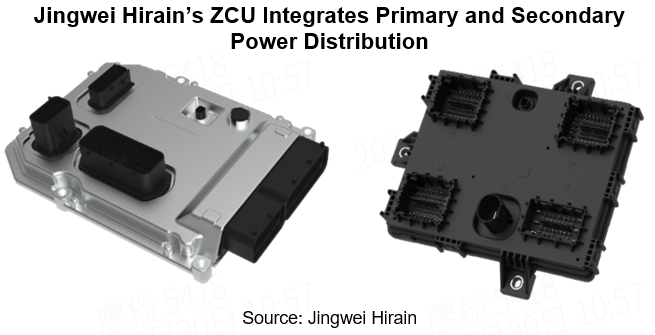
Jingwei Hirain’s physical ZCU: the ZCU meets ASIL B/D functional safety requirements, and integrates the signal acquisition and load drive of the new energy power domain, partial chassis domain, body comfort, and air conditioning thermal management control, as well as primary power distribution, secondary power distribution and zonal gateway functions. The hardware architecture is based on a multi-core MCU processor, deploys standard AUTOSAR CP software, and integrates electromechanical control algorithms such as power distribution algorithm, DC motor closed-loop control algorithm and anti-pinch algorithm, thermal protection algorithm, and authentication and localization algorithms for entry and startup.???
ZCU realizes intelligent power distribution via e-Fuse.
ZCU will use e-Fuse (intelligent fuse module) to replace the traditional relay + fuse solution. e-Fuse is an integrated circuit that integrates MOSFET, drive, logic circuit, diagnosis and other modules on a single chip. It adopts a software protection strategy for circuit detection, diagnosis and OTA updates to achieve intelligent power distribution and energy-efficient scheduling, thereby reducing energy consumption and increasing cruising range.

UAES: UAES's ZCU uses e-Fuse for intelligent power distribution and supports fault diagnosis and fuse self-recovery. Jointly created by UAES and TE Connectivity, this local power distribution network management solution optimizes the matching of E-fuse and wiring harness design in intelligent power distribution scenarios. Through e-Fuse intelligent power distribution, it enables separate and directional power distribution control according to working requirements of ECUs. It can cut vehicle wiring harness length by 25%, optimize wiring harness path by 28%, and reduce the number of vehicle distribution circuits by 10%.???
UAES’ explorations in intelligent power distribution application in ZCU:
Case 1: When charging, cut off body-related radars to reduce power consumption and increase charging speed;
Case 2: In sentry mode (i.e., when a vehicle is in the parking state, once it is hit or moved, the exterior camera will record surroundings and notify the owner via mobile phone APP), cut off all controllers related to intelligent driving to save power and increase cruising range;
Case 3: When the system predicts thermal runaway risks, only retain the power consumption of safety-related components to lower the risks; in addition, upload the accessory data to allow customers to obtain power usage of most ECU controllers in different scenarios, optimizing overall power distribution of the vehicle.??
ZCU software: Implement function call and platform-based portability via SOA, helping to cut costs.
As the I/O control center in a zone, ZCU not only integrates functions of individual body domain controllers such as air conditioning control, door control, and seat control, but will also gradually integrate more cross-domain function modules such as suspension control and radar interface in the future. Wherein, most of logical calculations of software will be moved up to the central computing platform, and ZCU will only be responsible for signal acquisition and hardware driver at the bottom layer, so that I/O can be extracted from the central computing platform, realizing separation of software and hardware and making it easier for OEMs to integrate functions across domains.?????
To reduce costs, ZCU needs to improve scalability and versatility, and use standardized hardware platforms to adapt to different vehicle configurations of various OEMs. ZCU also makes a gradual shift from signal-based services to service-based SOA design. This process requires ZCU to standardize interfaces, transform services, and manage packaging at the function level (body comfort, AC, chassis, HCU, etc.) to facilitate the central computing platform to flexibly call functions. Therefore, ZCU requires a highly integrated, standardized, and customizable design.??
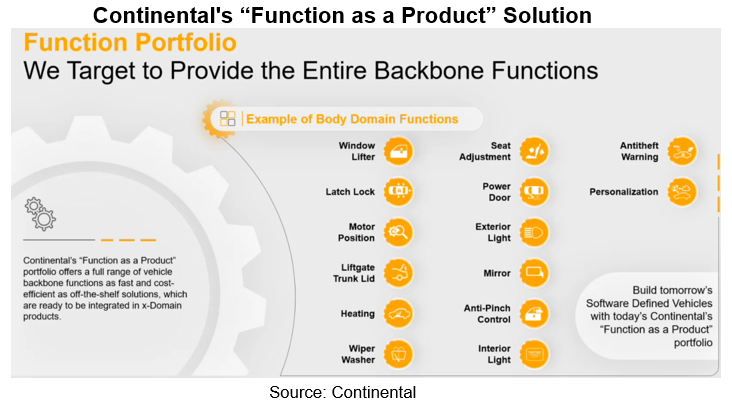
Continental: For software solutions for the body domain and actuators, Continental has launched the "Function as a Product" service, which can be quickly integrated into vehicle cross-domain products. For example, there are corresponding software kits for various body domain functions such as window lifting, trunk control, seat adjustment, seat heating, power doors, and exterior lighting control.?
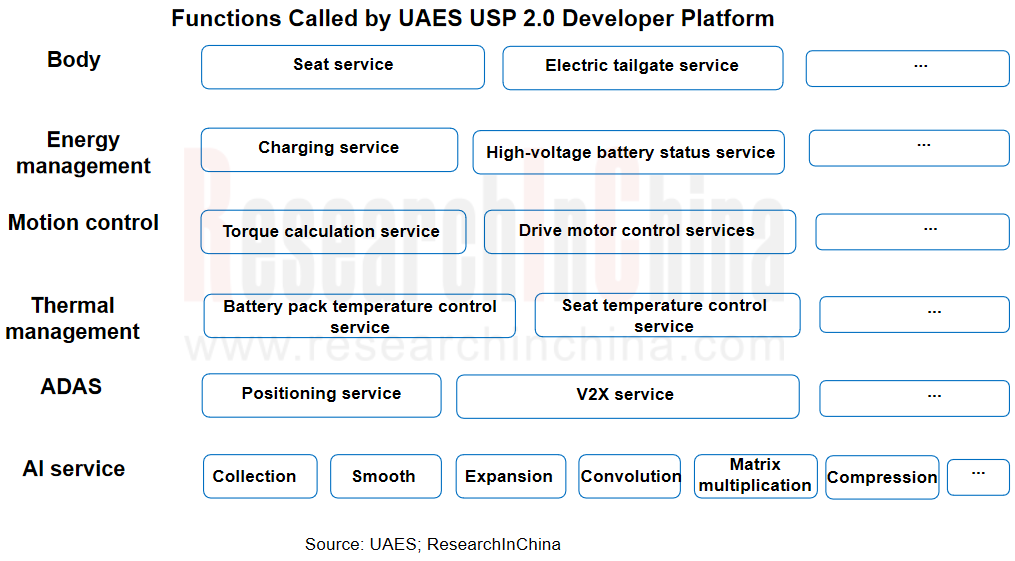
UAES USP 2.0 Developer Platform:The USP 2.0 platform can integrate nearly 20 independent ECUs through zonal architecture, increasing the communication rate from 2M to up to 1000M. On the USP2.0 platform, services that can be called have penetrated into fields of body control, energy management, motion control, thermal management, etc. Currently it has 951 basic functions, 126 atomic services and 105 basic services, and can provide 1,100+ vehicle APIs, 65 OTA APIs and 55 AI operators. These APIs and operators can help developers easily realize cross-domain application scenarios for vehicles.
Automotive Microcontroller Unit (MCU) and Application Scenario Research Report, 2026
Automotive MCU Research: Increased demand for redundant security drives ASIL D-compliant MCU shipments to exceed 100 million units
In a vehicle EEA, MCUs are widely distributed in various functional ...
China Intelligent Cockpit Patent Analysis Report, 2026
Intelligent Cockpit Patent Research: Cockpit AI, In?vehicle Health, and Infotainment Are Upgrade to Scenario?based and Proactive Functions
From a patent perspective, this report explores the cutting?...
Research Report on Application of VLA Large Model in Automobiles and Robots, 2026
Research on Automotive and Robot VLA: Hybrid Architectures Become Mainstream, VLA Integrates with General World Models, and Reinforcement Learning Serves as Core Engine
Vision?Language?Action (VLA) m...
China Charging Infrastructure (Supercharging, Battery Swapping, V2G, etc.) and High-Performance Supercharging Battery Research Report, 2026
Charging and battery swapping research: as 5C+ supercharging vehicle models go into mass production, the pace of OEMs self-building supercharging networks quickens
800-1000V high-voltage platforms ar...
China Passenger Car Electronic Controlled Suspension Industry Report, 2026
Electronic Controlled Suspension Industry Research: As the First Year of Full Active Suspension Unfolds, Three Technical Routes Race Forward
1. Penetration Rate Surges Three Times, and Electronic Con...
Intelligent Driving SoC Research Report, 2026
Research on Intelligent Driving SoCs: Competition Focus Shifts to L3/L4 Embedded Hardware, and Computing Power of Flagship Vehicle Models Exceeds 1,000 TOPS
In terms of intelligent driving system in...
Automotive AI Large Model Technology Research Report, 2026
Automotive AI Large Model Research: Competition Shifts from "Who Has the Stronger Model" to "Who Boasts Higher Link Efficiency"
ResearchInChina released the Automotive AI Large Model Technology Resea...
Intelligent Vehicle Cockpit Domain Controller Research Report, 2026
Cockpit domain controller research: L3 AIDV intelligent cockpit domain controllers are entering a boom period
Driven by multiple factors such as the continuous evolution of the automotive central int...
Automotive Acoustic System (Audio, Multi-Channel) Industry Report, 2026
Automotive Acoustics Research: Multiple Channels, AI Tuning, and Self-Developed Algorithms Drive the Transformation of High-End Cockpit Sound Fields
I. Automotive Audio Hardware Solutions with 6–9 S...
Autonomous Driving Sensor Chip Research Report, 2026
Research on Autonomous Driving Sensor Chips: Deeply Perceiving the Physical World, Sensor Chips Are Playing A “Leading Role” in Intelligence
In 2026, the autonomous driving sensor chip industr...
Passenger Car Corner Module and Wheel‑Side Control System Research Report, 2026
Wheel-side control research: the “last mile” chassis innovation
Wheel-side control dismantles the traditional drive, braking, steering, and suspension control of the chassis from a "centralized" styl...
Embodied Artificial Intelligence (& Humanoid Robot) MCU Research Report, 2026
Research on Humanoid Robot MCUs: Evolution from General-Purpose Control to High-Value Dedicated Chip Solutions Integrated with Edge AI Functions
MCU (Microcontroller Unit) refers to a compact integra...
Intelligent Vehicle Zone Control Unit (ZCU) Research Report, 2026
ZCU Research: Cross-domain integrated ZCUs are becoming the edge computing nodes of the next-generation zonal architecture
Currently, the mainstream zonal architecture is mainly the quasi-central + z...
Automotive Cybersecurity and Data Security Research Report, 2026
Cybersecurity & Data Security Research: Intelligent Connected Vehicles Enter the Era of “Systematic Offense-Defense and AI-Defined Security”.
Centering on the panorama of intelligent connect...
Report on Breakthrough Strategies of OEMs and ADAS Tier 1 Suppliers for Overseas Layout of Intelligent Driving, 2026
Regulatory Breakthrough, Local System Establishment, OEMs Competing for NOA Layout: Overall Trends of China’s Intelligent Driving Overseas Layout in 2026
Research on overseas intelligent driving layo...
OEMs and Tier1s’ Intelligent Cockpit Platform (Hardware and Software) Innovation Strategy Research Report, 2026
Intelligent Cockpit Platform Research: multi-dimensional cockpit system architecture reconstruction for multi-agent collaboration and proactive intelligent services
The intelligent cockpit software s...
Automotive AIOS Research Report, 2026
Automotive AIOS Research: Mass Production Solutions Are Implemented
Mass Production Solutions Are Implemented on A Small Scale.
In 2026, AIOS starts small-scale implementation, helping to improve v...
Automotive Telematics Service Provider (TSP) Research Report, 2026
TSP Research: Leading providers collectively turn to AI agents to provide all-scenario active services
Telematics Service Providers (TSPs) are the core hub of the telematics industry chain, connectin...