Analysis on Xiaomi Auto's Electrification, Connectivity, Intelligence and Sharing, 2024
Research on Xiaomi Auto: Xiaomi Auto's strengths and weaknesses
Since the release of SU7, Xiaomi delivered 7,058 units and 8,630 units in April and May, respectively, and more than 10,000 units in both June and July. Xiaomi officially expects to fulfill 110,000 orders in November, which means it needs to achieve the average monthly delivery of 16,000 units in the next four months from August to November.
Xiaomi Auto’s first car was a success thanks to its advantages in many aspects, but there are also some shortcomings in its development.
Strength 1: Sufficient funds, ten times more investment to polish hot-selling products
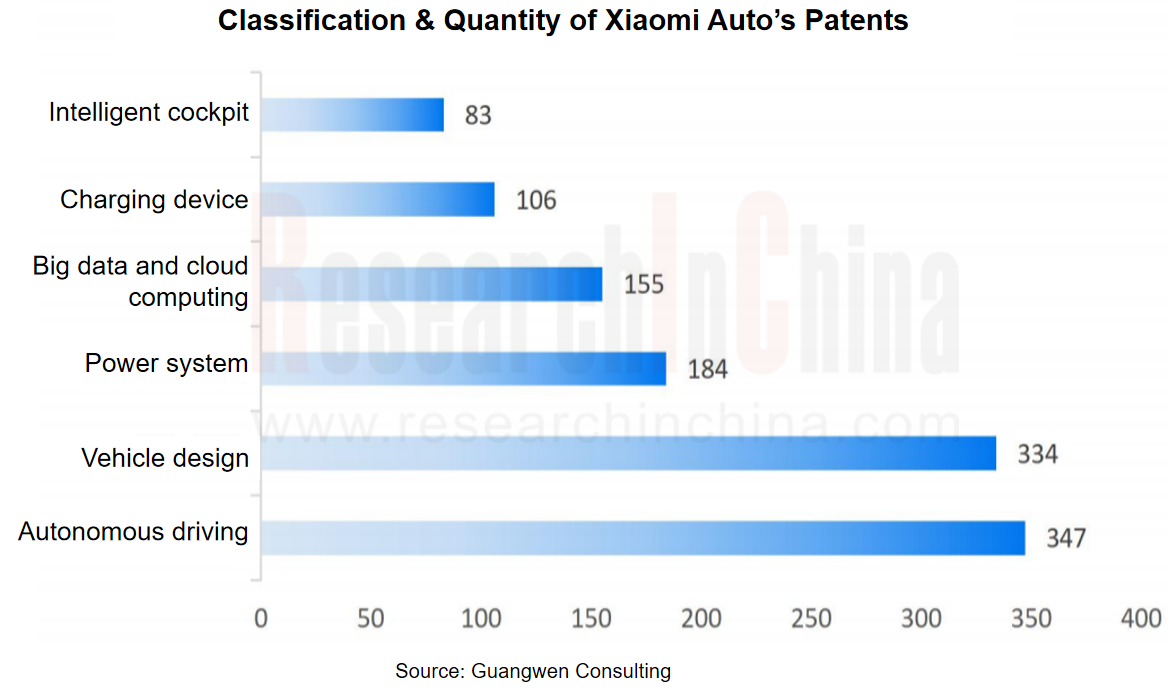
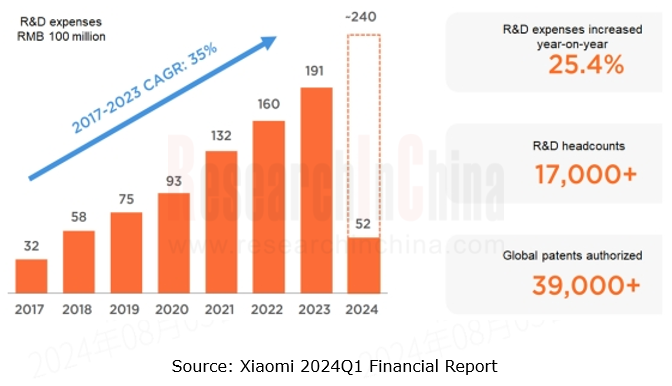
Compared with other emerging auto brands that need to keep raising funds, Xiaomi Group itself is a listed company with about RMB100 billion in cash. Traditional OEMs generally input 300 to 400 people and RMB1-2 billion in R&D funds to develop a vehicle. Xiaomi put 3,400 engineers and a total R&D funds of RMB10 billion to develop its first car, of which the investment in the key technology intelligent driving was as high as RMB4.7 billion, with the dedicated team size exceeding 1,000 people. By H1 2024, Xiaomi Auto has published about 1,200 Chinese patents/patent fillings, most of which are autonomous driving and vehicle design patents.
Strength 2: High brand awareness and a huge fan base
Xiaomi has built a fan base by marketing means such as community marketing. As of Q4 2023, the global monthly active users of MIUI have numbered 641 million. Lei Jun's personal Weibo has 24 million fans, far more than other emerging auto brand leaders. Traditional OEM bosses lack influence on Internet.
Xiaomi Group's new retail system enables vehicle sales services. Xiaomi has created a new online and offline integrated retail model. Major online channels are Xiaomi Mall, Xiaomi Youpin (e-commerce platform), Xiaomi Tmall Flagship Store, Xiaomi JD Flagship Store, and offline channels are mainly Xiaomi Home (including direct-sale and franchised) in the core business districts of cities, authorized experience stores/special areas in suburbs and towns, and service outlets. As of April 2024, Xiaomi Group has boasted a total of 12,060 offline stores, including 5,993 Xiaomi Home stores/franchised stores/exclusive stores + 281 Xiaomi Home direct-sale stores + 1,595 service outlets + 4,472 authorized experience stores/special areas.
By the end of July 2024, Xiaomi Auto has opened across China: 30 delivery centers, 102 sales stores, and 58 service outlets.
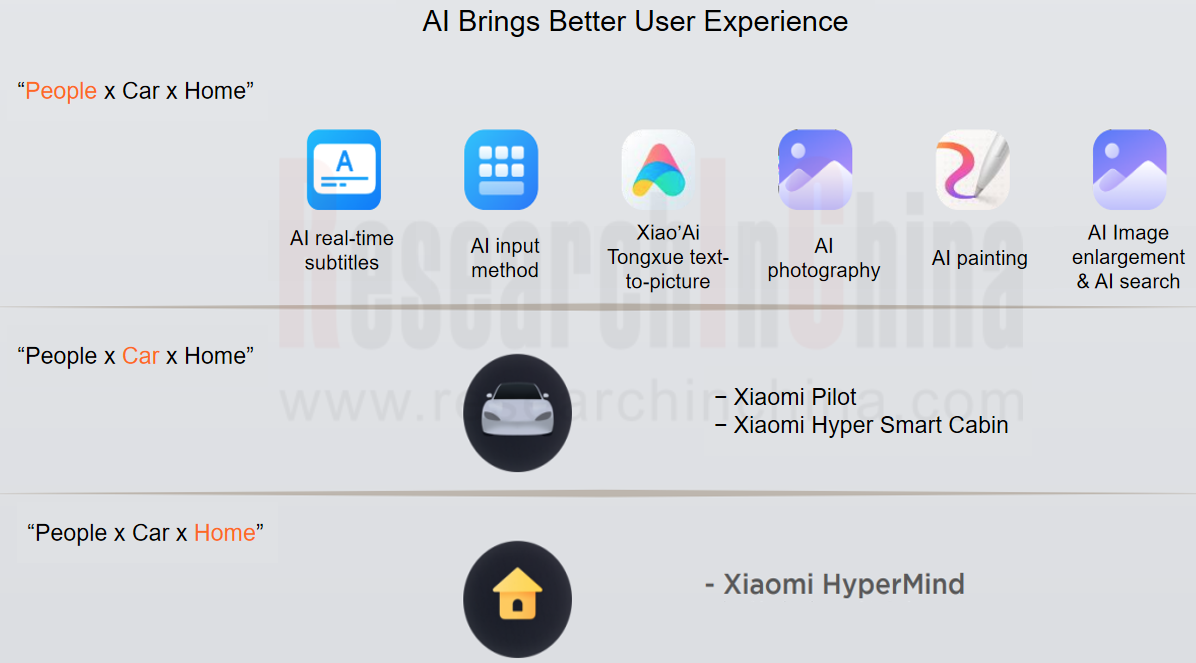
Strength 3: The people-car-home ecosystem brings convenience to Xiaomi Auto users through integration of information and intelligent applications
In 2022, Xiaomi decided to unify the OS of various devices, involving the software architecture of MIUI, Vela, Mina, and IVI OS. In October 2023, Xiaomi announced HyperOS, a system which is based on the fusion of Android in deep evolution and the self-developed Vela system, rewrites the underlying architecture, and enables dynamic real-time networking of all devices, bringing a new terminal interconnection experience.
Strength 4: Excellent marketing and pre-sale activities
Xiaomi is good at using social media and online and offline channels for all-round marketing and promotion. The Xiaomi Auto Launch in December last year and the Xiaomi SU7 Launch in March this year were particularly eye-catching. In these two launches, Xiaomi Auto easily dominated the top trending searches on major social media platforms. According to the statistical report of Zhiwei Data, on the Launch day in December, Xiaomi Auto had more than 350,000 posts and more than 200 hot searches/hashtags on the entire Internet. This launch event had an influence index of up to 80.6, higher than 97% of events and higher than 98% of corporate events. It was really the king of traffic, and even the king of Weibo, Li Auto, could not catch up with it.
Through well-planned launch and online live broadcast, it attracted a mass of viewers. Meanwhile, Xiaomi introduced limited-time offers such as generous gifts for first-day car purchase and exclusive rights for limited-time car ordering, which stimulated consumers' enthusiasm for ordering.
Strength 5: Supply chain integration and manufacturing capabilities
Although Xiaomi is a fresh entrant in the automobile manufacturing industry, it has been able to quickly build a high-quality automobile production system relying on its strong supply chain management and resource integration capabilities, ensuring the timely delivery and stable production supply, thus eliminating consumers' concerns about insufficient supply in the early stages of new product launch.
Despite multiple advantages, Xiaomi Auto also has some obvious shortcomings:
Shortcoming 1: Insufficient manufacturing experience
Xiaomi has always adopted an asset-light business model, and often relies on external partners in product manufacturing. Yet the manufacturing process of automobiles is far more complicated than consumer electronics, which is a big challenge to Xiaomi. Since its birth, Xiaomi has entrusted mobile phone production to ODMs. Xiaomi is responsible for design and sales, while ODMs take charge of production.??????
Among emerging carmakers, Li Auto, Xpeng Motors and NIO all chose the OEM/ODM mode to enter the market at the beginning. Under the premise that mobile phones are all produced by ODMs/OEMs, it is undoubtedly a huge challenge for Xiaomi to directly skip to building its own car factory and manufacturing cars.
Shortcoming 2: The threshold for core automotive technology is high, and Xiaomi’s automotive R&D expertise is insufficient.
Although Xiaomi has gathered rich experience in intelligent hardware and electronics, automobile manufacturing is a complex system engineering that requires higher technical thresholds and longer technology accumulation. Xiaomi's technical expertise in battery management, vehicle systems, power batteries, and autonomous driving development is relatively insufficient.
Compared with Huawei, Li Auto, NIO, and Tesla, Xiaomi makes underinvestment in EE architecture, automotive basic software, and charging/swapping facilities. Compared with traditional OEMs such as Geely, BYD, and Changan, Xiaomi has insufficient expertise in batteries, hybrids, chassis, and production & manufacturing.
Shortcoming 3: BEV market growth slows down, and need to start from scratch in extended-range models.
Sales data from 2023 to 2024 show that the BEV market has reached a growth bottleneck, and hybrid electric vehicles (especially the extended-range) grew much faster. Xiaomi plans to launch an extended-range SUV in 2026. It has started R&D of extended-range vehicles. After all, it needs to start from scratch and lags behind Li Auto and Huawei for several years. It is not easy to catch up with the two tough rivals.
Shortcoming 4: There are many faults in new cars. Xiaomi still needs to polish software and manufacturing and improve after-sales services.
According to feedback from some we-media (like Leyuan Wangchuang), Xiaomi Auto mainly has following problems since car release:
1. Battery: Many users said that the cruising mileage of cars is quite different from the officially announced, and even some cars had battery failures, thus failing to start normally.
2. Software failures: Problems such as vehicle system halt, inaccurate navigation system, and slow response of voice control affect user experience.
3. Manufacturing quality: Some car owners reported that there are defects in the vehicle assembly process, such as uneven door gaps, loose interior trims, and abnormal body noise.
4. After-sales services: Faced with frequent quality problems, Xiaomi Auto seems to be overstretched in after-sales services, for example, long time to wait for repair and insufficient supply of accessories.
Xiaomi Auto's long-term goal is to "become one of the top five global automakers with 15-20 years of efforts and create a mobile smart space that looks good and is easy to drive, comfortable and safe." Relying on the strengths of Xiaomi Group, Xiaomi Auto has made an initial success in SU7. However, to achieve its long-term goal, Xiaomi Auto still has many problems to overcome.
Automotive Microcontroller Unit (MCU) and Application Scenario Research Report, 2026
Automotive MCU Research: Increased demand for redundant security drives ASIL D-compliant MCU shipments to exceed 100 million units
In a vehicle EEA, MCUs are widely distributed in various functional ...
China Intelligent Cockpit Patent Analysis Report, 2026
Intelligent Cockpit Patent Research: Cockpit AI, In?vehicle Health, and Infotainment Are Upgrade to Scenario?based and Proactive Functions
From a patent perspective, this report explores the cutting?...
Research Report on Application of VLA Large Model in Automobiles and Robots, 2026
Research on Automotive and Robot VLA: Hybrid Architectures Become Mainstream, VLA Integrates with General World Models, and Reinforcement Learning Serves as Core Engine
Vision?Language?Action (VLA) m...
China Charging Infrastructure (Supercharging, Battery Swapping, V2G, etc.) and High-Performance Supercharging Battery Research Report, 2026
Charging and battery swapping research: as 5C+ supercharging vehicle models go into mass production, the pace of OEMs self-building supercharging networks quickens
800-1000V high-voltage platforms ar...
China Passenger Car Electronic Controlled Suspension Industry Report, 2026
Electronic Controlled Suspension Industry Research: As the First Year of Full Active Suspension Unfolds, Three Technical Routes Race Forward
1. Penetration Rate Surges Three Times, and Electronic Con...
Intelligent Driving SoC Research Report, 2026
Research on Intelligent Driving SoCs: Competition Focus Shifts to L3/L4 Embedded Hardware, and Computing Power of Flagship Vehicle Models Exceeds 1,000 TOPS
In terms of intelligent driving system in...
Automotive AI Large Model Technology Research Report, 2026
Automotive AI Large Model Research: Competition Shifts from "Who Has the Stronger Model" to "Who Boasts Higher Link Efficiency"
ResearchInChina released the Automotive AI Large Model Technology Resea...
Intelligent Vehicle Cockpit Domain Controller Research Report, 2026
Cockpit domain controller research: L3 AIDV intelligent cockpit domain controllers are entering a boom period
Driven by multiple factors such as the continuous evolution of the automotive central int...
Automotive Acoustic System (Audio, Multi-Channel) Industry Report, 2026
Automotive Acoustics Research: Multiple Channels, AI Tuning, and Self-Developed Algorithms Drive the Transformation of High-End Cockpit Sound Fields
I. Automotive Audio Hardware Solutions with 6–9 S...
Autonomous Driving Sensor Chip Research Report, 2026
Research on Autonomous Driving Sensor Chips: Deeply Perceiving the Physical World, Sensor Chips Are Playing A “Leading Role” in Intelligence
In 2026, the autonomous driving sensor chip industr...
Passenger Car Corner Module and Wheel‑Side Control System Research Report, 2026
Wheel-side control research: the “last mile” chassis innovation
Wheel-side control dismantles the traditional drive, braking, steering, and suspension control of the chassis from a "centralized" styl...
Embodied Artificial Intelligence (& Humanoid Robot) MCU Research Report, 2026
Research on Humanoid Robot MCUs: Evolution from General-Purpose Control to High-Value Dedicated Chip Solutions Integrated with Edge AI Functions
MCU (Microcontroller Unit) refers to a compact integra...
Intelligent Vehicle Zone Control Unit (ZCU) Research Report, 2026
ZCU Research: Cross-domain integrated ZCUs are becoming the edge computing nodes of the next-generation zonal architecture
Currently, the mainstream zonal architecture is mainly the quasi-central + z...
Automotive Cybersecurity and Data Security Research Report, 2026
Cybersecurity & Data Security Research: Intelligent Connected Vehicles Enter the Era of “Systematic Offense-Defense and AI-Defined Security”.
Centering on the panorama of intelligent connect...
Report on Breakthrough Strategies of OEMs and ADAS Tier 1 Suppliers for Overseas Layout of Intelligent Driving, 2026
Regulatory Breakthrough, Local System Establishment, OEMs Competing for NOA Layout: Overall Trends of China’s Intelligent Driving Overseas Layout in 2026
Research on overseas intelligent driving layo...
OEMs and Tier1s’ Intelligent Cockpit Platform (Hardware and Software) Innovation Strategy Research Report, 2026
Intelligent Cockpit Platform Research: multi-dimensional cockpit system architecture reconstruction for multi-agent collaboration and proactive intelligent services
The intelligent cockpit software s...
Automotive AIOS Research Report, 2026
Automotive AIOS Research: Mass Production Solutions Are Implemented
Mass Production Solutions Are Implemented on A Small Scale.
In 2026, AIOS starts small-scale implementation, helping to improve v...
Automotive Telematics Service Provider (TSP) Research Report, 2026
TSP Research: Leading providers collectively turn to AI agents to provide all-scenario active services
Telematics Service Providers (TSPs) are the core hub of the telematics industry chain, connectin...