Automotive Fragrance and Air Conditioning System Research Report, 2024
Research on automotive fragrance/air purification: With surging installations, automotive olfactory interaction is being linked with more scenarios.
As users require higher quality of personalized, intelligent and scenario-based car life, the healthy air in cars receives ever more attention. At present, automotive air conditioning systems mainly use air conditioner, air filters (filter elements, PM2.5 filter devices, AQS, physical adsorption, etc.), air purification systems (negative ion/plasma generator, ultraviolet generator, photocatalyst technology, etc.), and fragrance systems to bring pleasant fragrance to cockpits, remove formaldehyde and odor, purify harmful gas particles with negative ions, and kill and inhibit bacteria.

Chinese standards for monitoring and managing in-car air quality include the national standard GB/T 27630-2011 "Guideline for Air Quality Assessment of Passenger Car", the association standard " Passenger Cars - In-car Air Quality Measurement and Odor Evaluation Methods", the industrial standard QC/T 998-2023 "Cabin Air Filter for Automobiles", the association standard "Testing Specifications for Automotive Fragrance Capsules", the association standard "Technical Specifications for Automotive Fragrance Systems” and the association standard “Key Chemical Substances Controlled by REACH in the Automotive Industry Part 2: Testing Specifications".
In the aspect of air quality health certification, besides the CN95 healthy cockpit certification of China Automotive Technology & Research Center (CATARC) & CAQC (by the particle filtration efficiency index of automotive air conditioner filters, the certified products are divided into five grades: CN60, CN70, CN80, CN90 and CN95, of which CN95 is the highest grade, that is, the filtration efficiency of 0.3μm non-oily particles exceeds 95%), there is also "China Automotive Health Index" introduced by China Automotive Engineering Research Institute Co., Ltd. (CAERI), covering five evaluation dimensions, namely, volatile organic compounds (VOC), vehicle odor intensity (VOI), electromagnetic radiation (EMR), particulate matter (PM) and vehicle allergy risk (VAR).
 ??
??
1. The installations of automotive air conditioning devices have increased, especially automotive fragrance having seen exponential growth.
At present, automotive air conditioning devices mainly include fragrance systems, air purifiers, PM2.5 filter devices and negative ion systems.
From 2021 to May 2024, the installations of automotive air purifiers and fragrance systems rose rapidly. In 2023, 821,000 cars were equipped with fragrance systems as standard; from January to May 2024, fragrance systems as a standard configuration were installed in 489,192 cars, a year-on-year spike of 122%. It is expected that over 1.1 million cars will carry such systems in 2024.
Meanwhile, the installations of air purifiers made steady growth. It increased by 14.8% year on year in 2022 and 22.4% year on year in 2023 as standard. From January to May 2024, 2.451 million vehicles were equipped with air purifiers as standard, a year-on-year increase of 7.8%. It is expected that air purifiers will be installed in over 7 million vehicles in 2024. From January to May 2024, 6.3336 million vehicles were installed with PM2.5 filters, a year-on-year increase of 12.1%; 1.0256 million vehicles carried negative ion systems, a year-on-year decrease of 5.7%.

2. Air purification technologies such as photocatalyst and ultraviolet ray are applied to more models.
On mainstream models, air purification systems are mainly used for disinfection and sterilization, for example, plasma purification, photocatalyst purification and ultraviolet sterilization. At present, air purification systems are often matched with air filters to build a complete automotive air purification management system. An automotive air purifier is an air purification device specifically used to purify PM2.5, toxic and harmful gases (formaldehyde, benzene, TVOC, etc.), odor, bacteria, viruses and other in-car pollutants.
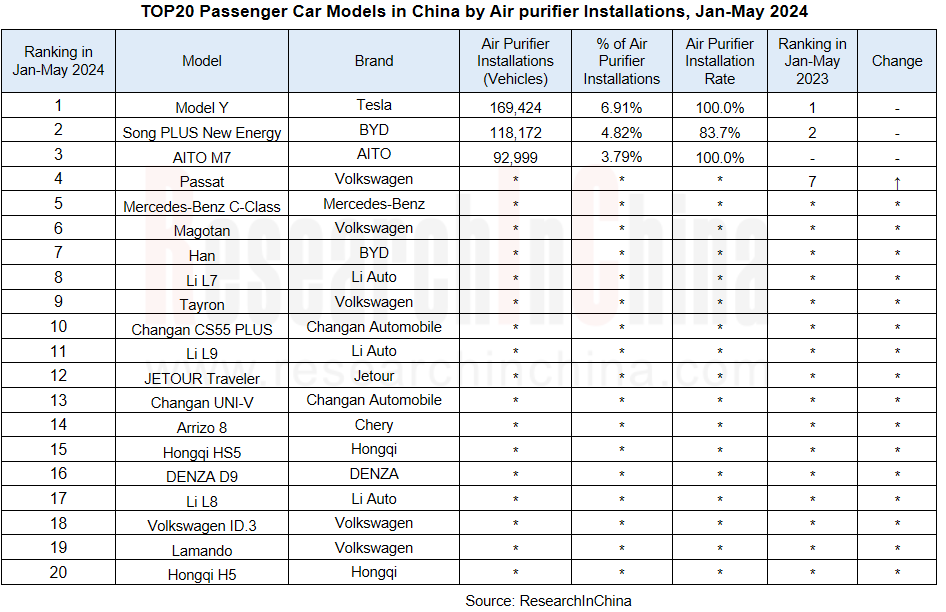
For in-car air purification, ever more OEMs are trying to apply such technologies as ultraviolet disinfection and photocatalyst to improve the in-car air health index, in addition to negative ions/plasma. For example, AITO M9 uses UVC photocatalyst disinfection technology, and the high-configuration model of GAC Toyota Camry is equipped with photocatalyst air purifiers and Panasonic nanoe? X, a nano negative ion air moisturizing purification system.
「Photocatalyst, represented by nanometer titanium dioxide (TiO2), is a collective name for semiconductor materials that does not change under the irradiation of light but can promote chemical reactions and has catalytic function. The biggest feature of photocatalyst is that it strongly absorbs ultraviolet rays in light. After absorbing ultraviolet rays, the molecules of photocatalyst move violently and become active, but its substance remains unchanged. When odorous substances (formaldehyde, acetic acid, ammonia, etc.) in the air pass through the photocatalyst net, they collide with the active photocatalyst, absorb some energy, and become active as well. The molecules move violently and unsteadily, a series of chemical reactions (which are called photodissociation reactions) occur, and the odorous substances are transformed into odorless substances.」
For example, AITO M9 uses a UVC photocatalyst disinfection system combined with air conditioning to not only efficiently filter out tiny particles such as PM2.5 and dust, but also actively eliminate viruses and bacteria in the air conditioning duct and internal air. According to the testing report issued by the authoritative organization “National Center of Quality Inspection and Testing on Air Purification Products”, the photocatalyst air sterilizer assembled into AITO M9 can effectively kill the common influenza virus H1N1, with the removal rate higher than 99.99% within 15 minutes. The killing rate of Staphylococcus albus in 15 minutes goes beyond 99.9%. The extinction rate of natural bacteria in the air surpasses 94% within 30 minutes.
In addition, the principle of ultraviolet disinfection is to destroy the molecular structure of DNA or RNA in microbial cells by using ultraviolet rays with appropriate wavelength, resulting in the death of growing cells and/or regenerative cells, thus accomplishing disinfection. The automotive ultraviolet sterilization systems on market generally adopt the UVC wavelength band (200~275 nm).
3. Fragrance systems are heading in the direction of multimodal control.
The fragrance system releases the fragrance to the whole vehicle through the air conditioning system. The automotive intelligent fragrance system can control the switch according to the settings, and adjust the fragrance concentration, mode and working time interval through various intelligent methods such as WeChat applet, voice control or smart control panel. In general, an automotive intelligent fragrance system is composed of a fragrance container, IVI display, audio control system, fragrance controller and fragrance actuator.
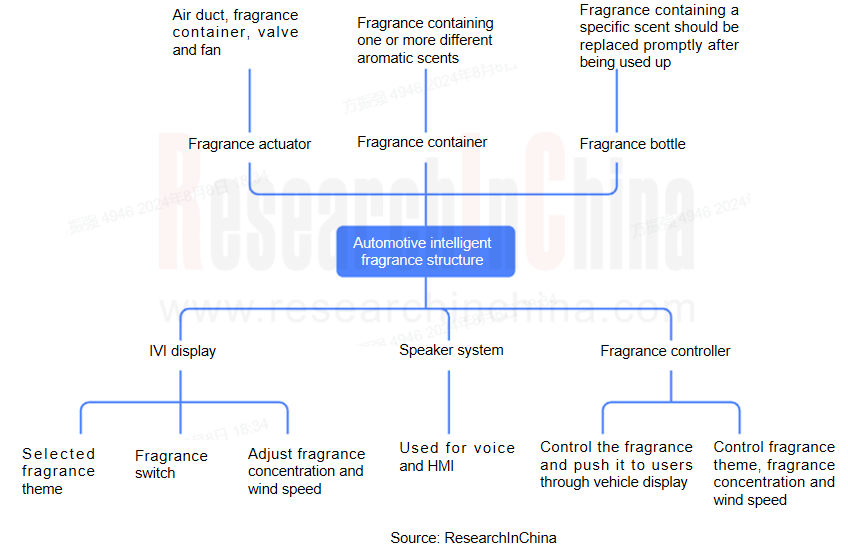
As intelligent cockpit interaction technology develops, multiple control modes for intelligent fragrance systems come out, for example:
Voice control: NIO EC7, Neta GT, HiPhi Y, Voyah Passion, Changan Nevo A07, Livan 7, etc.
Gesture interaction: The intelligent fragrance system of Avatr 11 can be controlled by gesture recognition, emotion recognition, voice interaction and scenario modes.
Face recognition: When a tired driver is detected, NIO EC7 will automatically release the refreshing fragrance.
Remote control: The 2024 Xpeng G9 allows users to remotely turn on/off the air conditioner, adjust the temperature, and select the fragrance scent via their mobile phones. The 2024 AITO M9 lets users remotely turn on/off the air conditioner, adjust the temperature, and tweak the fragrance concentration through via mobile phones. The 2024 Zeekr 001 allows users to remotely turn on/off the air conditioner, adjust the temperature, select the fragrance scent, and tweak the fragrance concentration via mobile phones.
Biometrics: In the future, vehicles will release different scents according to users. For example, the patent issued by Meizu will make the car recognize the user's first odor information for automatic release. A patent issued by BMW can obtain the driver's psychological state by detecting his/her odor to give multiple assists (such as fragrance) or remind the driver, so as to detect whether he/she is tired of driving.
Emotion recognition: Hyundai Motor once unveiled a mini electric vehicle using Emotion Adaptive Vehicle Control (EAVC), a technology which can monitor facial expressions, heart rate and respiratory rate, and combines these readings with input from the vehicle including speed, acceleration, noise and vibration. The technology uses the information to control lighting, climate, music and fragrance dispenser. So far, the Real-time Emotion Adaptive Driving (R.E.A.D.) System has not been applied to the production models of Kia.
4. Automotive olfactory interaction is linked with more scenarios.
In the future, in-vehicle air conditioning is not only about air purification, odor removal and pleasant fragrance, but also about matching the users' application scenario through various scenario modes and intelligently adapting to meet the individual needs of users. In-vehicle olfactory interaction will enable scenario interaction, releasing different scents according to scenarios, for example, releasing appropriate fragrance (e.g., AION LX Plus’ Chinese fragrance) in scenarios with babies or elderly people, and sending out the corresponding scent (e.g., the earthy smell when it is sunny after rain) according to the ambient atmosphere and music style.
 The vehicle monitors the driver's status and reminds him/her via fragrance as soon as tired driving is detected. For example, when the driver is drowsy, the left front A-pillar camera of Livan 7 will capture facial information and give an audio prompt while releasing fragrance.
?When the user plays game, the combination of AR+fragrance can provide a better gaming experience; in different weather and seasons, corresponding fragrance is provided.
Fragrance can be linked with various scenario modes. In Nevo A07’s case, in the leisure mode, the seat position/massage intensity, windows, fragrance type and concentration, music duration and volume, ambient lighting, etc. can be customized by users.
Automotive Microcontroller Unit (MCU) and Application Scenario Research Report, 2026
Automotive MCU Research: Increased demand for redundant security drives ASIL D-compliant MCU shipments to exceed 100 million units
In a vehicle EEA, MCUs are widely distributed in various functional ...
China Intelligent Cockpit Patent Analysis Report, 2026
Intelligent Cockpit Patent Research: Cockpit AI, In?vehicle Health, and Infotainment Are Upgrade to Scenario?based and Proactive Functions
From a patent perspective, this report explores the cutting?...
Research Report on Application of VLA Large Model in Automobiles and Robots, 2026
Research on Automotive and Robot VLA: Hybrid Architectures Become Mainstream, VLA Integrates with General World Models, and Reinforcement Learning Serves as Core Engine
Vision?Language?Action (VLA) m...
China Charging Infrastructure (Supercharging, Battery Swapping, V2G, etc.) and High-Performance Supercharging Battery Research Report, 2026
Charging and battery swapping research: as 5C+ supercharging vehicle models go into mass production, the pace of OEMs self-building supercharging networks quickens
800-1000V high-voltage platforms ar...
China Passenger Car Electronic Controlled Suspension Industry Report, 2026
Electronic Controlled Suspension Industry Research: As the First Year of Full Active Suspension Unfolds, Three Technical Routes Race Forward
1. Penetration Rate Surges Three Times, and Electronic Con...
Intelligent Driving SoC Research Report, 2026
Research on Intelligent Driving SoCs: Competition Focus Shifts to L3/L4 Embedded Hardware, and Computing Power of Flagship Vehicle Models Exceeds 1,000 TOPS
In terms of intelligent driving system in...
Automotive AI Large Model Technology Research Report, 2026
Automotive AI Large Model Research: Competition Shifts from "Who Has the Stronger Model" to "Who Boasts Higher Link Efficiency"
ResearchInChina released the Automotive AI Large Model Technology Resea...
Intelligent Vehicle Cockpit Domain Controller Research Report, 2026
Cockpit domain controller research: L3 AIDV intelligent cockpit domain controllers are entering a boom period
Driven by multiple factors such as the continuous evolution of the automotive central int...
Automotive Acoustic System (Audio, Multi-Channel) Industry Report, 2026
Automotive Acoustics Research: Multiple Channels, AI Tuning, and Self-Developed Algorithms Drive the Transformation of High-End Cockpit Sound Fields
I. Automotive Audio Hardware Solutions with 6–9 S...
Autonomous Driving Sensor Chip Research Report, 2026
Research on Autonomous Driving Sensor Chips: Deeply Perceiving the Physical World, Sensor Chips Are Playing A “Leading Role” in Intelligence
In 2026, the autonomous driving sensor chip industr...
Passenger Car Corner Module and Wheel‑Side Control System Research Report, 2026
Wheel-side control research: the “last mile” chassis innovation
Wheel-side control dismantles the traditional drive, braking, steering, and suspension control of the chassis from a "centralized" styl...
Embodied Artificial Intelligence (& Humanoid Robot) MCU Research Report, 2026
Research on Humanoid Robot MCUs: Evolution from General-Purpose Control to High-Value Dedicated Chip Solutions Integrated with Edge AI Functions
MCU (Microcontroller Unit) refers to a compact integra...
Intelligent Vehicle Zone Control Unit (ZCU) Research Report, 2026
ZCU Research: Cross-domain integrated ZCUs are becoming the edge computing nodes of the next-generation zonal architecture
Currently, the mainstream zonal architecture is mainly the quasi-central + z...
Automotive Cybersecurity and Data Security Research Report, 2026
Cybersecurity & Data Security Research: Intelligent Connected Vehicles Enter the Era of “Systematic Offense-Defense and AI-Defined Security”.
Centering on the panorama of intelligent connect...
Report on Breakthrough Strategies of OEMs and ADAS Tier 1 Suppliers for Overseas Layout of Intelligent Driving, 2026
Regulatory Breakthrough, Local System Establishment, OEMs Competing for NOA Layout: Overall Trends of China’s Intelligent Driving Overseas Layout in 2026
Research on overseas intelligent driving layo...
OEMs and Tier1s’ Intelligent Cockpit Platform (Hardware and Software) Innovation Strategy Research Report, 2026
Intelligent Cockpit Platform Research: multi-dimensional cockpit system architecture reconstruction for multi-agent collaboration and proactive intelligent services
The intelligent cockpit software s...
Automotive AIOS Research Report, 2026
Automotive AIOS Research: Mass Production Solutions Are Implemented
Mass Production Solutions Are Implemented on A Small Scale.
In 2026, AIOS starts small-scale implementation, helping to improve v...
Automotive Telematics Service Provider (TSP) Research Report, 2026
TSP Research: Leading providers collectively turn to AI agents to provide all-scenario active services
Telematics Service Providers (TSPs) are the core hub of the telematics industry chain, connectin...