Research on automotive smart exteriors: in the trend towards electrification and intelligence, which exteriors will be replaced by intelligence
The Automotive Smart Exteriors Research Report, 2024 released by ResearchInChina analyzes and studies the installation, market size, content-per-car value, competitive pattern, suppliers’ strategy, OEMs’ strategy, and development trends of various automotive smart exteriors.
The research covers the following:
 Digital grille: digital grille (application scenarios and development history); active grille shutter (installations and installation rate, distribution by price range, and competitive pattern); luminous interactive grille (installations and installation rate, market size, supplier pattern, etc.).
Smart charging gate: features, installation, vehicle model cases, suppliers, development trends, etc.
Hidden door handle: categories, system costs, installation, market size, vehicle model cases, suppliers and competitive pattern, development trends, etc.
Intelligent headlight: development history, main technology routes, installations, penetration rate, vehicle model cases, suppliers, etc.
Body ambient lighting: various body ambient lights, luminous LOGO, application scenarios of projector lamp, installation rate, application cases, etc.
Smart B-pillar: features, vehicle model cases, etc.
Smart glass: features, new applications and trends, etc.
Electronic exterior rearview mirror: features, vehicle model cases, development trends, etc.
1. In 2030, China’s new energy passenger car exteriors market will be valued at more than RMB150 billion.
In the trend towards electrification and intelligence, the penetration rate of smart exteriors in passenger cars in China is on the rise. By one estimate, the penetration rate was 10.4% in 2023 and is expected to reach 20.8% in 2030.
Compared with traditional exteriors, smart exteriors boast higher content-per-car value.
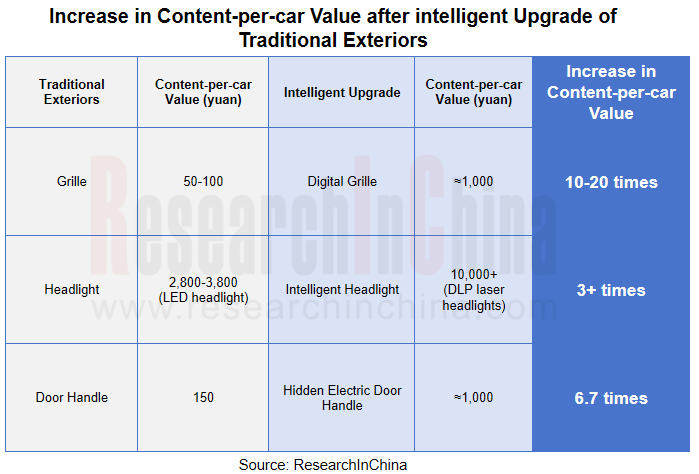
The cost of traditional exteriors is about RMB2,000 per car (excluding headlights), largely for bumpers, exterior rearview mirrors, sealing strips, and wheel trims. If the cost of headlights is added (by RMB2,800-3,800 for LED headlights per car), the cost of exteriors per car will be around RMB5,000.
In the intelligent upgrade process, the value of exteriors has surged. For example, the digital grille is more than 10 times the ordinary grille, the laser headlight is more than 3 times the LED headlight, and the hidden electric door handle is 6.7 times the ordinary door handle. Overall, the content value of smart exteriors per car will be more than 5 times traditional exteriors, that is, the cost per car is RMB10,000 (excluding headlights), and plus headlights, the content-per-car value is higher than RMB20,000.
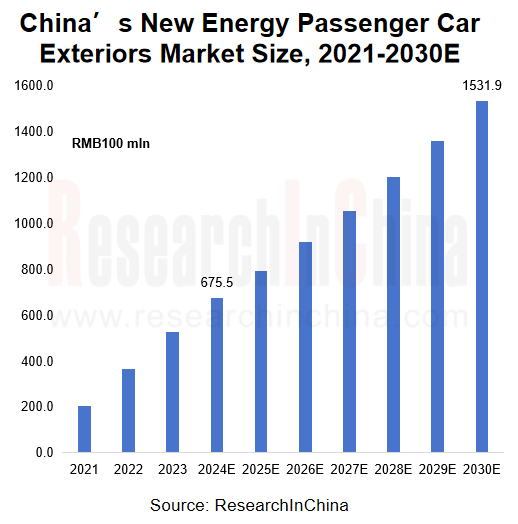
New energy passenger cars pioneer smart exteriors. On ResearchInChina’s estimate, China’s new energy passenger car exteriors market will be worth RMB67.55 billion in 2024, of which smart exteriors will be valued at RMB25.05 billion, accounting for 37.1%. It is predicted that China’s new energy passenger car exteriors market will be valued at RMB153.19 billion in 2030, of which smart exteriors will take an over 50% share.
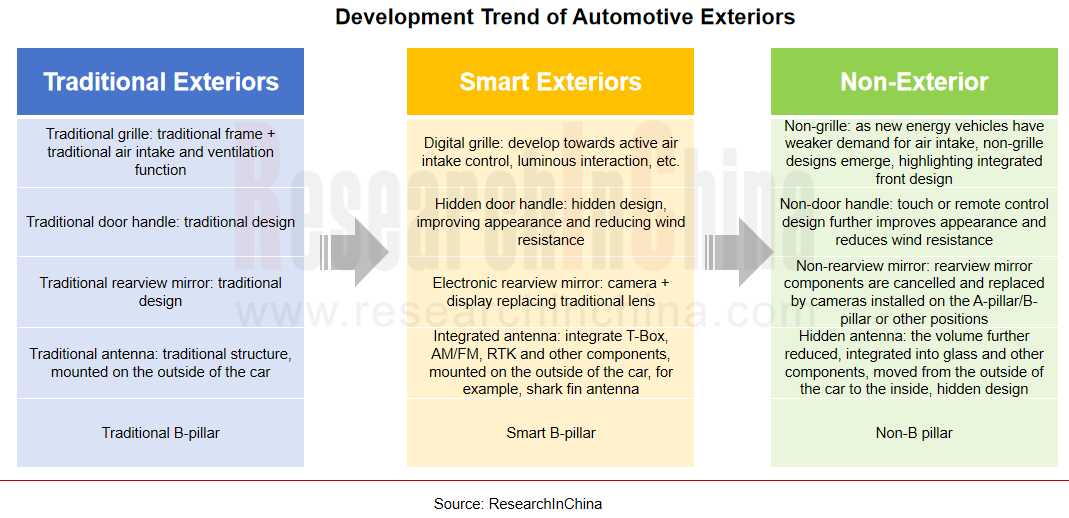
2. In the trend towards intelligence, some traditional exteriors are being replaced by intelligence.
As exteriors tend to be smart, some traditional components will gradually be replaced by intelligence, and even non-exterior designs will appear.
1) Non-B pillar design
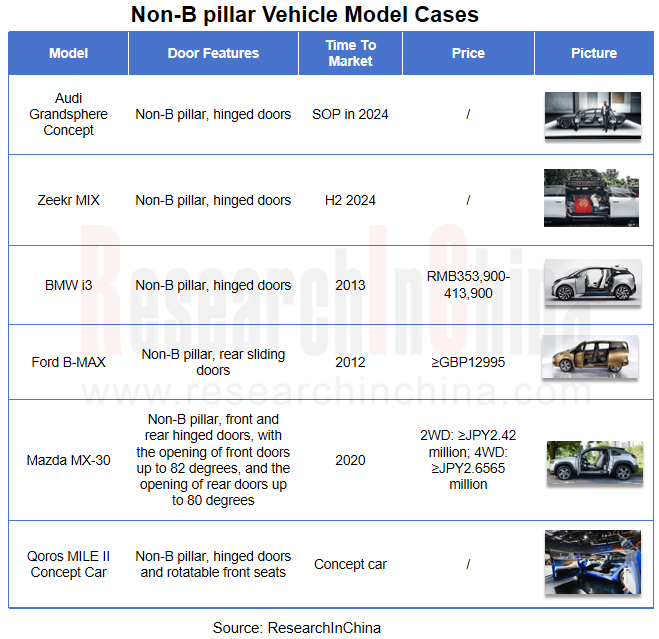
The non-B pillar design is usually a non-B pillar + hinged door design. Not only is the door opening full of sense of ritual, but the extra-wide door opening (maximum opening of more than 1m) makes it more convenient for users to get on and off the car. The non-B pillar design has received much attention in the market, especially from household and business users who appreciate the convenience and space utilization of this design.
Zeekr MIX, to be launched in the second half of 2024, adopts a non-B pillar design. The removal of B-pillar can further expand the opening area of ??Zeekr MIX’s doors, enhance the airy and open feel and flexibility of the car’s interior space, and make the car’s interior layout more flexible.
2) Non-door handle design
Hidden door handles are quite controversial, and non-door handle solutions then come out.
In the keyless entry trend, non-door handle design becomes possible. Non-door handle design is a new solution developed for users to unlock and get in and off cars. It often applies wireless inductive unlocking technology and power door system. When the user carries the smart key or authorizes the car via the mobile phone APP to unlock, the control unit triggers the operation of the built-in electric actuator of the door after receiving the command, so that the door automatically pops out or slides at a preset angle, so as to facilitate the user's entry.
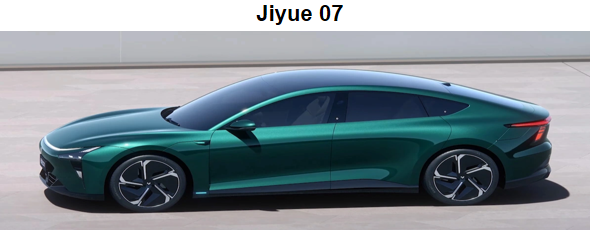
In April 2024, Jiyue 07 was unveiled at the Auto China. It adopts a non-door handle design. In addition, Jiyue 07 is also equipped with intelligent inductive power doors, allowing the user to open the door with one button and enabling more intelligent door opening.
3) Non-grille design
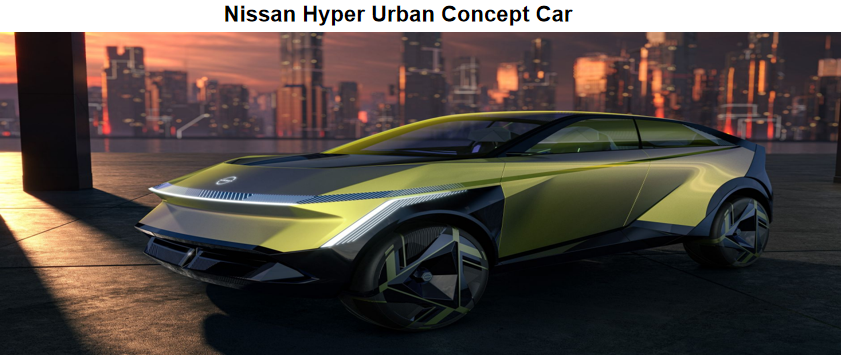
The original intention of grille design was to meet the engine's need for air intake and heat dissipation. As new energy vehicles develop, this demand has become much weaker. Non-grille design will become a trend in the future.
At the Tokyo Motor Show in November 2023, Nissan's first all-electric crossover concept car Hyper Urban removed its typical V-Motion grille. This means that in the wave of electrification transformation, Nissan begins to use a non-grille design.
4) Hidden antenna design
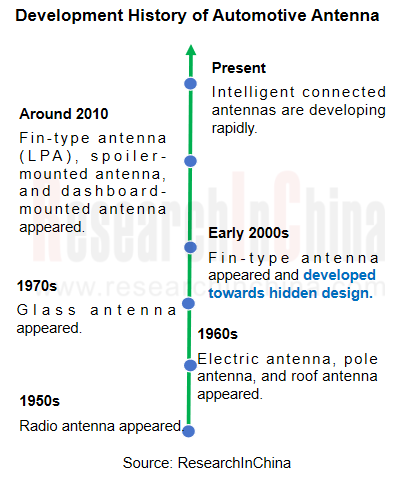
Automotive antennas tend to be miniaturized and integrated, and hidden design is one of its future development directions.
The significance of hidden antennas is that the introduction of antennas does not affect the appearance of the vehicle body, that is, they are hidden somewhere on the body. Hidden design requires overall consideration of what types of antennas are used and how to simplify antenna deployment on the vehicle body.
5) Non-rearview mirror design
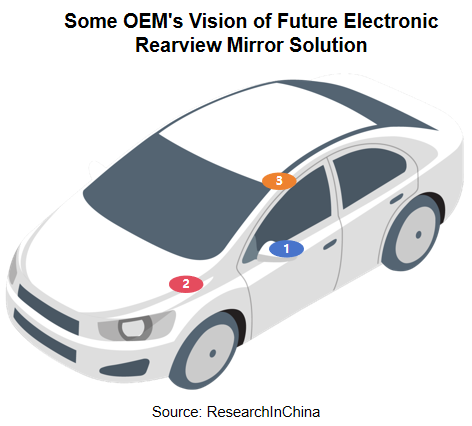
In current stage, the camera of the electronic exterior rearview mirror is installed in the positions similar to ADAS, mainly on the traditional exterior rearview mirror or at the rear of the vehicle. There is also overlap between the functions of the two, such as blind spot detection and lane change assist based on side cameras. At present, one direction of OEMs to achieve overall cost reduction is reuse of ADAS cameras. From the perspective of field of view, the two have the possibility of reuse. In this period, the camera of the electronic exterior rearview mirror still lies in the traditional positions.
In the future, as traditional rearview mirrors disappear, electronic exterior rearview mirrors will only exist for the purpose of installing cameras, and become much less necessary. Some OEM once mentioned its vision of the future electronic rearview mirror solution in which the camera is expected to be moved to the side of the front hood (position ② in the figure below) or the top corner of the window (position ③ in the figure below). By then, the "non-rearview mirror" design will be realized.
Automotive Microcontroller Unit (MCU) and Application Scenario Research Report, 2026
Automotive MCU Research: Increased demand for redundant security drives ASIL D-compliant MCU shipments to exceed 100 million units
In a vehicle EEA, MCUs are widely distributed in various functional ...
China Intelligent Cockpit Patent Analysis Report, 2026
Intelligent Cockpit Patent Research: Cockpit AI, In?vehicle Health, and Infotainment Are Upgrade to Scenario?based and Proactive Functions
From a patent perspective, this report explores the cutting?...
Research Report on Application of VLA Large Model in Automobiles and Robots, 2026
Research on Automotive and Robot VLA: Hybrid Architectures Become Mainstream, VLA Integrates with General World Models, and Reinforcement Learning Serves as Core Engine
Vision?Language?Action (VLA) m...
China Charging Infrastructure (Supercharging, Battery Swapping, V2G, etc.) and High-Performance Supercharging Battery Research Report, 2026
Charging and battery swapping research: as 5C+ supercharging vehicle models go into mass production, the pace of OEMs self-building supercharging networks quickens
800-1000V high-voltage platforms ar...
China Passenger Car Electronic Controlled Suspension Industry Report, 2026
Electronic Controlled Suspension Industry Research: As the First Year of Full Active Suspension Unfolds, Three Technical Routes Race Forward
1. Penetration Rate Surges Three Times, and Electronic Con...
Intelligent Driving SoC Research Report, 2026
Research on Intelligent Driving SoCs: Competition Focus Shifts to L3/L4 Embedded Hardware, and Computing Power of Flagship Vehicle Models Exceeds 1,000 TOPS
In terms of intelligent driving system in...
Automotive AI Large Model Technology Research Report, 2026
Automotive AI Large Model Research: Competition Shifts from "Who Has the Stronger Model" to "Who Boasts Higher Link Efficiency"
ResearchInChina released the Automotive AI Large Model Technology Resea...
Intelligent Vehicle Cockpit Domain Controller Research Report, 2026
Cockpit domain controller research: L3 AIDV intelligent cockpit domain controllers are entering a boom period
Driven by multiple factors such as the continuous evolution of the automotive central int...
Automotive Acoustic System (Audio, Multi-Channel) Industry Report, 2026
Automotive Acoustics Research: Multiple Channels, AI Tuning, and Self-Developed Algorithms Drive the Transformation of High-End Cockpit Sound Fields
I. Automotive Audio Hardware Solutions with 6–9 S...
Autonomous Driving Sensor Chip Research Report, 2026
Research on Autonomous Driving Sensor Chips: Deeply Perceiving the Physical World, Sensor Chips Are Playing A “Leading Role” in Intelligence
In 2026, the autonomous driving sensor chip industr...
Passenger Car Corner Module and Wheel‑Side Control System Research Report, 2026
Wheel-side control research: the “last mile” chassis innovation
Wheel-side control dismantles the traditional drive, braking, steering, and suspension control of the chassis from a "centralized" styl...
Embodied Artificial Intelligence (& Humanoid Robot) MCU Research Report, 2026
Research on Humanoid Robot MCUs: Evolution from General-Purpose Control to High-Value Dedicated Chip Solutions Integrated with Edge AI Functions
MCU (Microcontroller Unit) refers to a compact integra...
Intelligent Vehicle Zone Control Unit (ZCU) Research Report, 2026
ZCU Research: Cross-domain integrated ZCUs are becoming the edge computing nodes of the next-generation zonal architecture
Currently, the mainstream zonal architecture is mainly the quasi-central + z...
Automotive Cybersecurity and Data Security Research Report, 2026
Cybersecurity & Data Security Research: Intelligent Connected Vehicles Enter the Era of “Systematic Offense-Defense and AI-Defined Security”.
Centering on the panorama of intelligent connect...
Report on Breakthrough Strategies of OEMs and ADAS Tier 1 Suppliers for Overseas Layout of Intelligent Driving, 2026
Regulatory Breakthrough, Local System Establishment, OEMs Competing for NOA Layout: Overall Trends of China’s Intelligent Driving Overseas Layout in 2026
Research on overseas intelligent driving layo...
OEMs and Tier1s’ Intelligent Cockpit Platform (Hardware and Software) Innovation Strategy Research Report, 2026
Intelligent Cockpit Platform Research: multi-dimensional cockpit system architecture reconstruction for multi-agent collaboration and proactive intelligent services
The intelligent cockpit software s...
Automotive AIOS Research Report, 2026
Automotive AIOS Research: Mass Production Solutions Are Implemented
Mass Production Solutions Are Implemented on A Small Scale.
In 2026, AIOS starts small-scale implementation, helping to improve v...
Automotive Telematics Service Provider (TSP) Research Report, 2026
TSP Research: Leading providers collectively turn to AI agents to provide all-scenario active services
Telematics Service Providers (TSPs) are the core hub of the telematics industry chain, connectin...