Research on automotive digital power supply: looking at the digital evolution of automotive power supply from the power supply side, power distribution side, and power consumption side
This report focuses on automotive? digital power supplies and chips, including:
? Power supply side, OBC, DC-DC, 12V & 48V lithium/sodium battery solutions and their digitalization;
? Power Distribution side, high-voltage distribution, low-voltage distribution solutions and their digitalization;
? Power consumption side, power solutions and digitalization for vehicle control, autonomous driving, intelligent cockpit, suspension, Brake-by-Wire, chassis, etc.;
? Digital power supply (power supply, power distribution, power consumption) digital solutions for OEM and Tier1s.

Power supply side: low-voltage starter batteries are developed towards 12V & 48V lithium/sodium batteries and redundant power supply systems
At present, lead-acid batteries are the most widely used in the start-stop field, accounting for about 90%. However, lead-acid batteries are not the best choice for starting batteries in the future. With the development of vehicle electrification and intelligence, and the addition of a wide variety of sensors and chips, the original electrical architecture is increasingly weak, and applications such as 12V & 48V lithium/sodium batteries and low-voltage start-up battery BMS are accelerating.
Lithium iron battery (LFP) is configured as four single cells in series (4s1p), plus a battery management system (BMS) to form a typical 12V low-voltage battery network, which can support single monitoring and semiconductor battery main switch. BYD has fully switched from lead-acid batteries to lithium iron batteries. The new Tesla Model S Plaid, the new Model X, and the domestic Model Y performance version also use 12V lithium batteries.
In addition to lithium iron batteries that have been applied in large quantities, 12V sodium electricity has also entered the early stage of industrialization. On August 14, 2024, Beijing New Energy Automobile issued an invitation tenders announcement on "12V sodium electricity (sodium vanadium phosphate) new technology development service project selection".
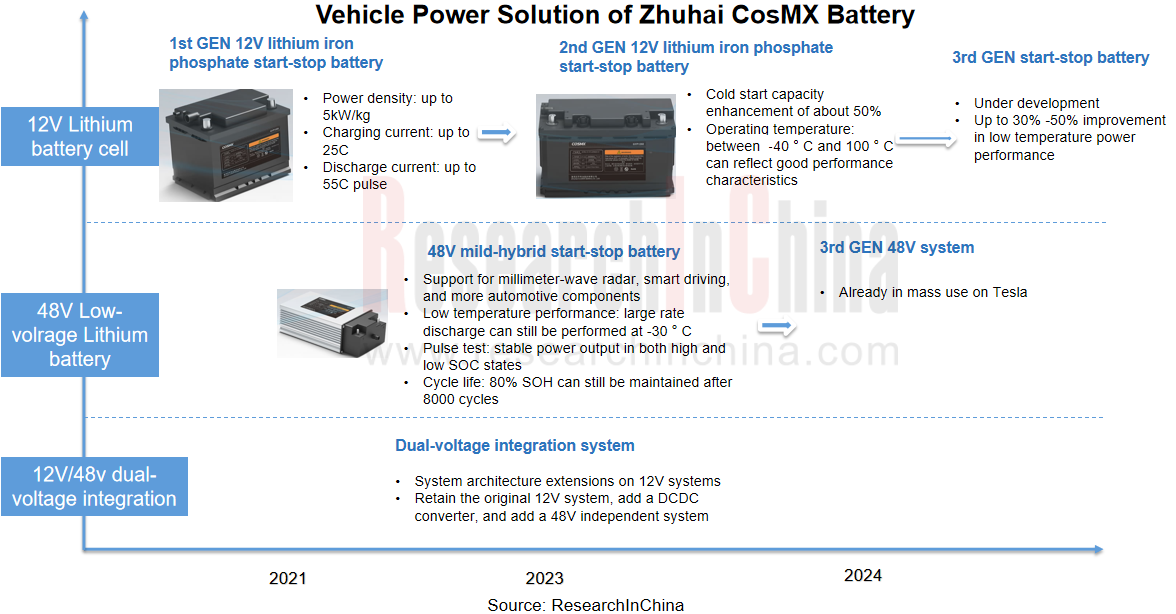
Leading battery manufacturers such as CATL, BYD, EVE Energy, Wanxiang A123 System, and Zhuhai CosMX Battery have all expanded their product lines in the field of 12V/48V start-up batteries, and gradually expanded their product lines to 12V + 48V redundant integrated systems and low-voltage power distribution systems. From the perspective of Zhuhai CosMX Battery's vehicle power solution:
? 12V lithium battery solution
In 2023, Zhuhai CosMX Battery's low-voltage lithium battery products have begun to be shipped in batches. 12V LFP start-stop battery can reach 8000 times, much higher than lead-acid batteries, which can ensure that the battery does not need to be replaced during the life cycle of the car. The company has accelerated its overseas expansion in low-voltage start-stop business, and has successively obtained designation of many well-known OEMs such as Jaguar Land Rover (2025 SOP), Stellantis (2026 SOP), GM (2025 SOP), and IM (IM LS7 12V lithium battery, 2023 SOP).
? 48V lithium battery solution
The Cybertruck is located in the middle of the front cabin. The 48V power supply position of the Cybertruck is fixed to the vehicle by two bolts, and the torque of the bolts is 8Nm. From the disassembly point of view, Zhuhai CosMX is Tesla's 48V lithium battery supplier.

? 12 + 48V + DC/DC dual voltage redundant power supply solution
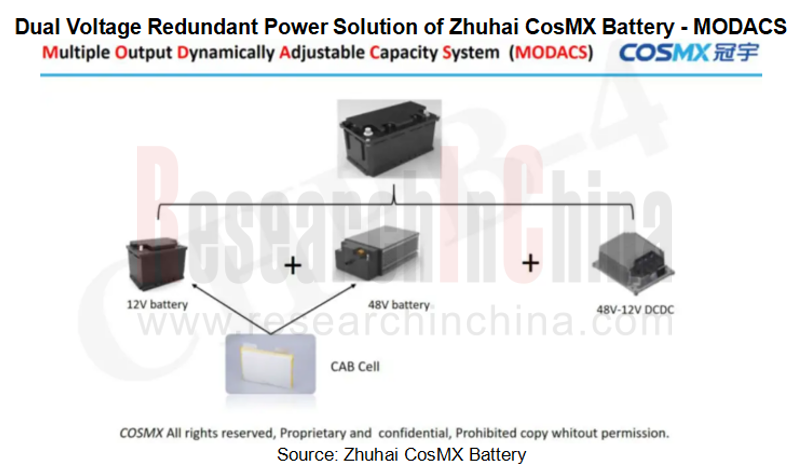
Zhuhai CosMX Battery's dual-voltage integrated products basically expand the system architecture on the 12V system, retaining the original 12V system, adding a DC/DC conversion device and a 48V independent system. The entire system is very large. The? 12V/48V dual-voltage system developed by Zhuhai CosMX Battery uses a battery pack to meet the 12V system function and 48V system function, and integrates DC/DC converter together. The integrated products can achieve 12V and 48V under the premise of fuel saving and consumption reduction. The cost is relatively low, the weight is relatively light, and the advantages are obvious.
Power supply side: DC/DC, OBC and other vehicle power modules are developing towards integration, efficiency and digitalization to achieve cost reduction and efficiency increase
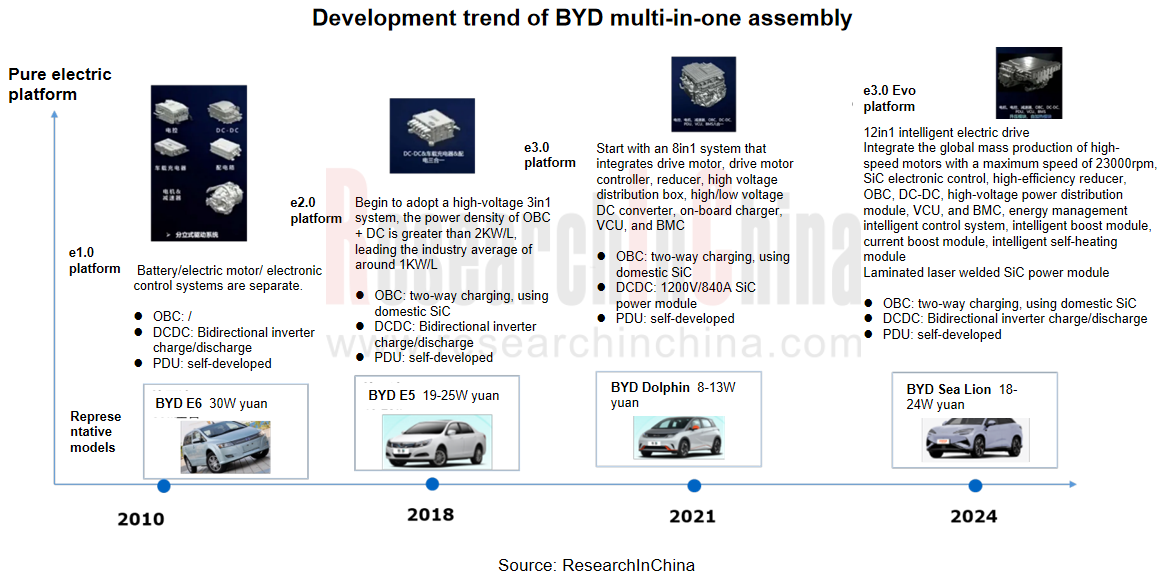
The application of "two-in-one" and "three-in-one" power assemblies has become very common, and automotive power supply has further formed an all-in-one assembly with electric drive, reducer, VCU/BMS, etc. The E/E architecture of the whole vehicle is rapidly evolving towards centralization. The ECU that used to be "separate" is integrated into one place, and new products such as 7in1, 8in1, 9in1 and even BYD e3.0 Evo's 12in1 are emerging in an endless stream.
Under this evolving trend, major Tier1 and Tier2 chip vendors have launched highly integrated solutions.
?VMAX: Committed to becoming a world-class electric vehicle power domain overall solution provider, it has obtained the fixed points of many well-known enterprises at home and abroad such as SAIC Group, Great Wall Motors, and Sany Heavy Machinery, and has realized the mass production and shipment of motor controllers, electric drive three-in-one assembly products and "power + electric drive" all-in-one assembly products.
? SemiDrive Technology: In February 2023, SemiDrive cooperated with Kotei to create a domestic power domain solution based on E3 "Control Core". The solution will also cover the all-in-one design of the power system in the future, and deeply integrate high-voltage electrical accessories such as DC/DC, OBC, and PDU.
? ST: Introduced a new generation of high-performance MCU products based on Arm ? architecture - the Stellar family, including three categories of Stellar E, Stellar G and Stellar P. Includes a 22kW OBC-DC/DC 2-in-1 solution based on Stellar E, a Stellar G-based ZCU, and a new all-in-one Stellar P-based powertrain domain controller at Munich Shanghai Electronics Show in? 2023.
ST aims to achieve "replacing the respective MCUs in multiple ECUs with a single Stellar P-series MCU, realizing the centralization of computing power, and users can develop and maintain products with only one software toolchain."
Stellar P-series MCUs support up to 6 Cortex ? R52 + cores, provide more than 10K DMIPS computing power, and support OBC, DC/DC, inverter, BMU and VCU function integration. The highly integrated form allows the entire controller size to be further reduced, the degree of integration will be higher, and the system BOM cost can be further optimized.
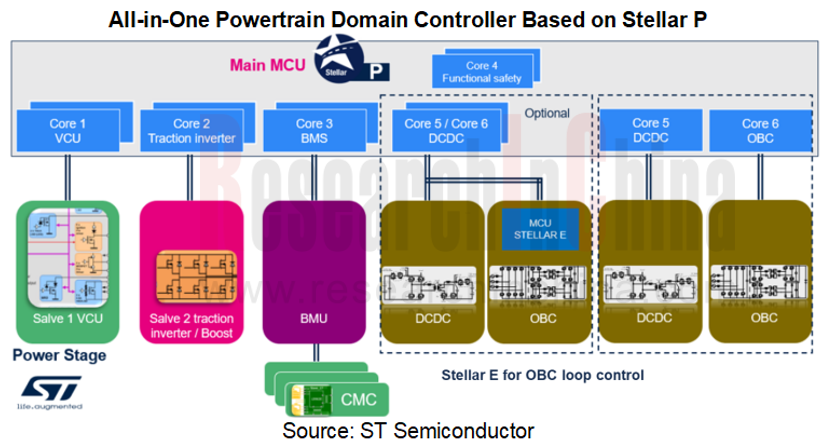
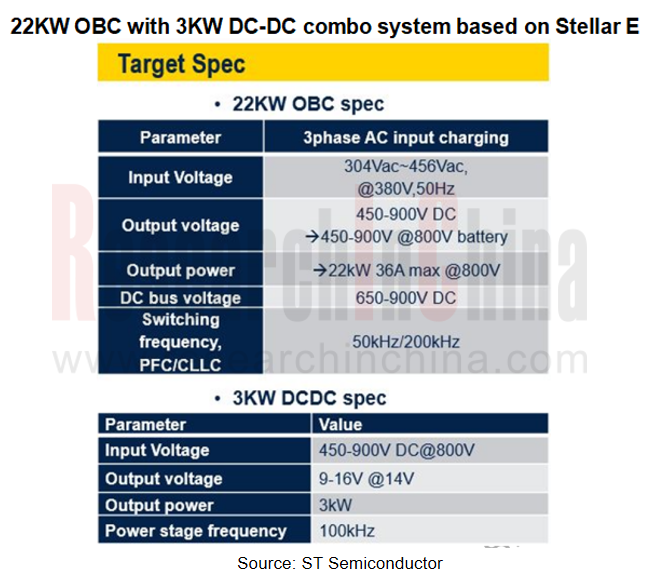
Based on Stellar E's 22KW OBC with 3KW DC-DC combo system two-in-one solution, compatible with 3.3KW & 6.6KW & 11KW on the market, its Stellar-E1 is a dual-core MCU with 300MHz computing power, rich peripherals, the biggest advantage is that the chip has security functions, no need to be designed with a security chip, in line with the security function requirements of ISO26262 ASIL-D, and also has OTA functions.
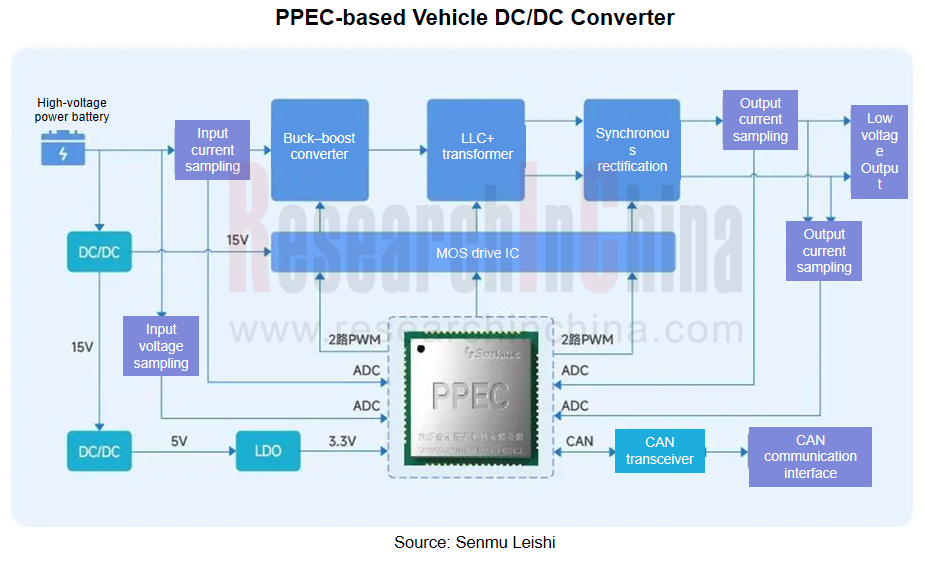
In the vehicle power system, the traditional DC/DC converter generally has problems such as low conversion efficiency and large size. It can achieve small size and high performance of DC/DC by using advanced technology controllers. Digital power solution provider "Wuhan Senmu Leishi Tech" has launched a self-developed PPEC (programmable power electronic controller) digital power control chip.
Power consumption side: safety power solutions for autonomous driving HPC, intelligent cockpit HPC, ECU, etc
The technological progress of SoCs in automotive intelligent cockpits puts forward higher requirements for computing power, main frequency and dynamic response speed. At the same time, the power consumption of the whole board continues to increase, and the power conversion efficiency needs to be higher to save energy; the dynamic response speed is faster, and the functional safety level requirements of power modules continue to increase (generally ASIL-B or above). These factors all bring various challenges to the design of automotive power supplies.
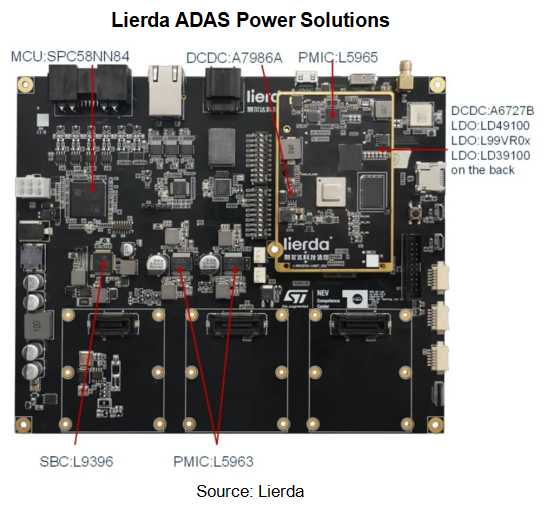
? Lierda and ST Launch ADAS Power Solution for Intelligent Driving
The core components of this solution include large computing power chip, ST's PMIC power chip, DCDC chip, LDO chip and ST's SPC series MCU. The power management chip solution can ensure that the ADAS domain controller can still provide stable and reliable power supply in the face of high current power consumption.
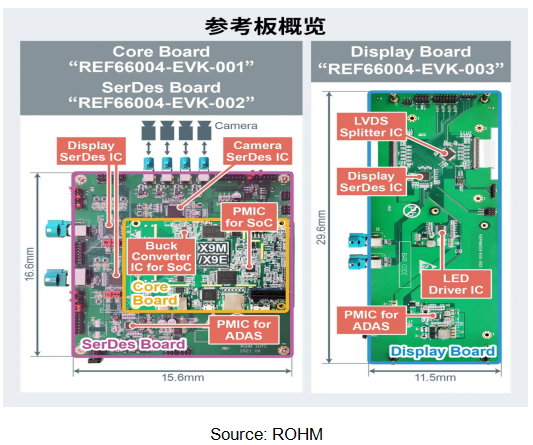
ROHM and SemiDrive Technology jointly develop an in-vehicle SoC reference design
The reference design mainly covers SemiDrive Technology's smart cockpit SoC * 1 "X9M" and "X9E" products, which are equipped with ROHM's PMIC * 2, SerDes IC * 3 and LED drivers.
In addition to the SerDes IC used in the "X9H" reference board, ROHM further provided? "BD96801Q12-C" SoC PMIC and "BD9SA01F80-C" buck converter IC? for driving the SoC, as well as??? "BD39031MUF-C" general-purpose PMIC for ADAS that supplies power to the SerDes IC. This solution supports operation of up to three display projections and four ADAS cameras (Surround-view camera).
Automotive Microcontroller Unit (MCU) and Application Scenario Research Report, 2026
Automotive MCU Research: Increased demand for redundant security drives ASIL D-compliant MCU shipments to exceed 100 million units
In a vehicle EEA, MCUs are widely distributed in various functional ...
China Intelligent Cockpit Patent Analysis Report, 2026
Intelligent Cockpit Patent Research: Cockpit AI, In?vehicle Health, and Infotainment Are Upgrade to Scenario?based and Proactive Functions
From a patent perspective, this report explores the cutting?...
Research Report on Application of VLA Large Model in Automobiles and Robots, 2026
Research on Automotive and Robot VLA: Hybrid Architectures Become Mainstream, VLA Integrates with General World Models, and Reinforcement Learning Serves as Core Engine
Vision?Language?Action (VLA) m...
China Charging Infrastructure (Supercharging, Battery Swapping, V2G, etc.) and High-Performance Supercharging Battery Research Report, 2026
Charging and battery swapping research: as 5C+ supercharging vehicle models go into mass production, the pace of OEMs self-building supercharging networks quickens
800-1000V high-voltage platforms ar...
China Passenger Car Electronic Controlled Suspension Industry Report, 2026
Electronic Controlled Suspension Industry Research: As the First Year of Full Active Suspension Unfolds, Three Technical Routes Race Forward
1. Penetration Rate Surges Three Times, and Electronic Con...
Intelligent Driving SoC Research Report, 2026
Research on Intelligent Driving SoCs: Competition Focus Shifts to L3/L4 Embedded Hardware, and Computing Power of Flagship Vehicle Models Exceeds 1,000 TOPS
In terms of intelligent driving system in...
Automotive AI Large Model Technology Research Report, 2026
Automotive AI Large Model Research: Competition Shifts from "Who Has the Stronger Model" to "Who Boasts Higher Link Efficiency"
ResearchInChina released the Automotive AI Large Model Technology Resea...
Intelligent Vehicle Cockpit Domain Controller Research Report, 2026
Cockpit domain controller research: L3 AIDV intelligent cockpit domain controllers are entering a boom period
Driven by multiple factors such as the continuous evolution of the automotive central int...
Automotive Acoustic System (Audio, Multi-Channel) Industry Report, 2026
Automotive Acoustics Research: Multiple Channels, AI Tuning, and Self-Developed Algorithms Drive the Transformation of High-End Cockpit Sound Fields
I. Automotive Audio Hardware Solutions with 6–9 S...
Autonomous Driving Sensor Chip Research Report, 2026
Research on Autonomous Driving Sensor Chips: Deeply Perceiving the Physical World, Sensor Chips Are Playing A “Leading Role” in Intelligence
In 2026, the autonomous driving sensor chip industr...
Passenger Car Corner Module and Wheel‑Side Control System Research Report, 2026
Wheel-side control research: the “last mile” chassis innovation
Wheel-side control dismantles the traditional drive, braking, steering, and suspension control of the chassis from a "centralized" styl...
Embodied Artificial Intelligence (& Humanoid Robot) MCU Research Report, 2026
Research on Humanoid Robot MCUs: Evolution from General-Purpose Control to High-Value Dedicated Chip Solutions Integrated with Edge AI Functions
MCU (Microcontroller Unit) refers to a compact integra...
Intelligent Vehicle Zone Control Unit (ZCU) Research Report, 2026
ZCU Research: Cross-domain integrated ZCUs are becoming the edge computing nodes of the next-generation zonal architecture
Currently, the mainstream zonal architecture is mainly the quasi-central + z...
Automotive Cybersecurity and Data Security Research Report, 2026
Cybersecurity & Data Security Research: Intelligent Connected Vehicles Enter the Era of “Systematic Offense-Defense and AI-Defined Security”.
Centering on the panorama of intelligent connect...
Report on Breakthrough Strategies of OEMs and ADAS Tier 1 Suppliers for Overseas Layout of Intelligent Driving, 2026
Regulatory Breakthrough, Local System Establishment, OEMs Competing for NOA Layout: Overall Trends of China’s Intelligent Driving Overseas Layout in 2026
Research on overseas intelligent driving layo...
OEMs and Tier1s’ Intelligent Cockpit Platform (Hardware and Software) Innovation Strategy Research Report, 2026
Intelligent Cockpit Platform Research: multi-dimensional cockpit system architecture reconstruction for multi-agent collaboration and proactive intelligent services
The intelligent cockpit software s...
Automotive AIOS Research Report, 2026
Automotive AIOS Research: Mass Production Solutions Are Implemented
Mass Production Solutions Are Implemented on A Small Scale.
In 2026, AIOS starts small-scale implementation, helping to improve v...
Automotive Telematics Service Provider (TSP) Research Report, 2026
TSP Research: Leading providers collectively turn to AI agents to provide all-scenario active services
Telematics Service Providers (TSPs) are the core hub of the telematics industry chain, connectin...