1. EHB penetration rate exceeded 40% in 2024H1 and is expected to overshoot 50% within the year
In 2024H1, the installations of electro-hydraulic brake (EHB) approached 4 million units, a year-on-year increase of 101%; the installation rate exceeded 40%, up 19.9 percentage points compared with the same period last year, the EHB market has kept prosper.
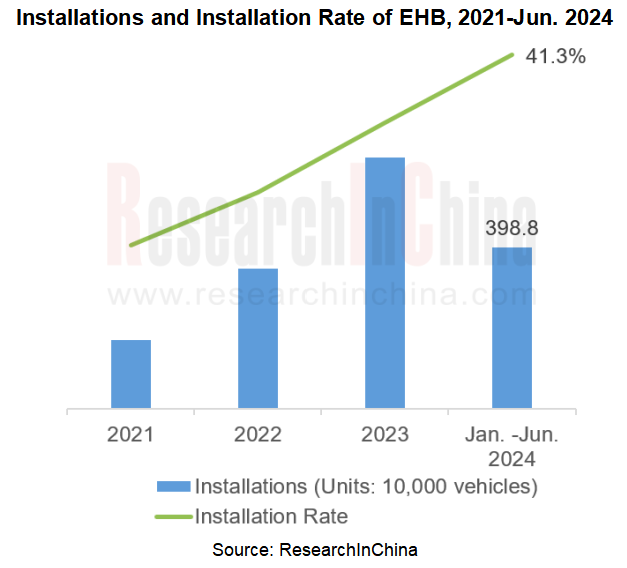
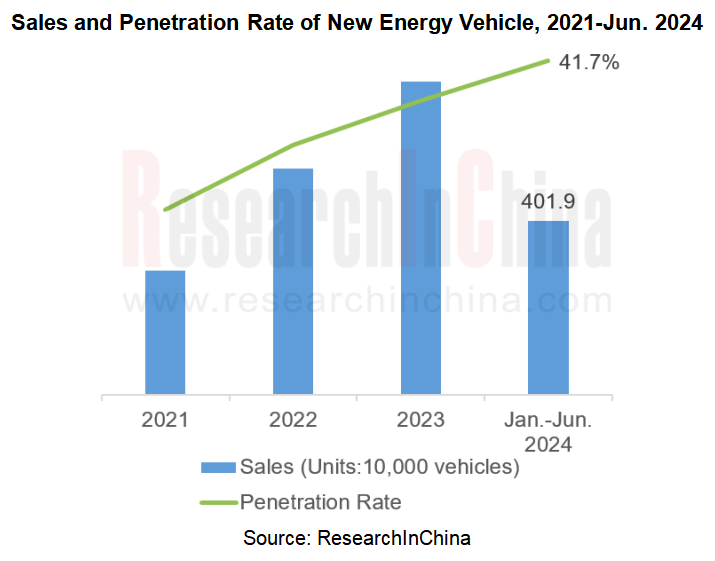
The hot brake-by-wire market is largely driven by the new energy market. Brake-by-wire meets a series of requirements of new energy vehicles, such as no vacuum power source, high requirements for system response speed, and brake energy recovery. The following figure shows the sales and penetration rate of new energy vehicles from 2021 to June 2024. From the data, the growth trend of brake-by-wire installations and installation rate is highly consistent with that of new energy vehicle sales and penetration rate.
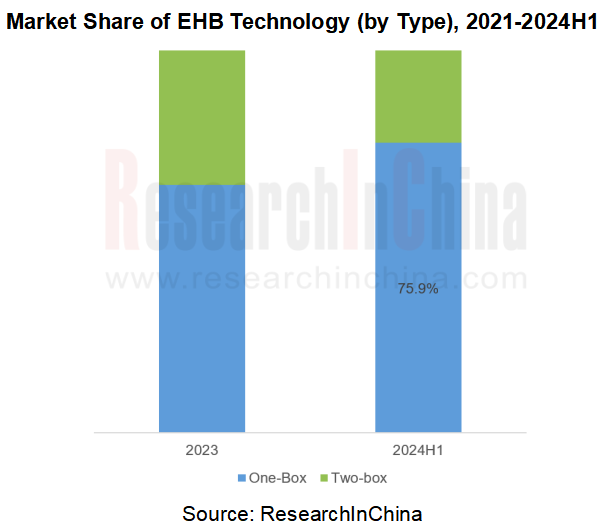
From the perspective of EHB technology classification, the share of One-Box has further expanded. In 2024H1, the share of One-Box increased to 75.9%, an increase of 17.4 percentage points from the same period last year.
2. Some OEMs have taken the lead in completing the layout of brake-by-wire industry chain
Some OEMs, mainly Chinese independent brands, have entered the brake-by-wire market by setting up subsidiaries or joint ventures with other manufacturers. By 2024, many OEMs have completed mass production of brake-by-wire products.
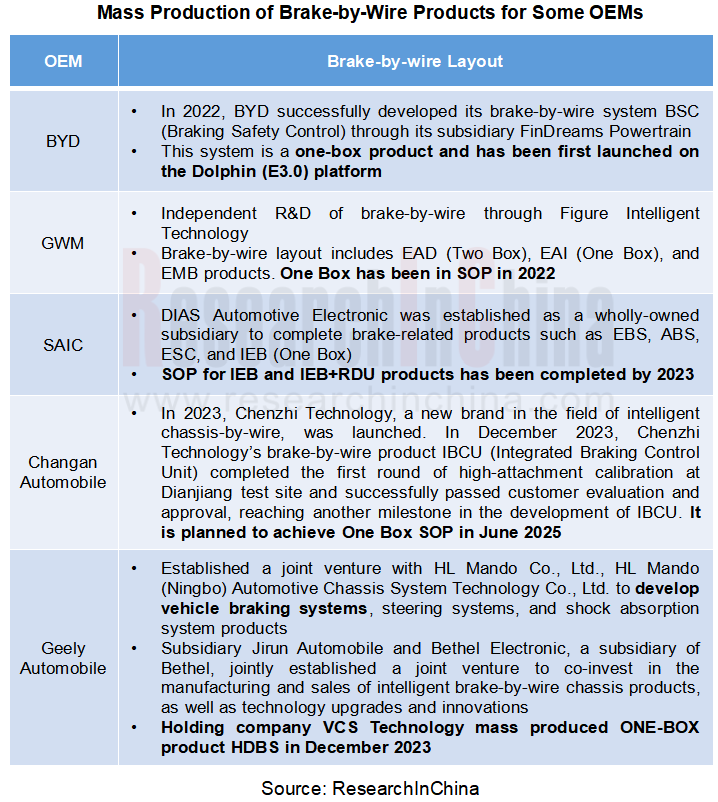
Geely - VCS Technology
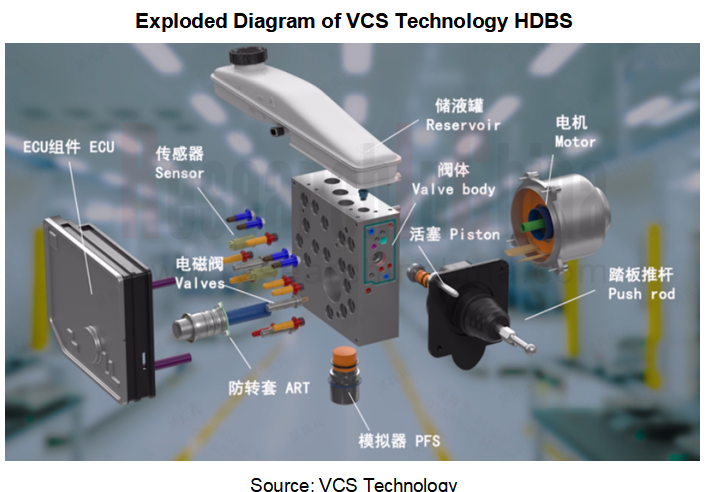
Founded in May 2022, VCS Technology focuses on the R&D and production of 3 core chassis systems, namely brake-by-wire, steer-by-wire and suspension-by-wire, as well as chassis domain controllers.

In December 2023, VCS Technology's One-Box product HDBS was mass-produced and rolled off the production line, with an expected annual output of 600,000 sets. The system can realize brake assist, conventional ESC functions and intelligent driver assist functions, and the response time can reach within 150ms. Its application range can cover fuel, all-electric and hybrid models, and can also be applied to some light commercial vehicles. It is reported that VCS Technology HDBS will be the first to be equipped on Geely brands after mass production.
3. EMB expects to achieve small-scale mass production by 2026 at the latest
It is an industry consensus that EMB is truly brake-by-wire. Although the research history of EMB system has been more than 20 years, it is difficult to overcome a series of technical problems such as "high requirements for motors, no fail-safe backup braking function, and high cost", and EMB system has not been applied in large quantities so far. However, in recent years, Chinese and foreign manufacturers have made great progress in EMB research and development. According to the plans of various manufacturers, it is expected that EMB will be able to achieve small-scale mass production by 2026 at the latest.
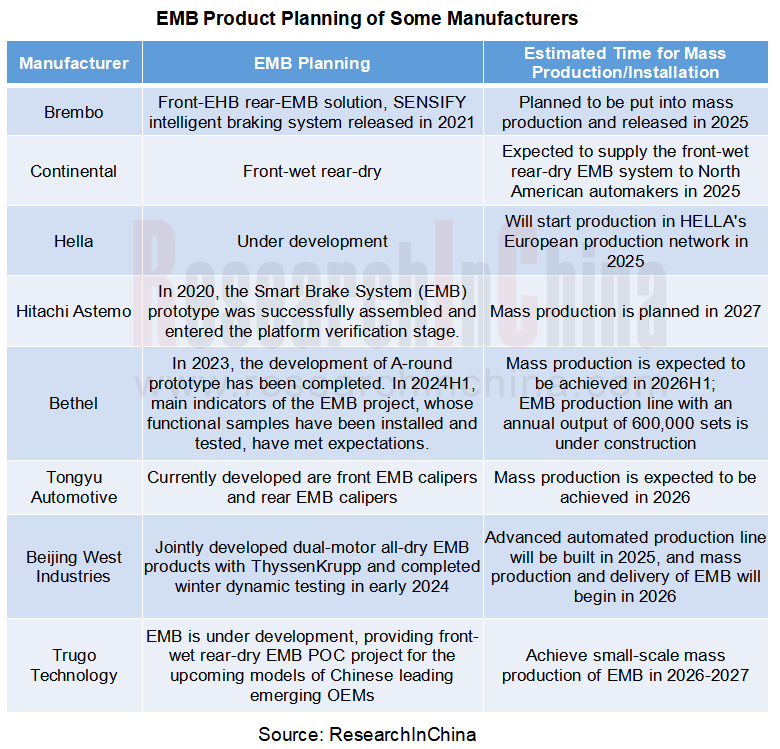
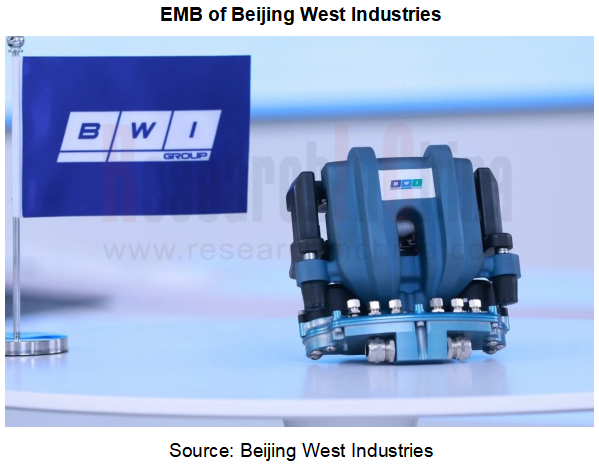
Beijing West Industries (BWI)'S EMB will be mass-produced in 2026, with the first batch to be launched in Kaiyi Auto and U POWER
In July 2024, BWI released the "2035 Full X-by-wire" global technology strategy, which mentioned that BWI's electronic mechanical braking system (EMB) has obtained strategic cooperation with Kaiyi Automobile and U POWER, and will be mass-produced for customers in 2026. Its product features include:
BWI's EMB system integrates ABS, ESC, TCS, ACC, etc. The self-developed dual-motor EMB system dramatically accelerates the response speed, and the wheel locking time is as short as 75ms. Four-wheel independent control maximizes braking stability.
Without servo mechanism or ESC module, BWI EMB realizes truly x-by-wire. The system is completely free of braking pipe, while left and right rudder structures are unified, reducing space requirements and enhancing the possibility of lightweight and compactness.
Utilizes plug-in electronic structural interfaces, eliminating the need for filling or discharge brake fluid and simplifying the assembly process.
Once finished braking, the BWI EMB system releases calipers instantly, achieving true zero drag, effectively lowering energy consumption and reducing CO2 & particulate matter emissions.
Automotive Microcontroller Unit (MCU) and Application Scenario Research Report, 2026
Automotive MCU Research: Increased demand for redundant security drives ASIL D-compliant MCU shipments to exceed 100 million units
In a vehicle EEA, MCUs are widely distributed in various functional ...
China Intelligent Cockpit Patent Analysis Report, 2026
Intelligent Cockpit Patent Research: Cockpit AI, In?vehicle Health, and Infotainment Are Upgrade to Scenario?based and Proactive Functions
From a patent perspective, this report explores the cutting?...
Research Report on Application of VLA Large Model in Automobiles and Robots, 2026
Research on Automotive and Robot VLA: Hybrid Architectures Become Mainstream, VLA Integrates with General World Models, and Reinforcement Learning Serves as Core Engine
Vision?Language?Action (VLA) m...
China Charging Infrastructure (Supercharging, Battery Swapping, V2G, etc.) and High-Performance Supercharging Battery Research Report, 2026
Charging and battery swapping research: as 5C+ supercharging vehicle models go into mass production, the pace of OEMs self-building supercharging networks quickens
800-1000V high-voltage platforms ar...
China Passenger Car Electronic Controlled Suspension Industry Report, 2026
Electronic Controlled Suspension Industry Research: As the First Year of Full Active Suspension Unfolds, Three Technical Routes Race Forward
1. Penetration Rate Surges Three Times, and Electronic Con...
Intelligent Driving SoC Research Report, 2026
Research on Intelligent Driving SoCs: Competition Focus Shifts to L3/L4 Embedded Hardware, and Computing Power of Flagship Vehicle Models Exceeds 1,000 TOPS
In terms of intelligent driving system in...
Automotive AI Large Model Technology Research Report, 2026
Automotive AI Large Model Research: Competition Shifts from "Who Has the Stronger Model" to "Who Boasts Higher Link Efficiency"
ResearchInChina released the Automotive AI Large Model Technology Resea...
Intelligent Vehicle Cockpit Domain Controller Research Report, 2026
Cockpit domain controller research: L3 AIDV intelligent cockpit domain controllers are entering a boom period
Driven by multiple factors such as the continuous evolution of the automotive central int...
Automotive Acoustic System (Audio, Multi-Channel) Industry Report, 2026
Automotive Acoustics Research: Multiple Channels, AI Tuning, and Self-Developed Algorithms Drive the Transformation of High-End Cockpit Sound Fields
I. Automotive Audio Hardware Solutions with 6–9 S...
Autonomous Driving Sensor Chip Research Report, 2026
Research on Autonomous Driving Sensor Chips: Deeply Perceiving the Physical World, Sensor Chips Are Playing A “Leading Role” in Intelligence
In 2026, the autonomous driving sensor chip industr...
Passenger Car Corner Module and Wheel‑Side Control System Research Report, 2026
Wheel-side control research: the “last mile” chassis innovation
Wheel-side control dismantles the traditional drive, braking, steering, and suspension control of the chassis from a "centralized" styl...
Embodied Artificial Intelligence (& Humanoid Robot) MCU Research Report, 2026
Research on Humanoid Robot MCUs: Evolution from General-Purpose Control to High-Value Dedicated Chip Solutions Integrated with Edge AI Functions
MCU (Microcontroller Unit) refers to a compact integra...
Intelligent Vehicle Zone Control Unit (ZCU) Research Report, 2026
ZCU Research: Cross-domain integrated ZCUs are becoming the edge computing nodes of the next-generation zonal architecture
Currently, the mainstream zonal architecture is mainly the quasi-central + z...
Automotive Cybersecurity and Data Security Research Report, 2026
Cybersecurity & Data Security Research: Intelligent Connected Vehicles Enter the Era of “Systematic Offense-Defense and AI-Defined Security”.
Centering on the panorama of intelligent connect...
Report on Breakthrough Strategies of OEMs and ADAS Tier 1 Suppliers for Overseas Layout of Intelligent Driving, 2026
Regulatory Breakthrough, Local System Establishment, OEMs Competing for NOA Layout: Overall Trends of China’s Intelligent Driving Overseas Layout in 2026
Research on overseas intelligent driving layo...
OEMs and Tier1s’ Intelligent Cockpit Platform (Hardware and Software) Innovation Strategy Research Report, 2026
Intelligent Cockpit Platform Research: multi-dimensional cockpit system architecture reconstruction for multi-agent collaboration and proactive intelligent services
The intelligent cockpit software s...
Automotive AIOS Research Report, 2026
Automotive AIOS Research: Mass Production Solutions Are Implemented
Mass Production Solutions Are Implemented on A Small Scale.
In 2026, AIOS starts small-scale implementation, helping to improve v...
Automotive Telematics Service Provider (TSP) Research Report, 2026
TSP Research: Leading providers collectively turn to AI agents to provide all-scenario active services
Telematics Service Providers (TSPs) are the core hub of the telematics industry chain, connectin...