Research on automotive smart glass: How does glass intelligence evolve
ResearchInChina has released the Automotive Smart Glass Research Report 2024. The report details the latest advances in dimming glass and glass antenna technologies in automotive smart glass, analyzes typical vehicle models, summarizes the layout and market share of suppliers, and predicts future development trends.
As an important part of automotive intelligent technology, automotive smart glass (including dimming glass, glass antennas, window intelligent information displays and touch-responsive glass) is gradually changing people's riding experience. As per the installation of automotive smart glass, the Automotive Smart Glass Research Report 2024 focuses on "smart dimming glass” and "glass antennas".

1.The increase in panoramic canopy installations drives higher demand for smart dimming glass
Driven by the demand for vertical space utilization of new energy vehicles and consumer demand for better cockpit experience, the panoramic canopy market is growing rapidly In the first half of 2024, 1.16 million passenger cars in China were equipped with panoramic canopies, representing a 6.5% increase compared to the same period last year and accounting for 12.0%.
Against this background, the widespread application of panoramic canopies has encountered a severe challenge - dimming and heat insulation. With its unique advantages, smart dimming glass can meet the rigid market demand. More and more OEMs are offering smart dimming glass as a high-end or optional feature when launching models equipped with panoramic canopies, aiming to provide consumers with a more flexible, comfortable and energy-saving riding environment.

Case 1: Avatr 12 is equipped with a front intelligent light-sensitive color-changing windshield and an intelligent light-sensitive panoramic canopy
The top configuration version of Avatr 12 is equipped with an intelligent light-sensitive front windshield and an intelligent light-sensitive panoramic canopy, which can effectively block the sun, insulate heat and protect privacy while ensuring an ultra-wide field of view. Among them, the intelligent light-sensitive color-changing front windshield uses 5-layer laminated glass with adaptive light-sensitive function, with a lighting area of up to 2.57 square meters, low energy transmittance and strong ultraviolet defense; the intelligent light-sensitive panoramic canopy uses 7-layer laminated canopy, which supports Zone control enables full color change within 90 seconds. The 7-layer laminated intelligent light-sensitive panoramic canopy supports zonal control, and changes color within 90 seconds.

Case 2: NIO ET7 is equipped with a zoned smart dimming panoramic canopy
The 2024 ET7 executive signature version is equipped with a zoned smart dimming panoramic canopy, which uses EC light sensing technology to intelligently perceive ambient light, actively adjust shading, provide sun protection and heat insulation, and protect privacy. It can adjust the front and rear of the canopy separately. It supports four levels of independent adjustment for the front and rear zones, and can block 99.9% of ultraviolet rays and 86.3% of heat.

2. The application of automotive smart glass is accelerating and expanding from sunroofs to all auto parts.
At present, smart dimming glass is mainly used in automotive sunroofs/canopies. As the technology matures, dimming glass has gradually been integrated into core parts such as door glass, rear corner windows, front/rear windshields, etc.; and glass antenna technology has also been applied to sunroofs, front windshields, door glass, etc., demonstrating its versatility and high integration.
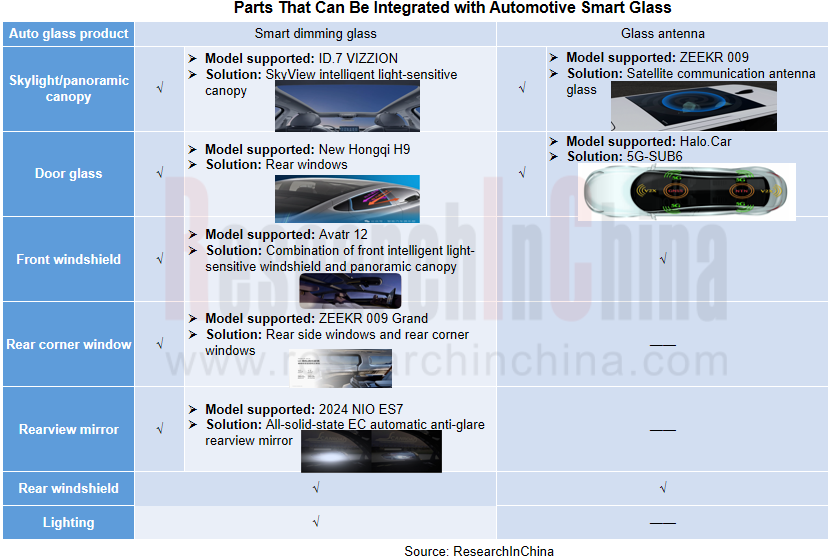
Case 1: The rear windows of the new Hongqi H9 feature stepless dimming
The new Hongqi H9 equipped with stepless LC dimming glass supports wide temperature intelligent dimming from -20℃ to 85℃ and can block 99.9% of ultraviolet rays and 99.5% of visible light. After the dimming function is turned on, the brightness of the left/right windows can be manually adjusted and the brightness can be stored. In addition, LC dimming glass offers ultimate privacy, ensuring that no one outside the car can peek into the car, while the view inside the car is unobstructed. It surpasses traditional gray glass to perfectly protect privacy even when the screen is always on at night.


Case 2: ZEEKR 009 installs satellite communication antenna glass on the sunroof
The antenna is integrated into the sunroof of ZEEKR 009 through metal coating technology, which not only achieves heat insulation and sun protection, but also enables high-precision automotive satellite communication. In emergency situations, such as when the ground network is damaged, the vehicle can autonomously alarm through the satellite antenna.

3. How do OEMs and suppliers expand intelligent glass?
The global automotive glass market is highly concentrated, with four leading companies accounting for approximately 90% of the market. According to public information, China-based Fuyao Glass ranked first with about 34% market share in 2023, followed by AGC with 23%, NSG with 18% (in FY2024) and Saint-Gobain with 14%.

With the accelerated development of automotive intelligence and connectivity, the manufacturing and research and development of automotive smart glass which is a core component of the vehicle is no longer limited to glass suppliers. OEMs are also actively involved, forming an ecosystem in which suppliers and OEMs participate. In this ecosystem, suppliers leverage their excellent manufacturing capabilities and professional technologies to produce high-performance smart glass products; OEMs vigorously join in the research and development process, gain insights into changes in market demand, and meet users' growing demand for personalization and customization, further broadening the application scope of automotive smart glass.

Case 1: Fuyao’s panoramic canopies feature starry domes and projection functions
The starry dome can be customized with patterns and create a romantic atmosphere with gorgeous lights. The projection canopy can display high-definition images in full color, forging an exclusive "private cinema" in the cockpit.

Case 2: GAC Honda enables immersive somatosensory games on rear windows based on dimming glass technology
The window interactive display patent disclosed by GAC Honda in June 2023 uses double-layer dimming glass and double-sided OLED screen technology. Combined with the in-cockpit human recognition system, it brings an unprecedented immersive somatosensory gaming experience to rear passengers, significantly improving the interactivity and entertainment in the car.

Automotive Microcontroller Unit (MCU) and Application Scenario Research Report, 2026
Automotive MCU Research: Increased demand for redundant security drives ASIL D-compliant MCU shipments to exceed 100 million units
In a vehicle EEA, MCUs are widely distributed in various functional ...
China Intelligent Cockpit Patent Analysis Report, 2026
Intelligent Cockpit Patent Research: Cockpit AI, In?vehicle Health, and Infotainment Are Upgrade to Scenario?based and Proactive Functions
From a patent perspective, this report explores the cutting?...
Research Report on Application of VLA Large Model in Automobiles and Robots, 2026
Research on Automotive and Robot VLA: Hybrid Architectures Become Mainstream, VLA Integrates with General World Models, and Reinforcement Learning Serves as Core Engine
Vision?Language?Action (VLA) m...
China Charging Infrastructure (Supercharging, Battery Swapping, V2G, etc.) and High-Performance Supercharging Battery Research Report, 2026
Charging and battery swapping research: as 5C+ supercharging vehicle models go into mass production, the pace of OEMs self-building supercharging networks quickens
800-1000V high-voltage platforms ar...
China Passenger Car Electronic Controlled Suspension Industry Report, 2026
Electronic Controlled Suspension Industry Research: As the First Year of Full Active Suspension Unfolds, Three Technical Routes Race Forward
1. Penetration Rate Surges Three Times, and Electronic Con...
Intelligent Driving SoC Research Report, 2026
Research on Intelligent Driving SoCs: Competition Focus Shifts to L3/L4 Embedded Hardware, and Computing Power of Flagship Vehicle Models Exceeds 1,000 TOPS
In terms of intelligent driving system in...
Automotive AI Large Model Technology Research Report, 2026
Automotive AI Large Model Research: Competition Shifts from "Who Has the Stronger Model" to "Who Boasts Higher Link Efficiency"
ResearchInChina released the Automotive AI Large Model Technology Resea...
Intelligent Vehicle Cockpit Domain Controller Research Report, 2026
Cockpit domain controller research: L3 AIDV intelligent cockpit domain controllers are entering a boom period
Driven by multiple factors such as the continuous evolution of the automotive central int...
Automotive Acoustic System (Audio, Multi-Channel) Industry Report, 2026
Automotive Acoustics Research: Multiple Channels, AI Tuning, and Self-Developed Algorithms Drive the Transformation of High-End Cockpit Sound Fields
I. Automotive Audio Hardware Solutions with 6–9 S...
Autonomous Driving Sensor Chip Research Report, 2026
Research on Autonomous Driving Sensor Chips: Deeply Perceiving the Physical World, Sensor Chips Are Playing A “Leading Role” in Intelligence
In 2026, the autonomous driving sensor chip industr...
Passenger Car Corner Module and Wheel‑Side Control System Research Report, 2026
Wheel-side control research: the “last mile” chassis innovation
Wheel-side control dismantles the traditional drive, braking, steering, and suspension control of the chassis from a "centralized" styl...
Embodied Artificial Intelligence (& Humanoid Robot) MCU Research Report, 2026
Research on Humanoid Robot MCUs: Evolution from General-Purpose Control to High-Value Dedicated Chip Solutions Integrated with Edge AI Functions
MCU (Microcontroller Unit) refers to a compact integra...
Intelligent Vehicle Zone Control Unit (ZCU) Research Report, 2026
ZCU Research: Cross-domain integrated ZCUs are becoming the edge computing nodes of the next-generation zonal architecture
Currently, the mainstream zonal architecture is mainly the quasi-central + z...
Automotive Cybersecurity and Data Security Research Report, 2026
Cybersecurity & Data Security Research: Intelligent Connected Vehicles Enter the Era of “Systematic Offense-Defense and AI-Defined Security”.
Centering on the panorama of intelligent connect...
Report on Breakthrough Strategies of OEMs and ADAS Tier 1 Suppliers for Overseas Layout of Intelligent Driving, 2026
Regulatory Breakthrough, Local System Establishment, OEMs Competing for NOA Layout: Overall Trends of China’s Intelligent Driving Overseas Layout in 2026
Research on overseas intelligent driving layo...
OEMs and Tier1s’ Intelligent Cockpit Platform (Hardware and Software) Innovation Strategy Research Report, 2026
Intelligent Cockpit Platform Research: multi-dimensional cockpit system architecture reconstruction for multi-agent collaboration and proactive intelligent services
The intelligent cockpit software s...
Automotive AIOS Research Report, 2026
Automotive AIOS Research: Mass Production Solutions Are Implemented
Mass Production Solutions Are Implemented on A Small Scale.
In 2026, AIOS starts small-scale implementation, helping to improve v...
Automotive Telematics Service Provider (TSP) Research Report, 2026
TSP Research: Leading providers collectively turn to AI agents to provide all-scenario active services
Telematics Service Providers (TSPs) are the core hub of the telematics industry chain, connectin...