OEM ADAS research: adjust structure, integrate teams, and compete in D2D, all for a leadership in intelligent driving
In recent years, China's intelligent driving market has experienced escalating technological competition in driving-parking integration, highway NOA, urban NOA, and map-free NOA. Small and medium-sized ADAS Tier1s are gradually slow to keep up with the pace of technological evolution.
Since 2024, China's ADAS and autonomous driving markets have entered an end-to-end competition. End-to-end autonomous driving requires OEMs to change their previous R&D model and invest a lot of R&D, computing power and data resources. However, multi-brand and multi-technology routes make it difficult for OEMs to pool resources to win the battle of intelligent driving. Organizational structure adjustment and team integration have become compulsory courses for domestic OEMs in 2024.
To compete in intelligent driving, OEMs keep adjusting their structure and integrating their teams
NIO continues to dynamically adjust its organizational structure to adapt to different development stages. In June 2024, NIO adjusted the organizational structure of its intelligent driving team from original perception-planning & control-execution to end-to-end autonomous driving. NIO's Intelligent Driving R&D Department has newly established the Foundation Model Department (responsible for R&D of end-to-end models), Deployment Architecture and Solution Department (responsible for vehicle-related overall algorithm development, architecture design and function delivery), and Spatiotemporal Information Department (responsible for algorithm/model development and services related to the map information on vehicle and cloud), and canceled the original Perception Department, Planning & Control Department, Environmental Information Department and Solution Delivery Department.
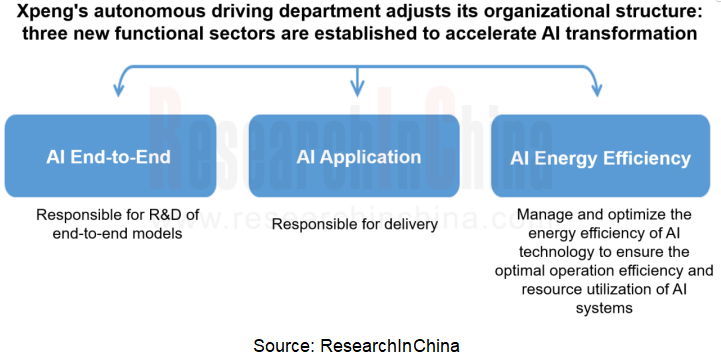
Xpeng has also adjusted its technology development department in 2024. Its technology development department covers R&D of algorithms for perception, planning, control, and positioning. After the adjustment, the technology development department was split into three departments: AI End-to-End, AI Application, and AI Energy Efficiency.
Around August 2024, Xiaomi Auto's intelligent driving team also completed a new round of organizational structure adjustments, mainly combining the two secondary departments of "Perception" and "Planning & Control" and reorganizing them into the "End-to-End Algorithm and Function Department."
Not only are emerging OEMs constantly adjusting their organizational structures, but also traditional OEMs are making a rapid change.
In June 2024, BYD set up the Tianxuan Development Department for developing intelligent driving in house. It is positioned to self-develop high-level intelligent driving solutions. BYD also established the Tianlang Development Department, positioned to develop low-level intelligent driving solutions. In the second half of 2024, BYD deeply integrated its organizational structure. The core members of the original "Tianxuan" team have been incorporated into the "Tianlang" self-development team.
"Parking space to parking space” (D2D) will become the focus of competition among OEMs in 2025
Following Huawei that introduced parking space to parking space intelligent driving in August this year, Li Auto, Xpeng and Xiaomi among others will also implement high-level intelligent driving from parking space to parking space.
Xpeng Motors says: Based on the Xpeng Turing AI Intelligent Driving System, Xpeng has become a company that can enable the parking space to parking space function using a set of intelligent driving software and end-to-end foundation models. The solution adopts a set of software logics to connect scenarios such as underground garages, gates, and urban roads. It also lays less stress on maps and radars, and can generate routes unconsciously. Xpeng Motors announced the launch of the first full network test at the Auto Guangzhou, and will push it in full on AI Dimensity 5.5.0 in the future.
As well at the Auto Beijing, Fan Haoyu, Senior Vice President of Li Auto's Product Department, said that the parking space to parking space function based on end-to-end + VLM has been pushed to 10,000 beta test users, and test drive cars of outlets, across the country. In late November, all AD Max users can enjoy D2D supervised intelligent driving.
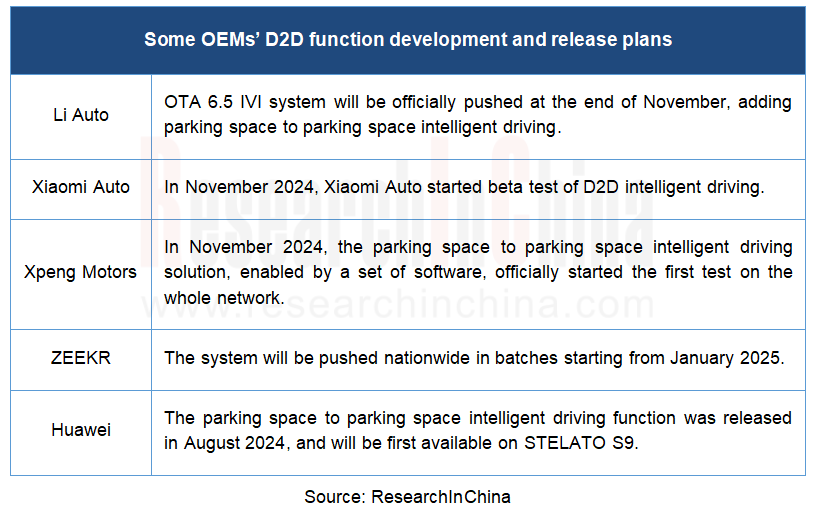
On November 16, Xiaomi Auto announced on its WeChat official account: the official name of its parking space to parking space function is All-scenario Intelligent Driving. This function enables parking space to parking space driving assistance as the user gets in the car. All-scenario Intelligent Driving will be installed in Xiaomi HAD (Hyper Autonomous Driving). In the future, Xiaomi SU7 Pro, Xiaomi SU7 Max, and Xiaomi SU7 Ultra models can all be upgraded with this function.
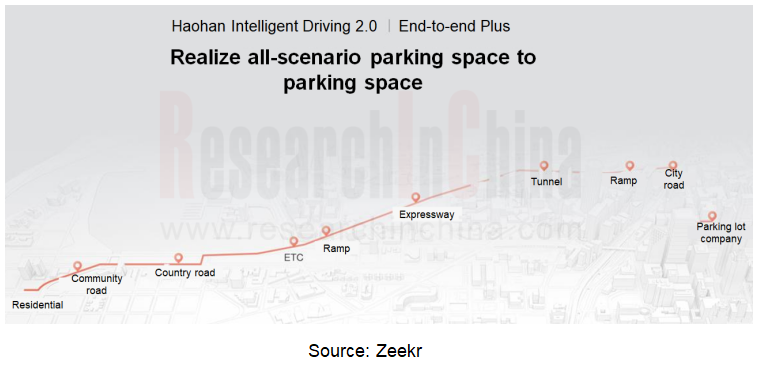
In November 2024, Zeekr released the Haohan Intelligent Driving 2.0, which will soon enable D2D intelligent driving. The D2D function launched by Zeekr has three core highlights: full-speed activation, all-gate access, and all-scenario intelligent parking not limiting parking spaces. It is the industry’s first to realize automated parking without memorizing the road in advance, creating a caring parking space-to-parking space service for users. This function is expected to be pushed in batches in January 2025, and will be fully pushed nationwide to all Zeekr products equipped with Haohan Intelligent Driving 2.0 in Q2 2025.
How long can emerging OEMs self-developing intelligent driving maintain their lead?
Looking at OEMs’ development course of intelligent driving in past few years, emerging OEMs are undoubtedly successful and have always been the leaders. However, Huawei, DJI, MOMENTA and other leading Tier1s do not lag behind. The state-of-the-art all-scenario parking space-to-parking space intelligent driving function in 2024 is first launched on BAIC STELATO S9.
Li Auto has made great progress in intelligent driving in 2024 by relying on its huge user base and rapid entry into end-to-end. Chinese OEMs such as BYD, Chery, SAIC, and Geely, with much more sales, are also expected to change the pattern in 2025 with the support of leading intelligent driving Tier1s.
In addition to traditional Chinese OEMs, there are also foreign OEMs. On November 14, at its 2024 Technology Innovation Day event, Mercedes-Benz introduced a new “map-free L2++ all-scenario high-level intelligent driving function based on vision-only solution”. This high-level intelligent driving system adopts a vision-only solution and NVIDIA DRIVE Orin chip, does not rely on HD maps, uses end-to-end foundation models, and can achieve perception-decision integration. In the future, it will have point-to-point all-scenario intelligent driving capabilities (i.e. parking space to parking space intelligent driving capabilities) from pulling out of the starting parking space to pulling in the destination parking space.
This intelligent driving system of Mercedes-Benz was developed with the support of MOMENTA, a leading intelligent driving Tier1. As multinational OEMs such as Mercedes-Benz, Toyota, and Volkswagen learn to introduce Chinese intelligent supply chains, they also equip their cars with cutting-edge intelligent driving and cockpit functions. Market competition will become fiercer in 2025. A former leader may not always be the leader.
Automotive Microcontroller Unit (MCU) and Application Scenario Research Report, 2026
Automotive MCU Research: Increased demand for redundant security drives ASIL D-compliant MCU shipments to exceed 100 million units
In a vehicle EEA, MCUs are widely distributed in various functional ...
China Intelligent Cockpit Patent Analysis Report, 2026
Intelligent Cockpit Patent Research: Cockpit AI, In?vehicle Health, and Infotainment Are Upgrade to Scenario?based and Proactive Functions
From a patent perspective, this report explores the cutting?...
Research Report on Application of VLA Large Model in Automobiles and Robots, 2026
Research on Automotive and Robot VLA: Hybrid Architectures Become Mainstream, VLA Integrates with General World Models, and Reinforcement Learning Serves as Core Engine
Vision?Language?Action (VLA) m...
China Charging Infrastructure (Supercharging, Battery Swapping, V2G, etc.) and High-Performance Supercharging Battery Research Report, 2026
Charging and battery swapping research: as 5C+ supercharging vehicle models go into mass production, the pace of OEMs self-building supercharging networks quickens
800-1000V high-voltage platforms ar...
China Passenger Car Electronic Controlled Suspension Industry Report, 2026
Electronic Controlled Suspension Industry Research: As the First Year of Full Active Suspension Unfolds, Three Technical Routes Race Forward
1. Penetration Rate Surges Three Times, and Electronic Con...
Intelligent Driving SoC Research Report, 2026
Research on Intelligent Driving SoCs: Competition Focus Shifts to L3/L4 Embedded Hardware, and Computing Power of Flagship Vehicle Models Exceeds 1,000 TOPS
In terms of intelligent driving system in...
Automotive AI Large Model Technology Research Report, 2026
Automotive AI Large Model Research: Competition Shifts from "Who Has the Stronger Model" to "Who Boasts Higher Link Efficiency"
ResearchInChina released the Automotive AI Large Model Technology Resea...
Intelligent Vehicle Cockpit Domain Controller Research Report, 2026
Cockpit domain controller research: L3 AIDV intelligent cockpit domain controllers are entering a boom period
Driven by multiple factors such as the continuous evolution of the automotive central int...
Automotive Acoustic System (Audio, Multi-Channel) Industry Report, 2026
Automotive Acoustics Research: Multiple Channels, AI Tuning, and Self-Developed Algorithms Drive the Transformation of High-End Cockpit Sound Fields
I. Automotive Audio Hardware Solutions with 6–9 S...
Autonomous Driving Sensor Chip Research Report, 2026
Research on Autonomous Driving Sensor Chips: Deeply Perceiving the Physical World, Sensor Chips Are Playing A “Leading Role” in Intelligence
In 2026, the autonomous driving sensor chip industr...
Passenger Car Corner Module and Wheel‑Side Control System Research Report, 2026
Wheel-side control research: the “last mile” chassis innovation
Wheel-side control dismantles the traditional drive, braking, steering, and suspension control of the chassis from a "centralized" styl...
Embodied Artificial Intelligence (& Humanoid Robot) MCU Research Report, 2026
Research on Humanoid Robot MCUs: Evolution from General-Purpose Control to High-Value Dedicated Chip Solutions Integrated with Edge AI Functions
MCU (Microcontroller Unit) refers to a compact integra...
Intelligent Vehicle Zone Control Unit (ZCU) Research Report, 2026
ZCU Research: Cross-domain integrated ZCUs are becoming the edge computing nodes of the next-generation zonal architecture
Currently, the mainstream zonal architecture is mainly the quasi-central + z...
Automotive Cybersecurity and Data Security Research Report, 2026
Cybersecurity & Data Security Research: Intelligent Connected Vehicles Enter the Era of “Systematic Offense-Defense and AI-Defined Security”.
Centering on the panorama of intelligent connect...
Report on Breakthrough Strategies of OEMs and ADAS Tier 1 Suppliers for Overseas Layout of Intelligent Driving, 2026
Regulatory Breakthrough, Local System Establishment, OEMs Competing for NOA Layout: Overall Trends of China’s Intelligent Driving Overseas Layout in 2026
Research on overseas intelligent driving layo...
OEMs and Tier1s’ Intelligent Cockpit Platform (Hardware and Software) Innovation Strategy Research Report, 2026
Intelligent Cockpit Platform Research: multi-dimensional cockpit system architecture reconstruction for multi-agent collaboration and proactive intelligent services
The intelligent cockpit software s...
Automotive AIOS Research Report, 2026
Automotive AIOS Research: Mass Production Solutions Are Implemented
Mass Production Solutions Are Implemented on A Small Scale.
In 2026, AIOS starts small-scale implementation, helping to improve v...
Automotive Telematics Service Provider (TSP) Research Report, 2026
TSP Research: Leading providers collectively turn to AI agents to provide all-scenario active services
Telematics Service Providers (TSPs) are the core hub of the telematics industry chain, connectin...