Intelligent Vehicle Cockpit-driving Integration (Cockpit-driving-parking) Industry Report, 2024-2025
Cockpit-driving integration is gaining momentum, and single-chip solutions are on the horizon
The Intelligent Vehicle Cockpit-driving Integration (Cockpit-driving-parking) Industry Report, 2024-2025 released by ResearchInChina combs through and summarizes the advantages and disadvantages of driving-parking integration, cockpit-parking integration and cockpit-driving integration (cockpit-driving-parking), their implementation modes, business models, used chips, market application and distribution, OEMs’ planning and layout, competitive landscape, and suppliers, and analyzes and predicts the market size of cockpit-driving integration (cockpit-driving-parking).
1. The installations of driving-parking integration domain controllers soared by 61.9% year on year, and the overall penetration rate exceeded 10%.
In the current general trend towards EEA centralization and OEMs' cost reduction needs, driving-parking integration, cockpit-parking integration and cockpit-driving integration (cockpit-driving-parking) domain controllers have come into being. Compared with cockpit-parking integration and cockpit-driving integration, driving-parking integration is implemented earlier and develops relatively maturely. Driving-parking integration began to be applied in 2021, and went into mass production in 2022. In the first three quarters of 2024, nearly 1.651 million vehicles installed with driving-parking integration domain controllers were sold, a like-on-like spike of 61.9%.
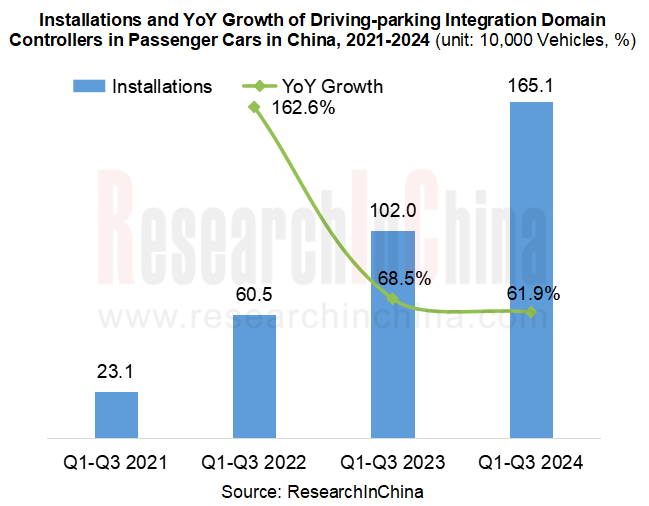
In the first three quarters of 2024, the penetration rate of driving-parking integration domain controllers was 10.7%, up 3.8 percentage points from the prior-year period and 3.6 percentage points versus 2023.

In the first three quarters of 2024, driving-parking integration domain controllers were largely installed on battery electric and extended-range passenger cars, which took a combined 95.1% share. Wherein, the installation rate in battery electric cars was 23.2%, mainly Tesla; the installation rate in the extended-range cars was as high as 77.3%, led by Li Auto and Harmony Intelligent Mobility Alliance (HIMA).
Driving-parking integration domain controller suppliers: Desay SV is far ahead, alone commanding over 30% of the market.
At present, some OEMs design driving-parking integration domain controllers by themselves, and outsource production to third-party suppliers, for example, Tesla (Quanta/Pegatron) and NIO (Flex); some large strong OEMs like Great Wall Motor (Haomo.ai) and BYD (BYD Research Institute) self-develop and self-produce the controllers; Li Auto, HIMA, Zeekr, Xiaomi, IM Motors, and Xpeng among others choose to cooperate with third-party suppliers.
Among the driving-parking integration domain controller suppliers, Desay SV holds a safe lead, alone taking a 30% share in the market. It has formed partnerships with Li Auto, Xiaomi, Zeekr, and Xpeng. Its best-selling products include IPU03 (Horizon J5/NVIDIA Xavier) and IPU04 (NVIDIA Orin X).

The share of single-chip solutions for driving-parking integration domain controllers reached 41%.
Driving-parking integration domain controllers generally adopt multi-chip solutions, but single-chip solutions have already taken a favorable market share (41%), and are expected to prevail in the market soon in the general trend for reducing costs and improving efficiency.
Driving-parking Integration Chip Solution

In the first three quarters of 2024, driving-parking integration domain controllers for passenger cars used a total of 2.68 million chips. Only Tesla (self-use), NVIDIA, and Huawei HiSilicon (mainly for HIMA) together sweep 76% of the market, showing a high market concentration. As concerns chip compute and process, the mainstream chips Tesla’s second-generation FSD, Nvidia Orin-X, and Huawei HiSilicon Ascend 610 all boast higher than 100 TOPS and 7nm process.
2. 2024 is the first year for mass production of cockpit-parking integration.
Cockpit-parking integration solutions lower costs and improve efficiency mainly by saving a parking chip and exploiting the compute redundancy of the cockpit chip. For mainly processing image display and audio functions, the cockpit chip has relatively high GPU compute, but limited NPU compute. It is more suitable for integrating basic parking functions and targets vehicle models priced below RMB200,000. The two cockpit-parking integration models launched in August 2024 are both priced within RMB150,000:
The full range of Geely Galaxy E5, launched in early August, uses ECARX’s cockpit domain controllers with 1 SiEngine Longying No.1 chip. Only the top-end starship edition adopts a cockpit-parking integration solution, with the manufacturer's suggested retail price (MSRP) of RMB145,800.
Xpeng MONA M03, launched in late August, uses Desay SV’s cockpit domain control hardware and AutoAI’s software, and packs Qualcomm Snapdragon 8155P. This model has three editions: Long-range Edition with MSRP of RMB119,800, Ultra-long-range Edition with MSRP of RMB129,800, and Ultra-long-range MAX Edition with MSRP of RMB155,800.
Among them the long-range and the ultra-long-range editions adopt a cockpit-parking integration solution, and the driving chip is Mobileye EyeQ4H. The Ultra-long-range MAX Edition with a price of higher than RMB150,000 adopts a driving-parking integration solution, and the driving chip is 2*NVIDIA Orin-X.
It is reported that the above two models have been available on market for only more than three months, but the cumulative delivery has been about 80,000 units, successfully bringing cockpit-parking integration into the mass production stage. In addition, quite a few OEMs such as Dongfeng Forthing, FAW Hongqi, GAC, NIO, Changan, BAIC Arcfox and Neta have already planned to use cockpit-parking integration, and the related suppliers have also introduced multiple cockpit-parking integration domain controllers, including ECARX Antora 1000/Antora 1000 Pro, Desay SV’s Gen4 Series, Yuanfeng Technology's Cockpit-parking Integration Controller 1.0/2.0, AutoLink AL-N1/AL-C2, and Foryou Cockpit Platform 3.0.
3. Cockpit-driving integration develops better than expected, skyrocketing by 1071.9% year on year.
As an advanced form of cross-domain integration, cockpit-driving integration is the focus of the layout by players. It was put into use in 2023, ahead of cockpit-parking integration. In April 2023, Voyah Passion, the first model packing a cockpit-driving integration domain controller, was rolled off on market. In just one and a half years, models that actually apply cockpit-driving integration function have numbered up to 17.

In the first three quarters of 2024, cockpit-driving integration domain controllers were installed in 246,600 cars, soaring by 1071.9% on a like-on-like basis. Of course, cockpit-driving integration products are in the introduction stage, and the installation in 246,600 cars suffices to show that cockpit-driving integration has officially entered the mass production and application stage.
In the first three quarters of 2024, the penetration rate of cockpit-driving integration domain controllers was only 1.6%. Yet seen from the application layout of cockpit-driving integration by many OEMs, suppliers, and chip companies, most of them plan volume production and application of it in 2025. We hence speculate that 2025-2027 will be a boom period for cockpit-driving integration, and its penetration rate is expected to reach between 15% and 25% in 2027.
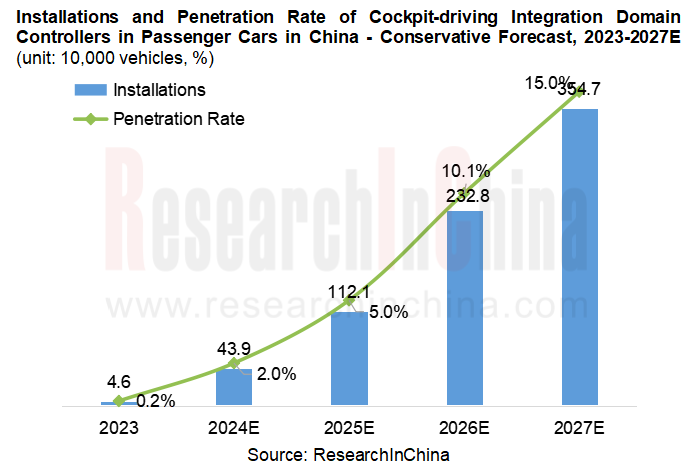
There is a huge market space for cockpit-driving integration suppliers in the future.
From the supplier side, in current stage cockpit-driving integration domain controllers are primarily developed and designed by OEMs, and produced by third parties. Voyah, a subsidiary of the traditional OEM Dongfeng, however adopts the cooperative product of the third-party suppliers Neusoft Reach and Megatronix. Geely, Changan, BAIC and GAC, which plan to set foot in the market in 2025, have established relations with different suppliers on R&D of cockpit-driving integration. There is still huge market space left for suppliers in the future.
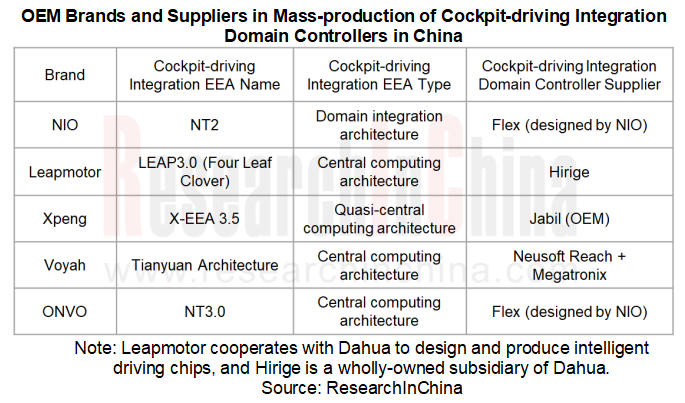
Desay SV signed cooperation agreements with GAC Hyper and Chery in April and October 2024, respectively, on cockpit-driving integration domain controllers. In October, it also brought related products to Geely to exchange and share technological innovation and application.
Single-chip solutions for cockpit-driving integration are expected to land in 2025.
Among the current cockpit-driving integration models, except for the low-end edition (within RMB200,000) of Leapmotor C Series, all other models have adopted a multi-chip solution, with a typical configuration of mainstream intelligent cockpit chip (Qualcomm 8155/8295) + mainstream intelligent driving chip (Nvidia Orin-X). Regarding single-chip solutions, multiple OEMs and suppliers prefer Nvidia Thor and Qualcomm Ride Flex SA8775P chips, both of which are scheduled to come into mass production in 2025.

Automotive Microcontroller Unit (MCU) and Application Scenario Research Report, 2026
Automotive MCU Research: Increased demand for redundant security drives ASIL D-compliant MCU shipments to exceed 100 million units
In a vehicle EEA, MCUs are widely distributed in various functional ...
China Intelligent Cockpit Patent Analysis Report, 2026
Intelligent Cockpit Patent Research: Cockpit AI, In?vehicle Health, and Infotainment Are Upgrade to Scenario?based and Proactive Functions
From a patent perspective, this report explores the cutting?...
Research Report on Application of VLA Large Model in Automobiles and Robots, 2026
Research on Automotive and Robot VLA: Hybrid Architectures Become Mainstream, VLA Integrates with General World Models, and Reinforcement Learning Serves as Core Engine
Vision?Language?Action (VLA) m...
China Charging Infrastructure (Supercharging, Battery Swapping, V2G, etc.) and High-Performance Supercharging Battery Research Report, 2026
Charging and battery swapping research: as 5C+ supercharging vehicle models go into mass production, the pace of OEMs self-building supercharging networks quickens
800-1000V high-voltage platforms ar...
China Passenger Car Electronic Controlled Suspension Industry Report, 2026
Electronic Controlled Suspension Industry Research: As the First Year of Full Active Suspension Unfolds, Three Technical Routes Race Forward
1. Penetration Rate Surges Three Times, and Electronic Con...
Intelligent Driving SoC Research Report, 2026
Research on Intelligent Driving SoCs: Competition Focus Shifts to L3/L4 Embedded Hardware, and Computing Power of Flagship Vehicle Models Exceeds 1,000 TOPS
In terms of intelligent driving system in...
Automotive AI Large Model Technology Research Report, 2026
Automotive AI Large Model Research: Competition Shifts from "Who Has the Stronger Model" to "Who Boasts Higher Link Efficiency"
ResearchInChina released the Automotive AI Large Model Technology Resea...
Intelligent Vehicle Cockpit Domain Controller Research Report, 2026
Cockpit domain controller research: L3 AIDV intelligent cockpit domain controllers are entering a boom period
Driven by multiple factors such as the continuous evolution of the automotive central int...
Automotive Acoustic System (Audio, Multi-Channel) Industry Report, 2026
Automotive Acoustics Research: Multiple Channels, AI Tuning, and Self-Developed Algorithms Drive the Transformation of High-End Cockpit Sound Fields
I. Automotive Audio Hardware Solutions with 6–9 S...
Autonomous Driving Sensor Chip Research Report, 2026
Research on Autonomous Driving Sensor Chips: Deeply Perceiving the Physical World, Sensor Chips Are Playing A “Leading Role” in Intelligence
In 2026, the autonomous driving sensor chip industr...
Passenger Car Corner Module and Wheel‑Side Control System Research Report, 2026
Wheel-side control research: the “last mile” chassis innovation
Wheel-side control dismantles the traditional drive, braking, steering, and suspension control of the chassis from a "centralized" styl...
Embodied Artificial Intelligence (& Humanoid Robot) MCU Research Report, 2026
Research on Humanoid Robot MCUs: Evolution from General-Purpose Control to High-Value Dedicated Chip Solutions Integrated with Edge AI Functions
MCU (Microcontroller Unit) refers to a compact integra...
Intelligent Vehicle Zone Control Unit (ZCU) Research Report, 2026
ZCU Research: Cross-domain integrated ZCUs are becoming the edge computing nodes of the next-generation zonal architecture
Currently, the mainstream zonal architecture is mainly the quasi-central + z...
Automotive Cybersecurity and Data Security Research Report, 2026
Cybersecurity & Data Security Research: Intelligent Connected Vehicles Enter the Era of “Systematic Offense-Defense and AI-Defined Security”.
Centering on the panorama of intelligent connect...
Report on Breakthrough Strategies of OEMs and ADAS Tier 1 Suppliers for Overseas Layout of Intelligent Driving, 2026
Regulatory Breakthrough, Local System Establishment, OEMs Competing for NOA Layout: Overall Trends of China’s Intelligent Driving Overseas Layout in 2026
Research on overseas intelligent driving layo...
OEMs and Tier1s’ Intelligent Cockpit Platform (Hardware and Software) Innovation Strategy Research Report, 2026
Intelligent Cockpit Platform Research: multi-dimensional cockpit system architecture reconstruction for multi-agent collaboration and proactive intelligent services
The intelligent cockpit software s...
Automotive AIOS Research Report, 2026
Automotive AIOS Research: Mass Production Solutions Are Implemented
Mass Production Solutions Are Implemented on A Small Scale.
In 2026, AIOS starts small-scale implementation, helping to improve v...
Automotive Telematics Service Provider (TSP) Research Report, 2026
TSP Research: Leading providers collectively turn to AI agents to provide all-scenario active services
Telematics Service Providers (TSPs) are the core hub of the telematics industry chain, connectin...