Research Report on the Application of AI in Automotive Cockpits, 2025
Cockpit AI Application Research: From "Usable" to "User-Friendly," from "Deep Interaction" to "Self-Evolution"
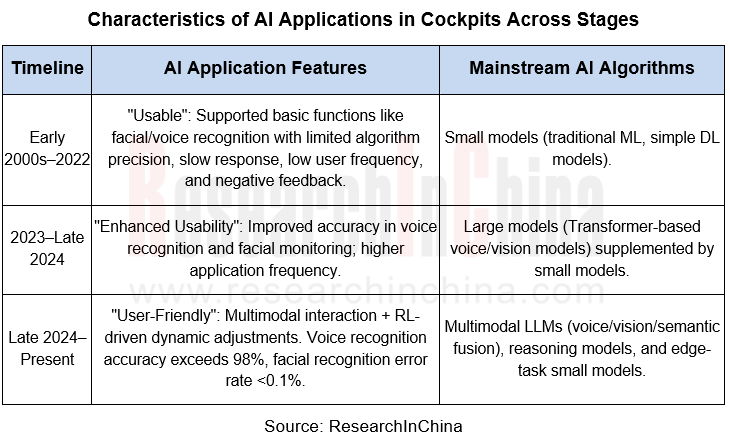
From the early 2000s, when voice recognition and facial monitoring functions were first integrated into vehicles, to the rise of the "large model integration" trend in 2023, and further to 2025 when automakers widely adopt the reasoning model DeepSeek-R1, the application of AI in cockpits has evolved through three key phases:
Pre-large model era: Cockpits transitioned from mechanical to electronic and then to intelligent systems, integrating small AI models for scenarios like facial and voice recognition.
Post-large model era: AI applications expanded in scope and quantity, with significant improvements in effectiveness, though accuracy and adaptability remained inconsistent.
Multimodal large language models (LLMs) and reasoning models: Cockpits advanced from basic intelligence to a stage of "deep interaction and self-evolution."
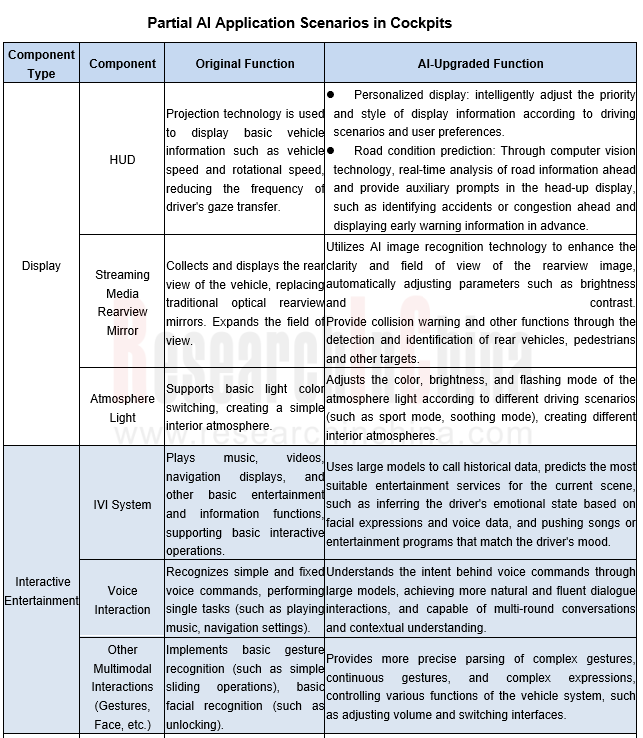
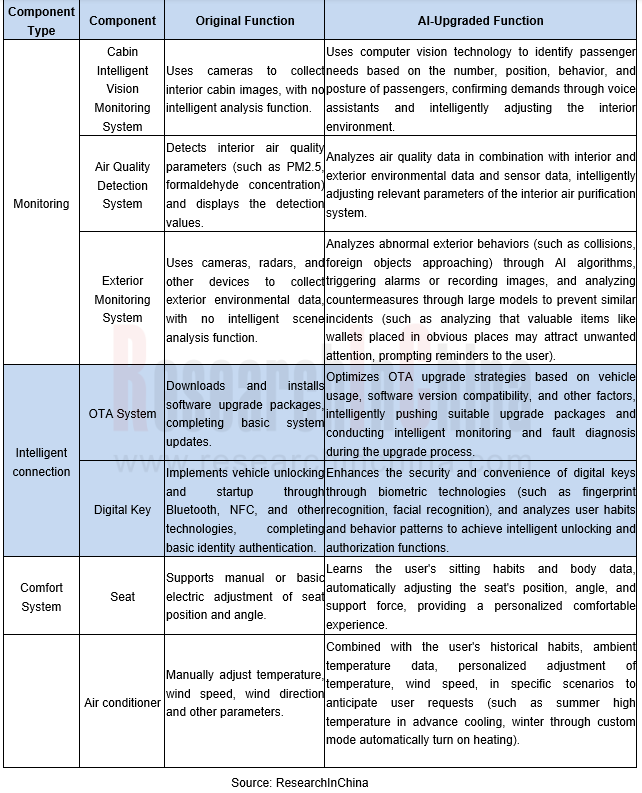
ResearchInChina has sorted out the application scenarios of AI in different cockpit component systems, some of which are shown in the table:
Cockpit AI Development Trend 1: Deep Interaction
Deep interaction is reflected in "linkage interaction", "multi-modal interaction", "personalized interaction", "active interaction" and "precise interaction".
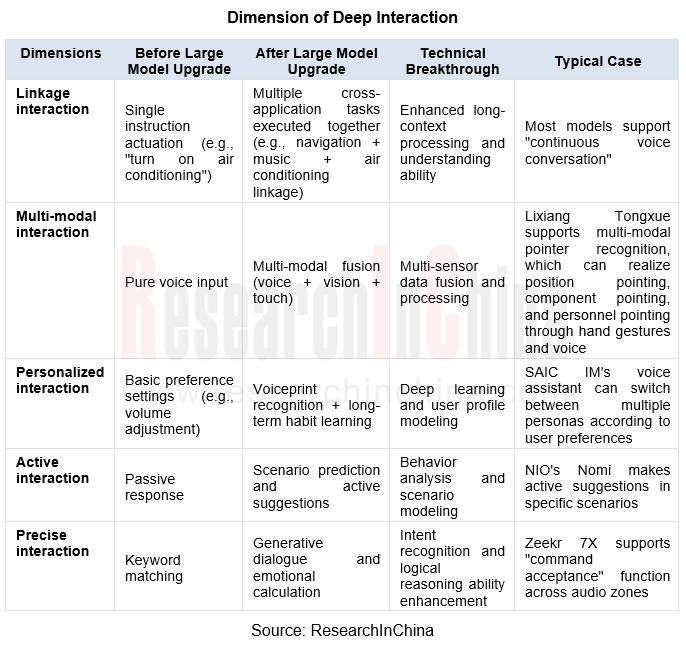
Taking "precise interaction" as an example, the inference large model not only improves the accuracy of voice interaction, especially the accuracy of continuous recognition, but also through dynamic understanding of context, combined with sensor fusion processing data, relying on multi-task learning architecture to synchronously process navigation, music and other composite requests, and the response speed is increased by 40% compared with traditional solutions. It is expected that in 2025, after the large-scale loading of inference models (such as DeepSeek-R1), end-side inference capabilities can make the automatic speech recognition process faster and further improve the accuracy.
Taking "multi-modal interaction" as an example, using the multi-source data processing capabilities of large models, a cross-modal collaborative intelligent interaction system can be built. Through the deep integration of 3D cameras and microphone arrays, the system can simultaneously analyze gesture commands, voice semantics and environmental characteristics, and complete multi-modal intent understanding in a short time, which is 60% faster than traditional solutions. Based on the cross-modal alignment model, gesture control and voice commands can be coordinated to further reduce the misoperation rate in complex driving scenarios. It is expected that in 2025-2026, multi-modal data fusion processing capabilities will become standard in the new generation of cockpits. Typical scenarios include:
Gesture control: Drivers can conveniently control functions such as windows, sunroof, volume, navigation, etc. through simple gestures, such as waving, pointing, etc., without distracting their driving attention.
Facial recognition and personalization: The system can automatically identify the driver through facial recognition technology, and automatically adjust the settings of seats, rearview mirrors, air conditioners, music, etc. according to their personal preferences, to achieve a personalized experience of "get in the car and enjoy".
Eye tracking and attention monitoring: Through eye tracking technology, the system can monitor the driver's gaze direction and attention state, detect risk behaviors such as fatigue driving and inattention in a timely manner, and provide early warning prompts to improve driving safety.
Emotional recognition and emotional interaction: AI systems can even identify the driver's emotional state, such as judging whether the driver is anxious, tired or excited through facial expressions, voice tone, etc., and adjust the ambient lighting, music, air conditioning, etc. in the car accordingly to provide more intimate emotional services.
Cockpit AI Development Trend 2: self-evolution
In 2025, the cockpit agent will become the medium for users to interact with the cockpit, and one of its salient features is "self-evolution", reflected in "long-term memory", "feedback learning", and "active cognition".
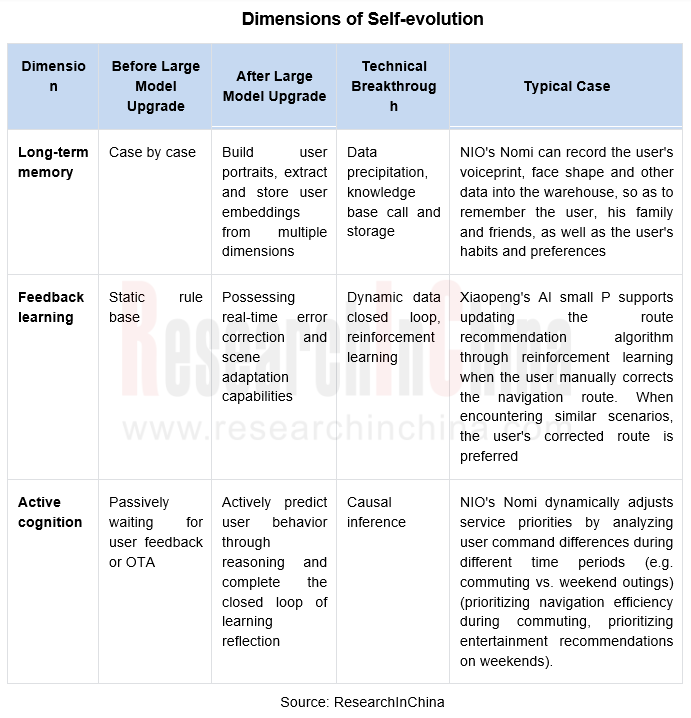
“Long-term memory”, “feedback learning”, and “active cognition” are gradual processes. AI constructs user portraits through voice communication, facial recognition, behavior analysis and other data to achieve “thousands of people and thousands of faces” services. This function uses reinforcement learning and reasoning related technology implementation, and the system relies on data closed-loop continuous learning of user behavior. Under the reinforcement learning mechanism, each user feedback becomes the key basis for optimizing the recommendation results.
With the continuous accumulation of data, the large model can more quickly discover the law of user interest point transfer, and can anticipate user requests in advance. It is expected that in the next two years, with the help of more advanced reinforcement learning algorithms and efficient reasoning architecture, the system will increase the mining speed of users’ new areas of interest by 50%, and the accuracy of recommended results will be further improved. Such as:
BMW’s cockpit system remembers driver seat preferences, frequented locations, and automatically dims ambient lights to relieve anxiety on rainy days;
Mercedes-Benz’s voice assistant can recommend restaurants based on the user’s schedule and reserve charging stations in advance.
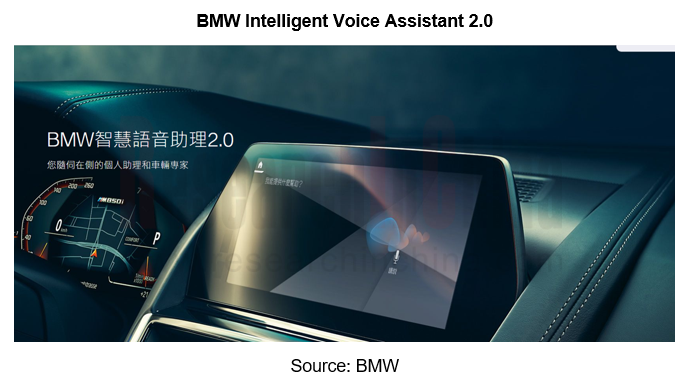
BMW Intelligent Voice Assistant 2.0 is based on Amazon’s Large Language Model (LLM) and combines the roles of personal assistant, vehicle expert and accompanying occupant to generate customized suggestions by analyzing the driver’s daily route, music preferences and even seat adjustment habits. For example, if the system detects that the driver often stops at a coffee shop every Monday morning, it will proactively prompt in a similar situation: “Are you going to a nearby Starbucks?” In addition, the system can also adjust recommendations based on weather or traffic conditions, such as recommending indoor parking on rainy days; when the user says “Hello BMW, take me home”, “Hello BMW, help me find a restaurant”, the personal assistant can quickly plan a route and recommend a restaurant.
Cockpit AI Development Trend 3: Symbiosis of Large and Small Models
The large model has been on the bus for nearly two years, but the phenomenon of the large model “completely replacing” the small model has not occurred. With its lightweight and low power consumption characteristics, the small model performs well in end-side task scenarios with high real-time requirements and relatively small data processing. For example, in intelligent voice interaction, the small model can quickly parse commands such as “turn on the air conditioner” or “next song” to provide instant responses. Similarly, in gesture recognition, the small model realizes low-latency operation through local computing, avoiding the time lag of cloud transmission. This efficiency makes the small model the key to improving the user interaction experience.
In practical applications, the two complement each other; the large model is responsible for complex calculations in the background (such as path planning), while the small model focuses on the fast response of the front desk (such as voice control), jointly building an efficient and intelligent cockpit ecosystem. Especially inspired by DeepSeek’s distillation technology, it is expected that after 2025, the end-side small models obtained by distilling high-performance large models will be mass-produced on a certain scale.”
Taking NIO as an example, it runs its AI application in a two-wheel drive manner for large and small models as a whole, with a focus on large models, but it does not ignore the application of small models.
Automotive Microcontroller Unit (MCU) and Application Scenario Research Report, 2026
Automotive MCU Research: Increased demand for redundant security drives ASIL D-compliant MCU shipments to exceed 100 million units
In a vehicle EEA, MCUs are widely distributed in various functional ...
China Intelligent Cockpit Patent Analysis Report, 2026
Intelligent Cockpit Patent Research: Cockpit AI, In?vehicle Health, and Infotainment Are Upgrade to Scenario?based and Proactive Functions
From a patent perspective, this report explores the cutting?...
Research Report on Application of VLA Large Model in Automobiles and Robots, 2026
Research on Automotive and Robot VLA: Hybrid Architectures Become Mainstream, VLA Integrates with General World Models, and Reinforcement Learning Serves as Core Engine
Vision?Language?Action (VLA) m...
China Charging Infrastructure (Supercharging, Battery Swapping, V2G, etc.) and High-Performance Supercharging Battery Research Report, 2026
Charging and battery swapping research: as 5C+ supercharging vehicle models go into mass production, the pace of OEMs self-building supercharging networks quickens
800-1000V high-voltage platforms ar...
China Passenger Car Electronic Controlled Suspension Industry Report, 2026
Electronic Controlled Suspension Industry Research: As the First Year of Full Active Suspension Unfolds, Three Technical Routes Race Forward
1. Penetration Rate Surges Three Times, and Electronic Con...
Intelligent Driving SoC Research Report, 2026
Research on Intelligent Driving SoCs: Competition Focus Shifts to L3/L4 Embedded Hardware, and Computing Power of Flagship Vehicle Models Exceeds 1,000 TOPS
In terms of intelligent driving system in...
Automotive AI Large Model Technology Research Report, 2026
Automotive AI Large Model Research: Competition Shifts from "Who Has the Stronger Model" to "Who Boasts Higher Link Efficiency"
ResearchInChina released the Automotive AI Large Model Technology Resea...
Intelligent Vehicle Cockpit Domain Controller Research Report, 2026
Cockpit domain controller research: L3 AIDV intelligent cockpit domain controllers are entering a boom period
Driven by multiple factors such as the continuous evolution of the automotive central int...
Automotive Acoustic System (Audio, Multi-Channel) Industry Report, 2026
Automotive Acoustics Research: Multiple Channels, AI Tuning, and Self-Developed Algorithms Drive the Transformation of High-End Cockpit Sound Fields
I. Automotive Audio Hardware Solutions with 6–9 S...
Autonomous Driving Sensor Chip Research Report, 2026
Research on Autonomous Driving Sensor Chips: Deeply Perceiving the Physical World, Sensor Chips Are Playing A “Leading Role” in Intelligence
In 2026, the autonomous driving sensor chip industr...
Passenger Car Corner Module and Wheel‑Side Control System Research Report, 2026
Wheel-side control research: the “last mile” chassis innovation
Wheel-side control dismantles the traditional drive, braking, steering, and suspension control of the chassis from a "centralized" styl...
Embodied Artificial Intelligence (& Humanoid Robot) MCU Research Report, 2026
Research on Humanoid Robot MCUs: Evolution from General-Purpose Control to High-Value Dedicated Chip Solutions Integrated with Edge AI Functions
MCU (Microcontroller Unit) refers to a compact integra...
Intelligent Vehicle Zone Control Unit (ZCU) Research Report, 2026
ZCU Research: Cross-domain integrated ZCUs are becoming the edge computing nodes of the next-generation zonal architecture
Currently, the mainstream zonal architecture is mainly the quasi-central + z...
Automotive Cybersecurity and Data Security Research Report, 2026
Cybersecurity & Data Security Research: Intelligent Connected Vehicles Enter the Era of “Systematic Offense-Defense and AI-Defined Security”.
Centering on the panorama of intelligent connect...
Report on Breakthrough Strategies of OEMs and ADAS Tier 1 Suppliers for Overseas Layout of Intelligent Driving, 2026
Regulatory Breakthrough, Local System Establishment, OEMs Competing for NOA Layout: Overall Trends of China’s Intelligent Driving Overseas Layout in 2026
Research on overseas intelligent driving layo...
OEMs and Tier1s’ Intelligent Cockpit Platform (Hardware and Software) Innovation Strategy Research Report, 2026
Intelligent Cockpit Platform Research: multi-dimensional cockpit system architecture reconstruction for multi-agent collaboration and proactive intelligent services
The intelligent cockpit software s...
Automotive AIOS Research Report, 2026
Automotive AIOS Research: Mass Production Solutions Are Implemented
Mass Production Solutions Are Implemented on A Small Scale.
In 2026, AIOS starts small-scale implementation, helping to improve v...
Automotive Telematics Service Provider (TSP) Research Report, 2026
TSP Research: Leading providers collectively turn to AI agents to provide all-scenario active services
Telematics Service Providers (TSPs) are the core hub of the telematics industry chain, connectin...