Software-Defined Vehicles in 2025: SOA and Middleware Industry Research Report
Research on automotive SOA and middleware: Development towards global SOA, cross-domain communication middleware, AI middleware, etc.
With the implementation of centrally integrated EEAs, OEM software architectures are evolving towards global SOAs
In the context of software-defined vehicles, automotive architectures are evolving towards centralized EEAs, and SOA design has become the best choice for the next generation of automotive software architectures. Many OEMs continue to strengthen their layout in SOAs and their core middleware.
At the same time, automotive SOAs are spreading from domain controllers to centrally integrated vehicles. Global SOAs allow any application to call any service anywhere, achieving complete vertical and horizontal decoupling of systems.
The operating system layer of Changan SDA is based on SOA. On the integrated and high-real-time EEA with hardware and software, Changan SDA's middleware and application layers decouple software and hardware, and have implemented more than 3,000 vehicle-defined service buses, including more than 1,000 I/O abstract standardized software and hardware interfaces, more than 500 atomic services, more than 200 enhanced services, and more than 200 scenario services. It has also established a replicable and portable standard system, improving the efficiency of new function development by more than 30%.
In 2024, NIO released its full-stack self-developed SkyOS. Its self-developed SOA framework can best provide fast service discovery, reliable remote calls, high-bandwidth communication, precise access control and flexible deployment. SkyOS uses the self-developed SOA framework to abstract more than 1,600 atomic capabilities of the vehicle and call them in the form of APIs for different applications in different domains.
when designing the SOA framework, NIO defines a high-performance cross-domain communication protocol named TOX, which means Talks Over X, that is, it can be applied to all types of networks and all communication terminals.
Under the trend of cross-domain integration, the focus is on the deployment of unified middleware for the vehicle
As EEAs continue to develop towards central integration and cross-domain integration, automotive software can no longer effectively satisfy novel automotive architectures. Driven by the demand of OEMs, major suppliers have launched unified communications middleware that meets SOA requirements to enable cockpit-driving integrated product layout.
In order to deploy cross-domain integration better, Xpeng has built a unified communication middleware for the vehicle, including system security middleware, data security middleware, functional safety, vehicle OTA, vehicle SOA, middleware, etc. With such vehicle communication middleware, cockpit applications and autonomous driving applications are immune to differences or changes in hardware platforms, thus greatly improving research and development efficiency and speed. After the middleware is unified, the service-oriented or atomized capabilities will be further enhanced.
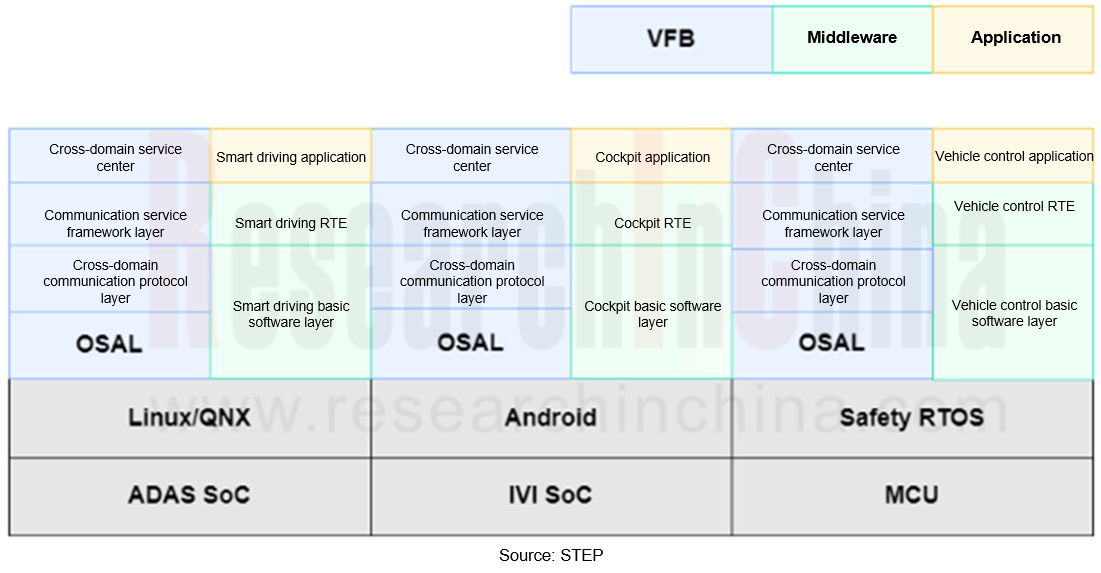
In February 2025, STEP released a cross-platform and cross-domain vehicle service communication framework dubbed VFB, which features unified multi-domain software technology, efficient cross-domain service collaboration, and rapid response to changing demand. Through centralized service governance, VFB achieves efficient collaboration and unified management between different functional domains (such as central gateway, intelligent driving, cockpit system, etc.), ensuring the consistency and efficiency of services, greatly improving system integration efficiency, reducing cross-domain communication friction, simplifying the construction of a vehicle SOA-based system, and greatly improving development efficiency. VFB can efficiently adapt to multiple models and multiple EEAs, facilitating the quick realization of the vehicle SOA platform.
In December 2024, Vector launched System Gateway, a system routing system adapted to third-party protocol stacks, to help customers apply different middleware products to cross-domain integration platforms. It enables communication between IP and ROS/DDS, between SOME/IP and Android, etc..
From the perspective of Vector's system design, there are many ecosystems and software on top of the SoC, and cross-ecosystem communication is done through "IPC" which can cross processes, chips or containers, depending on the specific project scenario. MICROSAR Adaptive is a general, automotive-grade solution that can be applied to most microprocessors. For third-party ecosystems, Vector achieves integration through System Gateway, which is in blue in the figure below.
The integration trend of AI foundation models and automotive middleware
With their application and penetration in the automotive industry, AI foundation models have improved the capabilities to automotive software systems and put forward new requirements for vehicle software systems. In 2025, automotive software is expected to see the integration of AI foundation models and middleware.
For vehicle software architectures, the software system middleware layer of AI ??foundation models has been fully upgraded. At the public library level, AI-related content such as security, RAG (retrieval-augmented generation ), vector databases, and reasoning engines have been added to build a unified reasoning framework, SDK (software development kit) and interface. The framework layer also incorporates many AI elements. For example, multimodal foundation model service knowledge bases, intelligent agent services, model management, edge-cloud collaborative services, distributed AI services, etc., provide all-round support for the development and operation of AI applications.
In October 2024, AUTOSEMO released the latest "China Automotive Basic Software Development Report 5.0", which proposed that with the help of AI foundation models, automotive basic software platforms will evolve to the open software architectures, which mainly consist of ASF middleware and standard middleware, of AI foundation models. In addition to cross-domain SOA middleware, ASF middleware also integrates middleware products such as AI foundation models/application frameworks to help in-depth development of AI models on vehicles.
In 2024, Changan Automobile added an AI service framework to the SDA software and actively integrated other architecture layers, including a new AI service layer, AI data services, AI scheduling, AI interface adaptation, and local model reasoning. The AI ??perception layer and AI actuation layer are integrated into the hardware layer to support computing and offer data collection and output services. The AI ??application layer is integrated into the vehicle function layer to provide AI application services. The hardware, data, framework, and algorithm layers are integrated into the cloud big data layer to offer massive AI data resources and train AI models.
In January 2025, Geely released the "Global Smart Car AI" technology system, which revolves around AI OS. Downward is the model layer and basic layer content contained in AI OS, and upward is terminal devices. For example, it is used for smart cars on the C-end, and serves R&D, production and other machine and enterprise management software on the B-end. It can be understood that AI ??OS is a platform that can flexibly adapt to various terminals, ensuring system security and user privacy while achieving efficient resource management and task scheduling.
At the same time, the AI ??OS scheduling engine enables the seamless cross-terminal flow of foundation model functions and services. In the entire product ecosystem, a unified all-causal intention understanding framework can integrate the needs and perception data of multiple devices such as vehicles, mobile phones, tablet PCs, wearable devices, smart homes, and other forms of embodied agents.
Automotive Microcontroller Unit (MCU) and Application Scenario Research Report, 2026
Automotive MCU Research: Increased demand for redundant security drives ASIL D-compliant MCU shipments to exceed 100 million units
In a vehicle EEA, MCUs are widely distributed in various functional ...
China Intelligent Cockpit Patent Analysis Report, 2026
Intelligent Cockpit Patent Research: Cockpit AI, In?vehicle Health, and Infotainment Are Upgrade to Scenario?based and Proactive Functions
From a patent perspective, this report explores the cutting?...
Research Report on Application of VLA Large Model in Automobiles and Robots, 2026
Research on Automotive and Robot VLA: Hybrid Architectures Become Mainstream, VLA Integrates with General World Models, and Reinforcement Learning Serves as Core Engine
Vision?Language?Action (VLA) m...
China Charging Infrastructure (Supercharging, Battery Swapping, V2G, etc.) and High-Performance Supercharging Battery Research Report, 2026
Charging and battery swapping research: as 5C+ supercharging vehicle models go into mass production, the pace of OEMs self-building supercharging networks quickens
800-1000V high-voltage platforms ar...
China Passenger Car Electronic Controlled Suspension Industry Report, 2026
Electronic Controlled Suspension Industry Research: As the First Year of Full Active Suspension Unfolds, Three Technical Routes Race Forward
1. Penetration Rate Surges Three Times, and Electronic Con...
Intelligent Driving SoC Research Report, 2026
Research on Intelligent Driving SoCs: Competition Focus Shifts to L3/L4 Embedded Hardware, and Computing Power of Flagship Vehicle Models Exceeds 1,000 TOPS
In terms of intelligent driving system in...
Automotive AI Large Model Technology Research Report, 2026
Automotive AI Large Model Research: Competition Shifts from "Who Has the Stronger Model" to "Who Boasts Higher Link Efficiency"
ResearchInChina released the Automotive AI Large Model Technology Resea...
Intelligent Vehicle Cockpit Domain Controller Research Report, 2026
Cockpit domain controller research: L3 AIDV intelligent cockpit domain controllers are entering a boom period
Driven by multiple factors such as the continuous evolution of the automotive central int...
Automotive Acoustic System (Audio, Multi-Channel) Industry Report, 2026
Automotive Acoustics Research: Multiple Channels, AI Tuning, and Self-Developed Algorithms Drive the Transformation of High-End Cockpit Sound Fields
I. Automotive Audio Hardware Solutions with 6–9 S...
Autonomous Driving Sensor Chip Research Report, 2026
Research on Autonomous Driving Sensor Chips: Deeply Perceiving the Physical World, Sensor Chips Are Playing A “Leading Role” in Intelligence
In 2026, the autonomous driving sensor chip industr...
Passenger Car Corner Module and Wheel‑Side Control System Research Report, 2026
Wheel-side control research: the “last mile” chassis innovation
Wheel-side control dismantles the traditional drive, braking, steering, and suspension control of the chassis from a "centralized" styl...
Embodied Artificial Intelligence (& Humanoid Robot) MCU Research Report, 2026
Research on Humanoid Robot MCUs: Evolution from General-Purpose Control to High-Value Dedicated Chip Solutions Integrated with Edge AI Functions
MCU (Microcontroller Unit) refers to a compact integra...
Intelligent Vehicle Zone Control Unit (ZCU) Research Report, 2026
ZCU Research: Cross-domain integrated ZCUs are becoming the edge computing nodes of the next-generation zonal architecture
Currently, the mainstream zonal architecture is mainly the quasi-central + z...
Automotive Cybersecurity and Data Security Research Report, 2026
Cybersecurity & Data Security Research: Intelligent Connected Vehicles Enter the Era of “Systematic Offense-Defense and AI-Defined Security”.
Centering on the panorama of intelligent connect...
Report on Breakthrough Strategies of OEMs and ADAS Tier 1 Suppliers for Overseas Layout of Intelligent Driving, 2026
Regulatory Breakthrough, Local System Establishment, OEMs Competing for NOA Layout: Overall Trends of China’s Intelligent Driving Overseas Layout in 2026
Research on overseas intelligent driving layo...
OEMs and Tier1s’ Intelligent Cockpit Platform (Hardware and Software) Innovation Strategy Research Report, 2026
Intelligent Cockpit Platform Research: multi-dimensional cockpit system architecture reconstruction for multi-agent collaboration and proactive intelligent services
The intelligent cockpit software s...
Automotive AIOS Research Report, 2026
Automotive AIOS Research: Mass Production Solutions Are Implemented
Mass Production Solutions Are Implemented on A Small Scale.
In 2026, AIOS starts small-scale implementation, helping to improve v...
Automotive Telematics Service Provider (TSP) Research Report, 2026
TSP Research: Leading providers collectively turn to AI agents to provide all-scenario active services
Telematics Service Providers (TSPs) are the core hub of the telematics industry chain, connectin...