ResearchInChina released the " AI/AR Glasses Industry Research Report, 2025", which deeply explores the field of AI smart glasses, sorts out product R&D and ecological layout of leading domestic and foreign manufacturers, and analyzes OEM-related eco-chain enterprises in AI glasses field. It conducts a panoramic review of typical AI glasses products newly launched between 2024 and 2025, and presents their technical highlights and functional characteristics in multiple dimensions.
1. In the past 12 months, mainstream manufacturers have released more than 30 AI smart glasses
Between 2024 and 2025, many manufacturers at home and abroad have launched AI smart glasses, especially around the CES2025, the market ushered in an intensive release period. Market statistics show that in 2024, the global sales of AI smart glasses were about 1.52 million pairs, of which AI glasses brands in China accounted for about 3%, or only 50,000 pairs. As major manufacturers continue to exert their efforts in technology R&D and market promotion, the AI smart glasses market has great potential for future growth. It is estimated that by 2030, the global sales of AI smart glasses are expected to soar to 90 million pairs, becoming a growth point that cannot be ignored in the field of consumer electronics.
From a technical perspective, some manufacturers have incorporated AR display functions into AI smart glasses, cleverly combining virtual information with real scenes and presenting them to users in a more intuitive and vivid way, effectively broadening the application scenarios and functional scope of AI glasses.
In terms of weight, the overall weight of AI glasses varies greatly, ranging from as light as 25g to 99g. The weight of most products is concentrated between 31g and 70g. The trend of lightweight reflects the significant improvement in hardware integration.
2. Five technical paths for AI glasses foundation models, with more than 30 mainstream models
AI glasses are increasingly connected to foundation models. From the cooperation between AI glasses manufacturers and foundation model suppliers, there are mainly three core strategies:
① Completely independent research and development of foundation models: This type of glasses manufacturer needs to have the ability to independently build foundation models, aiming to achieve a closed loop of technology and ensure the autonomy and controllability of the technology.
② Access to third-party services: Through the ability to call external foundation models through API or SDK, glasses manufacturers can quickly integrate functions. Some manufacturers choose to deeply customize their own foundation models to optimize the interactive experience; while others build a multi-model ecosystem to give users the flexibility to call on demand.
③ "Self- developed + access" hybrid modes: This strategy aims to balance the autonomy of technology and commercialization efficiency. In key scenarios, manufacturers will independently develop models to meet specific needs; for general functions, they will access third-party foundation models to achieve rapid deployment.
In short, AI glasses use a variety of methods when equipped with foundation models, including deep integration of self- developed foundation models, customized models for specific scenarios, compatible calls of multiple models, end-cloud collaborative strategies to optimize performance and power consumption, and lightweight technology to achieve local deployment.
3. AI smart glasses ecosystem
AI glasses are based on the "all-in-one integration" mode. By integrating core components such as speakers, cameras, biosensors, AR displays, etc., they cleverly combine functions of multiple devices such as myopia glasses, smart speakers, sports cameras, e-books, projectors, etc., to meet users' needs in audio-visual, photo, health monitoring, information interaction, etc., bringing users a convenient, diverse and efficient experience.
AI glasses are gradually building a comprehensive, intelligent ecological interconnected environment for users. Its core value lies in being user-centric, relying on efficient interconnection technology and hybrid computing architecture to seamlessly connect various terminals in life, work, and entertainment (such as smartphones, computers/keyboards, game controllers, smart home devices, and IVI terminals).
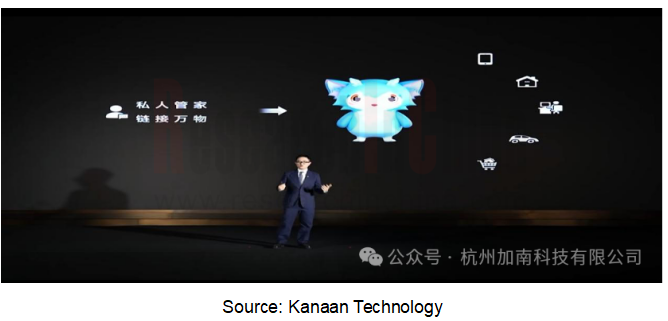
Kanaan Technology officially released the KANAAN-K1 AI smart glasses on December 31, 2024. The glasses are equipped with voice assistant "Xiaonan", which can easily connect to various terminals. Users only need to wake up "Xiaonan" to seamlessly access smart home ecosystem, freely adjust the brightness of indoor lights, the temperature of air conditioners, and the opening and closing of curtains, and fully realize the convenient experience of "voice as a service".
4. Application prospects of AI glasses in vehicles
DreamSmart's AR+AI smart glasses, powered by the Flyme AI OS and Flyme Link technology, enable seamless connectivity and smooth switching across multiple devices (including smartphones, IVI systems, and other terminals) in all scenarios, delivering a boundless intelligent experience.
AI glasses technology is accelerating its iteration, and the standardized system platforms and interconnection technologies built by major manufacturers are becoming more mature, which gives AI glasses a broad application prospect in automotive field.
As seen from the above functions, AI glasses and AR-HUD share some overlapping functionalities. However, AI glasses far surpass AR-HUD in terms of virtual display size, display richness, multimodal interaction capabilities, and upgradability.
Beyond enabling "display enhancement" in the cockpit, AI glasses can also provide "computing power enhancement." With the advancement of foundation models, smart cockpits are demanding increasingly higher computing power. Upgrading the built-in IVI system's computing capacity is often challenging, whereas some AI glasses come equipped with a computing power module that can enhance the cockpit's processing capabilities.
Automotive Microcontroller Unit (MCU) and Application Scenario Research Report, 2026
Automotive MCU Research: Increased demand for redundant security drives ASIL D-compliant MCU shipments to exceed 100 million units
In a vehicle EEA, MCUs are widely distributed in various functional ...
China Intelligent Cockpit Patent Analysis Report, 2026
Intelligent Cockpit Patent Research: Cockpit AI, In?vehicle Health, and Infotainment Are Upgrade to Scenario?based and Proactive Functions
From a patent perspective, this report explores the cutting?...
Research Report on Application of VLA Large Model in Automobiles and Robots, 2026
Research on Automotive and Robot VLA: Hybrid Architectures Become Mainstream, VLA Integrates with General World Models, and Reinforcement Learning Serves as Core Engine
Vision?Language?Action (VLA) m...
China Charging Infrastructure (Supercharging, Battery Swapping, V2G, etc.) and High-Performance Supercharging Battery Research Report, 2026
Charging and battery swapping research: as 5C+ supercharging vehicle models go into mass production, the pace of OEMs self-building supercharging networks quickens
800-1000V high-voltage platforms ar...
China Passenger Car Electronic Controlled Suspension Industry Report, 2026
Electronic Controlled Suspension Industry Research: As the First Year of Full Active Suspension Unfolds, Three Technical Routes Race Forward
1. Penetration Rate Surges Three Times, and Electronic Con...
Intelligent Driving SoC Research Report, 2026
Research on Intelligent Driving SoCs: Competition Focus Shifts to L3/L4 Embedded Hardware, and Computing Power of Flagship Vehicle Models Exceeds 1,000 TOPS
In terms of intelligent driving system in...
Automotive AI Large Model Technology Research Report, 2026
Automotive AI Large Model Research: Competition Shifts from "Who Has the Stronger Model" to "Who Boasts Higher Link Efficiency"
ResearchInChina released the Automotive AI Large Model Technology Resea...
Intelligent Vehicle Cockpit Domain Controller Research Report, 2026
Cockpit domain controller research: L3 AIDV intelligent cockpit domain controllers are entering a boom period
Driven by multiple factors such as the continuous evolution of the automotive central int...
Automotive Acoustic System (Audio, Multi-Channel) Industry Report, 2026
Automotive Acoustics Research: Multiple Channels, AI Tuning, and Self-Developed Algorithms Drive the Transformation of High-End Cockpit Sound Fields
I. Automotive Audio Hardware Solutions with 6–9 S...
Autonomous Driving Sensor Chip Research Report, 2026
Research on Autonomous Driving Sensor Chips: Deeply Perceiving the Physical World, Sensor Chips Are Playing A “Leading Role” in Intelligence
In 2026, the autonomous driving sensor chip industr...
Passenger Car Corner Module and Wheel‑Side Control System Research Report, 2026
Wheel-side control research: the “last mile” chassis innovation
Wheel-side control dismantles the traditional drive, braking, steering, and suspension control of the chassis from a "centralized" styl...
Embodied Artificial Intelligence (& Humanoid Robot) MCU Research Report, 2026
Research on Humanoid Robot MCUs: Evolution from General-Purpose Control to High-Value Dedicated Chip Solutions Integrated with Edge AI Functions
MCU (Microcontroller Unit) refers to a compact integra...
Intelligent Vehicle Zone Control Unit (ZCU) Research Report, 2026
ZCU Research: Cross-domain integrated ZCUs are becoming the edge computing nodes of the next-generation zonal architecture
Currently, the mainstream zonal architecture is mainly the quasi-central + z...
Automotive Cybersecurity and Data Security Research Report, 2026
Cybersecurity & Data Security Research: Intelligent Connected Vehicles Enter the Era of “Systematic Offense-Defense and AI-Defined Security”.
Centering on the panorama of intelligent connect...
Report on Breakthrough Strategies of OEMs and ADAS Tier 1 Suppliers for Overseas Layout of Intelligent Driving, 2026
Regulatory Breakthrough, Local System Establishment, OEMs Competing for NOA Layout: Overall Trends of China’s Intelligent Driving Overseas Layout in 2026
Research on overseas intelligent driving layo...
OEMs and Tier1s’ Intelligent Cockpit Platform (Hardware and Software) Innovation Strategy Research Report, 2026
Intelligent Cockpit Platform Research: multi-dimensional cockpit system architecture reconstruction for multi-agent collaboration and proactive intelligent services
The intelligent cockpit software s...
Automotive AIOS Research Report, 2026
Automotive AIOS Research: Mass Production Solutions Are Implemented
Mass Production Solutions Are Implemented on A Small Scale.
In 2026, AIOS starts small-scale implementation, helping to improve v...
Automotive Telematics Service Provider (TSP) Research Report, 2026
TSP Research: Leading providers collectively turn to AI agents to provide all-scenario active services
Telematics Service Providers (TSPs) are the core hub of the telematics industry chain, connectin...