Integrated Battery (CTP, CTB, CTC, and CTV) and Battery Innovation Technology Report, 2025
Power battery research: 17 vehicle models use integrated batteries, and 34 battery innovation technologies are released
ResearchInChina released Integrated Battery (CTP, CTB, CTC, and CTV)and Battery Innovation Technology Report 2025, which summarizes the development status, installation, supply layout, etc. of integrated batteries (such as CTP, CTB, CTC, and CTV) and battery innovation technologies, and predicts the development trends of integrated batteries and battery innovation technologies.
1. The application of integrated battery technologies is gradually deepening
Integrated battery technologies include two forms: battery pack integration and body integration. The former is reflected in CTP (Cell to Pack) technology, and body integration exists in the form of CTB (Cell to Body)/CTV (Cell to Vehicle) and CTC (Cell to Chassis).
Integrated battery technologies integrate the battery cells directly into the chassis to increase the range of electric vehicles, enhance body rigidity, improve driving comfort and optimize the Z-axis space in the cabin. According to incomplete statistics, up to 17 models (including those that have been released and planned to be launched) have applied integrated technologies, whose application is constantly deepening.
CTC and CTB were first seen on models of OEMs such as Leapmotor, BYD, Tesla, and Xpeng. Today, car companies such as Changan, Geely, and Avatr have also released their CTB, CTV and other integration technologies.
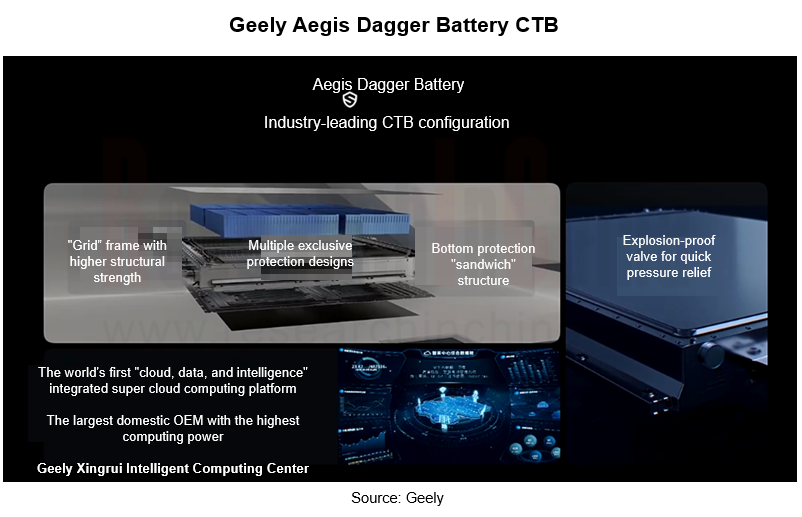
In April 2024, Geely officially unveiled the latest generation of self-developed and self-produced "blade-type" LiFePO4 batteries: the Aegis Dagger Battery. This battery is further upgraded and iterated on the basis of the original Aegis battery safety system. It adopts CTB and uses the battery as part of the body structure. It was first installed on the Geely Galaxy E5.
The Aegis Dagger Battery has the following features:
The internal battery cell and shell are integrated through structural glue and thermally conductive structural glue, which improves the modal and torsional stiffness of the entire package;
For example, core technologies such as the high-strength steel composite top cover, the highly stable "grid" frame structure, the bottom "armor” of the "sandwich" structure, rapid pressure relief in extreme situations, double thermal and electric separation, the three-phase fusion of "isolation, drainage and conduction", and battery fire prevention have greatly improved the safety of the battery pack.
In March 2025,Leapmotor released CTC 2.0 Plus. CTC 2.0 Plus has improved safety, integration, and intelligence compared to CTC 2.0, and will first land on Leapmoon B10 which is to be launched in April 2025.
Leapao CTC 2.0 Plus has the following upgrades:
Safer: Six-fold ("source + vision + isolation + barrier + evacuation + cooling") safety design; 1,029 safety tests and 128 performance tests; 50% higher side impact coefficient; 20% higher bottom strength; no fire, no explosion, and no heat spread in extreme cases;
More integrated: Integrated design of battery chassis without battery pack; 9-in-1 ultra-integrated battery control system; 19% more power available in the same class;
Smarter: The adaptive AI BMS battery management system can improve battery estimation accuracy by 1%, battery thermal management energy consumption by 30%, and vehicle range by 2%.
2. From 2024 to 2025, battery suppliers successively released 34 battery innovation technologies
In February 2025, BMW's sixth-generation power battery debuted globally, using large cylindrical cells for the first time. It is planned to be first applied to BMW’s first next-generation model to be unveiled this year, as well as the Chinese next-generation models that will be mass-produced from 2026. BMW's upcoming industrial mass production of large cylindrical batteries will undoubtedly fuel the development of such batteries, and also provide a valuable demonstration for the continued breakthroughs in innovative power battery technologies.
According to incomplete statistics, 12 battery suppliers have successively released 34 new battery technologies since 2024, of which CATL has unveiled 7 battery technologies, which are widely used in light/heavy commercial vehicles, hybrid vehicles, buses and other models. CATL has also launched a 6C LiFePO4 battery, which can provide an additional 350 kilometers of range for vehicles in just 10 minutes of charging and will be installed on the Ultium quasi-900V platform in the future.
3. Fast charging batteries upgrade from 6C to 10C
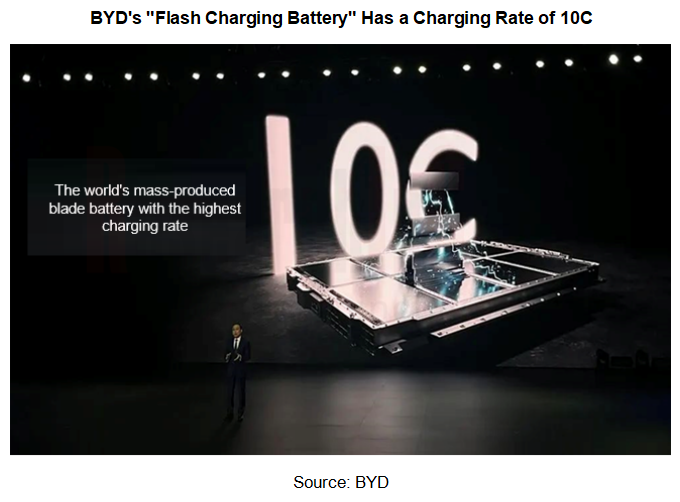
As battery manufacturers and OEMs have deployed high-rate battery technologies, batteries have continued to iterate and break through in the field of ultra-fast charging, evolving from 6C to 10C. For example, CATL launched a 6C LiFePO4 battery, SVOLT Energy released a 6C supercharged battery and Fengxing Short Blade Battery (supercharged version), and EVE unveiled the 6C Omnicel cylindrical battery. OEMs such as FAW and Chery have also actively dabbled in the arena, especially the flash charging battery released by BYD in March this year has a charge and discharge rate of 10C, constantly breaking the industry's upper limit.
For example, in order to completely alleviate users' anxiety about charging, BYD's "flash charging battery" is comparable to "refueling" in charging speed. From the positive electrode to the negative electrode of the battery, it builds an ultra-high-speed ion channel in all directions, reducing the internal resistance of the battery by 50% with the charging current of 1000A and the charging rate of 10C. With the support of 1,000V and 1,000A, the charging power can reach 1 megawatt (1000kW), a 10-second charging offers a range up to 20 kilometers, and a 5-minute flash charging enables a range of 400 kilometers. In terms of performance, the single-module single-motor power reaches 580kW, and the maximum speed exceeds 300km/h. The "flash charging battery" was first available on Han L and Tang L which are expected to be officially launched in April.
4. Batteries for PHEVs and EREVs have become an important development direction for the power battery industry
Batteries tailored for PHEVs and EREVs aim to balance battery-electric range and fast recharging. In order to meet users' needs for daily commuting and long-distance mobility, such batteries not only should support high power output, but also must have fast charging and long lifespan. Given this, power battery manufacturers such as CATL, SVOLT Energy, and CALB are vigorously developing and launching special batteries for PHEVs and EREVs.
In January 2024, CATL released the Freevoy Super Hybrid Battery for the first time with Avatr 12. It plans to apply it to nearly 30 PHEV and EREV models from Geely, Chery, GAC, and Voyah in 2025. In July 2024, SVOLT Energy released the 800V 4C Dragon Scale Armor hybrid battery for PHEVs, which will be mass-produced in July 2025. In January 2025, SVOLT Energy released two types of batteries for PHEVs and EREVs, namely off-road batteries (for plug-in hybrid, extended-range off-road vehicles) and HEV batteries (for commercial vehicles and passenger cars). off-road batteries have been mass-produced and first installed on Tank 500 Hi4-Z.
Automotive Microcontroller Unit (MCU) and Application Scenario Research Report, 2026
Automotive MCU Research: Increased demand for redundant security drives ASIL D-compliant MCU shipments to exceed 100 million units
In a vehicle EEA, MCUs are widely distributed in various functional ...
China Intelligent Cockpit Patent Analysis Report, 2026
Intelligent Cockpit Patent Research: Cockpit AI, In?vehicle Health, and Infotainment Are Upgrade to Scenario?based and Proactive Functions
From a patent perspective, this report explores the cutting?...
Research Report on Application of VLA Large Model in Automobiles and Robots, 2026
Research on Automotive and Robot VLA: Hybrid Architectures Become Mainstream, VLA Integrates with General World Models, and Reinforcement Learning Serves as Core Engine
Vision?Language?Action (VLA) m...
China Charging Infrastructure (Supercharging, Battery Swapping, V2G, etc.) and High-Performance Supercharging Battery Research Report, 2026
Charging and battery swapping research: as 5C+ supercharging vehicle models go into mass production, the pace of OEMs self-building supercharging networks quickens
800-1000V high-voltage platforms ar...
China Passenger Car Electronic Controlled Suspension Industry Report, 2026
Electronic Controlled Suspension Industry Research: As the First Year of Full Active Suspension Unfolds, Three Technical Routes Race Forward
1. Penetration Rate Surges Three Times, and Electronic Con...
Intelligent Driving SoC Research Report, 2026
Research on Intelligent Driving SoCs: Competition Focus Shifts to L3/L4 Embedded Hardware, and Computing Power of Flagship Vehicle Models Exceeds 1,000 TOPS
In terms of intelligent driving system in...
Automotive AI Large Model Technology Research Report, 2026
Automotive AI Large Model Research: Competition Shifts from "Who Has the Stronger Model" to "Who Boasts Higher Link Efficiency"
ResearchInChina released the Automotive AI Large Model Technology Resea...
Intelligent Vehicle Cockpit Domain Controller Research Report, 2026
Cockpit domain controller research: L3 AIDV intelligent cockpit domain controllers are entering a boom period
Driven by multiple factors such as the continuous evolution of the automotive central int...
Automotive Acoustic System (Audio, Multi-Channel) Industry Report, 2026
Automotive Acoustics Research: Multiple Channels, AI Tuning, and Self-Developed Algorithms Drive the Transformation of High-End Cockpit Sound Fields
I. Automotive Audio Hardware Solutions with 6–9 S...
Autonomous Driving Sensor Chip Research Report, 2026
Research on Autonomous Driving Sensor Chips: Deeply Perceiving the Physical World, Sensor Chips Are Playing A “Leading Role” in Intelligence
In 2026, the autonomous driving sensor chip industr...
Passenger Car Corner Module and Wheel‑Side Control System Research Report, 2026
Wheel-side control research: the “last mile” chassis innovation
Wheel-side control dismantles the traditional drive, braking, steering, and suspension control of the chassis from a "centralized" styl...
Embodied Artificial Intelligence (& Humanoid Robot) MCU Research Report, 2026
Research on Humanoid Robot MCUs: Evolution from General-Purpose Control to High-Value Dedicated Chip Solutions Integrated with Edge AI Functions
MCU (Microcontroller Unit) refers to a compact integra...
Intelligent Vehicle Zone Control Unit (ZCU) Research Report, 2026
ZCU Research: Cross-domain integrated ZCUs are becoming the edge computing nodes of the next-generation zonal architecture
Currently, the mainstream zonal architecture is mainly the quasi-central + z...
Automotive Cybersecurity and Data Security Research Report, 2026
Cybersecurity & Data Security Research: Intelligent Connected Vehicles Enter the Era of “Systematic Offense-Defense and AI-Defined Security”.
Centering on the panorama of intelligent connect...
Report on Breakthrough Strategies of OEMs and ADAS Tier 1 Suppliers for Overseas Layout of Intelligent Driving, 2026
Regulatory Breakthrough, Local System Establishment, OEMs Competing for NOA Layout: Overall Trends of China’s Intelligent Driving Overseas Layout in 2026
Research on overseas intelligent driving layo...
OEMs and Tier1s’ Intelligent Cockpit Platform (Hardware and Software) Innovation Strategy Research Report, 2026
Intelligent Cockpit Platform Research: multi-dimensional cockpit system architecture reconstruction for multi-agent collaboration and proactive intelligent services
The intelligent cockpit software s...
Automotive AIOS Research Report, 2026
Automotive AIOS Research: Mass Production Solutions Are Implemented
Mass Production Solutions Are Implemented on A Small Scale.
In 2026, AIOS starts small-scale implementation, helping to improve v...
Automotive Telematics Service Provider (TSP) Research Report, 2026
TSP Research: Leading providers collectively turn to AI agents to provide all-scenario active services
Telematics Service Providers (TSPs) are the core hub of the telematics industry chain, connectin...