Automotive Operating System and AIOS Integration Research Report, 2025
Research on automotive AI operating system (AIOS): from AI application and AI-driven to AI-native
Automotive Operating System and AIOS Integration Research Report, 2025, released by ResearchInChina, explains the status quo and trends of AI application in automotive operating systems (OS), and analyzes how vehicle OS and AIOS mutually empower and co-evolve.
The relationship between vehicle OS and AIOS:
From 2023 to 2024, with the rise of central computing architecture, domain operating systems started evolving towards vehicle OS which takes on integrating the full-domain software system.
In the second half of 2024, AI foundation models started being mass-produced and introduced into vehicles, which raises new requirements for vehicle operating systems and also enables their scheduling capabilities, further facilitating the adoption of automotive AIOS.
AIOS is an AI-driven operating system that enables operating systems with "intelligence", that is, allow the systems to independently make optimizations and decisions during task execution and scheduling. AIOS represents the pinnacle of vehicle intelligence, and is responsible for handling complex perceptual data, executing intelligent decision, and realizing human-like interaction, while vehicle OS serves as the software foundation for all vehicle functions. The deep integration of the two is not merely a functional overlay but a key force driving reshaping of underlying architecture, deep synergy in industry chain, and redefinition of competitive rules.
1.Vehicle OS supports the implementation of AI capabilities: Beyond providing computing power and data, the SOA of vehicle OS abstracts vehicle functions into independent services through standardized interfaces, achieving hardware-software decoupling, and makes it easy to call interfaces across different software modules through atomic services, providing a stable and flexible invocation environment for AI models. Take Geely as an example:
Geely’s customized OS, GOS, is based on an SOA development framework that encapsulates various vehicle functions as services and allows AI functions to quickly call these services for agile development and iteration, providing the foundation for the rapid deployment and continuous optimization of AI capabilities. In early 2025, Geely introduced its "Full-Domain AI" system, and upgraded its OS to AIOS, with a model layer set up for AIOS to call.
2.AI reconstructs vehicle OS: Shifting it from the traditional "function-driven" model to a smarter "intent-driven" model:
AI Agents at the application layer can leverage foundation models' semantic analysis capabilities to accurately understand users' natural language commands and even latent intentions, and automatically invoke underlying software modules to complete tasks. The "intent-driven" interaction model is used to enable vehicles to proactively understand needs and provide services, making user experience much more natural and convenient.
Foundation models at the middleware (or model) layer not only provide calling interfaces for agents but also optimize the scheduling capabilities of vehicle OS through planning. This process relies on historical data and real-time system states, and uses reinforcement learning and operations research algorithms to dynamically allocate system resources and prioritize tasks. For instance, when a user simultaneously initiates navigation planning and high-definition video playback, foundation models can predict the urgency of route calculation and the resource demands of video decoding, coordinate CPU, GPU, and NPU compute in advance to ensure both navigation response and smooth video playback, avoiding stuttering caused by resource contention in traditional scheduling algorithms.
Data at the resource layer serves as the bridge between the two. Vehicle OS is responsible for data collection and management, while AIOS handles data analysis and decision-making.
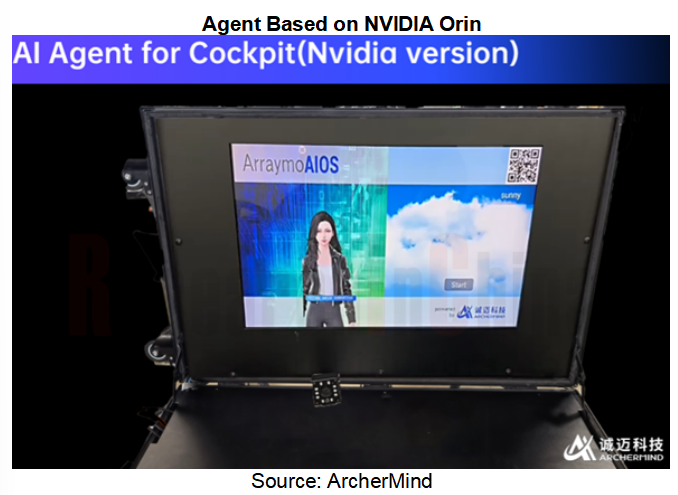
In ArcherMind’s case, its subsidiary Arraymo developed ArraymoAIOS 1.0, an on-device AI operating system which, together with the vehicle operating system FusionOS 2.0, constitutes the technical base of AIOS. Key features of this base include:
Support use of Qualcomm SA8775P to build cockpit agents, and NVIDIA Orin to build vehicle agents, each equipped with 10+ deeply optimized on-device models (DeepSeek, Llama, Baichuan, Gemma, Yi-Chat, etc.).
Introduce intelligent scheduling algorithms to monitor and analyze multi-modal task loads (text, image, audio, etc.) in real time, and dynamically adjust the strategies for allocation of resources like CPU, GPU, and memory.
Introduce the AI acceleration engine AMLightning to efficiently schedule computing units in AI chips, allowing reasoning tasks to run on the most suitable computing unit.
Evolution of AIOS: From AI Application and AI-Driven to AI-Native
In the automotive sector, AI was initially integrated at the application layer of the operating system, invoked via interfaces for specific scenarios. Entering the era of AIOS, AI starts penetrating deeper into the underlying layer, from being integrated into the middleware layer for driving functions, to touching the OS kernel and underlying architecture. In the future, it will evolve into AI-native OS.
As of April 2025, there have been three modes of AI integration in OS, corresponding to the three development phases of AIOS:
AI Application Phase: introduced as applications to serve scenarios.
AI-Driven Phase: connected at the middleware layer, utilizing components like AI Runtime and AI frameworks (models/agents/algorithm frameworks) to drive various software functions more flexibly.
AI-Native Phase: large language models (LLMs) are called as microkernel modular components, providing platform-level AI capabilities for the entire OS.
Huawei believes that the application of AI technology in terminal products typically passes through three phases: AI integration at the application layer, AI fusion at the system layer, and AI-centric new OS.
As of H1 2025, most OEMs have already deployed AI at the application layer and have begun to integrate AI components into the middleware layer. Examples include Li Auto’s Halo OS, NIO’s Sky OS, Xiaomi’s Hyper OS, and Geely’s AIOS GOS.
AI Application Phase
At this phase, AI is integrated into the application layer of OS to be called for scenarios. OS primarily provides computing power and data interfaces to optimize and upgrade basic AI functions like navigation and voice interaction. For example, in a "vehicle assistant" scenario, when a user calls AI for car-related knowledge, AI at the application layer first analyzes the request, converts it into a command, retrieves relevant data from databases, and formulates a natural-language answer displayed on the center console screen.
AI-Driven Phase
At this phase, AIOS extends into the middleware layer, becoming a mainstream approach for AI Agent invocation in intelligent cockpits. Upper-layer agents leverage AI components to directly call SOA atomic services via framework modules to control vehicle functions or other software features. Additionally, toolchains can be used to call multiple external tools and ecological interfaces to achieve "touchless" automation for scenarios.
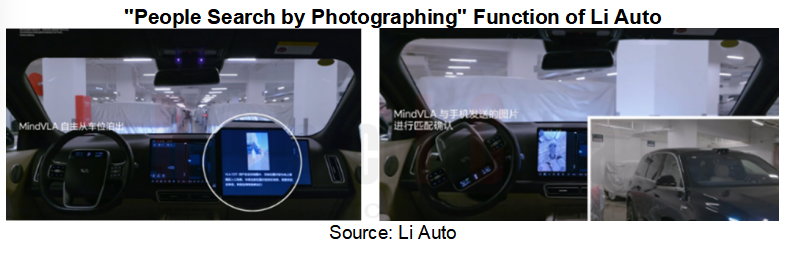
For instance, the "people search by photographing" function of Li Auto’s MindVLA requires MindVLA to successively complete such steps as object recognition, map data matching, and route planning, involving use of components like AI reasoning framework and reasoning acceleration, and invocation of external maps and location data.
Li Auto’s Halo OS incorporates an AI subsystem in the middleware layer, which includes not only AI Runtime but also components like AI reasoning engine and reasoning acceleration framework.
AI-Native Phase
AI-Native refers to systems or product forms that are fundamentally driven by AI, and deeply integrate AI in design from the ground up.
An AI-Native OS is an operating system that deeply integrates AI into its underlying architecture from the beginning of design, features system-level AI capabilities, and delivers all-scenario intelligent experience and rich agent ecosystems.
When AI and OS achieve deep integration, an AI-Native OS is formed. The system can intelligently optimize resource allocation and task scheduling according to application scenarios and demands, thus bringing a qualitative leap in overall efficiency and intelligence, rather than merely taking AI as an upper-layer application or functional module.
In Huawei’s case, its AI-Native OS has the following features:
Unified AI system base
AI-Native applications
Xiaoyi Super Agent
Open ecosystems
Underpinned by the AI system base, super apps/agents are built and rich ecosystems are created. AI-native HarmonyOS features multimodal understanding, personalized user data understanding, and privacy protection capabilities, and all-scenario perception and collaboration capabilities.
In April 2025, Huawei launched HarmonySpace 5, a HarmonyOS-based cockpit which adopts the MoLA hybrid foundation model architecture. It leverages a multi-model base (including DeepSeek), led by the PanGu Models, to enable system agent and vertical agent scenario applications. The entire upper-layer applications are supported by the system-level AI capabilities of HarmonyOS 5.0.
In ThunderSoft’s case, in 2025, AquaDrive OS has been upgraded to an AI-native OS, offering optimizations in the following directions:
The AI middleware of AquaDrive OS includes agent perception/execution services and an agent management framework to support multi-agent interaction. It also incorporates a foundation model inference and scheduling framework, supporting connection to various cloud and on-device foundation models to achieve life-oriented multimodal recognition and environmental guidance.
Its framework provides SOA services, and enables modular software function calls with atomized support.
Automotive Microcontroller Unit (MCU) and Application Scenario Research Report, 2026
Automotive MCU Research: Increased demand for redundant security drives ASIL D-compliant MCU shipments to exceed 100 million units
In a vehicle EEA, MCUs are widely distributed in various functional ...
China Intelligent Cockpit Patent Analysis Report, 2026
Intelligent Cockpit Patent Research: Cockpit AI, In?vehicle Health, and Infotainment Are Upgrade to Scenario?based and Proactive Functions
From a patent perspective, this report explores the cutting?...
Research Report on Application of VLA Large Model in Automobiles and Robots, 2026
Research on Automotive and Robot VLA: Hybrid Architectures Become Mainstream, VLA Integrates with General World Models, and Reinforcement Learning Serves as Core Engine
Vision?Language?Action (VLA) m...
China Charging Infrastructure (Supercharging, Battery Swapping, V2G, etc.) and High-Performance Supercharging Battery Research Report, 2026
Charging and battery swapping research: as 5C+ supercharging vehicle models go into mass production, the pace of OEMs self-building supercharging networks quickens
800-1000V high-voltage platforms ar...
China Passenger Car Electronic Controlled Suspension Industry Report, 2026
Electronic Controlled Suspension Industry Research: As the First Year of Full Active Suspension Unfolds, Three Technical Routes Race Forward
1. Penetration Rate Surges Three Times, and Electronic Con...
Intelligent Driving SoC Research Report, 2026
Research on Intelligent Driving SoCs: Competition Focus Shifts to L3/L4 Embedded Hardware, and Computing Power of Flagship Vehicle Models Exceeds 1,000 TOPS
In terms of intelligent driving system in...
Automotive AI Large Model Technology Research Report, 2026
Automotive AI Large Model Research: Competition Shifts from "Who Has the Stronger Model" to "Who Boasts Higher Link Efficiency"
ResearchInChina released the Automotive AI Large Model Technology Resea...
Intelligent Vehicle Cockpit Domain Controller Research Report, 2026
Cockpit domain controller research: L3 AIDV intelligent cockpit domain controllers are entering a boom period
Driven by multiple factors such as the continuous evolution of the automotive central int...
Automotive Acoustic System (Audio, Multi-Channel) Industry Report, 2026
Automotive Acoustics Research: Multiple Channels, AI Tuning, and Self-Developed Algorithms Drive the Transformation of High-End Cockpit Sound Fields
I. Automotive Audio Hardware Solutions with 6–9 S...
Autonomous Driving Sensor Chip Research Report, 2026
Research on Autonomous Driving Sensor Chips: Deeply Perceiving the Physical World, Sensor Chips Are Playing A “Leading Role” in Intelligence
In 2026, the autonomous driving sensor chip industr...
Passenger Car Corner Module and Wheel‑Side Control System Research Report, 2026
Wheel-side control research: the “last mile” chassis innovation
Wheel-side control dismantles the traditional drive, braking, steering, and suspension control of the chassis from a "centralized" styl...
Embodied Artificial Intelligence (& Humanoid Robot) MCU Research Report, 2026
Research on Humanoid Robot MCUs: Evolution from General-Purpose Control to High-Value Dedicated Chip Solutions Integrated with Edge AI Functions
MCU (Microcontroller Unit) refers to a compact integra...
Intelligent Vehicle Zone Control Unit (ZCU) Research Report, 2026
ZCU Research: Cross-domain integrated ZCUs are becoming the edge computing nodes of the next-generation zonal architecture
Currently, the mainstream zonal architecture is mainly the quasi-central + z...
Automotive Cybersecurity and Data Security Research Report, 2026
Cybersecurity & Data Security Research: Intelligent Connected Vehicles Enter the Era of “Systematic Offense-Defense and AI-Defined Security”.
Centering on the panorama of intelligent connect...
Report on Breakthrough Strategies of OEMs and ADAS Tier 1 Suppliers for Overseas Layout of Intelligent Driving, 2026
Regulatory Breakthrough, Local System Establishment, OEMs Competing for NOA Layout: Overall Trends of China’s Intelligent Driving Overseas Layout in 2026
Research on overseas intelligent driving layo...
OEMs and Tier1s’ Intelligent Cockpit Platform (Hardware and Software) Innovation Strategy Research Report, 2026
Intelligent Cockpit Platform Research: multi-dimensional cockpit system architecture reconstruction for multi-agent collaboration and proactive intelligent services
The intelligent cockpit software s...
Automotive AIOS Research Report, 2026
Automotive AIOS Research: Mass Production Solutions Are Implemented
Mass Production Solutions Are Implemented on A Small Scale.
In 2026, AIOS starts small-scale implementation, helping to improve v...
Automotive Telematics Service Provider (TSP) Research Report, 2026
TSP Research: Leading providers collectively turn to AI agents to provide all-scenario active services
Telematics Service Providers (TSPs) are the core hub of the telematics industry chain, connectin...