Automotive XR industry research: automotive XR application is still in its infancy, and some OEMs have already made forward-looking layout
The Automotive XR Industry Report, 2025, released by ResearchInChina, focuses on the automotive XR field, deconstructs the XR industry chain and key technological elements, provides a detailed interpretation of core technologies and optical display solutions, and summarizes the latest products and solutions of Chinese and foreign automotive XR device and software solution suppliers. In addition, this report offers an in-depth analysis of XR layout of OEMs and related ecosystem companies, involving OEMs’ XR strategic layout, latest automotive XR products, and XR patents. Finally, it explores the status quo and trends of automotive XR development according to market dynamics.
1. The integration of XR devices and AI foundation models is revolutionizing user mobility experience.
As technology advances, the integration of XR devices and AI foundation models is bringing a disruption to the automotive sector, significantly enhancing user mobility experience. Specifically, with introduction of AI foundation models, the AI memory function of XR devices can accurately record the parking location of a vehicle using image recognition technology, helping users quickly locate their cars in complex parking lots. Additionally, some XR devices feature offline payment function, fostering the evolution of automotive ecosystems. Users can leverage XR devices to integrate essential mobility scenarios such as parking fee and refueling payments. In the future, this may extend to subscription to music/video content, purchase of vehicle apps, or full-category online shopping, forming a smart service loop that covers the entire mobility link to create more intelligent and efficient in-vehicle experiences for users.
Case 1: the AI memory function of automotive XR helps users accurately locate their vehicles.
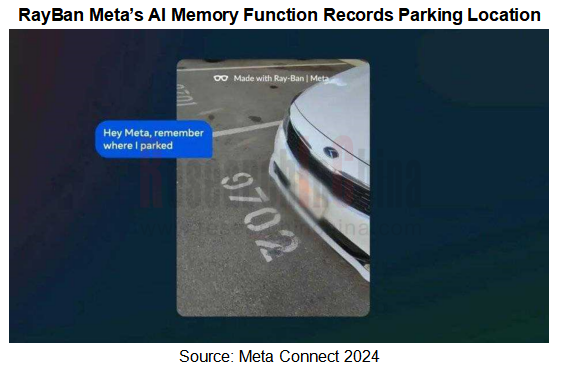
In April 2024, the second-generation Ray-Ban Meta introduced the Meta AI foundation model. On September 26, 2024, the new version Llama 3.2 was released at the Meta Connect. It further enhances AI interaction capabilities and brings users an AI memory function that helps them remember daily details, such as parking locations, phone numbers, and shopping reminders.
With this feature, after parking, users can take a photo of the parking spot via either voice commands or the button on the right temple of the glasses. The photo is automatically stored in the glasses and, if connected to Wi-Fi, synced to the phone. Moreover Ray-Ban Meta automatically performs AI recognition on the photo, extracting information such as the parking spot number and storing it accordingly. When users need to locate their vehicle, they simply voice to inquire, and the glasses will provide the parking spot number by speech. Users can also view the photo in the Meta View app to locate the car.
Case 2: XR devices integrate payment function, expected to land in in-vehicle payment scenarios.
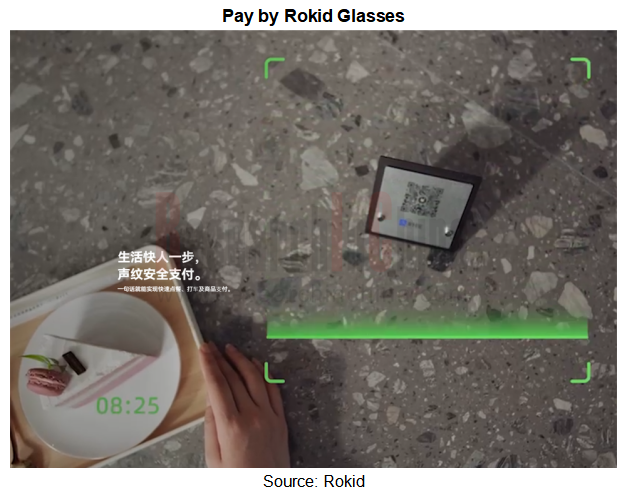
Rokid Glasses has now integrated Alipay's "AI Life Assistant" Zhi Xiao Bao, launching the innovative AR glasses payment function based on voiceprint recognition. In such scenarios as ride hailing, food ordering, or QR code scan to pay with Rokid Glasses, users only need to wake up Zhi Xiao Bao via voice command and state the amount (e.g., "Zhi Xiao Bao, pay 50 yuan"), and the system will complete identity verification through voiceprint comparison, enabling quick small-amount payments without any manual operation throughout the process.
On April 29, 2025, Meizu announced its official launch of the offline payment function for StarV Air2 smart glasses, and implementation of this function in Q3 this year. Users wearing StarV Air2 smart glasses only need to activate the payment function via the built-in voice assistant, utter a payment confirmation command, and voice to confirm payment details such as the amount, and they can complete the transaction effortlessly, without the need to pull out their phones or use other devices.
2. XR technology integrates vehicle data, expanding application scenarios.
XR technology integrates with vehicle software and hardware information. By deeply integrating vehicle hardware devices (e.g., radar and visual sensor) and software systems (navigation algorithm, infotainment system, vehicle cloud data, etc.), it expands vehicle application scenarios, including entertainment (e.g., in-cabin viewing/gaming), navigation and driving assistance (e.g., navigation instruction, parking assist, and danger warning), and seamless information flow (e.g., all-scenario interconnection between multiple devices like smartphones, smart glasses and smart cars).
3. OEMs deploy XR technology to expand new growth space in the market.
According to the analysis results of the report, although the integration of XR technology and vehicles demonstrates considerable application potential in scenarios, automotive XR technology is still in its infancy and has yet to reach a market tipping point. The advancement of the technology also faces obstacles, primarily due to challenges such as insufficient maturity, high costs, and the need to improve user acceptance in automotive applications.
Facing these challenges, OEMs work to deploy and seek the way to make breakthroughs. In 2025, GAC, FAW, Great Wall and Zeekr among others have disclosed XR-related patents; Li Auto also posted several job openings related to AI/VR smart glasses in its 2025 recruitment notices, including Senior Hardware Product Manager and AI Hardware Product Manager, which indicates its great efforts to build teams and promote application of XR technology in the automotive sector.
This shows that OEMs are highly confident in the application prospects of XR technology in the automotive field and are taking concrete actions to accelerate their deployment. As the technology matures, costs decline, and user demand for smart mobility experience grows, XR technology is expected to become a key driver of automotive industry transformation, creating new growth opportunities for the sector.
Automotive Microcontroller Unit (MCU) and Application Scenario Research Report, 2026
Automotive MCU Research: Increased demand for redundant security drives ASIL D-compliant MCU shipments to exceed 100 million units
In a vehicle EEA, MCUs are widely distributed in various functional ...
China Intelligent Cockpit Patent Analysis Report, 2026
Intelligent Cockpit Patent Research: Cockpit AI, In?vehicle Health, and Infotainment Are Upgrade to Scenario?based and Proactive Functions
From a patent perspective, this report explores the cutting?...
Research Report on Application of VLA Large Model in Automobiles and Robots, 2026
Research on Automotive and Robot VLA: Hybrid Architectures Become Mainstream, VLA Integrates with General World Models, and Reinforcement Learning Serves as Core Engine
Vision?Language?Action (VLA) m...
China Charging Infrastructure (Supercharging, Battery Swapping, V2G, etc.) and High-Performance Supercharging Battery Research Report, 2026
Charging and battery swapping research: as 5C+ supercharging vehicle models go into mass production, the pace of OEMs self-building supercharging networks quickens
800-1000V high-voltage platforms ar...
China Passenger Car Electronic Controlled Suspension Industry Report, 2026
Electronic Controlled Suspension Industry Research: As the First Year of Full Active Suspension Unfolds, Three Technical Routes Race Forward
1. Penetration Rate Surges Three Times, and Electronic Con...
Intelligent Driving SoC Research Report, 2026
Research on Intelligent Driving SoCs: Competition Focus Shifts to L3/L4 Embedded Hardware, and Computing Power of Flagship Vehicle Models Exceeds 1,000 TOPS
In terms of intelligent driving system in...
Automotive AI Large Model Technology Research Report, 2026
Automotive AI Large Model Research: Competition Shifts from "Who Has the Stronger Model" to "Who Boasts Higher Link Efficiency"
ResearchInChina released the Automotive AI Large Model Technology Resea...
Intelligent Vehicle Cockpit Domain Controller Research Report, 2026
Cockpit domain controller research: L3 AIDV intelligent cockpit domain controllers are entering a boom period
Driven by multiple factors such as the continuous evolution of the automotive central int...
Automotive Acoustic System (Audio, Multi-Channel) Industry Report, 2026
Automotive Acoustics Research: Multiple Channels, AI Tuning, and Self-Developed Algorithms Drive the Transformation of High-End Cockpit Sound Fields
I. Automotive Audio Hardware Solutions with 6–9 S...
Autonomous Driving Sensor Chip Research Report, 2026
Research on Autonomous Driving Sensor Chips: Deeply Perceiving the Physical World, Sensor Chips Are Playing A “Leading Role” in Intelligence
In 2026, the autonomous driving sensor chip industr...
Passenger Car Corner Module and Wheel‑Side Control System Research Report, 2026
Wheel-side control research: the “last mile” chassis innovation
Wheel-side control dismantles the traditional drive, braking, steering, and suspension control of the chassis from a "centralized" styl...
Embodied Artificial Intelligence (& Humanoid Robot) MCU Research Report, 2026
Research on Humanoid Robot MCUs: Evolution from General-Purpose Control to High-Value Dedicated Chip Solutions Integrated with Edge AI Functions
MCU (Microcontroller Unit) refers to a compact integra...
Intelligent Vehicle Zone Control Unit (ZCU) Research Report, 2026
ZCU Research: Cross-domain integrated ZCUs are becoming the edge computing nodes of the next-generation zonal architecture
Currently, the mainstream zonal architecture is mainly the quasi-central + z...
Automotive Cybersecurity and Data Security Research Report, 2026
Cybersecurity & Data Security Research: Intelligent Connected Vehicles Enter the Era of “Systematic Offense-Defense and AI-Defined Security”.
Centering on the panorama of intelligent connect...
Report on Breakthrough Strategies of OEMs and ADAS Tier 1 Suppliers for Overseas Layout of Intelligent Driving, 2026
Regulatory Breakthrough, Local System Establishment, OEMs Competing for NOA Layout: Overall Trends of China’s Intelligent Driving Overseas Layout in 2026
Research on overseas intelligent driving layo...
OEMs and Tier1s’ Intelligent Cockpit Platform (Hardware and Software) Innovation Strategy Research Report, 2026
Intelligent Cockpit Platform Research: multi-dimensional cockpit system architecture reconstruction for multi-agent collaboration and proactive intelligent services
The intelligent cockpit software s...
Automotive AIOS Research Report, 2026
Automotive AIOS Research: Mass Production Solutions Are Implemented
Mass Production Solutions Are Implemented on A Small Scale.
In 2026, AIOS starts small-scale implementation, helping to improve v...
Automotive Telematics Service Provider (TSP) Research Report, 2026
TSP Research: Leading providers collectively turn to AI agents to provide all-scenario active services
Telematics Service Providers (TSPs) are the core hub of the telematics industry chain, connectin...