ResearchInChina released the " AI/AR Glasses Industry Research Report, 2025", which deeply explores the field of AI smart glasses, sorts out product R&D and ecological layout of leading domestic and foreign manufacturers, and analyzes OEM-related eco-chain enterprises in AI glasses field. It conducts a panoramic review of typical AI glasses products newly launched between 2024 and 2025, and presents their technical highlights and functional characteristics in multiple dimensions.
1. In the past 12 months, mainstream manufacturers have released more than 30 AI smart glasses
Between 2024 and 2025, many manufacturers at home and abroad have launched AI smart glasses, especially around the CES2025, the market ushered in an intensive release period. Market statistics show that in 2024, the global sales of AI smart glasses were about 1.52 million pairs, of which AI glasses brands in China accounted for about 3%, or only 50,000 pairs. As major manufacturers continue to exert their efforts in technology R&D and market promotion, the AI smart glasses market has great potential for future growth. It is estimated that by 2030, the global sales of AI smart glasses are expected to soar to 90 million pairs, becoming a growth point that cannot be ignored in the field of consumer electronics.
From a technical perspective, some manufacturers have incorporated AR display functions into AI smart glasses, cleverly combining virtual information with real scenes and presenting them to users in a more intuitive and vivid way, effectively broadening the application scenarios and functional scope of AI glasses.
In terms of weight, the overall weight of AI glasses varies greatly, ranging from as light as 25g to 99g. The weight of most products is concentrated between 31g and 70g. The trend of lightweight reflects the significant improvement in hardware integration.
2. Five technical paths for AI glasses foundation models, with more than 30 mainstream models
AI glasses are increasingly connected to foundation models. From the cooperation between AI glasses manufacturers and foundation model suppliers, there are mainly three core strategies:
① Completely independent research and development of foundation models: This type of glasses manufacturer needs to have the ability to independently build foundation models, aiming to achieve a closed loop of technology and ensure the autonomy and controllability of the technology.
② Access to third-party services: Through the ability to call external foundation models through API or SDK, glasses manufacturers can quickly integrate functions. Some manufacturers choose to deeply customize their own foundation models to optimize the interactive experience; while others build a multi-model ecosystem to give users the flexibility to call on demand.
③ "Self- developed + access" hybrid modes: This strategy aims to balance the autonomy of technology and commercialization efficiency. In key scenarios, manufacturers will independently develop models to meet specific needs; for general functions, they will access third-party foundation models to achieve rapid deployment.
In short, AI glasses use a variety of methods when equipped with foundation models, including deep integration of self- developed foundation models, customized models for specific scenarios, compatible calls of multiple models, end-cloud collaborative strategies to optimize performance and power consumption, and lightweight technology to achieve local deployment.
3. AI smart glasses ecosystem
AI glasses are based on the "all-in-one integration" mode. By integrating core components such as speakers, cameras, biosensors, AR displays, etc., they cleverly combine functions of multiple devices such as myopia glasses, smart speakers, sports cameras, e-books, projectors, etc., to meet users' needs in audio-visual, photo, health monitoring, information interaction, etc., bringing users a convenient, diverse and efficient experience.
AI glasses are gradually building a comprehensive, intelligent ecological interconnected environment for users. Its core value lies in being user-centric, relying on efficient interconnection technology and hybrid computing architecture to seamlessly connect various terminals in life, work, and entertainment (such as smartphones, computers/keyboards, game controllers, smart home devices, and IVI terminals).
Kanaan Technology officially released the KANAAN-K1 AI smart glasses on December 31, 2024. The glasses are equipped with voice assistant "Xiaonan", which can easily connect to various terminals. Users only need to wake up "Xiaonan" to seamlessly access smart home ecosystem, freely adjust the brightness of indoor lights, the temperature of air conditioners, and the opening and closing of curtains, and fully realize the convenient experience of "voice as a service".
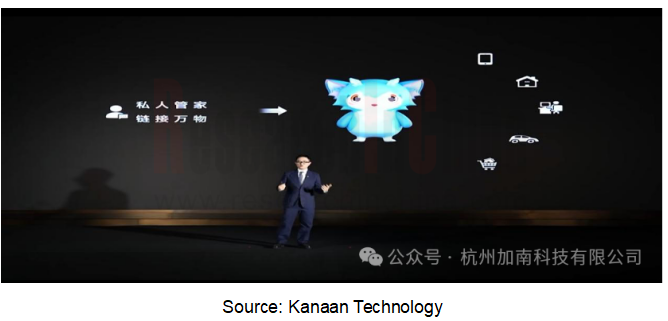
4. Application prospects of AI glasses in vehicles
DreamSmart's AR+AI smart glasses, powered by the Flyme AI OS and Flyme Link technology, enable seamless connectivity and smooth switching across multiple devices (including smartphones, IVI systems, and other terminals) in all scenarios, delivering a boundless intelligent experience.
AI glasses technology is accelerating its iteration, and the standardized system platforms and interconnection technologies built by major manufacturers are becoming more mature, which gives AI glasses a broad application prospect in automotive field.
As seen from the above functions, AI glasses and AR-HUD share some overlapping functionalities. However, AI glasses far surpass AR-HUD in terms of virtual display size, display richness, multimodal interaction capabilities, and upgradability.
Beyond enabling "display enhancement" in the cockpit, AI glasses can also provide "computing power enhancement." With the advancement of foundation models, smart cockpits are demanding increasingly higher computing power. Upgrading the built-in IVI system's computing capacity is often challenging, whereas some AI glasses come equipped with a computing power module that can enhance the cockpit's processing capabilities.
Global and China Intelligent Vehicle Standard System Construction and Certification Research Report, 2026
Intelligent Driving Standards and Certification: With the Maturing Standardization System, China Will Participate in Formulation of Global Standards
China's automotive industry is transforming from ...
Automotive Intelligent Diagnosis Industry Report, 2026
Automotive Intelligent Diagnosis Research: Powered by AI, Remote Diagnosis Is Being Upgraded towards Intelligence.
ResearchInChina released the Automotive Intelligent Diagnosis Industry Report, 2026....
Automotive Cloud Service Platform Research Report, 2026
Research on automotive cloud service platform: with architecture upgrade and computing power improvement, cloud services enter a new stage
In 2026, the Internet of Vehicles industry generates petaby...
Integrated Battery and Innovative Battery Technology Research Report, 2026
Power Battery Research: Sales of High-Capacity Vehicles Keep Rising, and Solid-State Batteries Begin to Be Installed in Vehicles
I. Sales of High-Capacity Vehicles Sustain Growth, and Those with A C...
Chinese Independent OEMs’ ADAS and Autonomous Driving Report, 2026
Research on OEMs' Intelligent Driving: Era of Physical AI, Standard Configuration of D2D, and Initial Exploration of L3 Commercial Pilot Projects
From 2023 to 2025, the intelligent driving installati...
Intelligent Vehicle New Technology Application Analysis Report, 2025-2026
New Technology Research: Innovative Products such as Bionic Cameras, Vision-LiDAR Fusion Sensors, Auditory Sensors Further Enhance Vehicle Perception Capabilities
ForewordResearchInChina released th...
Automotive Optical Fiber Communication (Optical Fiber Ethernet, PON) and Supply Chain Research Report, 2026
Research on Automotive Optical Fiber Communication: Introduction of Optical Fiber in Vehicles Accelerates, with Priority Deployment in High-Speed Communication Link (10+Gbps) Scenarios
Automotive opt...
Automotive Intelligent Cockpit SoC Research Report, 2026
Automotive Cockpit SoC Research: Passenger Cars in the Price Range of RMB100,000–200,000 Account for Nearly 50% of Total Sales, and New-Generation Cockpit SoC Products Largely Enter Mass Production
P...
LiDAR (Automotive, Pan-Robotics, etc.) Application Research Report, 2025-2026
LiDAR research: hardware competition shifts to combined sensing capabilities from "point cloud" to "images” and from automotive to robots The "LiDAR (Automotive, Pan-Robotics, ...
Global and China Passenger Car T-Box Market Report, 2026
Based on 2025 market data and the latest business layouts of OEMs and suppliers from 2025 to 2026, this report analyzes the development status quo and future trends of China’s passenger car T-Box mark...
Global and China Range Extended Electric Vehicle (REEV) and Plug-in Hybrid Electric Vehicle (PHEV) Research Report, 2026
Research on REEVs and PHEVs: Foreign OEMs are considering extended-range technology as an important strategic option and will launch a series of new vehicles
Global PHEVs & REEVs tend to be domin...
Automotive Voice Industry Report, 2026
Automotive Voice Research: Explosive Growth in Features Like "See and Speak", 35-Fold Increase in External Voice Interaction in Two Years
ResearchInChina has released the Automotive Voice Industry R...
China Passenger Car Digital Chassis Research Report, 2026
Research on Digital Chassis: Leading OEMs Have Completed Configuration of Version 2.0 1. Leading OEMs Have Completed Configuration of Digital Chassis 2.0
By the degree of wired control of each c...
Vehicle Functional Safety and Safety Of The Intended Functionality (SOTIF) Research Report, 2026
Multiple Mandatory Standards for Intelligent Vehicles in China Upgrade Functional Safety Requirements from Recommended to Mandatory Access Criteria In 2026, China has intensively issued and promo...
Automotive 12V/48V Low-Voltage Lithium-ion Battery/Sodium-ion Battery Industry Research Report, 2026
Research on 12V/48V automotive low-voltage lithium-ion (sodium-ion) batteries: promoted by regulations and standardization, it is imperative to "replace lithium-ion (sodium-ion) batteries with lead-ac...
Next-Generation Automotive Wireless Communication Technologies (6G/5G-A, NearLink, Satellite Communication, UWB, etc.) and Automotive Communication Module Industry Report, 2026
Research on Next-Generation Communication and Modules: Accelerated Deployment of 5G-A, Satellite Communication, NearLink, UWB and Other Technologies in Automobiles
Automotive wireless communication t...
Research on Zonal Architecture: Smart Actuators (Micro-motors) and Application Trends in Sub-scenarios, 2026
Smart Actuator and Micro-motor Research: Under Zonal Architecture, Actuators Are Developing towards Edge Computing, 48V, and Brushless Motors.
The core components of automotive zonal architecture mai...
China Passenger Car Navigate on Autopilot (NOA) Industry Report, 2025
In 2025, NOA standardization was popularized, refined and deepened in parallel. In 2026, core variables will be added to the competitive landscape.
The evolution of autonomous driving follows a clear...