Global automotive LiDAR sensor market was USD300 million in 2017, and is expected to reach USD1.4 billion in 2022 and soar to USD4.4 billion in 2027 in the wake of large-scale deployment of L4/5 private autonomous cars.
Being subject to autonomous driving technologies as well as laws and regulations, the autonomous driving companies has limited demand for LiDAR as yet. Mature LiDAR firms are mostly foreign ones, such as Valeo and Quanergy. Major companies that have placed LiDARs on prototype autonomous driving test cars are Velodyne, Ibeo, Luminar, Valeo and SICK. There are four firms that have already brought or plan to bring products to the market, specifically;
Continental SRL1: State-of-the-art LiDAR for Advanced Driver Assistance Systems, single-beam solid-state LiDAR, installed on Volvo XC60 and S60L;
Valeo SCALA Gen.1, mechanical 4-beam LiDAR, installed on Audi A8/A7/A6;
InnovizOne (MEMS solid-state LiDAR), will be installed on L3 autonomous car to be launched by BMW in 2021;
Quanergy S3 (OPA LiDAR), will be installed on new luxury electric model- Emotion built by Fisker.
Chinese LiDAR companies lag behind key foreign peers in terms of time of establishment and technology. LiDARs are primarily applied to autonomous logistic vehicles (JD and Cainiao) and self-driving test cars (driverless vehicles of Beijing Union University and Moovita). Baidu launched Pandora (co-developed with Hesai Technologies), the sensor integrating LiDAR and camera, in its Apollo 2.5 hardware solution.
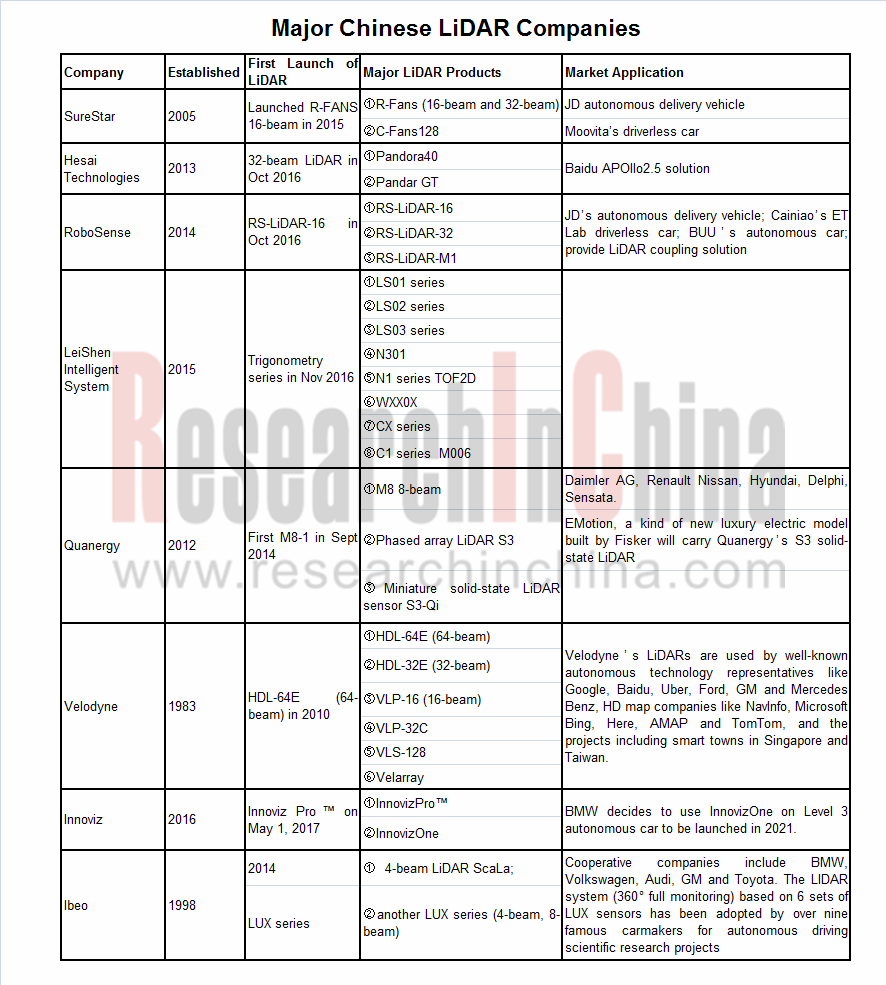
LiDAR will become smaller, solid-state and more cost-effective in the future. Solid-state LiDAR needs no rotating parts and hence is smaller and easily integrated in car body. Moreover, the reliability is improved and the costs can be reduced in great measure. So, the solid state of LiDAR will be an inevitable trend.
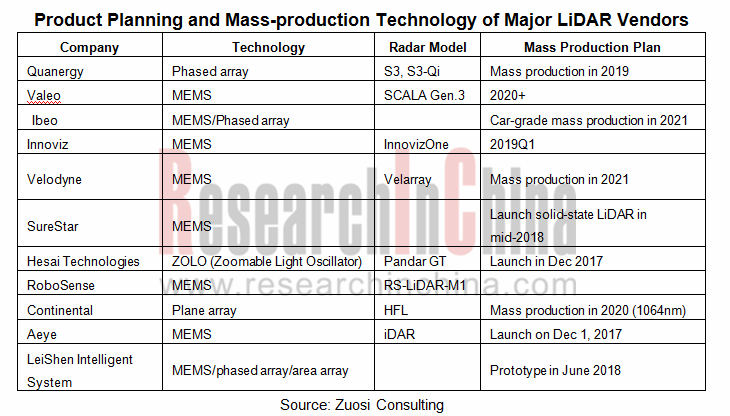
Most mainstream LiDAR vendors plan to launch solid-state radar around 2020, following technological routes of MEMS, OPA and Flash.
According to ADAS and autonomous driving plans of major OEMs, most of them will roll out SAE L3 models around 2020. Overseas OEMs: PAS SAE L3 (2020), Honda SAE L3 (2020), GM SAE L4 (2021+), Mercedes Benz SAE L3 (Mercedes Benz new-generation S in 2021), BMW SAE L3 (2021). Domestic OEMs: SAIC SAE L3 (2018-2020), FAW SAE L3 (2020), Changan SAE L3 (2020), Great Wall SAE L3 (2020), Geely SAE L3 (2020), and GAC SAE L3 (2020). The L3-and-above models with LiDAR are expected to share 10% of ADAS models in China in 2022. The figure will hit 50% in 2030.
Global and China In-vehicle LiDAR Industry Report, 2017-2022 focuses on the followings:
 In-vehicle LiDAR market (status quo of application, market size forecast);
Leading in-vehicle LiDAR companies at home and abroad (development course, profile, financing, LiDAR products, product planning & technical direction, partners, etc.);
Trends of LiDAR Technologies and Costs.
Vehicle-Road-Cloud Integration and C-V2X Industry Report, 2026
Vehicle-Road-Cloud and C-V2X Research: with the three-tier promotion system of "top-level planning + mandatory pilot + evaluation binding", the industry turning point is approachingThis report focuses...
China OEM Data Capability Analysis Report, 2026
OEM Data Capability Research: 24 OEMs × 9 Capability Domains, Who Takes the Lead?
An L4 autonomous driving R&D and test vehicle can generate approximately 10TB of raw data per single day — data v...
Autonomous Driving Domain Controller and Central Computing Unit (CCU) Industry Report, 2026
Autonomous Driving Domain Controller (ADCU) Research: One-Chip CCU solutions are quickly available in vehicles
In China's passenger car market, autonomous driving systems involved in mass production ...
Automotive EMS and ECU Industry Research Report, 2026
Automotive EMS Research: The boundaries between EMS providers and Tier1 suppliers are becoming blurred, and the supply chain model is evolving from a linear chain to a networked structure
Mainstream ...
Automotive Microcontroller Unit (MCU) and Application Scenario Research Report, 2026
Automotive MCU Research: Increased demand for redundant security drives ASIL D-compliant MCU shipments to exceed 100 million units
In a vehicle EEA, MCUs are widely distributed in various functional ...
China Intelligent Cockpit Patent Analysis Report, 2026
Intelligent Cockpit Patent Research: Cockpit AI, In?vehicle Health, and Infotainment Are Upgrade to Scenario?based and Proactive Functions
From a patent perspective, this report explores the cutting?...
Research Report on Application of VLA Large Model in Automobiles and Robots, 2026
Research on Automotive and Robot VLA: Hybrid Architectures Become Mainstream, VLA Integrates with General World Models, and Reinforcement Learning Serves as Core Engine
Vision?Language?Action (VLA) m...
China Charging Infrastructure (Supercharging, Battery Swapping, V2G, etc.) and High-Performance Supercharging Battery Research Report, 2026
Charging and battery swapping research: as 5C+ supercharging vehicle models go into mass production, the pace of OEMs self-building supercharging networks quickens
800-1000V high-voltage platforms ar...
China Passenger Car Electronic Controlled Suspension Industry Report, 2026
Electronic Controlled Suspension Industry Research: As the First Year of Full Active Suspension Unfolds, Three Technical Routes Race Forward
1. Penetration Rate Surges Three Times, and Electronic Con...
Intelligent Driving SoC Research Report, 2026
Research on Intelligent Driving SoCs: Competition Focus Shifts to L3/L4 Embedded Hardware, and Computing Power of Flagship Vehicle Models Exceeds 1,000 TOPS
In terms of intelligent driving system in...
Automotive AI Large Model Technology Research Report, 2026
Automotive AI Large Model Research: Competition Shifts from "Who Has the Stronger Model" to "Who Boasts Higher Link Efficiency"
ResearchInChina released the Automotive AI Large Model Technology Resea...
Intelligent Vehicle Cockpit Domain Controller Research Report, 2026
Cockpit domain controller research: L3 AIDV intelligent cockpit domain controllers are entering a boom period
Driven by multiple factors such as the continuous evolution of the automotive central int...
Automotive Acoustic System (Audio, Multi-Channel) Industry Report, 2026
Automotive Acoustics Research: Multiple Channels, AI Tuning, and Self-Developed Algorithms Drive the Transformation of High-End Cockpit Sound Fields
I. Automotive Audio Hardware Solutions with 6–9 S...
Autonomous Driving Sensor Chip Research Report, 2026
Research on Autonomous Driving Sensor Chips: Deeply Perceiving the Physical World, Sensor Chips Are Playing A “Leading Role” in Intelligence
In 2026, the autonomous driving sensor chip industr...
Passenger Car Corner Module and Wheel‑Side Control System Research Report, 2026
Wheel-side control research: the “last mile” chassis innovation
Wheel-side control dismantles the traditional drive, braking, steering, and suspension control of the chassis from a "centralized" styl...
Embodied Artificial Intelligence (& Humanoid Robot) MCU Research Report, 2026
Research on Humanoid Robot MCUs: Evolution from General-Purpose Control to High-Value Dedicated Chip Solutions Integrated with Edge AI Functions
MCU (Microcontroller Unit) refers to a compact integra...
Intelligent Vehicle Zone Control Unit (ZCU) Research Report, 2026
ZCU Research: Cross-domain integrated ZCUs are becoming the edge computing nodes of the next-generation zonal architecture
Currently, the mainstream zonal architecture is mainly the quasi-central + z...
Automotive Cybersecurity and Data Security Research Report, 2026
Cybersecurity & Data Security Research: Intelligent Connected Vehicles Enter the Era of “Systematic Offense-Defense and AI-Defined Security”.
Centering on the panorama of intelligent connect...