Report on Emerging Automakers in China in 2018 (Corporate Reach & Connectivity Functions)
There have emerged more than a hundred new automakers in the wake of the rapidly expanding electric vehicle market in China over the past few years, among which fifty ones or so have gained popularity. Amid the depressed economy and the waning vehicle sales, the majority of these players will suffer a setback in attempts to expand, and capital and industrial resources will thus flow to a few big ones.
19 emerging automakers are analytically selected in the report focusing on their layout in production, research and development, manufacturing, marketing and mobility, as well as configurations of their typical connected vehicle models, technology roadmaps and development strategies.
Emerging automakers did not yet slow their pace of raising funds in the past two years. Bellwethers’ financing scale jumped from more than hundreds of millions of yuan to billions of yuan before hitting tens of billions of yuan in the near future.
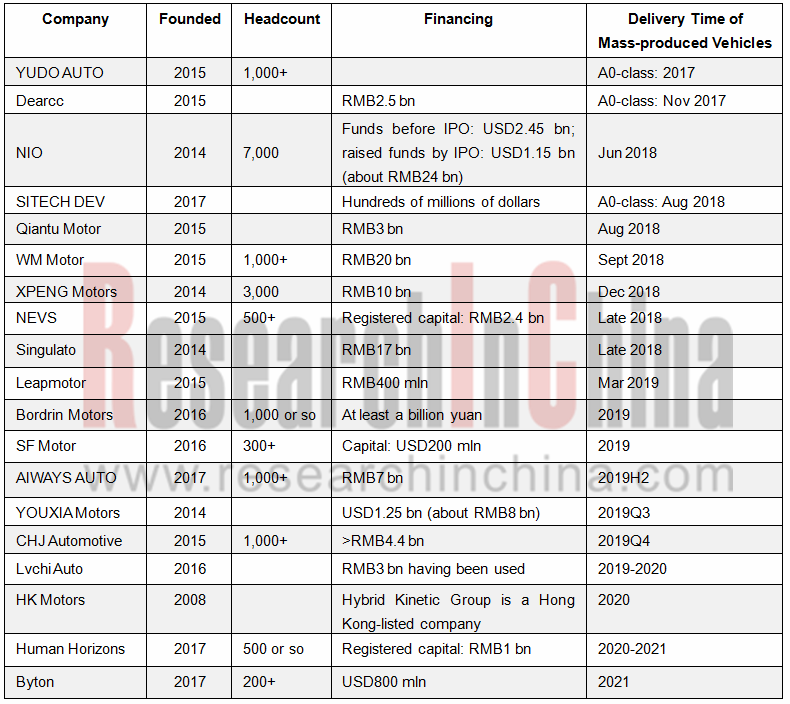
Most of the 19 firms have launched cars on the market since 2018. The vehicles released by YUDO Auto and Dearcc in 2017 are A0-class models. In 2018 another 7 automakers have cars delivered or to be delivered; in 2019, 6 carmakers will have launches; between 2020 and 2021, four carmakers will do so.
Emerging automakers strive for a place in the huge Chinese automobile market where they compete in a differentiated way with the help of Tier1 suppliers. Thanks to more capital inflows, they can exert themselves to innovations in local Chinese market as automobile is going smart, connected, electrified and shared.
Most players use the cutting-edge automotive electrical/electronic architecture, coupling local featured services (e.g., allowing couriers to put a package directly into the receiver’s car trunk), to build intelligent connected cars. The report introduces 110 intelligent and connectivity capabilities as a points-based criterion system to evaluate how typical car models of the 19 firms are intelligent and connected.
Here is a briefing of connected car strategies and development directions of emerging automakers:
1. These firms prefer 4-to-6-inch LCD screens. Multi-screen is a highlight but also a challenge, because display and interaction of multiple screens cost a lot of computing resources, which undoubtedly leads to the rising costs of chip and software development.
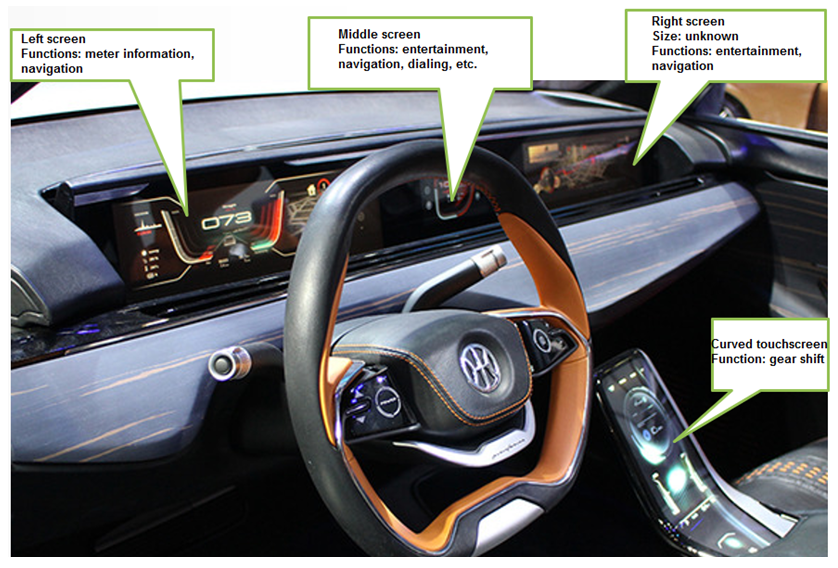
2. More use of HUD, multiple interactive systems and biometric system provides front and rear seat occupants with independent space of entertainment and interaction.
3. More than 20 sensors are preset as hardware for upgrading ADAS and automated driving functions. Examples include NIO ES8 equipped with 21 sensors, Xpeng G3 with 25 and Singulato iS6 with 25. Some manufacturers even express that users can get an upgrade of hardware like sensors. OTA has been a standard configuration for software update.
4. For Chinese suppliers have no mature applicable automated driving solutions, the emerging automakers choose either Mobileye’s solutions or independent development and iterations, of which NIO, WM Motor and YOUXIA Motors partner with Mobileye. Those without cooperating with major suppliers are running out of time to develop telematics and automated driving systems by themselves (or teaming up with their partners), because their foreign counterparts like WAYMO and Tesla have left them far behind. Mobileye’s solutions, Banma Zhixing system and Baidu Apollo system are being utilized by more and more automakers.
5. These players set up special funds to back their own supply chain system. For example, NIO Capital, NIO’s fund management agency with fundraising target of RMB10 billion, has invested 15 companies in the areas of car sharing, autonomous driving and automotive new materials through its RMB funds; Dearcc’s automotive industry development funds managing more than RMB2.5 billion, will concentrate on investment in the industry chain of intelligent electric vehicle and integration of resources in new energy power technology, intelligent driving and shared services; Singulato and Suzhou Municipal Government have built a RMB10 billion joint investment fund for intelligent electric vehicle industry.
As a whole, the boom of emerging automakers lends vigor to innovation and transformation in China’s automobile industry. A great number of Chinese automakers offer opportunities for suppliers in the intelligent connected vehicle (ICV) industry chain covering sensors, software and algorithms, communication systems, controllers, chips, connectivity systems and system integration, mobility services, entertainment services, parking services and charging systems, making China the one boasting the most number of start-ups in the ICV field and innovating at the fastest speed.
Tesla achieved great success in the third quarter of 2018. It is believed that several out of dozens of Chinese emerging automakers will come to the fore.
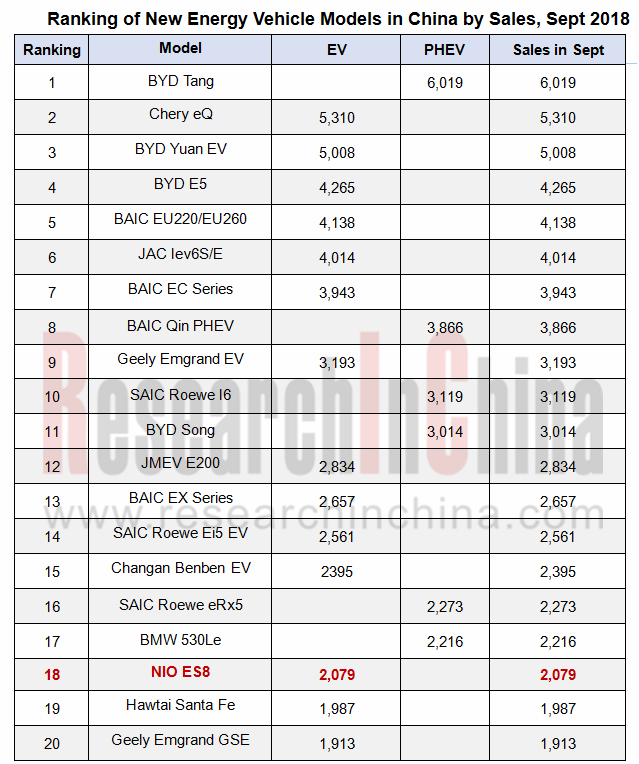
NIO ES8 has edged into the top20, according to the ranking list of new energy vehicle models in China by sales in September 2018. The emerging automakers will have more models on the list in the second half of 2019.
Automotive Microcontroller Unit (MCU) and Application Scenario Research Report, 2026
Automotive MCU Research: Increased demand for redundant security drives ASIL D-compliant MCU shipments to exceed 100 million units
In a vehicle EEA, MCUs are widely distributed in various functional ...
China Intelligent Cockpit Patent Analysis Report, 2026
Intelligent Cockpit Patent Research: Cockpit AI, In?vehicle Health, and Infotainment Are Upgrade to Scenario?based and Proactive Functions
From a patent perspective, this report explores the cutting?...
Research Report on Application of VLA Large Model in Automobiles and Robots, 2026
Research on Automotive and Robot VLA: Hybrid Architectures Become Mainstream, VLA Integrates with General World Models, and Reinforcement Learning Serves as Core Engine
Vision?Language?Action (VLA) m...
China Charging Infrastructure (Supercharging, Battery Swapping, V2G, etc.) and High-Performance Supercharging Battery Research Report, 2026
Charging and battery swapping research: as 5C+ supercharging vehicle models go into mass production, the pace of OEMs self-building supercharging networks quickens
800-1000V high-voltage platforms ar...
China Passenger Car Electronic Controlled Suspension Industry Report, 2026
Electronic Controlled Suspension Industry Research: As the First Year of Full Active Suspension Unfolds, Three Technical Routes Race Forward
1. Penetration Rate Surges Three Times, and Electronic Con...
Intelligent Driving SoC Research Report, 2026
Research on Intelligent Driving SoCs: Competition Focus Shifts to L3/L4 Embedded Hardware, and Computing Power of Flagship Vehicle Models Exceeds 1,000 TOPS
In terms of intelligent driving system in...
Automotive AI Large Model Technology Research Report, 2026
Automotive AI Large Model Research: Competition Shifts from "Who Has the Stronger Model" to "Who Boasts Higher Link Efficiency"
ResearchInChina released the Automotive AI Large Model Technology Resea...
Intelligent Vehicle Cockpit Domain Controller Research Report, 2026
Cockpit domain controller research: L3 AIDV intelligent cockpit domain controllers are entering a boom period
Driven by multiple factors such as the continuous evolution of the automotive central int...
Automotive Acoustic System (Audio, Multi-Channel) Industry Report, 2026
Automotive Acoustics Research: Multiple Channels, AI Tuning, and Self-Developed Algorithms Drive the Transformation of High-End Cockpit Sound Fields
I. Automotive Audio Hardware Solutions with 6–9 S...
Autonomous Driving Sensor Chip Research Report, 2026
Research on Autonomous Driving Sensor Chips: Deeply Perceiving the Physical World, Sensor Chips Are Playing A “Leading Role” in Intelligence
In 2026, the autonomous driving sensor chip industr...
Passenger Car Corner Module and Wheel‑Side Control System Research Report, 2026
Wheel-side control research: the “last mile” chassis innovation
Wheel-side control dismantles the traditional drive, braking, steering, and suspension control of the chassis from a "centralized" styl...
Embodied Artificial Intelligence (& Humanoid Robot) MCU Research Report, 2026
Research on Humanoid Robot MCUs: Evolution from General-Purpose Control to High-Value Dedicated Chip Solutions Integrated with Edge AI Functions
MCU (Microcontroller Unit) refers to a compact integra...
Intelligent Vehicle Zone Control Unit (ZCU) Research Report, 2026
ZCU Research: Cross-domain integrated ZCUs are becoming the edge computing nodes of the next-generation zonal architecture
Currently, the mainstream zonal architecture is mainly the quasi-central + z...
Automotive Cybersecurity and Data Security Research Report, 2026
Cybersecurity & Data Security Research: Intelligent Connected Vehicles Enter the Era of “Systematic Offense-Defense and AI-Defined Security”.
Centering on the panorama of intelligent connect...
Report on Breakthrough Strategies of OEMs and ADAS Tier 1 Suppliers for Overseas Layout of Intelligent Driving, 2026
Regulatory Breakthrough, Local System Establishment, OEMs Competing for NOA Layout: Overall Trends of China’s Intelligent Driving Overseas Layout in 2026
Research on overseas intelligent driving layo...
OEMs and Tier1s’ Intelligent Cockpit Platform (Hardware and Software) Innovation Strategy Research Report, 2026
Intelligent Cockpit Platform Research: multi-dimensional cockpit system architecture reconstruction for multi-agent collaboration and proactive intelligent services
The intelligent cockpit software s...
Automotive AIOS Research Report, 2026
Automotive AIOS Research: Mass Production Solutions Are Implemented
Mass Production Solutions Are Implemented on A Small Scale.
In 2026, AIOS starts small-scale implementation, helping to improve v...
Automotive Telematics Service Provider (TSP) Research Report, 2026
TSP Research: Leading providers collectively turn to AI agents to provide all-scenario active services
Telematics Service Providers (TSPs) are the core hub of the telematics industry chain, connectin...