Global Autonomous Driving Simulation and Virtual Test Industry Chain Report, 2018-2019
It is in this report that the autonomous driving simulation industry is analytically expounded, ranging from simulation platform, vehicle dynamics simulation, sensor simulation, scenario simulation to scenario library.
Simulation technologies seem afar to people’s lives and are hard to understand for them, but it is a key domain in which breakthroughs are to be made for automotive sector, even intelligent manufacturing in China and it deserves heavy investments.
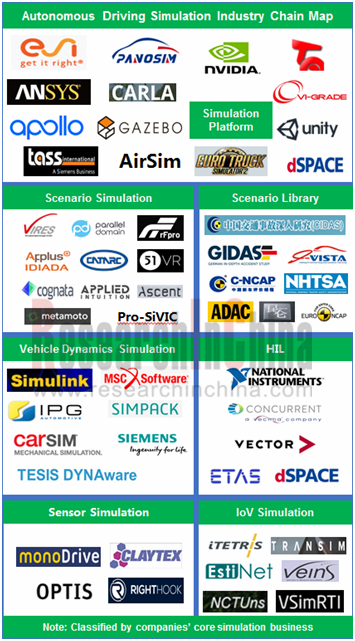
Simulation technology is the simulation model technology that reveals the system behaviors and process by way of simulation experiments and numerical computing with simulation hardware and software. Simulation technology found initial application in the early 20th century, taking example for the building of water conservancy model in laboratories for research of hydraulics. In 1940s-1950s, the burgeoning aviation & aerospace and atomic energy technologies conduced to advances in simulation technology. In 1960s, the computer technology flourished and the advanced simulation tools became available, which expedited evolution of simulation technology.
From 1990s on, simulation and digital virtualization technologies has been an integral crucial to the R&D of automobiles. The advanced idea to develop cars based on mathematical model and digital simulation has prevailed among the automakers worldwide.
The vehicle R&D becomes ever sophisticated as cars are going smarter and smarter, causing higher costs of vehicle development and a prolonged development cycle. Lots of new technologies about vehicle security are subject to external environment and test security restraints and are hard to be carried out effectively. Yet, the traditional means for R&D, tests and validation are out of date.
For adequate security validation, autonomous driving requires a great deal of scalable simulation testing service (billions of km and even to tens of billions of km). Actually, the real road test is featured with low efficiency, and many automakers favor selecting autonomous driving simulation tests.
It is pointed out by a guest speaker on an automobile forum that, 90 percent of autonomous driving tests will be done by simulation, 9 percent done in test fields, and 1 percent on real roads.
The so-called autonomous driving simulation tests are to test autonomous cars with technologies such as sensor simulation, vehicle dynamics simulation, advanced graphics processing, traffic flow simulation, numerical simulation and road modeling, and with algorithms to build the comparatively real driving scenarios.
Such processes must be undergone to develop an autonomous driving system, as software simulation, hardware in the loop (HiL), vehicle in the loop (VIL), indoors lab tests, outdoor test field, and to ultimately the massive tests on public roads.
The Vehicle Simulation Industry Dominated by German and American Companies
There are dozens of simulation test companies around the globe, among which America ranks first by the number of companies but Germany boast most simulation firms in the automotive sector.
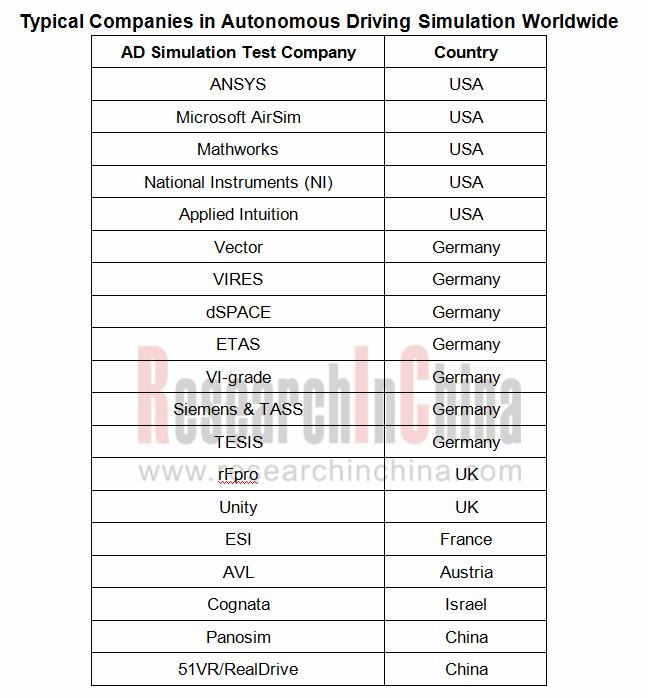
It can be seen from the development course of simulation industry that new opportunities emerge all the time and the emerging companies have sprung up incessantly. Simulation tycoons have grown ever competitive through mergers and acquisitions and have developed dozens of and even hundreds of product categories which are applied in tens of industries.
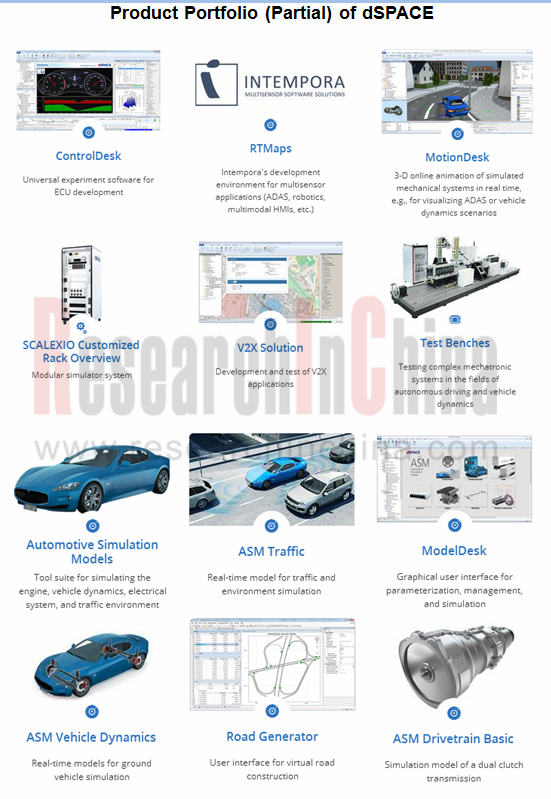

Through over ten acquisitions on companies inside and outside the industry, ANSYS dominates the CFD market, develops the embedded codes, beefs up chip encapsulation design, and enriches internal combustion engine simulation products. ANSYS purchased OPTIS in 2018 and improved the simulation technologies about sensors like LiDAR, camera and radar.
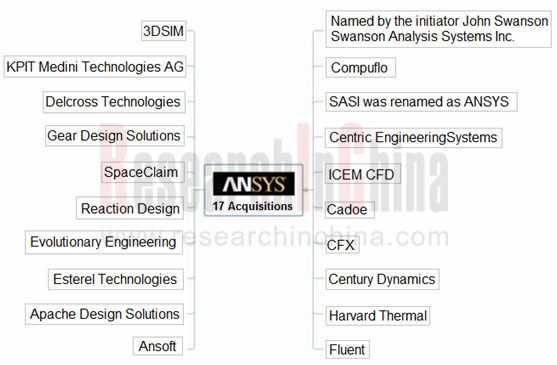
The potentiality of the autonomous driving simulation market has allured the inrush of many enterprises outside the automotive sector.
Autonomous driving tests call for various traffic scenarios simulation tool and massive scenario library. This is a totally new market, bringing traditional simulation companies, startups and new entrants on a par, and attracting the inroads of game firms, VR/AR firms and internet firms.
In October 2018, Cognata -- the Israel-based autonomous driving simulation startup -- completed the B-round funding of $18.5 million. Cognata reproduces the cities on its 3D simulation platform by fusing artificial intelligence, deep learning and computer vision, and provides the customers with a variety of the driving test scenarios simulating the real world. AID (Autonomous Intelligent Driving GmbH) under Audi reached cooperation with Cognata.
Founded in 2015, 51VR was grown from real property market and then made its foray in automobile, education, games and other fields, and is now primarily focused on 3D simulation reconstruction. In December 2017, 51VR conducted its B-round funding of RMB210 million. For now, 51VR boasts nearly 100 talents in the automotive business covering three modules, i.e., simulated driving experience (VR car), vehicle visualization, and autonomous driving simulation platform, of which simulation platform team accounts for more than a half of its workforce.
Baidu Apollo simulation platform is in-built with simulation scenarios with HD maps in favor of multi-algorithm (sensing, planning and control) module verification, making the autonomous driving algorithm verification more rigorous. Apollo 1.5 version began to open its simulation platform, empowering autonomous driving companies like Idriverplus to significantly improve their efficiency in R&D via Apollo cloud simulation capabilities. Baidu Apollo could sell HD map, simulation platform, computing hardware ACU in future, said by Li Yanhong, the chairman of Baidu. So, simulation platform will be one of the profit points of Baidu self-driving platform.
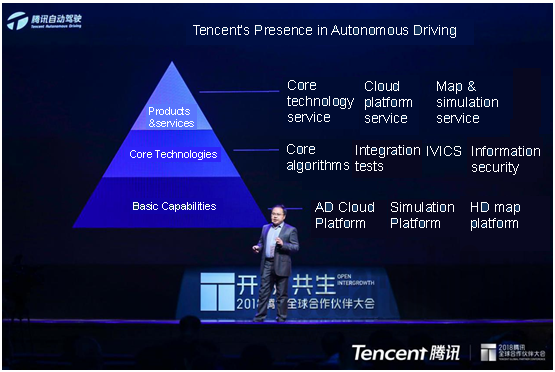
In line with Tencent’s layout in autonomous driving, simulation platform is one of the three basic competencies; maps and simulation services will be one of three profit engines of Tencent in future. Thanks to its superiorities in game engine, virtual reality, cloud games technologies, etc., Tencent has successfully built the simulation system TAD Sim (virtual + real combination) that is capable of verifying the closed-loop simulation of all modules (like sensing, decision, control algorithm) of a real car. Tencent wishes its simulation platform can help the automakers shorten development cycle, improve development efficiency, and reduce the costs of tests.
Since simulation software involves with hundreds of product categories, into which there are many ways to go. In comparison with difficulties in chassis and vehicle chip, the (automotive) industrial software represented by autonomous driving simulation is possibly the best field where IT/AI/VR firms can make investments.
Automotive Microcontroller Unit (MCU) and Application Scenario Research Report, 2026
Automotive MCU Research: Increased demand for redundant security drives ASIL D-compliant MCU shipments to exceed 100 million units
In a vehicle EEA, MCUs are widely distributed in various functional ...
China Intelligent Cockpit Patent Analysis Report, 2026
Intelligent Cockpit Patent Research: Cockpit AI, In?vehicle Health, and Infotainment Are Upgrade to Scenario?based and Proactive Functions
From a patent perspective, this report explores the cutting?...
Research Report on Application of VLA Large Model in Automobiles and Robots, 2026
Research on Automotive and Robot VLA: Hybrid Architectures Become Mainstream, VLA Integrates with General World Models, and Reinforcement Learning Serves as Core Engine
Vision?Language?Action (VLA) m...
China Charging Infrastructure (Supercharging, Battery Swapping, V2G, etc.) and High-Performance Supercharging Battery Research Report, 2026
Charging and battery swapping research: as 5C+ supercharging vehicle models go into mass production, the pace of OEMs self-building supercharging networks quickens
800-1000V high-voltage platforms ar...
China Passenger Car Electronic Controlled Suspension Industry Report, 2026
Electronic Controlled Suspension Industry Research: As the First Year of Full Active Suspension Unfolds, Three Technical Routes Race Forward
1. Penetration Rate Surges Three Times, and Electronic Con...
Intelligent Driving SoC Research Report, 2026
Research on Intelligent Driving SoCs: Competition Focus Shifts to L3/L4 Embedded Hardware, and Computing Power of Flagship Vehicle Models Exceeds 1,000 TOPS
In terms of intelligent driving system in...
Automotive AI Large Model Technology Research Report, 2026
Automotive AI Large Model Research: Competition Shifts from "Who Has the Stronger Model" to "Who Boasts Higher Link Efficiency"
ResearchInChina released the Automotive AI Large Model Technology Resea...
Intelligent Vehicle Cockpit Domain Controller Research Report, 2026
Cockpit domain controller research: L3 AIDV intelligent cockpit domain controllers are entering a boom period
Driven by multiple factors such as the continuous evolution of the automotive central int...
Automotive Acoustic System (Audio, Multi-Channel) Industry Report, 2026
Automotive Acoustics Research: Multiple Channels, AI Tuning, and Self-Developed Algorithms Drive the Transformation of High-End Cockpit Sound Fields
I. Automotive Audio Hardware Solutions with 6–9 S...
Autonomous Driving Sensor Chip Research Report, 2026
Research on Autonomous Driving Sensor Chips: Deeply Perceiving the Physical World, Sensor Chips Are Playing A “Leading Role” in Intelligence
In 2026, the autonomous driving sensor chip industr...
Passenger Car Corner Module and Wheel‑Side Control System Research Report, 2026
Wheel-side control research: the “last mile” chassis innovation
Wheel-side control dismantles the traditional drive, braking, steering, and suspension control of the chassis from a "centralized" styl...
Embodied Artificial Intelligence (& Humanoid Robot) MCU Research Report, 2026
Research on Humanoid Robot MCUs: Evolution from General-Purpose Control to High-Value Dedicated Chip Solutions Integrated with Edge AI Functions
MCU (Microcontroller Unit) refers to a compact integra...
Intelligent Vehicle Zone Control Unit (ZCU) Research Report, 2026
ZCU Research: Cross-domain integrated ZCUs are becoming the edge computing nodes of the next-generation zonal architecture
Currently, the mainstream zonal architecture is mainly the quasi-central + z...
Automotive Cybersecurity and Data Security Research Report, 2026
Cybersecurity & Data Security Research: Intelligent Connected Vehicles Enter the Era of “Systematic Offense-Defense and AI-Defined Security”.
Centering on the panorama of intelligent connect...
Report on Breakthrough Strategies of OEMs and ADAS Tier 1 Suppliers for Overseas Layout of Intelligent Driving, 2026
Regulatory Breakthrough, Local System Establishment, OEMs Competing for NOA Layout: Overall Trends of China’s Intelligent Driving Overseas Layout in 2026
Research on overseas intelligent driving layo...
OEMs and Tier1s’ Intelligent Cockpit Platform (Hardware and Software) Innovation Strategy Research Report, 2026
Intelligent Cockpit Platform Research: multi-dimensional cockpit system architecture reconstruction for multi-agent collaboration and proactive intelligent services
The intelligent cockpit software s...
Automotive AIOS Research Report, 2026
Automotive AIOS Research: Mass Production Solutions Are Implemented
Mass Production Solutions Are Implemented on A Small Scale.
In 2026, AIOS starts small-scale implementation, helping to improve v...
Automotive Telematics Service Provider (TSP) Research Report, 2026
TSP Research: Leading providers collectively turn to AI agents to provide all-scenario active services
Telematics Service Providers (TSPs) are the core hub of the telematics industry chain, connectin...