ADAS and Autonomous Driving Industry Chain Report, 2018-2019– Automotive Radar
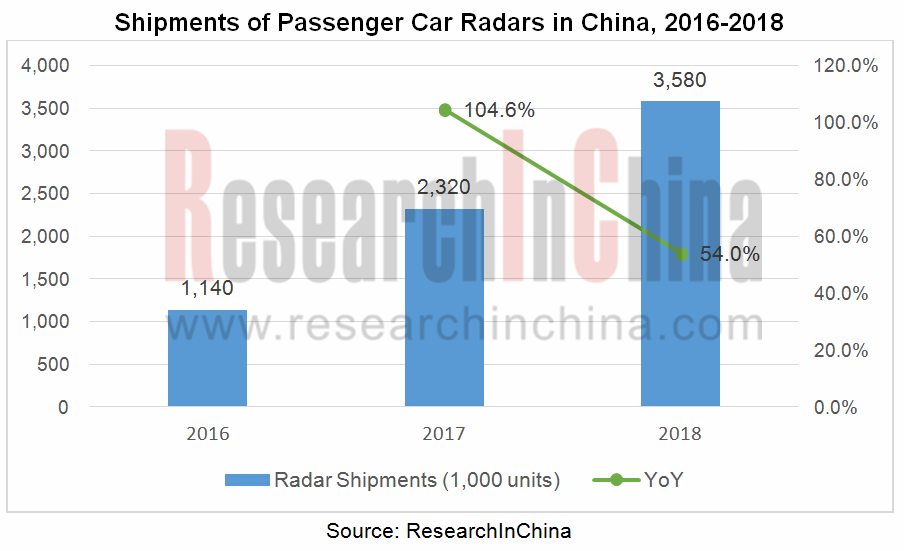
China’s passenger car radar market gathered pace from 2017, with shipments approaching 2.32 million units in the year, an annualized spurt of 104.6%. The growth trend continued in the first half of 2018 but slowed markedly in the second half due to a decline in automobile sales, leading to a much lower full-year growth in shipments. In 2018, the shipments of passenger car radars reached 3.58 million units in China, up by 54% versus 2017.
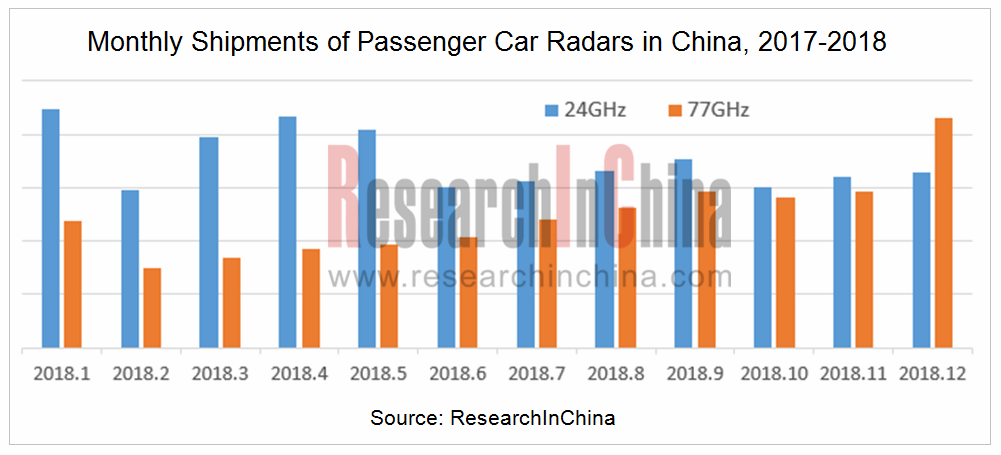
According to our monthly study of radar, 77GHz radar was narrowing its shipment gap with 24GHz radar in recent years, and came from behind at last in December 2018, two years earlier than we expected.
It also comes as a surprise that Chinese radar chip vendors have sprung up. Main players include Xiamen IMSEMI Technology Co., Ltd., Radaric (Beijing) Technology Co., Ltd., SGR Semiconductors Inc., Calterah Semiconductor Technology (Shanghai) Co., Ltd., Nanjing Citta Microelectronics Co., Ltd. and Hangzhou Andar Technology Co., Ltd.
In 2017, Calterah Semiconductor Technology (Shanghai) Co., Ltd. released Yosemite (2T4R/4T8R), a 77GHz transceiver chip series for CMOS-based automotive radars; in 2018 Xiamen IMSEMI Technology Co., Ltd. rolled out SG24TR12, a 24GHz 1T2R chip and SG24TR14, a 24GHz 1T4R chip.
Radaric (Beijing) Technology Co., Ltd. founded in 2010 with the background of Tsinghua University, designed a CMOS-based 77GHz multi-channel monolithic integrated radar chip. SGR Semiconductors Inc., the successor of RFIC Division under Shanghai Industrial μTechnology Research Institute (SITRI), closed series A funding of RMB80 million in 2017 and finished capital increase in the A-round in 2018.
In February 2019 Hangzhou Andar Technology Co., Ltd. unveiled ADT2001, a phased array architecture-based 16T16R 77GHz radar chip with CMOS process and ADT1002, a 2T2R radar chip.
Though there are radar chip start-ups in China, they commit themselves to the development of RF transceiver modules. Their transceiver units play a small role in the whole radar system and cost not much. China-made radar chips are still not provided with the core function of algorithms about processing radar signals.
Foreign chip leaders are heading towards integration and high precision. In June 2018, Texas Instruments (TI) announced mass production of AWR1642, a highly integrated ultra-wideband radar sensor boasting remarkable technical superiorities as it integrates microcontroller (MCU) and digital signal processor (DSP). Many a start-up uses AWR1642 to develop “4D radar” (4D=3D position + 1D speed).
High resolution imaging, 79Ghz and CMOS hold the new trends for radars.
CMOS-based chip ecosystem has yet to be built even if a radar with CMOS process will be a typical one in the future. Chinese radar start-ups face challenges of immature technology and unverified products in spite of a large number. For automotive industry with a high demanding on mature and reliable technologies, the long-used silicon germanium process still prevails, so the giants like Bosch, Continental, Aptiv, Denso and Veoneer still rule the roost. In 2018, the top three players in China’s passenger car 77G long-range radar (LRR) OEM market seized a combined 80% share.
In 2018, new radar entrants in China grew up fleetly by resorting to the strategy of “encircling the cities from the rural areas”.
Wuhu Sensortech Intelligent Technology Co., Ltd. was invested by security giant Hikvision and affiliates of BAIC and GAC, with team members growing to over 300 persons. In 2018, Sensortech shipped more than 100,000 radars, generating the revenue of nearly RMB100 million. Security and transportation were main markets using around 70% of Sensortech’s radars.
Quite a few start-ups in China apply the business model: polishing products in other markets whilst forging ahead in automotive market. Sensortech’s radars will be available to 10 models in 2019 after being used in two mass-produced passenger car models in 2018. Sensortech targets to earn RMB200 million in 2019, including 40% from automotive business.
Sensortech also plans to expand its team members to 1,000 in the next two years from the current 300 with the help of Hikvision.
Suzhou Millimeter-wave Technology Co., Ltd. saw shipments of 2,000 sets of 24Ghz automotive radars in OEM market in 2018 before expectedly shipping 50,000 sets for passenger cars in 2019 as it becomes a designated supplier of two automakers for five of their models.
In August 2018, Shenzhen Anngic Technology Co., Ltd. announced the closing of RMB50 million series A rounds. Its products get utilized in automobiles, drones, security, transportation, etc..
The trend for high precision forces not only Chinese radar start-ups but time-honored brands to have stronger competence in radar signal processing algorithms. For instance, Analog Devices, Inc. (ADI), a 15-year-old company managed in March 2018 to acquire Germany-based Symeo whose RF and sensor technologies enable real-time position detection and distance measurement. ADI will leverage Symeo’s signal processing algorithms to offer customers a radar platform with significant improvements in angular accuracy and resolution.
Vision-radar Fusion Solutions
It grows a trend that vision and radar get fused safer and more reliable ADAS capabilities. Take Volvo S90 city safety system as an example. The Aptiv RACam system for it combines a 77GHz radar and a monocular camera mounted at the top of the windshield to deliver such functions as FCW, AEB and ACC.
Suzhou Millimeter-wave Technology Co., Ltd. is creating a radar and camera all-in-one. With pre-fusion technology for pixel-level fusion of two sensors, the device becomes much more aware of surroundings and robust in object recognition.
Sensortech and Hikvision team up to develop pixel-level radar and vision fusion technologies.
ADAS and Autonomous Driving Industry Chain Report, 2018-2019 of ResearchInChina covers following 17 reports:
1)Global Autonomous Driving Simulation and Virtual Test Industry Chain Report, 2018-2019
2)China Car Timeshare Rental and Autonomous Driving Report, 2018-2019
3)Report on Emerging Automakers in China, 2018-2019
4)Global and China HD Map Industry Report, 2018-2019
5)Global and China Automotive Domain Control Unit (DCU) Industry Report, 2018-2019
6)Global and China Automated Parking and Autonomous Parking Industry Report, 2018-2019
7)Cooperative Vehicle Infrastructure System (CVIS) and Vehicle to Everything (V2X) Industry Report, 2018-2019
8)Autonomous Driving High-precision Positioning Industry Report, 2018-2019
9)ADAS and Autonomous Driving Industry Chain Report, 2018-2019– Processor
10)ADAS and Autonomous Driving Industry Chain Report, 2018-2019– Automotive Lidar
11)ADAS and Autonomous Driving Industry Chain Report, 2018-2019– Automotive Radar
12)ADAS and Autonomous Driving Industry Chain Report, 2018-2019– Automotive Vision
13)ADAS and Autonomous Driving Industry Chain Report, 2018-2019– Passenger Car Makers
14)ADAS and Autonomous Driving Industry Chain Report, 2018-2019– System Integrators
15)ADAS and Autonomous Driving Industry Chain Report, 2018-2019– Commercial Vehicle Automated Driving
16)ADAS and Autonomous Driving Industry Chain Report, 2018-2019– Low-speed Autonomous Vehicle
17)ADAS and Autonomous Driving Industry Chain Report, 2018-2019– L4 Autonomous Driving
Automotive Microcontroller Unit (MCU) and Application Scenario Research Report, 2026
Automotive MCU Research: Increased demand for redundant security drives ASIL D-compliant MCU shipments to exceed 100 million units
In a vehicle EEA, MCUs are widely distributed in various functional ...
China Intelligent Cockpit Patent Analysis Report, 2026
Intelligent Cockpit Patent Research: Cockpit AI, In?vehicle Health, and Infotainment Are Upgrade to Scenario?based and Proactive Functions
From a patent perspective, this report explores the cutting?...
Research Report on Application of VLA Large Model in Automobiles and Robots, 2026
Research on Automotive and Robot VLA: Hybrid Architectures Become Mainstream, VLA Integrates with General World Models, and Reinforcement Learning Serves as Core Engine
Vision?Language?Action (VLA) m...
China Charging Infrastructure (Supercharging, Battery Swapping, V2G, etc.) and High-Performance Supercharging Battery Research Report, 2026
Charging and battery swapping research: as 5C+ supercharging vehicle models go into mass production, the pace of OEMs self-building supercharging networks quickens
800-1000V high-voltage platforms ar...
China Passenger Car Electronic Controlled Suspension Industry Report, 2026
Electronic Controlled Suspension Industry Research: As the First Year of Full Active Suspension Unfolds, Three Technical Routes Race Forward
1. Penetration Rate Surges Three Times, and Electronic Con...
Intelligent Driving SoC Research Report, 2026
Research on Intelligent Driving SoCs: Competition Focus Shifts to L3/L4 Embedded Hardware, and Computing Power of Flagship Vehicle Models Exceeds 1,000 TOPS
In terms of intelligent driving system in...
Automotive AI Large Model Technology Research Report, 2026
Automotive AI Large Model Research: Competition Shifts from "Who Has the Stronger Model" to "Who Boasts Higher Link Efficiency"
ResearchInChina released the Automotive AI Large Model Technology Resea...
Intelligent Vehicle Cockpit Domain Controller Research Report, 2026
Cockpit domain controller research: L3 AIDV intelligent cockpit domain controllers are entering a boom period
Driven by multiple factors such as the continuous evolution of the automotive central int...
Automotive Acoustic System (Audio, Multi-Channel) Industry Report, 2026
Automotive Acoustics Research: Multiple Channels, AI Tuning, and Self-Developed Algorithms Drive the Transformation of High-End Cockpit Sound Fields
I. Automotive Audio Hardware Solutions with 6–9 S...
Autonomous Driving Sensor Chip Research Report, 2026
Research on Autonomous Driving Sensor Chips: Deeply Perceiving the Physical World, Sensor Chips Are Playing A “Leading Role” in Intelligence
In 2026, the autonomous driving sensor chip industr...
Passenger Car Corner Module and Wheel‑Side Control System Research Report, 2026
Wheel-side control research: the “last mile” chassis innovation
Wheel-side control dismantles the traditional drive, braking, steering, and suspension control of the chassis from a "centralized" styl...
Embodied Artificial Intelligence (& Humanoid Robot) MCU Research Report, 2026
Research on Humanoid Robot MCUs: Evolution from General-Purpose Control to High-Value Dedicated Chip Solutions Integrated with Edge AI Functions
MCU (Microcontroller Unit) refers to a compact integra...
Intelligent Vehicle Zone Control Unit (ZCU) Research Report, 2026
ZCU Research: Cross-domain integrated ZCUs are becoming the edge computing nodes of the next-generation zonal architecture
Currently, the mainstream zonal architecture is mainly the quasi-central + z...
Automotive Cybersecurity and Data Security Research Report, 2026
Cybersecurity & Data Security Research: Intelligent Connected Vehicles Enter the Era of “Systematic Offense-Defense and AI-Defined Security”.
Centering on the panorama of intelligent connect...
Report on Breakthrough Strategies of OEMs and ADAS Tier 1 Suppliers for Overseas Layout of Intelligent Driving, 2026
Regulatory Breakthrough, Local System Establishment, OEMs Competing for NOA Layout: Overall Trends of China’s Intelligent Driving Overseas Layout in 2026
Research on overseas intelligent driving layo...
OEMs and Tier1s’ Intelligent Cockpit Platform (Hardware and Software) Innovation Strategy Research Report, 2026
Intelligent Cockpit Platform Research: multi-dimensional cockpit system architecture reconstruction for multi-agent collaboration and proactive intelligent services
The intelligent cockpit software s...
Automotive AIOS Research Report, 2026
Automotive AIOS Research: Mass Production Solutions Are Implemented
Mass Production Solutions Are Implemented on A Small Scale.
In 2026, AIOS starts small-scale implementation, helping to improve v...
Automotive Telematics Service Provider (TSP) Research Report, 2026
TSP Research: Leading providers collectively turn to AI agents to provide all-scenario active services
Telematics Service Providers (TSPs) are the core hub of the telematics industry chain, connectin...