Autonomous Commercial Vehicle Industry Report, 2019-2020
-
Mar.2020
- Hard Copy
- USD
$3,800
-
- Pages:280
- Single User License
(PDF Unprintable)
- USD
$3,600
-
- Code:
BJ002
- Enterprise-wide License
(PDF Printable & Editable)
- USD
$5,400
-
- Hard Copy + Single User License
- USD
$4,000
-
Self-driving commercial vehicle study: billions of dollars swarm into the field where fifty players compete fiercely, according to our recent report the Autonomous Commercial Vehicle Industry Report, 2019-2020
Automated commercial vehicle will be realized ahead of self-driving passenger car. The number of enterprises that forayed into commercial vehicle autonomy in 2019 doubled the prior-year figure. A case in point is TuSimple raised funds up to $215 million in 2019 and won 18 contract clients that devote themselves to transportation in the United States.
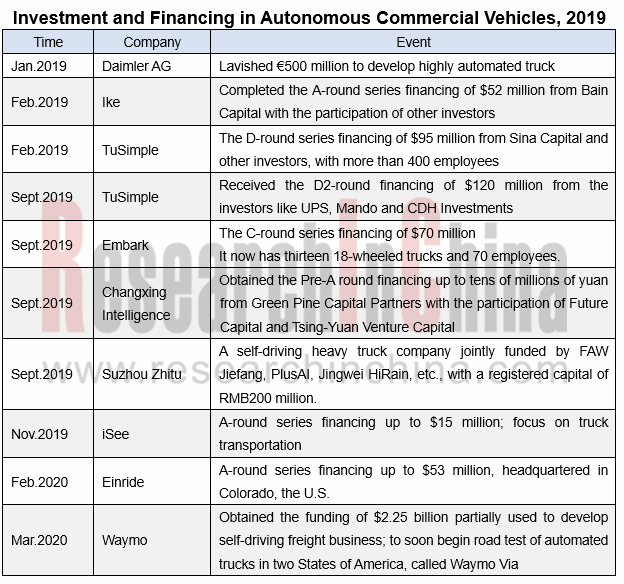
After over a year’s halt, Waymo restarted self-driving truck tests in May 2019. Pony.ai, a competitor in RoboTaxi operations and with the investment of $400 million from Toyota and other investors, was also pressing ahead with self-driving truck tests in 2019.
Truck platooning still remains the focus of automated truck test and gets increasingly combined with 5G technology in 2019, into which the companies have set foot including Daimler, CiDi, Scania, Iveco, Volvo, DAF, Peloton, SAIC, Foton, Huawei, TuSimple and Hyundai.
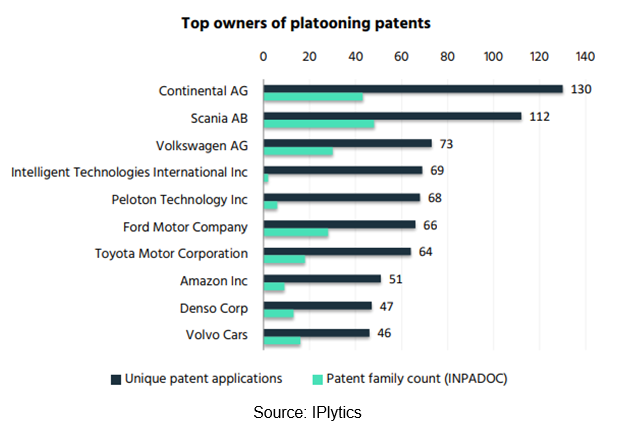
It can be seen from the top 10 holders of platooning patents that the competitive ones are Continental, Scania, Peloton, Ford, Toyota, among others. Chinese counterparts are rarely seen.
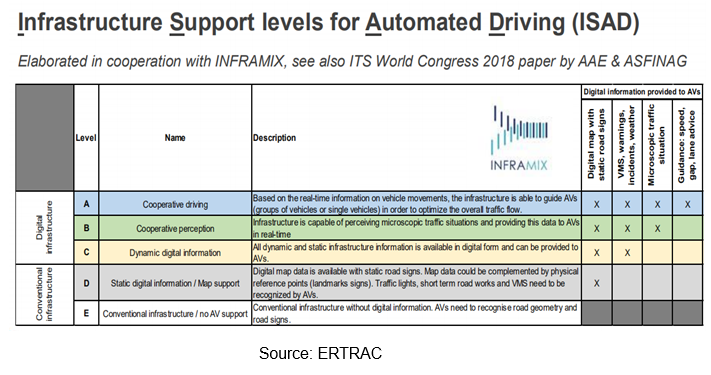
Commercial vehicle going smart coincides with road intelligence, about which the laws and regulations are getting perfect. Road infrastructure for automated driving is classified by ERTRAC (European Road Transport Research Advisory Council) into the five in the table below.
China Highway & Transportation Society (CHTS) Automated Driving Working Committee and Automated Driving Standardization Working Committee issued the Intelligent Connected Road System Levels and Interpretations (Exposure Draft) in September 2019, according to which traffic infrastructure system is divided into I0 level (zero information/intelligence/autonomy), I1 (preliminarily digital/intelligent/automated), I2 (partially connected/intelligent/automated), I3 (conditional autonomy and high connectivity based on traffic infrastructure), I4 (highly automated and based on traffic infrastructure), and I5 (fully automated driving based on traffic infrastructure).
The importance of road intelligence was shown in the platooning test on the Beijing-Chongli Expressway (Yanchong Expressway Beijing Section) in December 2019 that has complex road conditions for more than 94% of the sections are tunnels and viaducts. In most cases, autonomous driving in the tunnel became difficult because the GNSS signal was bad. Moreover, it was the middle of winter and the outdoor temperature remained as low as -20°C, challenging a multitude of supporting equipment. Huawei has installed the 5G vehicle terminal T-Box with 5G+C-V2X technology on Foton Commercial Vehicles, and also provides roadside sensing terminal cameras, radars, road side unit, edge computing, C-V2X Server, etc. Through the C-V2X services for the entire road sections, the deficiencies in positioning, communication and perception in the tunnel can be compensated. Foton commercial vehicles completed a 14-km L4 platooning demonstration, including a 9.8-km continuous extra-long tunnel.
Billions of dollars flocked to the maturing self-driving commercial vehicle market in 2019. Vehicle intelligence is prioritized in foreign countries, while CVIS (Cooperative Vehicle Infrastructure System) prevails in China. There will be greater development space from 2020 on.
The report details technologies about automated driving of commercial vehicle, organizations, the status quo of the market as well as progress in platooning; nearly 50 suppliers’ and automakers’ investments, deployments, technical routes, products & solutions, business models, plans and goals, tests, collaborations, applied scenarios, etc.
1. Overview of Autonomous Commercial Vehicle Industry
1.1 Overview of Autonomous Commercial Vehicle
1.1.1 Definition of Commercial Vehicle
1.1.2 Necessity of Autonomous Commercial Vehicle
1.1.3 Advantages of Commercial Vehicles Popularizing Autonomous Driving Technology
1.1.4 Development Stage of Autonomous Commercial Vehicle at Home and Abroad
1.1.5 Expected Development Path of Autonomous Commercial Vehicle
1.1.6 Development Stage of Autonomous Trucks
1.1.7 Features of Autonomous Trucks by Development Stage
1.2 Autonomous Commercial Vehicle Technology
1.2.1 Typical Applied Scenarios of Autonomous Commercial Vehicle and Technologies
1.2.2 Technology Solutions for Typical Applied Scenarios of Commercial Vehicles
1.2.3 Key Technologies for Autonomous Commercial Vehicle
1.2.4 Reference Architecture of Autonomous Commercial Vehicle
1.2.5 Evolution of Autonomous Commercial Vehicle
1.2.6 ADAS Features Required by L1-L2 Commercial Vehicle
1.3 Autonomous Commercial Vehicle and Regulations
1.3.1 Timeline of Regulations on Brake Control and ADAS (by Region) Worldwide
1.3.2 Active Safety and ADAS Are the Compulsory Requirements in Laws & Regulations of All Countries
1.3.3 China's Regulations on Active Safety and ADAS Are Rapidly Advancing
1.3.4 Latest Regulations and Policies in 2019
1.4 Challenges and Supporting Facilities for Autonomous Commercial Vehicle
1.4.1 Challenges to Autonomous Commercial Vehicle
1.4.2 Acceptance of Autonomous Commercial Vehicle
1.4.3 Challenges for and Impacts of Autonomous Trucks
1.4.4 Impact of Autonomous Driving on Stakeholders in the Truck Industry
1.4.5 Autonomous Commercial Vehicle Needs Related Infrastructure
1.4.6 Classification of Autonomous Driving-related Infrastructure (Road) (Europe)
1.4.7 Classification of Autonomous Driving-related Infrastructure (Road) (China)
1.5 Autonomous Truck Market Size Forecast
1.5.1 Global and China Autonomous Truck Market Size Forecast
1.5.2 Autonomous Truck Market Size Forecast by Type
1.6 Organizations Concerned and Important Projects
1.6.1 EATA
1.6.2 ENSEMBLE
1.6.3 Milestones of ENSEMBLE
2. Commercial Vehicle Platooning
2.1 Truck Platooning
2.1 Introduction to Truck Platooning
2.1.1 Key Truck Platooning Components and Functions
2.1.2 Evolution of Truck Platooning Technology
2.1.3 Value of Truck Platooning
2.1.4 Fuel Saving of Truck Platooning Tests
2.1.5 Status Quo of Truck Platooning in the World
2.1.6 Truck Platooning Projects Worldwide, 2018-2020
2.1.7 Comparison of Some Truck Platooning Projects
2.1.8 Development History of Truck Platooning
2.1.9 Truck Platooning Patent Analysis
2.2 Status Quo of Truck Platooning in Europe
2.3 Status Quo of Truck Platooning in US
2.3.1 Truck Platooning Overview in US
2.3.2 Truck Platooning Projects in US
2.3.3 Truck Platooning Test in US
2.3.4 Platooning Regulations in US by State
2.4 Status Quo of Truck Platooning in China
2.4.1 Representative Truck Platooning Projects in China, 2018
2.4.2 Cainiao’s Self-driving Truck Platooning Technology Solution
2.4.3 The First Large-scale Commercial Vehicle Platooning Trial in China
2.3.4 Platooning Is an Important Part of ICV Standard System Construction Guide
2.3.5 Truck Platooning Tests in China, 2019
2.4 Status Quo of Truck Platooning in Japan and South Korea
2.4.1 Platooning Projects in South Korea
2.4.2 Development Roadmap of Autonomous Trucks in South Korea
2.4.3 Platooning Participants in Japan
2.4.4 Platooning Development Roadmap in Japan
3. Foreign Providers of Autonomous Commercial Vehicle Solutions
3.1 Starsky Robotics
3.2 Embark
3.3 Peloton Technology
3.4 BestMile
3.5 Oxbotica
3.6 Einride
3.7 WABCO
3.8 Knorr-Bremse
3.9 Kodiak Robotics
3.10 Thor Trucks
3.11 WAYMO
3.12 Pronto
3.13 Ike
3.14 iSee
3.15 Outrider
Comparison of Foreign Autonomous Commercial Vehicle Solution Providers (including revenue, workforce, financing, major products, business models, major customers, partners, support for self-driving trucks, autonomous driving tests, truck platooning tests, etc.)
Conclusions
4. Chinese Providers of Autonomous Commercial Vehicle Solutions
4.1 Tsintel Technology
4.2 TuSimple
4.3 Westwell
4.4 FABU Technology
4.5 PlusAI
4.6 TRUNK
4.7 CiDi
4.8 Inceptio Technology
4.9 SuperG AI
4.10 Changxing Intelligence
4.11 Suzhou Zhitu
4.12 In-Driving
Comparison of Chinese Autonomous Commercial Vehicle Solution Providers (including location, registered capital, financing, headcount, main products, business models, major clients, partners, support for remote control, support for autonomous trucks/buses, autonomous driving tests, planning and goals, etc.)
Conclusions
5. Autonomous Driving Layout of Foreign Commercial Vehicle Makers
5.1 Volkswagen
5.2 PACCAR
5.3 Volvo
5.4 Daimler
5.5 SCANIA
5.6 Hino
5.7 Iveco
Comparison of Foreign Commercial Vehicle Companies (including revenue and growth rate, sales volume, profit, nationality, planned investment in autonomous driving, foreign investment, major products, ICV partners, investment in autonomous trucks / buses, autonomous driving tests, planning and goals, etc.)
Conclusions
6. Autonomous Driving Layout of Chinese Commercial Vehicle Makers
6.1 Beiqi Foton Motor
6.2 Dongfeng Motor
6.3 SINOTRUK Group
6.4 FAW Jiefang
6.5 China Shaanqi
6.6 SAIC Hongyan
6.7 Beiben Trucks
6.8 JMC
6.9 Zhengzhou Yutong Bus
6.10 King Long Bus
6.11 CRRC Electric Vehicle
6.12 Xiamen Golden Dragon Bus
6.13 Anhui Ankai Automobile
6.14 Skywell
Comparison of Chinese Commercial Vehicle Companies (including revenue and growth rate, sales volume, profit, registered capital, autonomous driving investment, main products, ICV partners, autonomous driving tests, launch time, planning and goals, etc.)
Conclusions
Automotive Microcontroller Unit (MCU) and Application Scenario Research Report, 2026
Automotive MCU Research: Increased demand for redundant security drives ASIL D-compliant MCU shipments to exceed 100 million units
In a vehicle EEA, MCUs are widely distributed in various functional ...
China Intelligent Cockpit Patent Analysis Report, 2026
Intelligent Cockpit Patent Research: Cockpit AI, In?vehicle Health, and Infotainment Are Upgrade to Scenario?based and Proactive Functions
From a patent perspective, this report explores the cutting?...
Research Report on Application of VLA Large Model in Automobiles and Robots, 2026
Research on Automotive and Robot VLA: Hybrid Architectures Become Mainstream, VLA Integrates with General World Models, and Reinforcement Learning Serves as Core Engine
Vision?Language?Action (VLA) m...
China Charging Infrastructure (Supercharging, Battery Swapping, V2G, etc.) and High-Performance Supercharging Battery Research Report, 2026
Charging and battery swapping research: as 5C+ supercharging vehicle models go into mass production, the pace of OEMs self-building supercharging networks quickens
800-1000V high-voltage platforms ar...
China Passenger Car Electronic Controlled Suspension Industry Report, 2026
Electronic Controlled Suspension Industry Research: As the First Year of Full Active Suspension Unfolds, Three Technical Routes Race Forward
1. Penetration Rate Surges Three Times, and Electronic Con...
Intelligent Driving SoC Research Report, 2026
Research on Intelligent Driving SoCs: Competition Focus Shifts to L3/L4 Embedded Hardware, and Computing Power of Flagship Vehicle Models Exceeds 1,000 TOPS
In terms of intelligent driving system in...
Automotive AI Large Model Technology Research Report, 2026
Automotive AI Large Model Research: Competition Shifts from "Who Has the Stronger Model" to "Who Boasts Higher Link Efficiency"
ResearchInChina released the Automotive AI Large Model Technology Resea...
Intelligent Vehicle Cockpit Domain Controller Research Report, 2026
Cockpit domain controller research: L3 AIDV intelligent cockpit domain controllers are entering a boom period
Driven by multiple factors such as the continuous evolution of the automotive central int...
Automotive Acoustic System (Audio, Multi-Channel) Industry Report, 2026
Automotive Acoustics Research: Multiple Channels, AI Tuning, and Self-Developed Algorithms Drive the Transformation of High-End Cockpit Sound Fields
I. Automotive Audio Hardware Solutions with 6–9 S...
Autonomous Driving Sensor Chip Research Report, 2026
Research on Autonomous Driving Sensor Chips: Deeply Perceiving the Physical World, Sensor Chips Are Playing A “Leading Role” in Intelligence
In 2026, the autonomous driving sensor chip industr...
Passenger Car Corner Module and Wheel‑Side Control System Research Report, 2026
Wheel-side control research: the “last mile” chassis innovation
Wheel-side control dismantles the traditional drive, braking, steering, and suspension control of the chassis from a "centralized" styl...
Embodied Artificial Intelligence (& Humanoid Robot) MCU Research Report, 2026
Research on Humanoid Robot MCUs: Evolution from General-Purpose Control to High-Value Dedicated Chip Solutions Integrated with Edge AI Functions
MCU (Microcontroller Unit) refers to a compact integra...
Intelligent Vehicle Zone Control Unit (ZCU) Research Report, 2026
ZCU Research: Cross-domain integrated ZCUs are becoming the edge computing nodes of the next-generation zonal architecture
Currently, the mainstream zonal architecture is mainly the quasi-central + z...
Automotive Cybersecurity and Data Security Research Report, 2026
Cybersecurity & Data Security Research: Intelligent Connected Vehicles Enter the Era of “Systematic Offense-Defense and AI-Defined Security”.
Centering on the panorama of intelligent connect...
Report on Breakthrough Strategies of OEMs and ADAS Tier 1 Suppliers for Overseas Layout of Intelligent Driving, 2026
Regulatory Breakthrough, Local System Establishment, OEMs Competing for NOA Layout: Overall Trends of China’s Intelligent Driving Overseas Layout in 2026
Research on overseas intelligent driving layo...
OEMs and Tier1s’ Intelligent Cockpit Platform (Hardware and Software) Innovation Strategy Research Report, 2026
Intelligent Cockpit Platform Research: multi-dimensional cockpit system architecture reconstruction for multi-agent collaboration and proactive intelligent services
The intelligent cockpit software s...
Automotive AIOS Research Report, 2026
Automotive AIOS Research: Mass Production Solutions Are Implemented
Mass Production Solutions Are Implemented on A Small Scale.
In 2026, AIOS starts small-scale implementation, helping to improve v...
Automotive Telematics Service Provider (TSP) Research Report, 2026
TSP Research: Leading providers collectively turn to AI agents to provide all-scenario active services
Telematics Service Providers (TSPs) are the core hub of the telematics industry chain, connectin...