Why is the installation rate of automated parking not high?
Automated parking was found in 7.7 percent of passenger cars in China in 2019, according to the data from ResearchInChina.
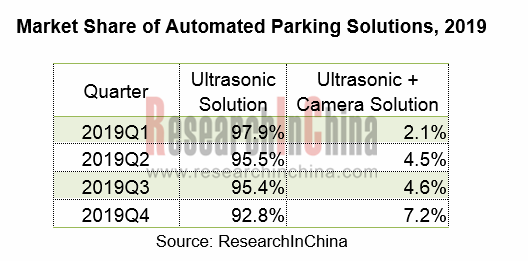
As shown in the table above, most Chinese new passenger cars were pre-installed with ultrasonic solutions for automated parking in 2019; while ultrasonic + vision fusion solution only held tiny shares but saw an uptrend from the fourth quarter.
The moderate assembly rate of automated parking results from the limited scenarios of traditional ultrasonic parking solutions where the driver has to stay in the car. To tackle this problem, there are two ways: better performance of ultrasonic radars and more sensors (such as cameras and millimeter-wave radars).
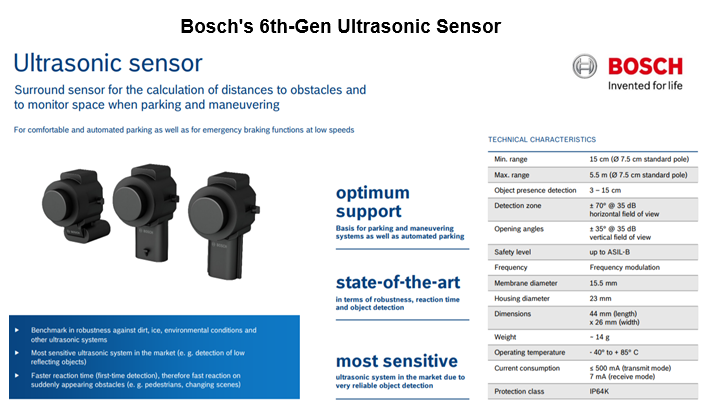
For instance, the AionS Automated Parking System, which was launched by GAC in the first half of 2019, uses 12 Bosch sixth-generation ultrasonic radars to detect a longer range than the previous generation and probe objects as close as 3cm instead of the original 6cm with faster refresh and agility.
More emerging models such as Changan CS75 PLUS, Geely Xingyue, SAIC Roewe MARVEL X, Chery EXEED, etc. have embarked on ultrasonic + vision fusion parking solutions.
Rare application of ultrasonic + visual fusion solution in the past lies in lack of algorithms and powerful compute. Tesla, the pioneer going intelligent, has long resorted to ultrasonic solutions, and its automated parking capability has not performed well. Even Smart Summon launched in the second half of 2019 is not so successful, either.
Tesla’s all models equipped with Autopilot 2.0 carry NVIDIA’s Drive PX2 chip which supports the access to up to 6 cameras. Autopilot 2.0 cannot bolster full work of 8 cameras in the car whatever the compute or video ports. Thus, Autopilot 2.0 does not attend to the fusion of ultrasonic + vision automated parking assistant sufficiently.
According to the study by Chris Zheng, Tesla annotates the mid-range camera in the front trifocal camera at 36 frames per second, records the front fisheye camera and four side-view cameras at 9 frames per second, while it temporarily abandons the remaining front long-range camera and rear-view camera. That is to say, when Autopilot is enabled, only 6 cameras in the car are involved in labeling and perception, of which only the front mid-range camera keeps a high perception frequency while the remaining 5 cameras run strenuously with the limited computing power.
Tesla began to develop chips for strong compute. In 2019, Elon Musk unveiled the Autopilot HW 3.0 hardware upgrade powered by Tesla’s self-developed FSD chip. The previous version HW2.5 uses Nvidia’s Drive PX2 chip. In terms of computing power, the new chip can process about 21 times more images per second than the old one (110 frames per second), at 2,300 frames per second. If all 8 cameras are running at 36 frames per second, the whole vehicle output will be 288 frames per second, which is equivalent to 12.5% of the processing capacity of the FSD chip and is quite sufficient for automated parking.
After solving the computing power, Tesla launched "Smart Summon" at the end of 2019, which is designed to allow the car to drive to the user or an appointed place by the user, maneuvering around objects and parking as necessary. The actual tests prove that Smart Summon still does not work in many cases, indicating that the algorithm needs improvement.
In March 2020, Musk said Tesla would finish work on Autopilot core foundation codes and 3D labelling to provide better algorithms and features for its cars, and then it would unveil "Reverse Summon" soon. Reverse Summon will likely be a mirror feature to Tesla’s existing “Smart Summon”. Whereas Smart Summon allows the user’s car to navigate from its parking space to the user, Reverse Summon likely reverses this. As such, it would conceivably entail that the user’s car can drop the user off, and then navigate to a parking space on its own. To ensure safety, Smart Summon works with the Tesla mobile app when the user’s phone is located within approximately 65 meters of the car with a projected top speed of 8 km/h.
Taking Tesla as a reference, OEMs and Tier1 suppliers are upgrading automated parking systems.
Desay SV told investors that its automated parking system using the vision + ultrasonic fusion solution (algorithms backed by MOMENTA) has been spawned for Chery EXEED, Geely Xing Yue and other models.
Tesla's new deep neural network will integrate all sub-neural networks including perception, path planning, and target recognition. The cooperation between Desay SV, which is adept at hardware, and MOMENTA, a veteran offer of neural network algorithms, inspires traditional Tier1 suppliers.
Valeo has long led the pack in the APA field, and its vision + ultrasonic fusion solution -- Park4U Remote has been applied to Mercedes-Benz's new S-Class sedans and Changan's new CS75 PLUS. With the powerful remote parking, Changan CS75 PLUS has been a best-seller nowadays.
To cater to the complicated parking scenarios in China, Valeo has prepared different sensor combinations for automated parking: Vision + Ultrasonic Radar Fusion Solution, and Millimeter Wave Radar + Ultrasonic Radar Fusion Solution. In 2020, a number of models using Valeo's automated parking solutions will be launched.
By launching Valeo.ai based in Paris, Valeo aims to host an open community network dedicated to the development of automotive applications in artificial intelligence and deep learning.
Souped-up compute and algorithms are not only necessary for automated parking and AVP systems, but also crucial to cockpit system, connected system, ADAS, etc. This involves changes in the vehicle's E/E architecture, super processors, domain controllers, vehicle OTA, information security, to name a few.
In the next few years, decentralized ECUs will be replaced by domain controllers whose development is often dominated by OEMs and Tier1 suppliers. The space for independent parking controllers is narrowing. For APA / AVP startups, it is of vital importance to improve algorithmic competences and have closer collaborations with Tier1 suppliers.
Vehicle-Road-Cloud Integration and C-V2X Industry Report, 2026
Vehicle-Road-Cloud and C-V2X Research: with the three-tier promotion system of "top-level planning + mandatory pilot + evaluation binding", the industry turning point is approachingThis report focuses...
China OEM Data Capability Analysis Report, 2026
OEM Data Capability Research: 24 OEMs × 9 Capability Domains, Who Takes the Lead?
An L4 autonomous driving R&D and test vehicle can generate approximately 10TB of raw data per single day — data v...
Autonomous Driving Domain Controller and Central Computing Unit (CCU) Industry Report, 2026
Autonomous Driving Domain Controller (ADCU) Research: One-Chip CCU solutions are quickly available in vehicles
In China's passenger car market, autonomous driving systems involved in mass production ...
Automotive EMS and ECU Industry Research Report, 2026
Automotive EMS Research: The boundaries between EMS providers and Tier1 suppliers are becoming blurred, and the supply chain model is evolving from a linear chain to a networked structure
Mainstream ...
Automotive Microcontroller Unit (MCU) and Application Scenario Research Report, 2026
Automotive MCU Research: Increased demand for redundant security drives ASIL D-compliant MCU shipments to exceed 100 million units
In a vehicle EEA, MCUs are widely distributed in various functional ...
China Intelligent Cockpit Patent Analysis Report, 2026
Intelligent Cockpit Patent Research: Cockpit AI, In?vehicle Health, and Infotainment Are Upgrade to Scenario?based and Proactive Functions
From a patent perspective, this report explores the cutting?...
Research Report on Application of VLA Large Model in Automobiles and Robots, 2026
Research on Automotive and Robot VLA: Hybrid Architectures Become Mainstream, VLA Integrates with General World Models, and Reinforcement Learning Serves as Core Engine
Vision?Language?Action (VLA) m...
China Charging Infrastructure (Supercharging, Battery Swapping, V2G, etc.) and High-Performance Supercharging Battery Research Report, 2026
Charging and battery swapping research: as 5C+ supercharging vehicle models go into mass production, the pace of OEMs self-building supercharging networks quickens
800-1000V high-voltage platforms ar...
China Passenger Car Electronic Controlled Suspension Industry Report, 2026
Electronic Controlled Suspension Industry Research: As the First Year of Full Active Suspension Unfolds, Three Technical Routes Race Forward
1. Penetration Rate Surges Three Times, and Electronic Con...
Intelligent Driving SoC Research Report, 2026
Research on Intelligent Driving SoCs: Competition Focus Shifts to L3/L4 Embedded Hardware, and Computing Power of Flagship Vehicle Models Exceeds 1,000 TOPS
In terms of intelligent driving system in...
Automotive AI Large Model Technology Research Report, 2026
Automotive AI Large Model Research: Competition Shifts from "Who Has the Stronger Model" to "Who Boasts Higher Link Efficiency"
ResearchInChina released the Automotive AI Large Model Technology Resea...
Intelligent Vehicle Cockpit Domain Controller Research Report, 2026
Cockpit domain controller research: L3 AIDV intelligent cockpit domain controllers are entering a boom period
Driven by multiple factors such as the continuous evolution of the automotive central int...
Automotive Acoustic System (Audio, Multi-Channel) Industry Report, 2026
Automotive Acoustics Research: Multiple Channels, AI Tuning, and Self-Developed Algorithms Drive the Transformation of High-End Cockpit Sound Fields
I. Automotive Audio Hardware Solutions with 6–9 S...
Autonomous Driving Sensor Chip Research Report, 2026
Research on Autonomous Driving Sensor Chips: Deeply Perceiving the Physical World, Sensor Chips Are Playing A “Leading Role” in Intelligence
In 2026, the autonomous driving sensor chip industr...
Passenger Car Corner Module and Wheel‑Side Control System Research Report, 2026
Wheel-side control research: the “last mile” chassis innovation
Wheel-side control dismantles the traditional drive, braking, steering, and suspension control of the chassis from a "centralized" styl...
Embodied Artificial Intelligence (& Humanoid Robot) MCU Research Report, 2026
Research on Humanoid Robot MCUs: Evolution from General-Purpose Control to High-Value Dedicated Chip Solutions Integrated with Edge AI Functions
MCU (Microcontroller Unit) refers to a compact integra...
Intelligent Vehicle Zone Control Unit (ZCU) Research Report, 2026
ZCU Research: Cross-domain integrated ZCUs are becoming the edge computing nodes of the next-generation zonal architecture
Currently, the mainstream zonal architecture is mainly the quasi-central + z...
Automotive Cybersecurity and Data Security Research Report, 2026
Cybersecurity & Data Security Research: Intelligent Connected Vehicles Enter the Era of “Systematic Offense-Defense and AI-Defined Security”.
Centering on the panorama of intelligent connect...