Tier 1 suppliers for autonomous driving: Chinese Tier 1 suppliers have not embarked on the actuation layer, and L3 will spread after 2022
Amid the controversy in L3, some media believe that Audi will give up L3, which is later denied by Audi saying it only elevate the L3 research to Volkswagen Group.
Most OEMs plan to launch L3 models in 2020 except Volvo, Ford and NextEV that will skip L3.
Strictly speaking, the L3 models to be launched by OEMs in 2020 may be prototypes of some high-end models or not real L3 models.
Tier 1 suppliers are not in readiness for large-scale supply to L3 models. Continental, for instance, focuses on L2 + models between 2019 and 2022, and will commercialize L3 models after 2022. Bosch will also begin commercializing the L3 highway pilot (HWP) function after 2022. To increase redundancy of the system, Bosch renders a dual-domain controller architecture to further ensure the system security.
In the realm of autonomous driving, Tier 1 suppliers profit mainly from ADAS. Although Mobileye enjoys the largest market share in terms of ADAS algorithms (including software and chips), it did not secure the highest revenue in 2019 in the ADAS market which also covers control units, millimeter wave radars, map positioning systems, etc.
A case in point is Continental whose ADAS revenue in 2019 posted €4 billion (20% from ADAS domain control unit (ADCU) and 40% from radars).
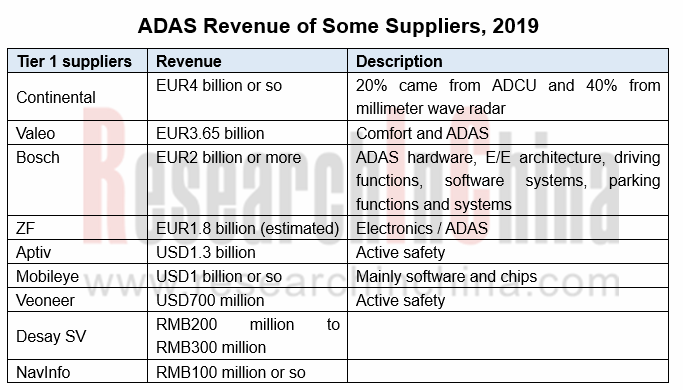
It can be seen in the table below that Bosch, Continental and Valeo stay ahead by deployments among foreign Tier 1 suppliers, and Huawei deploys most widely in Chinese Tier 1 suppliers.
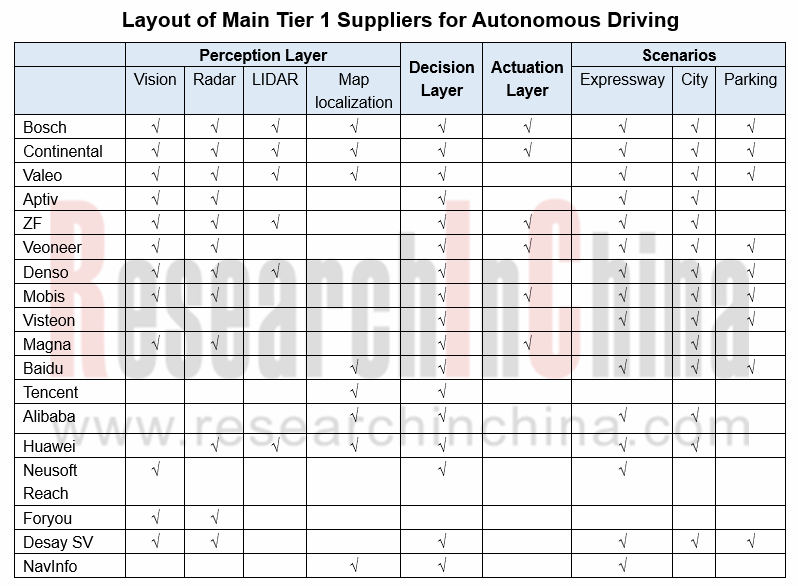
Chinese Tier 1 suppliers have not embarked on the actuation layer, which is undoubtedly their biggest shortcoming. Without the know-how about actuation technology, they cannot control the autonomous vehicles accurately nor have the initiative. It is expected that they will invest in or acquire related companies in the near future to address inadequacies.
Despite lagged far behind foreign Tier 1 suppliers in the underlying hardware of autonomous driving, Chinese Tier 1 suppliers delve more into application scenarios and V2X than foreign counterparts who usually deploy in expressways, urban roads, and autonomous parking, for the three of which Valeo, for example, launched Cruise4U, Drive4U, Park4U , respectively.
Chinese Tier 1 suppliers have laid out more scenarios. Together with partners, Baidu is present in such scenarios as autonomous cleaning, autonomous agricultural machinery, autonomous shuttles, RoboTaxi, autonomous delivery, autonomous buses, autonomous trucks, and AVP.
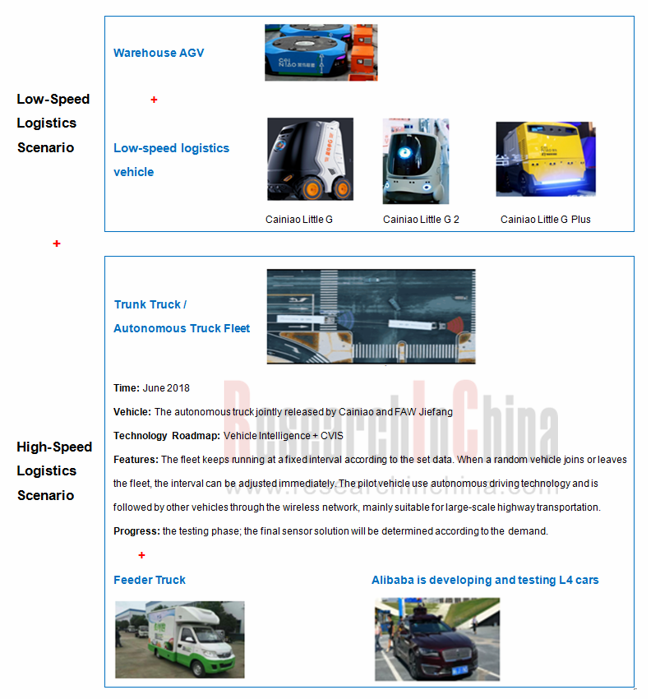
Alibaba is pivoted on autonomous logistics vehicle to bolster its e-commerce business.
Intelligent Driving SoC Research Report, 2026
Research on Intelligent Driving SoCs: Competition Focus Shifts to L3/L4 Embedded Hardware, and Computing Power of Flagship Vehicle Models Exceeds 1,000 TOPS
In terms of intelligent driving system in...
Automotive AI Large Model Technology Research Report, 2026
Automotive AI Large Model Research: Competition Shifts from "Who Has the Stronger Model" to "Who Boasts Higher Link Efficiency"
ResearchInChina released the Automotive AI Large Model Technology Resea...
Intelligent Vehicle Cockpit Domain Controller Research Report, 2026
Cockpit domain controller research: L3 AIDV intelligent cockpit domain controllers are entering a boom period
Driven by multiple factors such as the continuous evolution of the automotive central int...
Automotive Acoustic System (Audio, Multi-Channel) Industry Report, 2026
Automotive Acoustics Research: Multiple Channels, AI Tuning, and Self-Developed Algorithms Drive the Transformation of High-End Cockpit Sound Fields
I. Automotive Audio Hardware Solutions with 6–9 S...
Autonomous Driving Sensor Chip Research Report, 2026
Research on Autonomous Driving Sensor Chips: Deeply Perceiving the Physical World, Sensor Chips Are Playing A “Leading Role” in Intelligence
In 2026, the autonomous driving sensor chip industr...
Passenger Car Corner Module and Wheel‑Side Control System Research Report, 2026
Wheel-side control research: the “last mile” chassis innovation
Wheel-side control dismantles the traditional drive, braking, steering, and suspension control of the chassis from a "centralized" styl...
Embodied Artificial Intelligence (& Humanoid Robot) MCU Research Report, 2026
Research on Humanoid Robot MCUs: Evolution from General-Purpose Control to High-Value Dedicated Chip Solutions Integrated with Edge AI Functions
MCU (Microcontroller Unit) refers to a compact integra...
Intelligent Vehicle Zone Control Unit (ZCU) Research Report, 2026
ZCU Research: Cross-domain integrated ZCUs are becoming the edge computing nodes of the next-generation zonal architecture
Currently, the mainstream zonal architecture is mainly the quasi-central + z...
Automotive Cybersecurity and Data Security Research Report, 2026
Cybersecurity & Data Security Research: Intelligent Connected Vehicles Enter the Era of “Systematic Offense-Defense and AI-Defined Security”.
Centering on the panorama of intelligent connect...
Report on Breakthrough Strategies of OEMs and ADAS Tier 1 Suppliers for Overseas Layout of Intelligent Driving, 2026
Regulatory Breakthrough, Local System Establishment, OEMs Competing for NOA Layout: Overall Trends of China’s Intelligent Driving Overseas Layout in 2026
Research on overseas intelligent driving layo...
OEMs and Tier1s’ Intelligent Cockpit Platform (Hardware and Software) Innovation Strategy Research Report, 2026
Intelligent Cockpit Platform Research: multi-dimensional cockpit system architecture reconstruction for multi-agent collaboration and proactive intelligent services
The intelligent cockpit software s...
Automotive AIOS Research Report, 2026
Automotive AIOS Research: Mass Production Solutions Are Implemented
Mass Production Solutions Are Implemented on A Small Scale.
In 2026, AIOS starts small-scale implementation, helping to improve v...
Automotive Telematics Service Provider (TSP) Research Report, 2026
TSP Research: Leading providers collectively turn to AI agents to provide all-scenario active services
Telematics Service Providers (TSPs) are the core hub of the telematics industry chain, connectin...
Automotive Smart Interior Research Report, 2026
Smart Interior Research: As Technologies like Interactive Starlight Headliner, Hidden Display and Surface Projection Are Launched, Automotive Interiors Become Ever More Intelligent
The Automotive Sma...
Research Report on AI Applications in Cockpits, 2026
AI Application in Cockpits: AI Services Become More Comprehensive, Convenient, and Refined.
In the first half of 2026, cockpit AI functions underwent initial upgrades across multiple dimensions, inc...
Software-Defined Vehicles in 2026: OEM Software Development and Supply Chain Deployment Strategy Research Report
Research on OEMs’ Software Strategies: R&D Focus, Development Strategies and Supplier Building Models of 30 OEMs
In this paper, we adopt a research framework covering 13 subsystems and 48 sub-di...
Passenger Car Chassis Domain Control and Chassis Cross-Domain Integration Research Report, 2026
Chassis Control Research: Mass Production of Full Chassis-by-Wire Solutions Starts
1. A Cluster of Full Chassis-by-Wire Solutions Make Their Debut, and EMB Enters Mass Production and Adoption for the...
Central Domain Control (Powertrain, Chassis, Body) and Motion Controller Research Report, 2026
Central Domain Control and Motion Control Research: XYZ Coordinated Control and Full X-by-Wire Actuation System
With the gradual penetration of L3+ autonomous driving, the chassis control system is ...