OEM Autonomous Driving Research: Successive Launch of L2 Models on Market, Foreign Plan for Mass Production of L4 Models Earlier Than China
I. L2/L2+ models are successively available on the market
Over years of rapid growth, mainstream OEMs have spawned L2 ADAS systems and upgraded related functions, equipping their vehicles with core capabilities e.g., ACC, lane keeping assist (LKA)/lane centering assist (LCA), active steering (under driver’s confirmation) and traffic sign recognition, at all speeds. Deep fusion of these capabilities is of the essence for mass production.
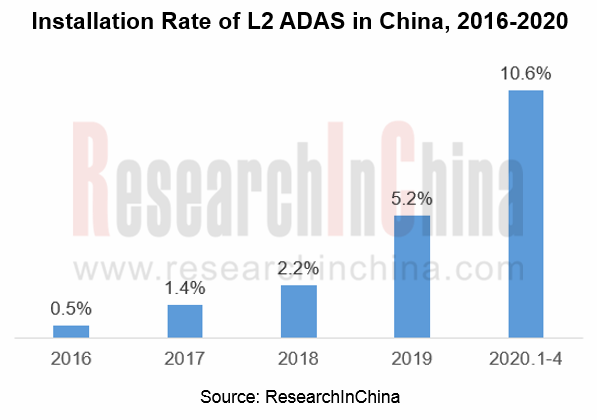
In China, installation rate of L2 ADAS was 10.6% in the first four months of 2020, 5.4 percentage points higher than in 2019. China has achieved initial success in development of ADAS/AD technology. Foreign brands like Volvo and Toyota, and new homegrown brands such as Lynk & Co, WEY, Geometry and EXEED stay ahead in installation.
II. L3 is expecting policy incentives
L3 automated driving is challenged as concerns technology and regulations. OEMs have mixed attitudes towards it:
 South Korea has been the first one to release L3 standards: Hyundai is expected to make headway in market;
Europe and the US have yet to loosen their policies: Audi slows its pace of commercializing L3;
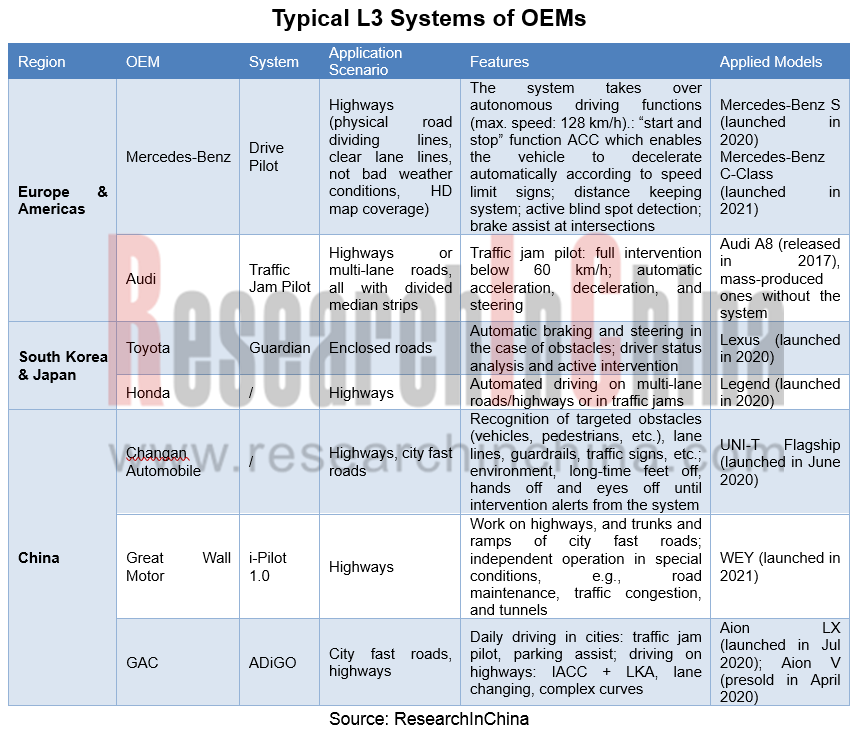
China’s policy still remains unclear but OEMs calls for it: GAC and Changan Automobile already gear up for mass production; Geely and Chery will follow up at any time.
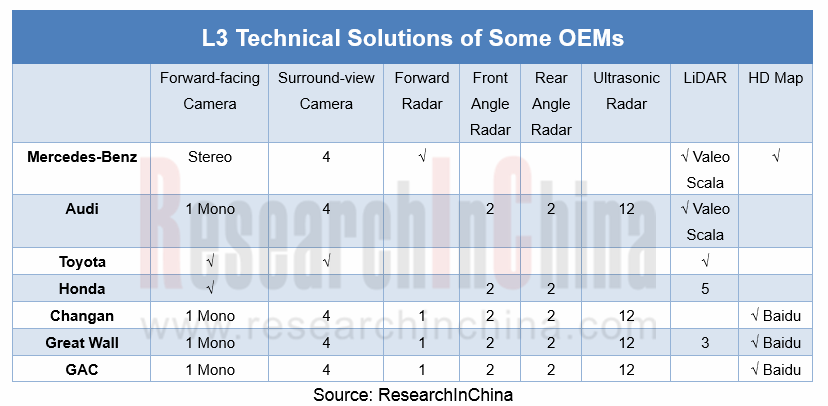
The released L3 solutions integrated with LiDAR and HD map, allow for hands-off steering wheel in the scenarios of highways and city fast roads but require good road conditions, e.g., physical road dividing lines and clear lane lines.
III. Foreign plan for mass-production of L4 models is earlier than China
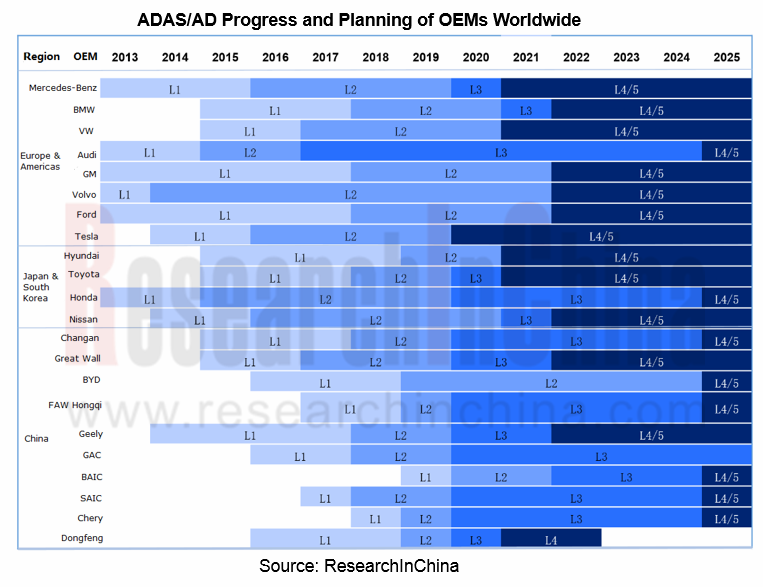
European and American OEMs stay ahead of others in L4 development; Mercedes-Benz and GM have carried out L4 pilot projects; BWM, VW and Audi have unveiled implementation plans in details;
Korean and Japanese OEMs begin to seek external collaborations for faster launch of L4. Examples include Hyundai’s cooperation with Pony.ai and Honda’s partnership with GM Cruise. Toyota originally planned to roll out L4 at the Tokyo 2020 Olympic Games but the COVID-19 pandemic makes the plan uncertain;
Chinese OEMs see L4 as a long-term plan. Only few of them, like Changan Automobile and FAW Hongqi are attempting at L4 tests.
In late June 2020, Volvo and Waymo announced that Waymo becomes “the exclusive global L4 partner for Volvo”. Volvo will leverage Waymo autonomous driving technology to build electric robotaxi and equip its two sub-brands Polestar and Lynk & Co. With the help of Waymo, Volvo is hopeful to be one of the first-movers in L4 camp.
In 2020, autonomous driving bellwethers secure enormous investments and leading automakers seize more of the market. Third or fourth-tier auto manufacturers go bankrupt at a faster pace. The ultrahigh technical barriers of autonomous driving encourage the survival of the fittest among OEMS.
Vehicle-Road-Cloud Integration and C-V2X Industry Report, 2026
Vehicle-Road-Cloud and C-V2X Research: with the three-tier promotion system of "top-level planning + mandatory pilot + evaluation binding", the industry turning point is approachingThis report focuses...
China OEM Data Capability Analysis Report, 2026
OEM Data Capability Research: 24 OEMs × 9 Capability Domains, Who Takes the Lead?
An L4 autonomous driving R&D and test vehicle can generate approximately 10TB of raw data per single day — data v...
Autonomous Driving Domain Controller and Central Computing Unit (CCU) Industry Report, 2026
Autonomous Driving Domain Controller (ADCU) Research: One-Chip CCU solutions are quickly available in vehicles
In China's passenger car market, autonomous driving systems involved in mass production ...
Automotive EMS and ECU Industry Research Report, 2026
Automotive EMS Research: The boundaries between EMS providers and Tier1 suppliers are becoming blurred, and the supply chain model is evolving from a linear chain to a networked structure
Mainstream ...
Automotive Microcontroller Unit (MCU) and Application Scenario Research Report, 2026
Automotive MCU Research: Increased demand for redundant security drives ASIL D-compliant MCU shipments to exceed 100 million units
In a vehicle EEA, MCUs are widely distributed in various functional ...
China Intelligent Cockpit Patent Analysis Report, 2026
Intelligent Cockpit Patent Research: Cockpit AI, In?vehicle Health, and Infotainment Are Upgrade to Scenario?based and Proactive Functions
From a patent perspective, this report explores the cutting?...
Research Report on Application of VLA Large Model in Automobiles and Robots, 2026
Research on Automotive and Robot VLA: Hybrid Architectures Become Mainstream, VLA Integrates with General World Models, and Reinforcement Learning Serves as Core Engine
Vision?Language?Action (VLA) m...
China Charging Infrastructure (Supercharging, Battery Swapping, V2G, etc.) and High-Performance Supercharging Battery Research Report, 2026
Charging and battery swapping research: as 5C+ supercharging vehicle models go into mass production, the pace of OEMs self-building supercharging networks quickens
800-1000V high-voltage platforms ar...
China Passenger Car Electronic Controlled Suspension Industry Report, 2026
Electronic Controlled Suspension Industry Research: As the First Year of Full Active Suspension Unfolds, Three Technical Routes Race Forward
1. Penetration Rate Surges Three Times, and Electronic Con...
Intelligent Driving SoC Research Report, 2026
Research on Intelligent Driving SoCs: Competition Focus Shifts to L3/L4 Embedded Hardware, and Computing Power of Flagship Vehicle Models Exceeds 1,000 TOPS
In terms of intelligent driving system in...
Automotive AI Large Model Technology Research Report, 2026
Automotive AI Large Model Research: Competition Shifts from "Who Has the Stronger Model" to "Who Boasts Higher Link Efficiency"
ResearchInChina released the Automotive AI Large Model Technology Resea...
Intelligent Vehicle Cockpit Domain Controller Research Report, 2026
Cockpit domain controller research: L3 AIDV intelligent cockpit domain controllers are entering a boom period
Driven by multiple factors such as the continuous evolution of the automotive central int...
Automotive Acoustic System (Audio, Multi-Channel) Industry Report, 2026
Automotive Acoustics Research: Multiple Channels, AI Tuning, and Self-Developed Algorithms Drive the Transformation of High-End Cockpit Sound Fields
I. Automotive Audio Hardware Solutions with 6–9 S...
Autonomous Driving Sensor Chip Research Report, 2026
Research on Autonomous Driving Sensor Chips: Deeply Perceiving the Physical World, Sensor Chips Are Playing A “Leading Role” in Intelligence
In 2026, the autonomous driving sensor chip industr...
Passenger Car Corner Module and Wheel‑Side Control System Research Report, 2026
Wheel-side control research: the “last mile” chassis innovation
Wheel-side control dismantles the traditional drive, braking, steering, and suspension control of the chassis from a "centralized" styl...
Embodied Artificial Intelligence (& Humanoid Robot) MCU Research Report, 2026
Research on Humanoid Robot MCUs: Evolution from General-Purpose Control to High-Value Dedicated Chip Solutions Integrated with Edge AI Functions
MCU (Microcontroller Unit) refers to a compact integra...
Intelligent Vehicle Zone Control Unit (ZCU) Research Report, 2026
ZCU Research: Cross-domain integrated ZCUs are becoming the edge computing nodes of the next-generation zonal architecture
Currently, the mainstream zonal architecture is mainly the quasi-central + z...
Automotive Cybersecurity and Data Security Research Report, 2026
Cybersecurity & Data Security Research: Intelligent Connected Vehicles Enter the Era of “Systematic Offense-Defense and AI-Defined Security”.
Centering on the panorama of intelligent connect...