T-Box Research: 46.7% of Passenger Cars Carry T-Box in 2020Q1
T-Box (Telematics-Box), also called telematics control unit (TCU), is comprised of GPS unit, outer interfaces for communications, electronic processing units, microcontrollers, mobile communication units and memory, enabling interaction between the terminal information in the car, the cloud and the roadside unit (RSU).
Around 2014, the mainstream solution of the first-generation T-BOX was a single-chip solution resorting to a combination of 2G+GPS. From 2015 to 2016, the second-generation T-BOX was added with memory, rich interfaces, and changed to employ Beidou/GPS dual-mode; also it was endowed with such new features as fault diagnosis, low power consumption design, dormant wake-up, SD card expansion, output power, RS232/485, USB and IO interfaces.
Since 2017, T-BOX communication has been upgraded to 4G, and the 4G module -- OPEN CPU technology solution has been prevailing in the industry as it boasts more powerful edge computing capabilities, supports vehicle Ethernet, over-the-air (OTA), fault diagnosis of protocols, Bluetooth, WIFI and other functions, and it even integrates gateways, CAN gateways, etc.
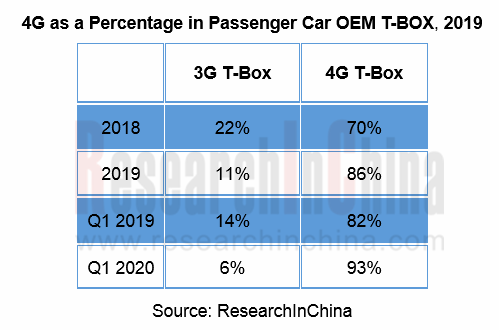
In 2019, 4G T-Box constituted 86% of passenger car OEM T-BOX, and the share rose to 93% in Q1 2020, according to ResearchInChina.
In China, 46.7% of passenger cars were installed with T-Box in Q1 2020, 14.2 percentage points higher than 32.5% in Q1 2019.
By price, the proportion of models worth RMB100,000-150,000 with T-Box rises fastest, from 34% in Q1 2019 to 40% in Q1 2020, largely thanks to Toyota (Corolla, LEVIN), Chevrolet (MONZA), Changan CS75 PLUS, etc.
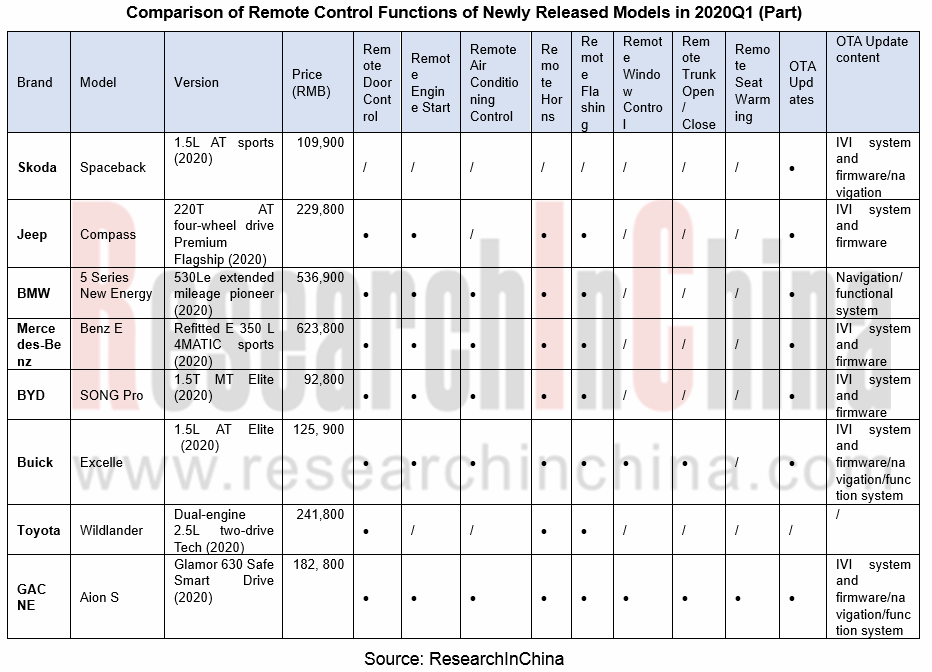
Among the new models launched in Q1 2020, GAC NE AionS has the most versatile remote functions enabling remote opening and closing of doors, windows and the trunk, remote engine start, remote air conditioning control, remote horns, remote flashing, and remote seat warming. For most models carrying T-BOX, there is universal availability of remote door control, remote horns, and remote flashing, while remote engine start-up, remote air conditioning control, remote seat warming, remote opening and closing of windows and the trunk are gaining ground.
Policies and the market players are pressing ahead with T-Box as a standard configuration.
Circular of the Ministry of Industry and Information Technology on Further Supervision over Promotion, Application and Security of New Energy Vehicles requires that the vehicles listed in the "Recommended Model Catalog for the Promotion and Application of New Energy Vehicles" must be packed with T-BOX.
On April 17, 2020, the Ministry of Ecology and Environment of China released Technical Specifications for Remote Emission Monitoring of Heavy Vehicles (Draft), which explicitly stipulates platform construction of remote emission system for heavy vehicles, T-BOX technology and measurement methodology, communication protocols and data formats.
With advances in Telematics, ADAS and OTA, in-vehicle systems will inevitably be interconnected with the cloud through T-BOX. At the same time, the massive data exchange between in-vehicle systems and remote terminals will beyond doubt fuel 4G T-BOX to head toward 5G T-BOX. Huawei is a leading enabler for 5G T-BOX.
In July 2019, Huawei rolled out the 5G automotive module -- MH5000.
In September 2019, Huawei unveiled the next-generation automotive T-Box platform at the Dongfeng Aeolus Smart Cockpit Conference, which substantially improves responsive agility and running speed of the smart cockpit and enabling remote start-up, air conditioning, vehicle control, and vehicle status review. Meanwhile, it features 5G capabilities like high speed and excellent reliability, allowing personalized interactivity such as intelligent scenario modes, voice via cloud, audiobooks and music.
In April 2020, BAIC BJEV's top-range brand ARCFOX installed the Huawei MH5000 T-BOX on its first production SUV -- ARCFOX α-T.
In May 2020, GAC Aion V pre-sales started. Aion V integrates 5G+C-V2X automotive intelligent communication system and Huawei MH5000.
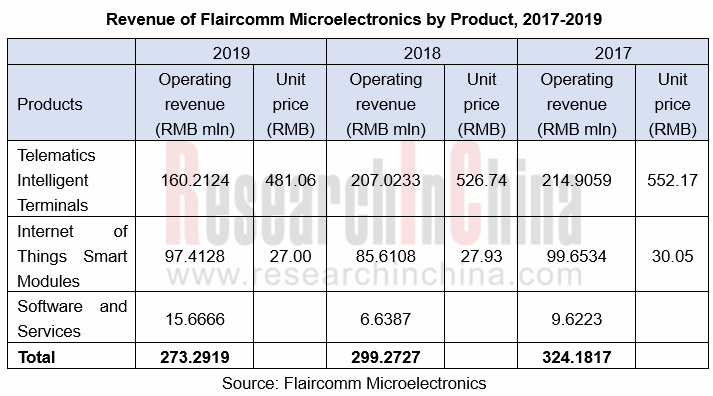
Flaircomm Microelectronics, a leading Chinese T-BOX supplier, is conducting the IPO on the SSE STAR Market, with a plan to raise RMB239.84 million for 5G T-Box R&D and industrialization projects. The raised funds will be earmarked to develop the 5GNR technology-oriented T-BOX, a fusion of new technologies like CANFD, Ethernet and smart antennas.
However, investors have doubts about Flaircomm Microelectronics whose revenue remains on a downswing over the past two years.
Like gateways, T-BOX, as a key integral of intelligent connected vehicle (ICV), involves OTA and network security. To take the initiative, OEMs tend to self-develop T-BOX software.
Amid OEMs enlarging software development teams, Tier1 hardware suppliers may turn into standard hardware vendors and have an ever weaker say. It is, indeed, a challenge not only to T-Box vendors but to Tier1 hardware suppliers.
Automotive Acoustic System (Audio, Multi-Channel) Industry Report, 2026
Automotive Acoustics Research: Multiple Channels, AI Tuning, and Self-Developed Algorithms Drive the Transformation of High-End Cockpit Sound Fields
I. Automotive Audio Hardware Solutions with 6–9 S...
Autonomous Driving Sensor Chip Research Report, 2026
Research on Autonomous Driving Sensor Chips: Deeply Perceiving the Physical World, Sensor Chips Are Playing A “Leading Role” in Intelligence
In 2026, the autonomous driving sensor chip industr...
Passenger Car Corner Module and Wheel‑Side Control System Research Report, 2026
Wheel-side control research: the “last mile” chassis innovation
Wheel-side control dismantles the traditional drive, braking, steering, and suspension control of the chassis from a "centralized" styl...
Embodied Artificial Intelligence (& Humanoid Robot) MCU Research Report, 2026
Research on Humanoid Robot MCUs: Evolution from General-Purpose Control to High-Value Dedicated Chip Solutions Integrated with Edge AI Functions
MCU (Microcontroller Unit) refers to a compact integra...
Intelligent Vehicle Zone Control Unit (ZCU) Research Report, 2026
ZCU Research: Cross-domain integrated ZCUs are becoming the edge computing nodes of the next-generation zonal architecture
Currently, the mainstream zonal architecture is mainly the quasi-central + z...
Automotive Cybersecurity and Data Security Research Report, 2026
Cybersecurity & Data Security Research: Intelligent Connected Vehicles Enter the Era of “Systematic Offense-Defense and AI-Defined Security”.
Centering on the panorama of intelligent connect...
Report on Breakthrough Strategies of OEMs and ADAS Tier 1 Suppliers for Overseas Layout of Intelligent Driving, 2026
Regulatory Breakthrough, Local System Establishment, OEMs Competing for NOA Layout: Overall Trends of China’s Intelligent Driving Overseas Layout in 2026
Research on overseas intelligent driving layo...
OEMs and Tier1s’ Intelligent Cockpit Platform (Hardware and Software) Innovation Strategy Research Report, 2026
Intelligent Cockpit Platform Research: multi-dimensional cockpit system architecture reconstruction for multi-agent collaboration and proactive intelligent services
The intelligent cockpit software s...
Automotive AIOS Research Report, 2026
Automotive AIOS Research: Mass Production Solutions Are Implemented
Mass Production Solutions Are Implemented on A Small Scale.
In 2026, AIOS starts small-scale implementation, helping to improve v...
Automotive Telematics Service Provider (TSP) Research Report, 2026
TSP Research: Leading providers collectively turn to AI agents to provide all-scenario active services
Telematics Service Providers (TSPs) are the core hub of the telematics industry chain, connectin...
Automotive Smart Interior Research Report, 2026
Smart Interior Research: As Technologies like Interactive Starlight Headliner, Hidden Display and Surface Projection Are Launched, Automotive Interiors Become Ever More Intelligent
The Automotive Sma...
Research Report on AI Applications in Cockpits, 2026
AI Application in Cockpits: AI Services Become More Comprehensive, Convenient, and Refined.
In the first half of 2026, cockpit AI functions underwent initial upgrades across multiple dimensions, inc...
Software-Defined Vehicles in 2026: OEM Software Development and Supply Chain Deployment Strategy Research Report
Research on OEMs’ Software Strategies: R&D Focus, Development Strategies and Supplier Building Models of 30 OEMs
In this paper, we adopt a research framework covering 13 subsystems and 48 sub-di...
Passenger Car Chassis Domain Control and Chassis Cross-Domain Integration Research Report, 2026
Chassis Control Research: Mass Production of Full Chassis-by-Wire Solutions Starts
1. A Cluster of Full Chassis-by-Wire Solutions Make Their Debut, and EMB Enters Mass Production and Adoption for the...
Central Domain Control (Powertrain, Chassis, Body) and Motion Controller Research Report, 2026
Central Domain Control and Motion Control Research: XYZ Coordinated Control and Full X-by-Wire Actuation System
With the gradual penetration of L3+ autonomous driving, the chassis control system is ...
48V Low-voltage Power Distribution Network (PDN) Architecture and Supply Chain Panorama Research Report, 2026
Research on 48V Low-Voltage Power Distribution Network (PDN): An Active 48V Supply Chain, with Priority Deployment in High-Power Scenarios Such as Steer-by-Wire Chassis
The automotive 48V low-voltage...
AI-Defined Vehicle (AIDV) OEMs' Deployment Strategies Research Report, 2026
AIDV Research: Deployment Strategies of 22 OEMs
The AI-Defined Vehicle (AIDV) OEMs' Deployment Strategies Research Report, 2026, released by ResearchInChina, analyzes the AI deployment strategies of ...
OEMs’ Passenger Car Model Planning Research Report, 2026
Vehicle Model Planning Research: Chinese OEMs Launch Sub-Brands Intensively, While Multinational OEMs Apply the Brakes to Electrification Strategies
ResearchInChina released the OEMs’ Passenger Car M...