Dual and multi display solutions and development tendencies are analyzed in this report.
Amid the smart cockpit trend, the display incarnates intelligence as the main interface of human-computer interaction. Following the large screen, multi display and dual display grow the new trend of the cockpit display. The “one-core multi-display” solution has become the apple in the eyes of OEMs and cockpit system integrators.
(I) Multi-display: Luxury brands adopt multi-display at first, and emerging brands follow suit.
The multi-display solution is superior in that the functions of the traditional console screen are split, so that navigation, multimedia and other information are placed on one screen or two, while vehicle information such as seats, air conditioning and ADAS are enabled on another screen. The system application menu and user’s operations are streamlined.
In 2016, Infiniti was the first to roll out a console solution with an 8.0-inch upper screen and a 7.0-inch lower screen. The Range Rover Velar unveiled in 2017 is equipped with two 10-inch console screens, featuring a sense of technology. Since then, foreign luxury brands like ACURA and Audi have followed suit.
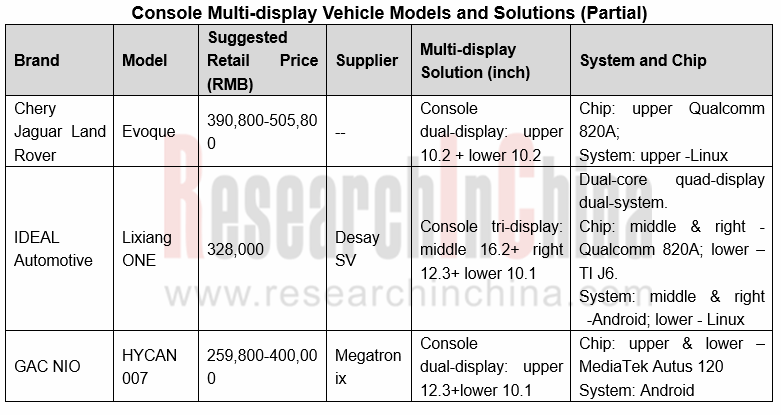
Emerging brands such as Lixiang ONE, Nezha U, and HYCAN 007 debuted in 2019-2020 launched dual-screen consoles and even triple-screen consoles in a successive way.
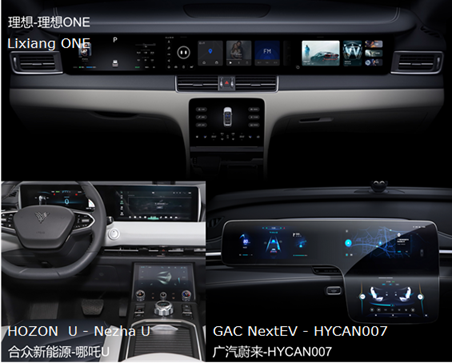
In Q1 2020, the sales volume of models packed with a dual-screen console exceeded 30,000 units in China, a year-on-year spike of 165.0%; the installation rate was 1.2%, up 0.9 percentage point over the same period last year. As for terminal applications, the cost pressure confines dual-screen consoles to high-end models priced at RMB400,000-RMB500,000.
(II) Dual Display: Local Chinese Brands and Joint Venture Brands Contend for Model Launches with Dual Display during 2019-2020
The traditional console screen and the dashboard are physically separated by a large distance, so that the driver has to pay more attention to touching the console display and reading information. At the same time, console screen and LCD cluster screen interact in some content, for instance, the navigation route displayed on the console screen, music, calls and other information can be interactively showed on the LCD dashboard. In the dual-display solution, the dashboard screen and the console screen share a glass cover, being connected almost seamlessly, visually creating a sense of screen integration, making it easier for the driver to fulfil touch operations and read information.
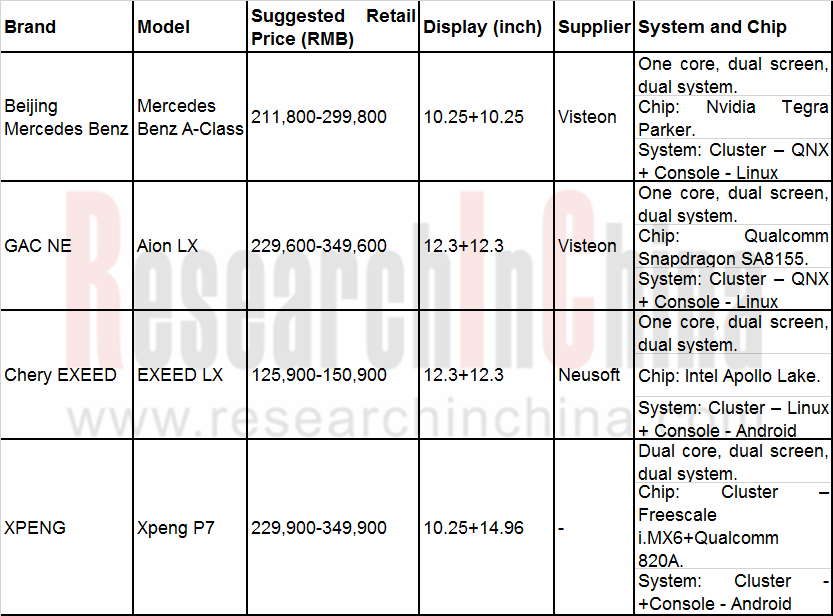
The dual display solution first appeared in 2016. The interior of Mercedes Benz E-class mounts two 12.3-inch full HD screens housed within a single unit. In November 2018, the solution officially spread to Mercedes Benz A-class. In 2017-2018, Chinese brands such as BAIC BJEV Lite and FAW Besturn T77 began to dabble in the solution. In 2019-2020, dozens of models with dual displays, including FAW Hongqi HS5, Changan CS75 PLUS, GAC Aion LX and Chery EXEED LX, were launched successively.
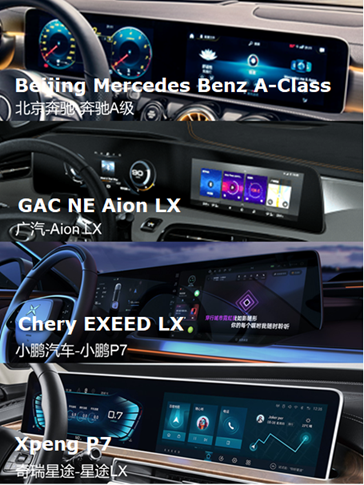
In 2020Q1, China sold nearly 70,000 passenger cars equipped with the dual display solution, a year-on-year increase of 6.1%; the installation rate reached 2.4%, up 1.1 percentage points from the same period last year. The solution is mostly available in high-end models, and it has penetrated into low- and medium-end models since 2019.
(III) The “one-core multi-screen” solution: the hotspot of multi- and dual- display solutions
For chip control and system drive, the one-core multi-display is a favored solution which is seen in Benz A-Class, BUICK GL8 Avenir series, Lixiang ONE, among others, and the pioneers are in such a pre-emptive move, such as Harman, Visteon, Aptiv, Desay SV, Neusoft, etc.
In January 2020, Samsung brought its Digital Cockpit 2020 at CES. The new cockpit was developed by Samsung and its subsidiary HARMAN International, and it’s packed with technologies including an Exynos Auto V9 SoC, Android 10, a Dashboard Display which is seamlessly incorporated into the vehicle’s interior design, a Front Display, a Console Display, a Center Information Display, two physical knobs (both of which have their own displays), two 7-inch displays on each side of the dashboard as digital mirrors powered by external cameras.
Digital Cockpit 2020 by Samsung and HARMAN -- multi-display, dual-display (integrated screen), one-core multi-display system
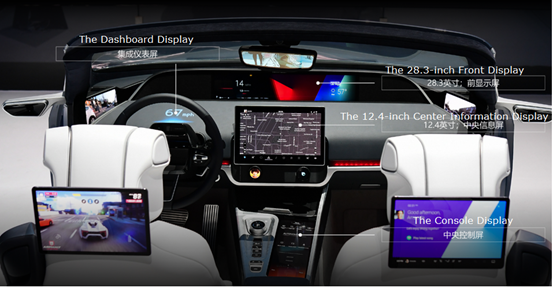
Considering screen arrangement and chip use, Digital Cockpit 2020 jointly launched by Samsung Electronics and Harman International applies both console multi-screen and dual display solutions. The Center Information Display and the Console Display enable varied information application in the car, and the Front Display can show contents in a split-screen mode.
Digital Cockpit 2020 is packed with 4 large displays and 2 small displays:
- The 28.3-inch Front Display provides visual navigation information and is positioned to ensure that the driver keeps their eyes on the road. It is equipped with QLED Local Dimming technology and split-screen mode to allow passengers to make use of the display without distracting the driver.
- The Dashboard Display, which is seamlessly incorporated into the vehicle’s interior design, is positioned under the Front Display and delivers visual notices and alerts.
- The 12.4-inch Center Information Display can automatically rise and fall, and can provide information like driver’s schedule once the driver is authenticated via facial recognition or a connected smartphone’s fingerprint reader.
- The Console Display can be set up to control various features and the functions of other displays, as well as the vehicle itself.
- Two physical knobs, both of which have their own displays, enable users to choose music.
In a nutshell, it seems unavoidable for automakers and parts suppliers how to get perfect human-machine interaction and information display as well as full exertion of console intelligence in accompaniment with a broad range of features and applications in the car. Multi-display ‘separate governance’ and dual display ‘all in one’ are the two alternatives for the automakers. What is the most challenging now are the expensive R&D costs of the ‘one-core multi-display’ solution and a high demanding on technical strength. For the OEMs, enormous investment is necessary for chip authorization, software and operating system (OS) development, etc.; for the system integrators, software complexity remains a hard nut to crack.
Automotive Microcontroller Unit (MCU) and Application Scenario Research Report, 2026
Automotive MCU Research: Increased demand for redundant security drives ASIL D-compliant MCU shipments to exceed 100 million units
In a vehicle EEA, MCUs are widely distributed in various functional ...
China Intelligent Cockpit Patent Analysis Report, 2026
Intelligent Cockpit Patent Research: Cockpit AI, In?vehicle Health, and Infotainment Are Upgrade to Scenario?based and Proactive Functions
From a patent perspective, this report explores the cutting?...
Research Report on Application of VLA Large Model in Automobiles and Robots, 2026
Research on Automotive and Robot VLA: Hybrid Architectures Become Mainstream, VLA Integrates with General World Models, and Reinforcement Learning Serves as Core Engine
Vision?Language?Action (VLA) m...
China Charging Infrastructure (Supercharging, Battery Swapping, V2G, etc.) and High-Performance Supercharging Battery Research Report, 2026
Charging and battery swapping research: as 5C+ supercharging vehicle models go into mass production, the pace of OEMs self-building supercharging networks quickens
800-1000V high-voltage platforms ar...
China Passenger Car Electronic Controlled Suspension Industry Report, 2026
Electronic Controlled Suspension Industry Research: As the First Year of Full Active Suspension Unfolds, Three Technical Routes Race Forward
1. Penetration Rate Surges Three Times, and Electronic Con...
Intelligent Driving SoC Research Report, 2026
Research on Intelligent Driving SoCs: Competition Focus Shifts to L3/L4 Embedded Hardware, and Computing Power of Flagship Vehicle Models Exceeds 1,000 TOPS
In terms of intelligent driving system in...
Automotive AI Large Model Technology Research Report, 2026
Automotive AI Large Model Research: Competition Shifts from "Who Has the Stronger Model" to "Who Boasts Higher Link Efficiency"
ResearchInChina released the Automotive AI Large Model Technology Resea...
Intelligent Vehicle Cockpit Domain Controller Research Report, 2026
Cockpit domain controller research: L3 AIDV intelligent cockpit domain controllers are entering a boom period
Driven by multiple factors such as the continuous evolution of the automotive central int...
Automotive Acoustic System (Audio, Multi-Channel) Industry Report, 2026
Automotive Acoustics Research: Multiple Channels, AI Tuning, and Self-Developed Algorithms Drive the Transformation of High-End Cockpit Sound Fields
I. Automotive Audio Hardware Solutions with 6–9 S...
Autonomous Driving Sensor Chip Research Report, 2026
Research on Autonomous Driving Sensor Chips: Deeply Perceiving the Physical World, Sensor Chips Are Playing A “Leading Role” in Intelligence
In 2026, the autonomous driving sensor chip industr...
Passenger Car Corner Module and Wheel‑Side Control System Research Report, 2026
Wheel-side control research: the “last mile” chassis innovation
Wheel-side control dismantles the traditional drive, braking, steering, and suspension control of the chassis from a "centralized" styl...
Embodied Artificial Intelligence (& Humanoid Robot) MCU Research Report, 2026
Research on Humanoid Robot MCUs: Evolution from General-Purpose Control to High-Value Dedicated Chip Solutions Integrated with Edge AI Functions
MCU (Microcontroller Unit) refers to a compact integra...
Intelligent Vehicle Zone Control Unit (ZCU) Research Report, 2026
ZCU Research: Cross-domain integrated ZCUs are becoming the edge computing nodes of the next-generation zonal architecture
Currently, the mainstream zonal architecture is mainly the quasi-central + z...
Automotive Cybersecurity and Data Security Research Report, 2026
Cybersecurity & Data Security Research: Intelligent Connected Vehicles Enter the Era of “Systematic Offense-Defense and AI-Defined Security”.
Centering on the panorama of intelligent connect...
Report on Breakthrough Strategies of OEMs and ADAS Tier 1 Suppliers for Overseas Layout of Intelligent Driving, 2026
Regulatory Breakthrough, Local System Establishment, OEMs Competing for NOA Layout: Overall Trends of China’s Intelligent Driving Overseas Layout in 2026
Research on overseas intelligent driving layo...
OEMs and Tier1s’ Intelligent Cockpit Platform (Hardware and Software) Innovation Strategy Research Report, 2026
Intelligent Cockpit Platform Research: multi-dimensional cockpit system architecture reconstruction for multi-agent collaboration and proactive intelligent services
The intelligent cockpit software s...
Automotive AIOS Research Report, 2026
Automotive AIOS Research: Mass Production Solutions Are Implemented
Mass Production Solutions Are Implemented on A Small Scale.
In 2026, AIOS starts small-scale implementation, helping to improve v...
Automotive Telematics Service Provider (TSP) Research Report, 2026
TSP Research: Leading providers collectively turn to AI agents to provide all-scenario active services
Telematics Service Providers (TSPs) are the core hub of the telematics industry chain, connectin...