Global and China Leading Tier1 Suppliers’ Intelligent Cockpit Business Research Report, 2020 (I)
Leading Tier1 Suppliers’ Cockpit Business Research Report: Eight Development Trends of Intelligent Cockpit
Abstract: in the next two or three years, a range of new intelligent cockpit technologies will be in place and mounted on vehicles, according to the Global and China Leading Tier1 Suppliers’ Intelligent Cockpit Business Research Report.
High automation faces technical and regulation challenges and it takes a long period of time to build 5G network and roadside infrastructure. In this context, much enthusiasm for intelligent cockpit is being aroused before automated driving technology becomes mature enough. Intelligent cockpits featuring new design concept draw more attention from consumers than automated driving technology does.
Globally, OEMs and Tier1 suppliers are racing to explore how to launch new intelligent cockpit technologies. We expect that numerous intelligent cockpit products will be launched successively in the upcoming two years or three. Based on the picture at CES 2020, development trends for intelligent cockpit can be seen below:
(1) Cockpit domain control unit (DCU): next-generation intelligent cockpit systems are DCU-centric and enable features of cockpit electronic systems through a unified software and hardware platform, which incorporate intelligent interaction, intelligent scenarios and personalized services and serve as the foundation for human-vehicle interaction and V2X connectivity.
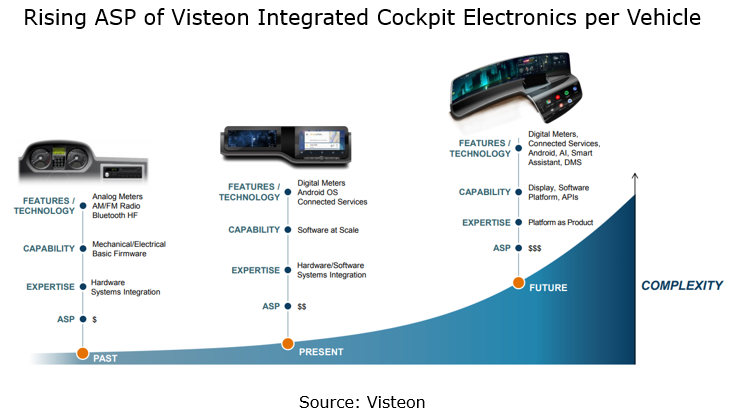
(2) Multi-display interaction: the cockpit design of dual-display interaction (center console, dashboard), four-display interaction (center console, dashboard, entertainment screen at the copilot’s seat, vehicle control display), or even five-display interaction (center console, dashboard, entertainment screen at the copilot’s seat, vehicle control display, rear seat entertainment display) is trending. Multi-display interaction needs complete cockpit domain architecture, and fusion of technologies, e.g., cockpit DCU, multi-chip (like TI automotive chips and Qualcomm entertainment chip), multiple operating systems (Linux, Android Automotive), Hypervisor virtualization technology, interaction logic, and HMI design. Tier1 suppliers are required to be more competent in product development and technology integration while seeking business growth amid the rising average selling price (ASP) of intelligent cockpit per vehicle.
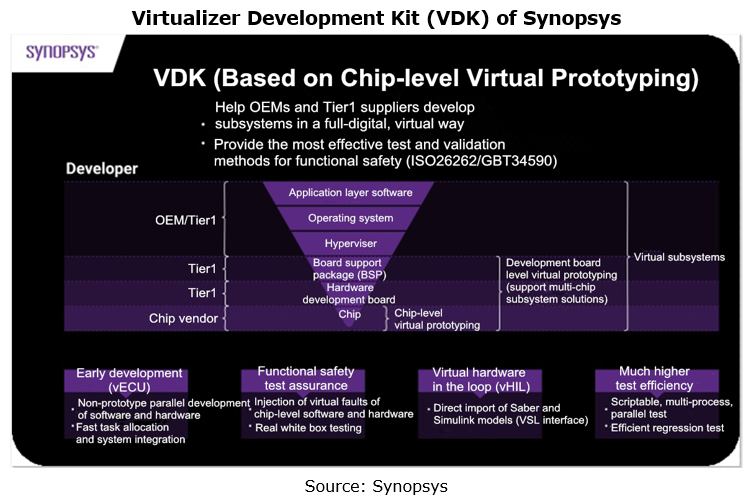
(3) Cockpit virtualization technology (separate development of software and hardware): virtual prototyping technology makes design, R&D and test of intelligent vehicles more efficient. Virtualizer Development Kit (VDK) based on virtual prototyping technology enables virtual simulation of electronic control units (ECU), e.g., chips, circuits and components. Automakers can commence development and test of software twelve months ahead of time before the availability of hardware, upgrading physical development to intelligent development in simulation environment. Also, ECUs for virtual simulation can accelerate and extend tests, and simulate various tests in extreme conditions, which is hard to achieve in real and physical circumstances and which secures faster roll-out of safer and more reliable products into market. The virtual prototyping technology is applicable to virtual development and test of all complex electronic systems such as intelligent cockpit and ADAS.
(4) Higher value of cockpit electronics software: the more complex vehicle system software means it makes up ever more of the total cost of a vehicle. OEMs and Tier1 suppliers are expanding software developers in R&D workforce. Examples include Desay SV, an intelligent cockpit bellwether in China, which boasted about 1,300 software engineers in 2019, a 70% share of its headcount; and Bosch in possession of 30,000 software talents, or 41% of the total staff in 2019 endeavoring to recruit more software developers. Between 2019 and 2020, Bosch set up Bosch China Innovation and Software R&D Center and Bosch Digital Cabin (Shanghai) R&D Center.
(5) Cockpit “terminal-cloud” integration, T-BOX and V2X as gateway of data from inside and outside vehicle, and cockpit big data as core competitive edge of products: intelligent cockpit will be a combination of terminals and cloud, in which all kinds of service contents, timely information sharing and complex computation will be offered and done over cloud, more than acts as a stand-alone terminal. In future cockpit big data will be the core competitive edge of products, making center console and dashboard, center information display (CID) navigation, T-BOX and air-conditioner controller, integrated.
(6) Evolution of vehicle display from flat rectangular screen to large curved screen: in January 2020, Corning’s high-performance Gorilla cold-rolled glass was first available to GAC Aion LX; in early 2020, Visteon and Corning joined hands to further develop ColdForm technology which will be spawned by Corning for automotive curved display systems; in July 2020, Rightware under Thundersoft, and LG Electronics partnered to develop the industry’s first curved OLED display for 2021 Cadillac Escalade.
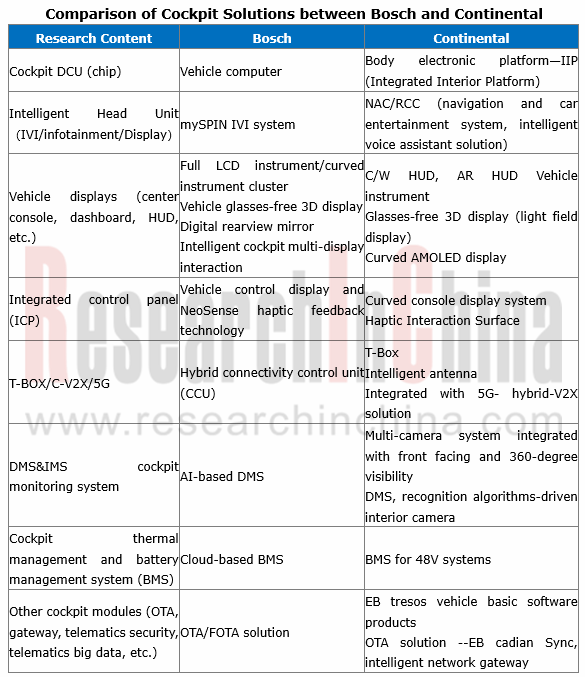
(7) Glasses-free 3D display: 3D effect makes eyes capture information more quickly. Bosch, Continental and more all focus on mass production and installation of glasses-free 3D displays in the next two year or three. At CES 2020, Continental showcased its 3D Lightfield display technology which was co-developed with Leia Inc. and mass production is arranged in 2022.
(8) Driver monitoring system (DMS) or interior monitoring system (IMS): IMS based on camera and AI is the core product of Tier1 suppliers. DMS will play a crucial role in whether a new vehicle model can be rated five stars by Euro NCAP. For example, Continental plans to mass-produce DMS in 2021 and Bosch in 2022.
The Global and China Leading Tier1 Suppliers’ Cockpit Business Research Report studies in depth strategies, technologies and products of leading Tier1 suppliers of intelligent cockpit, and highlights the following: (1) strategic plan and business layout of intelligent cockpit; (2) layout of intelligent cockpit technology centers, R&D centers and production bases; (3) intelligent cockpit product line, products and technical solutions, typical customers and vehicle models, mass production schedule, etc.; (4) intelligent cockpit product roadmap and development plan; (5) suppliers of intelligent cockpit products, technology and modules.
The Global and China Leading Tier1 Suppliers’ Cockpit Business Research Report has two parts, of which:
Part 1 with 320 pages in total covers 6 Tier1 suppliers, i.e., Bosch, Continental, Denso, Valeo, Faurecia and Panasonic.
Part 2 with 350 pages in total covers 7 Tier1 suppliers, i.e., Aptiv, Visteon, LG Electronics, Hella, Samsung Harman, Desay SV and Joyson Electronics.
Research Report on Application of VLA Large Model in Automobiles and Robots, 2026
Research on Automotive and Robot VLA: Hybrid Architectures Become Mainstream, VLA Integrates with General World Models, and Reinforcement Learning Serves as Core Engine
Vision?Language?Action (VLA) m...
China Charging Infrastructure (Supercharging, Battery Swapping, V2G, etc.) and High-Performance Supercharging Battery Research Report, 2026
Charging and battery swapping research: as 5C+ supercharging vehicle models go into mass production, the pace of OEMs self-building supercharging networks quickens
800-1000V high-voltage platforms ar...
China Passenger Car Electronic Controlled Suspension Industry Report, 2026
Electronic Controlled Suspension Industry Research: As the First Year of Full Active Suspension Unfolds, Three Technical Routes Race Forward
1. Penetration Rate Surges Three Times, and Electronic Con...
Intelligent Driving SoC Research Report, 2026
Research on Intelligent Driving SoCs: Competition Focus Shifts to L3/L4 Embedded Hardware, and Computing Power of Flagship Vehicle Models Exceeds 1,000 TOPS
In terms of intelligent driving system in...
Automotive AI Large Model Technology Research Report, 2026
Automotive AI Large Model Research: Competition Shifts from "Who Has the Stronger Model" to "Who Boasts Higher Link Efficiency"
ResearchInChina released the Automotive AI Large Model Technology Resea...
Intelligent Vehicle Cockpit Domain Controller Research Report, 2026
Cockpit domain controller research: L3 AIDV intelligent cockpit domain controllers are entering a boom period
Driven by multiple factors such as the continuous evolution of the automotive central int...
Automotive Acoustic System (Audio, Multi-Channel) Industry Report, 2026
Automotive Acoustics Research: Multiple Channels, AI Tuning, and Self-Developed Algorithms Drive the Transformation of High-End Cockpit Sound Fields
I. Automotive Audio Hardware Solutions with 6–9 S...
Autonomous Driving Sensor Chip Research Report, 2026
Research on Autonomous Driving Sensor Chips: Deeply Perceiving the Physical World, Sensor Chips Are Playing A “Leading Role” in Intelligence
In 2026, the autonomous driving sensor chip industr...
Passenger Car Corner Module and Wheel‑Side Control System Research Report, 2026
Wheel-side control research: the “last mile” chassis innovation
Wheel-side control dismantles the traditional drive, braking, steering, and suspension control of the chassis from a "centralized" styl...
Embodied Artificial Intelligence (& Humanoid Robot) MCU Research Report, 2026
Research on Humanoid Robot MCUs: Evolution from General-Purpose Control to High-Value Dedicated Chip Solutions Integrated with Edge AI Functions
MCU (Microcontroller Unit) refers to a compact integra...
Intelligent Vehicle Zone Control Unit (ZCU) Research Report, 2026
ZCU Research: Cross-domain integrated ZCUs are becoming the edge computing nodes of the next-generation zonal architecture
Currently, the mainstream zonal architecture is mainly the quasi-central + z...
Automotive Cybersecurity and Data Security Research Report, 2026
Cybersecurity & Data Security Research: Intelligent Connected Vehicles Enter the Era of “Systematic Offense-Defense and AI-Defined Security”.
Centering on the panorama of intelligent connect...
Report on Breakthrough Strategies of OEMs and ADAS Tier 1 Suppliers for Overseas Layout of Intelligent Driving, 2026
Regulatory Breakthrough, Local System Establishment, OEMs Competing for NOA Layout: Overall Trends of China’s Intelligent Driving Overseas Layout in 2026
Research on overseas intelligent driving layo...
OEMs and Tier1s’ Intelligent Cockpit Platform (Hardware and Software) Innovation Strategy Research Report, 2026
Intelligent Cockpit Platform Research: multi-dimensional cockpit system architecture reconstruction for multi-agent collaboration and proactive intelligent services
The intelligent cockpit software s...
Automotive AIOS Research Report, 2026
Automotive AIOS Research: Mass Production Solutions Are Implemented
Mass Production Solutions Are Implemented on A Small Scale.
In 2026, AIOS starts small-scale implementation, helping to improve v...
Automotive Telematics Service Provider (TSP) Research Report, 2026
TSP Research: Leading providers collectively turn to AI agents to provide all-scenario active services
Telematics Service Providers (TSPs) are the core hub of the telematics industry chain, connectin...
Automotive Smart Interior Research Report, 2026
Smart Interior Research: As Technologies like Interactive Starlight Headliner, Hidden Display and Surface Projection Are Launched, Automotive Interiors Become Ever More Intelligent
The Automotive Sma...
Research Report on AI Applications in Cockpits, 2026
AI Application in Cockpits: AI Services Become More Comprehensive, Convenient, and Refined.
In the first half of 2026, cockpit AI functions underwent initial upgrades across multiple dimensions, inc...